

An A1 DTF printer is a large-format Direct-to-Film printer with a roughly 60 cm (24 in) print width, built for garment shops that have outgrown A3 and A2 desktop units. Fujia Print’s A1 line delivers up to four times the hourly film output of an A3 printer while keeping the same DTF workflow: print film, powder, cure, press. This guide breaks down print width, dual printheads, real 2026 pricing, and how the A1 class compares to A2 and A3 models so you can choose the right format before you buy.

Key Takeaways
- An A1 DTF printer prints film up to about 60 cm wide, versus 45 cm on A2 and 30 cm on A3.
- Most industrial A1 units run dual Epson i3200 printheads for speed and redundancy.
- Real A1 DTF printer price in 2026 lands between USD 4,800 and USD 9,500 for a dual-i3200 roll unit.
- The A1 class suits print shops, uniform suppliers, and contract decorators doing 300+ shirts per day.
- Fujia Print builds A1 DTF printers in Guangzhou with in-house R&D, CE and ISO 9001 certification.
What Is an A1 DTF Printer?
An A1 DTF printer is a roll-fed Direct-to-Film machine sized to the A1 paper format. Under ISO 216, an A1 sheet measures 594 × 841 mm, and an “A1 DTF printer” uses a print width of about 600 mm (24 inches) to match that format ISO 216. The printer lays color and white ink onto PET film, then adhesive powder and heat cure the design before it is pressed onto garments. The A1 class sits above A2 (45 cm) and A3 (30 cm) desktop units and below industrial 1.2 m+ roll systems. Fujia Print’s industrial A1 model pairs dual Epson i3200 printheads for continuous production, while the 65 cm A1 variant adds XP600 and i1600 compatibility for mixed-media shops Epson. The broader digital textile printing market is expanding at a 12.4% CAGR and is projected to reach USD 7.46 billion by 2030, which is pushing more shops toward larger-format DTF capacity IndustryARC.
A1 DTF Printer Print Width and Format
Print width decides how many garments you can nest per run. The table below shows the four common DTF formats and the real film widths shipped by Fujia Print.
| Format | ISO 216 size | Real print width | Typical daily output |
|---|---|---|---|
| A4 | 210 × 297 mm | ~21 cm | 30–60 shirts |
| A3 | 297 × 420 mm | 30–35 cm | 80–150 shirts |
| A2 | 420 × 594 mm | 45 cm | 150–250 shirts |
| A1 | 594 × 841 mm | 60–65 cm | 300–500 shirts |
The A1 width of 60 cm lets a shop print two adult hoodies side by side or four youth tees per pass. Fujia Print’s A1 line ships at 60 cm and 65 cm widths to cover both standard and oversized garment work. A full explanation of the DTF process sits in the what is a DTF printer guide.
Printheads: Dual Epson i3200 Explained
The printhead is the most expensive wear part on any DTF printer. The A1 class almost always uses two heads instead of one.
| Printhead | Native resolution | Drop size | Role in A1 DTF |
|---|---|---|---|
| Epson i3200 | 1200 dpi | 4.7 pl variable | Main CMYK + white, high speed |
| Epson i1600 | 1200 dpi | 4.7 pl variable | Lower-cost dual-head config |
| Epson XP600 | 720 dpi | 3.5–6 pl | Entry budget builds |
Epson’s i3200 is a 1-inch PrecisionCore MEMS head rated for industrial duty cycles Epson. Two i3200 heads let the A1 printer hit 300–500 shirts per day; if one head needs service, the second keeps the line running. Fujia Print offers A1 builds with dual i3200, dual i1600, or a mixed i3200/XP600 setup depending on budget and media mix. The DTF printer for beginners guide covers head care for first-time owners.
A1 DTF Printer Price in 2026
Price scales with printhead count, width, and curing hardware. The ranges below reflect factory-direct quotes from Guangzhou manufacturers, not branded reseller markup.
| Model class | Printheads | 2026 factory price (USD) |
|---|---|---|
| A3 desktop | 1× XP600 | 1,200–2,200 |
| A2 45 cm | 2× i3200/i1600 | 3,000–4,800 |
| A1 60 cm | 2× i3200 | 4,800–7,500 |
| A1 65 cm | 2× i3200/i1600/XP600 | 6,500–9,500 |
A bare A1 chassis without a shaker or dryer costs less, but most buyers purchase the printer plus a powder shaker and curing oven as a line. Fujia Print quotes the full A1 line factory-direct, which removes the agent margin that inflates branded reseller prices. The DTF printer wholesale guide explains volume pricing tiers.
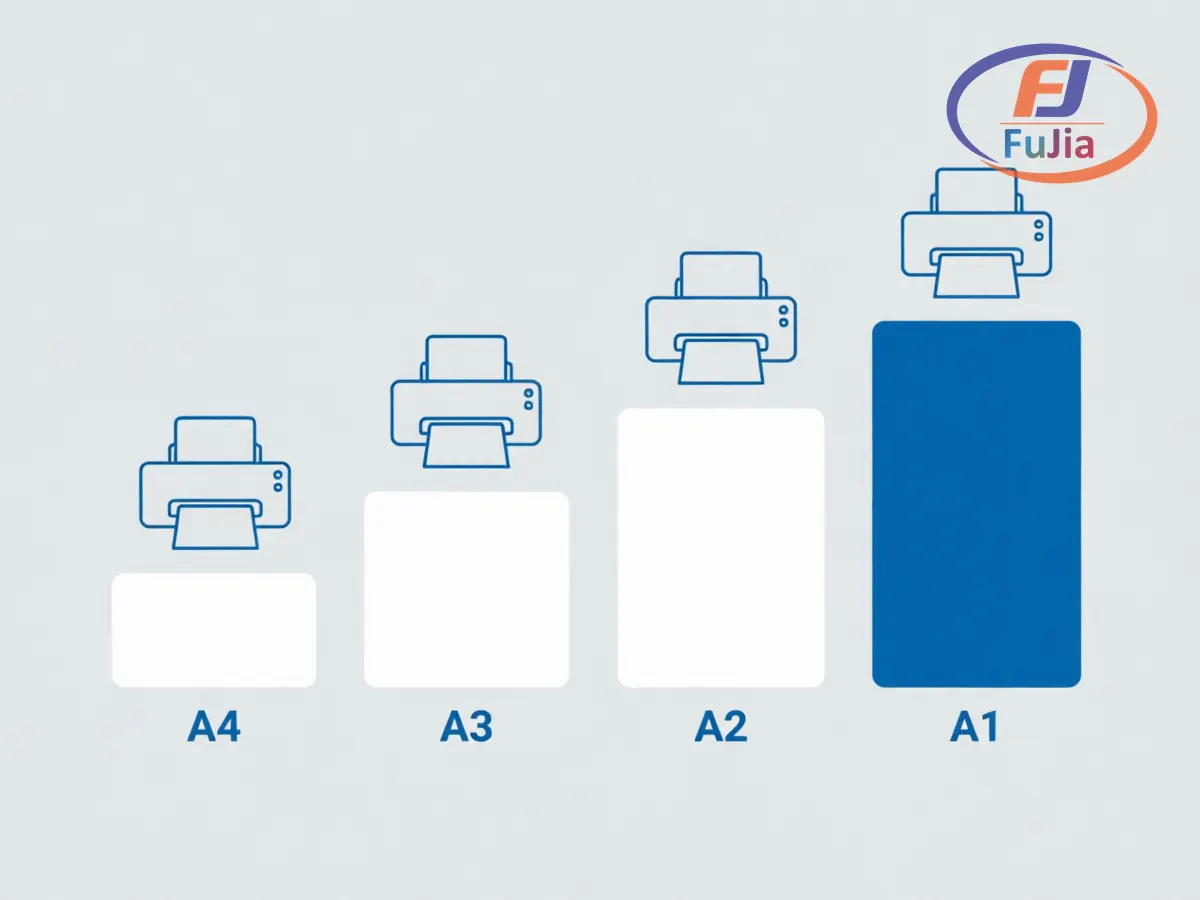
A1 vs A2 vs A3 DTF Printer
The three formats share the same DTF process, so the choice is about volume, floor space, and budget.
| Factor | A3 (30 cm) | A2 (45 cm) | A1 (60 cm) |
|---|---|---|---|
| Daily shirts | 80–150 | 150–250 | 300–500 |
| Floor space | Small desk | Workbench | Dedicated bay |
| Startup cost | Low | Medium | Higher |
| Best for | Hobby, Etsy | Small shop | Contract, uniforms |
An A3 unit fits a home studio. An A2 unit serves a growing shop. An A1 unit targets contract decorators and uniform suppliers who need throughput. Fujia Print covers all three with the A3 desktop, A2 45 cm, and A1 industrial lines, so a shop can scale within one supplier and one support team. The A3 DTF printer buying guide gives the smaller-format detail.
Who Should Buy an A1 DTF Printer?
Use the decision table to confirm the A1 class fits your operation.
| If you need… | Choose |
|---|---|
| Under 100 shirts per day | A3 desktop |
| 100–250 shirts per day | A2 45 cm |
| 300+ shirts per day, contract work | A1 60 cm |
| Oversized prints over 45 cm wide | A1 65 cm |
The A1 class pays off when labor is the bottleneck. A single A1 line replaces two A3 lines and one operator, cutting per-shirt labor cost. Shops doing event merch, team uniforms, and branded workwear are the strongest fit. The DTF business startup cost guide models the payback math.
Consumables and Running Costs
Every A1 print uses PET film, adhesive powder, and DTF ink. Per-square-meter running cost stays close to smaller formats because the process is identical.
- DTF film: ~USD 0.40–0.70 per m²
- DTF powder: ~USD 0.30–0.50 per m²
- DTF ink: ~USD 0.60–1.00 per m² (white ink is the largest share)
Fujia Print supplies film, powder, and ink as a matched set, which avoids the finger-pointing between separate suppliers that breaks a production line. The DTF transfer film guide and DTF powder guide cover specs in detail, and the DTF ink guide explains white-ink circulation.
Fujia Print A1 DTF Lineup
Fujia Print builds two A1 configurations in its Guangzhou factory. The industrial A1 uses dual Epson i3200 heads for maximum uptime, and the 65 cm A1 adds i1600 and XP600 support for shops running mixed media. Both ship with CE and ISO 9001 certification, in-house testing, and two after-sales teams. Fujia Print is a manufacturer, not a trading company, so the A1 line can be spec’d for OEM and ODM branding. The DTF printer OEM/ODM guide explains custom configuration, and the DTF printer maintenance guide covers daily head care.
A1 DTF vs A1 UV DTF: Which Format Fits Your Shop?
The “A1” label covers two different ink technologies, and picking the wrong one wastes thousands of dollars. A standard A1 DTF printer prints onto PET film, then binds the design with hot-melt adhesive powder and a curing oven before pressing onto garments. An A1 UV DTF printer replaces the powder and oven with UV-curable ink laid on an A+B film pair and cured by LED lamps — peel and stick, no powder, no heat. UV-curable ink hardens by photochemical reaction under UV LED light rather than by evaporation, so it bonds to glass, metal, acrylic, leather, and wood, while pure DTF stays on textiles and pre-coated hard surfaces UV curing.
The most common A1 UV DTF model is the 6090, a 600 × 900 mm bed that mirrors the A1 paper size of 594 × 841 mm. Brands such as Funsun list this size as an “A1 UV DTF printer,” and sourcing catalogs reuse the same 6090 chassis under both names. A UV DTF A1 line carries a 20–40% premium over a pure-DTF A1 unit because it adds the LED curing station and the A+B film system on top of the print engine. Fujia Print builds the 6090 UV DTF line in Guangzhou with CE and ISO 9001 certification, matching its pure-DTF A1 siblings on duty cycle.
Choose pure DTF when garments make up 80% or more of your work, because the film, powder, and ink set costs less per square meter. Choose UV DTF when you need hard-substrate gifts, signage, and promotional items alongside apparel, because one machine covers both. The UV DTF printer buying guide explains the A+B film pairing step by step, and the DTF vs UV vs DTG comparison shows where each process wins.
Frequently Asked Questions
What size is an A1 DTF printer?
An A1 DTF printer prints PET film about 60 cm (24 inches) wide, matching the 594 × 841 mm A1 paper format defined by ISO 216. The real print width on Fujia Print’s A1 line is 60 cm, with a 65 cm variant for oversized garments. This width fits two adult hoodies side by side or four youth tees in a single pass, roughly four times the nesting area of a 30 cm A3 unit. Print width, not physical footprint, is what defines the “A1” label, so always confirm the quoted width before buying. A true A1 machine should state 60 cm; anything narrower is an A2 or A3 unit sold under a loose name. The width also sets your maximum graphic size, so measure your largest common job, such as a full-front hoodie, against the 60 cm bed before committing. Fujia Print’s A1 line ships at both 60 cm and 65 cm so shops can match the bed to their real product mix. ISO 216
How much does an A1 DTF printer cost in 2026?
A dual-Epson-i3200 A1 DTF printer costs between USD 4,800 and USD 7,500 at factory-direct pricing in 2026, while a 65 cm A1 build with mixed i3200, i1600, and XP600 heads runs USD 6,500 to USD 9,500. These figures come from Guangzhou manufacturers and exclude branded reseller markup, which can add 30–60% on top. Most buyers purchase the printer together with a powder shaker and curing oven, so budget the full line, not just the chassis. Used and single-head units exist below USD 4,000 but lack the redundancy of a dual-head A1. Always confirm whether the quote includes the shaker, dryer, and a spare printhead, because those three items often shift a “complete” price by thousands. Fujia Print quotes the full A1 line factory-direct, which removes the agent margin that inflates branded reseller prices, and the DTF printer wholesale guide lists volume tiers for dealers.
How many printheads does an A1 DTF printer use?
Most industrial A1 DTF printers use two printheads rather than one, almost always a pair of Epson i3200 heads for CMYK plus white ink. The dual configuration raises daily output to 300–500 shirts and provides redundancy: if one head goes down for service, the second keeps production running. Some A1 builds mix an i3200 with an i1600 or XP600 to lower cost while keeping one high-duty head. Fujia Print’s industrial A1 ships with dual i3200 heads, and the 65 cm variant supports i3200, i1600, and XP600 combinations. Two heads is the standard for the A1 class because single-head speed cannot meet contract-volume demand. The printhead is also the costliest wear part, so a dual setup spreads risk and lets you run a full day even during a head swap. Epson rates the i3200 as a 1-inch PrecisionCore MEMS head built for industrial duty cycles. Epson
A1 vs A3 DTF printer: which should I buy?
Choose an A3 DTF printer if you print fewer than 100 shirts per day and work from a home studio or small shop, because the 30 cm width and USD 1,200–2,200 startup cost keep risk low. Choose an A1 DTF printer if you run contract decoration, uniforms, or event merch at 300+ shirts per day, because the 60 cm width and dual i3200 heads cut per-shirt labor by replacing two A3 lines with one operator. The A3 fits hobbyists and Etsy sellers; the A1 fits businesses where throughput is the bottleneck. Fujia Print sells both, so you can start on A3 and scale to A1 within one supplier and support team as volume grows. The A3 also needs less floor space and a smaller power draw, while the A1 needs a dedicated bay and stronger power. Match the format to your actual daily count, not your ambition, and use the A3 DTF printer buying guide to confirm the entry-level numbers before you step up.
Is an A1 DTF printer worth it for a small business?
An A1 DTF printer is worth it for a small business only when daily volume consistently exceeds 200 shirts, because the higher USD 4,800+ startup and dedicated floor space need throughput to pay back. Below that volume, an A2 (45 cm) or A3 (30 cm) unit delivers better margins with less risk. The A1 wins when labor is the constraint: one A1 line plus one operator replaces two A3 lines, lowering per-shirt cost on contract and uniform work. Shops doing team apparel, workwear, and event merch see the fastest return. Fujia Print’s factory-direct A1 pricing and matched consumables keep running cost predictable, which matters more than the sticker price for a small business. Before buying, model your true daily shirts and labor hours for one month; if a single A3 line already runs double shifts, the A1 is the rational next step, and the DTF business startup cost guide shows the payback math.
What is the price of an A1 UV DTF printer?
An A1 UV DTF printer, most often built on a 600 × 900 mm “6090” bed that matches the A1 paper size of 594 × 841 mm, costs between USD 6,500 and USD 12,000 at factory-direct pricing in 2026. The range spans single-UV-head entry units and dual-head industrial builds with a 65 cm wide option. A UV DTF A1 line carries a 20–40% premium over a pure-DTF A1 unit because it adds the LED curing station and the A+B film system on top of the print engine. Sourcing catalogs list the same 6090 chassis under names like “A1 UV DTF” and “Funsun A1 UV DTF,” so compare the real bed size rather than the label. Most quotes exclude the powder-free film pair and the UV ink starter kit, which add USD 300–800 to startup. Fujia Print quotes the 6090 UV DTF line factory-direct, and the UV DTF printer price guide breaks down film cost per square meter.
Conclusion
The A1 DTF printer is the large-format step for garment shops that have outgrown A3 and A2 desktop units, delivering 60 cm width and dual-i3200 throughput at a 2026 factory price of USD 4,800–9,500. For factory-direct A1 DTF printer pricing and free sample inquiries, contact Fujia Print.
