

Starting a DTF printing business costs ,000-8,000 for a basic setup and ,000-25,000 for a production-ready shop. Here is exactly where every dollar goes — printer, consumables, workspace, and training.
The gap between “I can do this” and “this is actually profitable” is about $2,000 in lessons most people learn the hard way. This guide exists to close that gap.
We’re going to break down the actual costs of starting a DTF printing business at three different scales — from a home-based side hustle buying pre-made transfers to a full in-house production setup. Every number comes from real suppliers, verified pricing, and documented case studies. No guesswork.
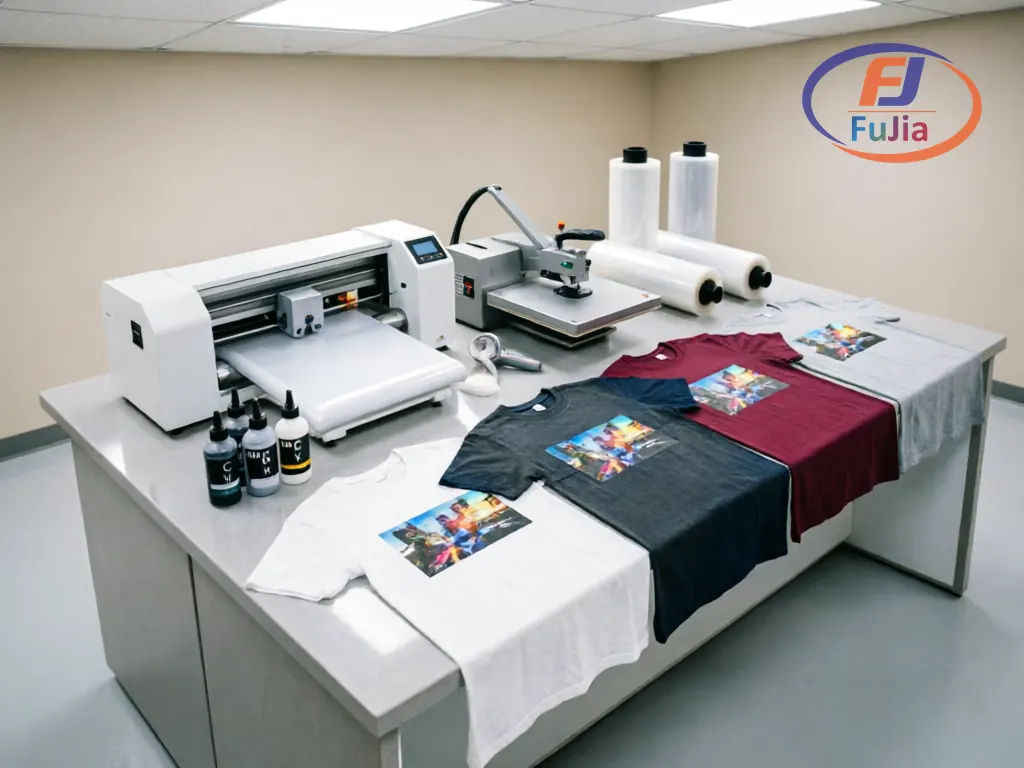
This article is for: Anyone evaluating whether a DTF printing business makes financial sense, from complete beginners to print shop owners adding DTF to existing operations.
The Three Paths Into DTF Printing (Pick One First)
There isn’t one DTF business model. There are three, and they require completely different investments and produce completely different margins.
| Path | Initial Investment | Profit Margin | Time to Profit | Best For |
|---|---|---|---|---|
| 1. Buy transfers, press at home | $550–$1,080 | 55–65% | 1–3 months | Side hustle, testing the market |
| 2. Entry in-house production | $5,000–$12,000 | 65–75% | 3–6 months | Serious part-time or small full-time |
| 3. Professional production line | $15,000–$35,000+ | 70–80% | 6–12 months | Full-time commercial business |
Most successful DTF businesses start at Path 1 or 2. Starting at Path 3 without existing customers is the #1 reason new DTF businesses fail — the equipment payments arrive before the revenue does.
Path 1: The Transfer Buyer ($550–$1,080 Startup)
This is the lowest-risk entry point. You don’t own a DTF printer. Instead, you buy custom-printed DTF transfers from a supplier and press them onto garments yourself.
Startup Costs
| Item | Cost | Notes |
|---|---|---|
| Heat press (15×15″) | $200–$400 | 16×20″ is better at $350–$600 |
| Teflon sheets & accessories | $30–$50 | Parchment paper works too |
| Initial garment inventory (20 shirts) | $70–$100 | Gildan 5000 or similar |
| First DTF transfer order | $150–$250 | Gang sheets at ~$25 each |
| Packaging materials | $50 | Poly mailers, tissue, stickers |
| Business license | $50–$200 | Varies by state/country |
| Total | $550–$1,080 |
Per-Shirt Economics
| Component | Cost |
|---|---|
| Blank Gildan 5000 | $3.50 |
| Medium DTF transfer (8–10″) | $10–$15 |
| Labor (3 min at $20/hr) | $1.00 |
| Packaging | $1.00 |
| Overhead allocation (15%) | $2.63 |
| Total cost per shirt | $18–$23 |
Revenue & Profit
Sell at $35–$45 per shirt. That’s $15–$25 gross profit per piece, or 55–65% margin.
At 25 shirts/month (a realistic side-hustle pace), you’re generating $875–$1,125 in monthly revenue and $500–$625 in profit. You break even on your initial investment within the first 20–30 shirts sold.
The catch: You’re paying someone else $10–$15 per transfer. Your margin ceiling is lower than if you printed in-house. This model works for proving demand before committing to equipment.
Path 2: Entry In-House Production ($5,000–$12,000)
This is where most serious DTF entrepreneurs land. You buy your own DTF printer, powder shaker, and curing oven. Your per-print cost drops dramatically, but your upfront investment jumps.
Equipment Costs
| Equipment | Budget Option | Recommended |
|---|---|---|
| DTF printer (60cm, XP600) | $2,500–$3,500 | $3,500–$5,000 (i1600) |
| Powder shaker (auto) | $1,500–$2,500 | $2,500–$3,500 |
| Curing oven (IR) | $800–$1,500 | $1,500–$2,500 |
| Heat press (16×20″) | $300–$500 | $500–$800 |
| Air purifier/ventilation | $200–$400 | $400–$800 |
| Equipment subtotal | $5,300–$8,400 | $8,400–$12,600 |
For detailed pricing on DTF printers by tier and printhead type, see our DTF printer OEM guide.
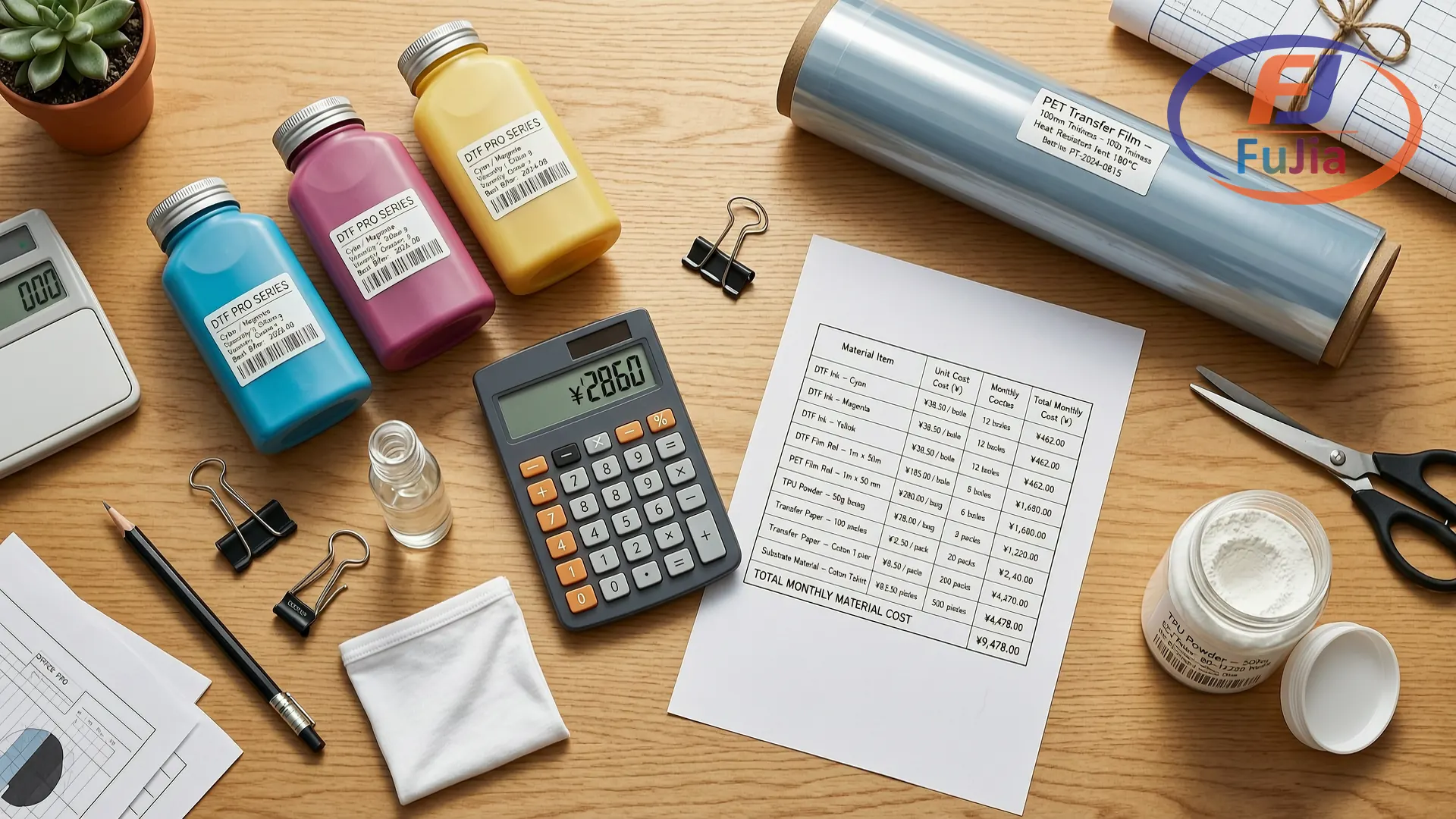
Initial Consumables
| Consumable | Quantity | Cost |
|---|---|---|
| DTF ink (CMYK + White, 1L each) | 5 bottles | $200–$400 |
| PET film (60cm × 100m rolls) | 3 rolls | $250–$500 |
| Hot-melt powder (TPU) | 5kg | $60–$150 |
| Printhead cleaner | 2 bottles | $40–$60 |
| Consumables subtotal | $550–$1,110 |
For a complete breakdown of consumables pricing and supplier sourcing, see our DTF consumables wholesale guide.
Per-Print Cost (In-House)
This is where owning the printer pays off:
| Component | Cost per print |
|---|---|
| DTF ink (CMYK + White) | $0.15–$0.40 |
| PET film | $0.30–$0.80 |
| Hot-melt powder | $0.05–$0.15 |
| Electricity | $0.02–$0.05 |
| Total consumables per print | $0.52–$1.40 |
Compare that to $10–$15 per purchased transfer. At 100 prints per month, in-house production saves $900–$1,400 monthly in consumables alone.
Per-Shirt Economics (In-House)
| Component | Cost |
|---|---|
| Blank shirt | $3.50 |
| DTF print (consumables) | $1.00 |
| Labor (5 min at $20/hr) | $1.67 |
| Packaging | $1.00 |
| Equipment depreciation (24 months) | $0.50 |
| Overhead (15%) | $1.15 |
| Total cost per shirt | $8.82 |
Sell at $35–$45. Gross profit per shirt: $26–$36. That’s 70–80% margin.
Hidden Costs That Surprise First-Timers
These are the expenses most DTF business plans forget:
| Hidden Cost | Monthly Impact |
|---|---|
| Wasted prints (learning curve, errors) | 5–8% of revenue |
| Printhead clogs (replacement budget) | $25–$50/month amortized |
| Rejected garments (quality control) | 2–3% of revenue |
| Payment processing fees | 2.9% + $0.30/transaction |
| Shipping supplies | $50–$100/month |
| Marketing (ads, samples) | $100–$300/month |
| Software subscriptions (design, RIP) | $30–$50/month |
Budget an additional $300–$500 per month beyond your loan payment or depreciation.
Path 3: Professional Production ($15,000–$35,000+)
This is the commercial tier. Dual i3200 printheads, integrated shaker-curer lines, dedicated workspace. For the equipment details and pricing, see our DTF printer OEM complete guide.
Equipment Investment
| Equipment | Cost Range |
|---|---|
| DTF printer (60cm, dual i3200) | $5,500–$10,000 |
| Integrated shaker-dryer-curer | $3,500–$6,000 |
| Heat press (auto-open, 16×20″) | $600–$1,200 |
| Ventilation/air filtration | $500–$1,500 |
| Workspace buildout (electrical, tables) | $1,000–$3,000 |
| Backup equipment (second press) | $300–$600 |
| Total equipment | $11,400–$22,300 |
Monthly Operating Costs
| Expense | Monthly Cost |
|---|---|
| Rent (500–1,000 sq ft) | $800–$2,000 |
| Utilities (electric, water) | $150–$300 |
| Consumables (at 500 prints/month) | $400–$700 |
| Labor (1 employee) | $2,500–$3,500 |
| Insurance | $100–$200 |
| Marketing | $300–$800 |
| Software & subscriptions | $50–$150 |
| Maintenance & parts | $100–$200 |
| Total monthly operating | $4,400–$7,850 |
Revenue Projections
At 500 prints/month selling wholesale transfers at $3–$5 each plus 200 finished shirts at $35–$45:
| Revenue Stream | Monthly Revenue |
|---|---|
| Wholesale transfers (500 × $4) | $2,000 |
| Finished shirts (200 × $40) | $8,000 |
| Total monthly revenue | $10,000 |
At $10,000 monthly revenue and $5,500 monthly costs (mid-range), net profit is $4,500/month or $54,000/year. The equipment pays for itself in 4–5 months.
Pricing Your DTF Prints: A Framework
The most common pricing mistake is charging based on what competitors charge without understanding your own cost structure. Use this framework instead.
Step 1: Calculate Your True Per-Unit Cost
Add up every cost that goes into one finished shirt: materials, labor, overhead allocation, and a waste factor (5% for beginners, 3% once you’re experienced).
Step 2: Choose Your Multiplier
| Business Stage | Multiplier | Resulting Margin |
|---|---|---|
| Building portfolio | 2.0–2.5× | 50–60% |
| Established local brand | 2.5–3.5× | 60–71% |
| Premium/niche market | 3.5–5.0× | 71–80% |
Step 3: Offer Volume Tiers
| Quantity | Discount | Effective Price (at $40 base) |
|---|---|---|
| 1–5 | Full price | $40 |
| 6–11 | 10% off | $36 |
| 12–24 | 15% off | $34 |
| 25–49 | 20% off | $32 |
| 50+ | Custom quote | $28–$30 |
Step 4: Charge for Extras
- Rush delivery (3–5 days): +$10/shirt
- Next-day delivery: +$20/shirt or +25% order total
- Design services: $25–$75 per design
- Product bundles: Shirt + tote bag = $55 (vs. $65 separate)
ROI Timeline: When Do You Actually Make Money?
| Scenario | Breakeven Point | Time to Breakeven |
|---|---|---|
| Transfer buyer ($800 investment) | 20–30 shirts sold | 1–3 months |
| Entry in-house ($8,000 investment) | 150–250 shirts sold | 3–6 months |
| Professional setup ($20,000 investment) | 400–600 shirts sold | 6–12 months |
A realistic progression for a dedicated operator:
| Month | Activity | Revenue | Profit |
|---|---|---|---|
| 1–2 | Learning, sample production, friends & family sales | $200–$500 | -$500 to $0 |
| 3–4 | First paying customers, online store launch | $800–$1,500 | $0–$400 |
| 5–6 | Consistent orders, word-of-mouth growth | $2,000–$4,000 | $500–$1,500 |
| 7–12 | Repeat customers, wholesale accounts | $4,000–$10,000 | $1,500–$5,000 |
| 12+ | Mature operation, considering expansion | $10,000+ | $4,000+ |
5 Cost-Saving Moves That Don’t Sacrifice Quality
- Buy film and powder in bulk. A single 100m film roll costs $80–$150. Buying 10 rolls at once typically gets you 15–20% off. Same for powder — 25kg bags cost 30–40% less per kg than 5kg bags. See our DTF consumables supply guide for wholesale pricing benchmarks.
- Gang your designs. Print multiple designs on a single roll width instead of one design per film width. This reduces film waste by 20–40%.
- Maintain your printhead religiously. A $30 monthly cleaning routine prevents a $500 printhead replacement. Daily nozzle checks, weekly deep cleans, and proper capping when idle.
- Start with XP600, not i3200. If you’re printing under 100 transfers per day, an XP600 machine ($3,500–$5,000) produces identical quality to an i3200 machine ($6,000–$10,000). The speed difference only matters at volume. Upgrade when demand justifies it.
- Negotiate consumable pricing. Once you’re consuming 10+ liters of ink per month, ask your supplier for volume pricing. Most will offer 10–15% off at that threshold.
FAQ
Q: How much does it cost to start a DTF printing business?
A: The minimum viable investment is $550–$1,080 if you buy pre-made transfers and press them yourself. For in-house production with your own printer, budget $5,000–$12,000 for equipment and initial consumables. A professional production line requires $15,000–$35,000+.
Q: Is DTF printing profitable?
A: Yes, at the right pricing. In-house DTF production delivers 70–80% gross margins on finished garments. Transfer buying delivers 55–65%. A full-time operation producing 300+ shirts/month can generate $8,000–$15,000 in monthly profit after all expenses.
Q: How long until a DTF business becomes profitable?
A: Transfer buyers typically break even within 1–3 months (20–30 shirts). In-house production setups break even in 3–6 months (150–250 shirts). Professional operations with higher overhead take 6–12 months (400–600 shirts).
Q: What’s the best DTF printer for beginners?
A: A 60cm single-head printer with an XP600 printhead ($3,500–$5,000) is the best balance of quality and cost for beginners. It produces the same print quality as industrial i3200 machines at half the price. Upgrade to i3200 when your daily volume exceeds 100 prints.
Q: How much should I charge for DTF prints?
A: For finished custom shirts, $35–$45 is the standard range for small businesses. For wholesale DTF transfers only, $3–$8 per transfer depending on size. Always calculate your true per-unit cost first and apply a 2.5–3.5× multiplier.
Next Steps
- Pick your entry path. Don’t try to launch at Path 3 if you have zero customers. Start with transfers to prove demand, then bring production in-house.
- Create a 90-day sales plan. Month 1: sell 10 pieces to friends and family. Month 2: sell 30–50 through local networking. Month 3: target 80–100 with online marketing.
- Track every expense from day one. Use a spreadsheet. Include the hidden costs — waste, shipping, payment fees. If you don’t know your true cost per shirt, you don’t know if you’re profitable.
- Invest in samples before marketing. Spend $100–$200 producing sample shirts to photograph and send to potential customers. A $5 sample shirt that leads to a $2,000 order is the best marketing spend you’ll make.
- Plan your equipment upgrade. When you’re consistently printing 50+ transfers per day and turning away work, that’s when you upgrade from Path 1 to Path 2, or from XP600 to i3200. Let demand pull the investment, not the other way around.
Related Reading
Factory-Direct Printing Equipment – Talk to the Source
Fujia Print manufactures DTF and UV printers in Guangzhou. Not a trading company, not a middleman. One supplier for your printer, consumables, and after-sales. Factory-direct pricing, in-house R&D, real support that answers the phone.
Industry cost benchmarks verified against SourcifyChina DTF printer cost analysis and manufacturer specifications.
