

If you’re choosing between a DTF printer and a sublimation printer for your print business, the answer isn’t about which technology is “better.” It’s about which one prints on the garments you actually sell, at the margins you actually need.
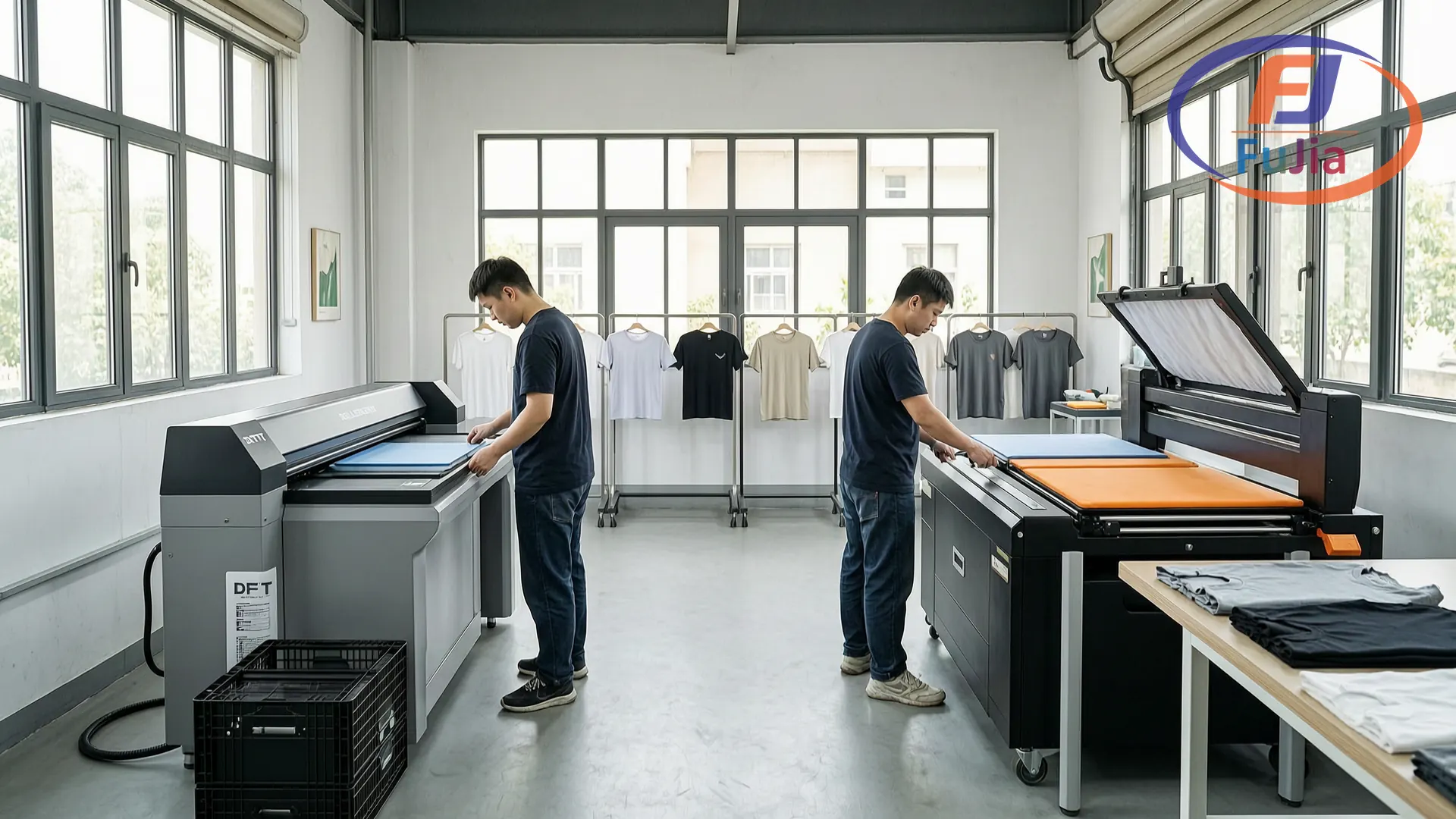
DTF dominates on cotton, dark fabrics, and mixed-material orders. Sublimation wins on polyester, hard goods, and zero-hand-feel quality. The wrong choice doesn’t mean bad prints — it means bad economics.
We manufacture both DTF and UV printers and have supplied both technologies to print shops across 40+ countries. This comparison pulls data from actual production runs, lab wash tests, and supplier pricing — not theoretical specs. By the end, you’ll know which method fits your business and exactly what the first 90 days of running it look like.
Quick Comparison: DTF vs Sublimation at a Glance
| Factor | DTF Printing | Sublimation |
|---|---|---|
| Works on | Cotton, polyester, blends, denim, nylon | Polyester (65%+), coated hard goods only |
| Dark garment printing | Yes (white ink underbase) | No — dye can’t show on dark fabric |
| Startup cost | $2,500–$12,000 (see our DTF startup cost guide) | $800–$3,500 |
| Cost per print (10×10″) | $0.50–$1.40 | $0.10–$0.15 (cfsubpaper.com) |
| Wash durability | 30–50+ washes (properly cured) | 50+ washes (dye bonds with fiber) |
| Hand feel | Light film layer (improving with thinner films) | Zero hand feel — dye becomes part of fabric |
| Learning curve | Moderate (powder, curing, temperature) | Easy (print, press, done) |
| Best for | Custom shops, mixed fabrics, dark garments | Sportswear, mugs, phone cases, all-over print |
How Each Technology Actually Works (The Physics That Drive Your Profit)
DTF: Print on Film, Powder, Melt, Press
DTF (Direct-to-Film) printing works by:
1. Printing your design onto a PET transfer film using CMYK + white ink
2. Applying hot-melt adhesive powder to the wet print
3. Curing (melting) the powder at 100–110°C for 2–3 minutes
4. Heat pressing the transfer onto the garment at 150–165°C for 10–15 seconds
The white ink underbase is what makes DTF unique — it creates an opaque foundation that lets vibrant colors print on any fabric color, including black cotton. For a detailed breakdown of DTF ink composition and white ink circulation, see our DTF consumables wholesale guide.
Sublimation: Print on Paper, Heat, Infuse
Sublimation printing works by:
1. Printing your design onto sublimation transfer paper using special dye-sub ink
2. Placing the paper face-down on the garment or coated substrate
3. Heat pressing at 190–205°C for 45–60 seconds
The heat converts the solid dye directly into gas (sublimation), which then penetrates the polyester fibers or polymer coating. When it cools, the dye becomes permanently part of the material. This is why sublimation prints have zero hand feel — there’s nothing sitting on top of the fabric.
The critical limitation: Sublimation dye only bonds with polyester or polymer coatings. It cannot print on 100% cotton, dark fabrics, or any surface without a polyester content of at least 65%. This single fact determines 80% of the buying decision.
The Deciding Factor: What Are You Actually Printing?
This isn’t a technology question. It’s a product mix question.
If 70%+ of your orders are cotton or dark garments → DTF
DTF handles black cotton, navy tees, denim jackets, canvas bags, and polyester blends in a single workflow. The white ink underbase makes dark fabric printing trivial.
If 70%+ of your orders are polyester or hard goods → Sublimation
Sublimation dominates on polyester sportswear, mouse pads, ceramic mugs, phone cases, aluminum panels, and coated tumblers. The print quality is stunning and the per-unit cost is the lowest in the industry.
If your orders are split 50/50 → Run both
Many successful shops operate a sublimation line for polyester/hard goods and a DTF line for cotton/dark garments. The combined startup cost ($5,000–$15,000) still undercuts buying a single industrial DTG machine, and together they cover 95% of custom print orders.
Cost Breakdown: Real Numbers, Not Marketing Claims
Startup Investment
| Cost Category | DTF (Entry) | Sublimation (Entry) |
|---|---|---|
| Printer | $2,500–$5,000 (60cm, XP600) | $400–$1,500 (Epson EcoTank converted) |
| Heat press | $300–$500 | $200–$400 |
| Consumables starter kit | $550–$1,110 | $150–$300 |
| Powder shaker + curing oven | $1,500–$2,500 | Not required |
| Ventilation system | $200–$400 | Not required |
| RIP software | $0–$500 (often included) | $0–$200 (Sawgrass Print Manager is free) |
| Total startup | $5,050–$9,510 | $750–$2,200 |
For a detailed DTF equipment cost analysis by tier, see our DTF printer OEM guide.
Per-Print Cost (10×10″ Graphic)
| Component | DTF Cost | Sublimation Cost |
|---|---|---|
| Ink | $0.15–$0.40 | $0.02–$0.05 |
| Transfer medium (PET film / paper) | $0.30–$0.80 | $0.05–$0.08 |
| Adhesive powder | $0.05–$0.15 | N/A |
| Electricity | $0.02–$0.05 | $0.01–$0.02 |
| Total per print | $0.52–$1.40 | $0.08–$0.15 |
Sublimation is 3–6× cheaper per print. But this is misleading without the revenue context.
Per-Shirt Revenue & Margin
| Scenario | DTF Shirt | Sublimation Shirt |
|---|---|---|
| Garment type | Gildan 5000 (cotton) | Gildan 42000 (polyester blend) |
| Blank cost | $3.50 | $4.00 |
| Print cost | $1.00 | $0.12 |
| Labor (press + handling) | $1.67 | $1.00 |
| Packaging | $1.00 | $1.00 |
| Total cost | $7.17 | $6.12 |
| Selling price | $35–$45 | $30–$40 |
| Gross profit | $27–$37 | $24–$34 |
| Margin | 74–82% | 71–83% |
The margins are nearly identical. The difference is what you can print on, not how much you make per shirt.
Quality Comparison: Side-by-Side
Color Vibrancy
| Method | On White Cotton | On Dark Cotton | On Polyester |
|---|---|---|---|
| DTF | ★★★★☆ (excellent with ICC profile) | ★★★★★ (white ink underbase) | ★★★★☆ |
| Sublimation | N/A (won’t work on cotton) | N/A | ★★★★★ (dye bonds with fiber) |
DTF requires an ICC color profile to get colors right out of the gate. Most DTF printer suppliers include profiles for their specific ink and film combination. Sublimation, by contrast, produces accurate colors almost immediately because the dye penetrates evenly into polyester fibers.
Hand Feel
Sublimation: Zero hand feel. The dye becomes part of the fabric. Customers cannot tell where the print ends and the shirt begins. This is sublimation’s single biggest quality advantage.
DTF: Light film layer. Early DTF transfers had a thick, plasticky feel. Modern thin-film DTF (using 75μm PET film instead of 100μm) reduces this dramatically, but a subtle layer is still detectable by running a finger across the print. For most commercial applications, it’s imperceptible to the wearer.
Wash Durability
According to AATCC Test Method 61, industry-standard wash testing shows:
| Method | Washes Before Visible Fading | Washes Before Cracking/Peeling |
|---|---|---|
| DTF (properly cured) | 30–50 | 40–60 |
| Sublimation | 50+ (virtually none — dye is in fiber) | N/A (no surface layer to crack) |
DTF durability depends heavily on proper curing temperature and hot-melt powder quality. Under-cured prints will peel after 10–15 washes. Properly cured DTF transfers routinely pass 40+ commercial wash cycles. For a complete guide to heat press temperature, time, and pressure settings, see our DTF heat press guide.
Production Speed & Workflow
DTF Workflow (per batch of 20 shirts)
| Step | Time | Notes |
|---|---|---|
| Print 20 designs on film (gang sheet) | 8–12 min | XP600: ~4 min/sqm |
| Apply powder + cure | 3–5 min | Automated shaker: 2 min; manual: 5+ min |
| Preheat press | 2 min (first run only) | 150–165°C |
| Press 20 shirts (15 sec each) | 5 min | With auto-open press |
| Peel transfers (hot peel) | 3 min | 1 per shirt |
| Total | 21–27 min | ~1 min/shirt |
Sublimation Workflow (per batch of 20 shirts)
| Step | Time | Notes |
|---|---|---|
| Print 20 designs on paper | 5–8 min | Faster than DTF (no white ink pass) |
| Tape paper to garment | 3 min | Heat-resistant tape |
| Press 20 shirts (50 sec each) | 17 min | Longer press time than DTF |
| Peel paper | 2 min | |
| Total | 27–30 min | ~1.5 min/shirt |
Surprising result: For small batches, DTF is actually faster per shirt once the film is printed. The bottleneck is the press — both methods need roughly the same press time, and DTF’s faster peel (hot peel vs. cooling wait) offsets the extra powder step.
At scale (500+ shirts/day), sublimation’s simpler workflow (no powder, no curing, no film waste management) gives it a labor cost advantage. According to industry analysis from cfsubpaper.com, sublimation operators spend approximately 40–60 seconds per press cycle with near-zero maintenance between runs, while DTF operators need roughly 2 hours of daily powder cleanup and equipment maintenance.
Environmental & Safety Considerations
This section is missing from most DTF vs sublimation comparisons, but it matters for your workspace setup and local regulations.
DTF Environmental Impact
- Powder ventilation: Hot-melt powder (TPU) releases fine particulates during application. OSHA recommends local exhaust ventilation (LEV) and an N95 mask during powder handling. For a 60cm DTF setup, budget $200–$400 for a ventilation system.
- Film waste: Used PET film is not recyclable in most municipal systems. A busy shop generating 200 prints/day goes through 3–5 meters of film daily.
- Ink disposal: DTF white ink containing TiO₂ requires proper disposal — it should not go down the drain. Check local regulations.
- Curing energy: The curing oven runs at 100–110°C continuously during production, adding $30–$60/month to electricity bills.
Sublimation Environmental Impact
- Minimal waste: Sublimation paper is thin and burns cleanly. No powder, no ventilation needed.
- No hazardous disposal: Dye-sub ink is water-based and non-toxic. Disposal is straightforward.
- Lower energy: The heat press only runs during active pressing (45–60 seconds per item), no continuous curing required.
Bottom line: Sublimation is cleaner and simpler to operate. DTF requires more workspace planning around ventilation and powder management.
When to Choose DTF Over Sublimation (Specific Scenarios)
Scenario 1: Custom T-Shirt Shop Serving Mixed Orders
You get orders for black cotton tees, colored hoodies, baby onesies, tote bags, and polyester sports jerseys. A single DTF setup covers all of these. Sublimation would only handle the polyester jerseys.
Winner: DTF
Scenario 2: Sportswear & Team Uniforms Business
Your primary product is polyester jerseys, leggings, and sublimation-friendly sportswear. You also want to offer branded mugs, phone cases, and mouse pads. Sublimation covers all of these products with zero hand feel and industry-leading wash durability.
Winner: Sublimation
Scenario 3: Print-on-Demand E-commerce Store
You sell custom designs on a Shopify store. Most orders are for cotton t-shirts and hoodies in various colors. You need to fulfill orders within 24–48 hours and can’t afford to reject dark garment orders.
Winner: DTF (see our startup cost guide for the full financial breakdown)
Scenario 4: Corporate Merchandise & Promotional Products
Your clients want branded mugs, mouse pads, aluminum panels, keychains, and polyester lanyards. These are all polymer-coated or polyester products — sublimation territory. DTF cannot print on hard goods (except with UV DTF, which is a different process entirely).
Winner: Sublimation
The Hybrid Model: Why Many Shops Eventually Run Both
Starting with one technology doesn’t mean staying with one. The most profitable small print shops we’ve supplied operate both DTF and sublimation lines. Here’s how it typically evolves:
| Phase | Investment | Capability |
|---|---|---|
| Phase 1: Start with sublimation | $1,000–$2,500 | Learn the basics, serve polyester/hard goods market |
| Phase 2: Add DTF when cotton orders arrive | +$5,000–$9,000 | Now covers 90%+ of custom print requests |
| Phase 3: Scale both lines | +$3,000–$8,000 | Second press, larger printer, automated shaker |
Total investment for both: $6,000–$19,500. Still less than a single industrial DTG machine ($15,000–$30,000) that can only print on cotton pretreated garments.
If you’re evaluating DTF printer suppliers for Phase 2, use our 12-point supplier checklist to avoid common pitfalls.
FAQ
Q: Can sublimation print on cotton?
A: No, not on 100% cotton. Sublimation dye only bonds with polyester fibers or polymer coatings. On cotton, the print washes out completely after 1–2 washes. Some suppliers offer “sublimation-ready” cotton with a polymer coating, but the hand feel becomes stiff and the coating cracks after washing.
Q: Which is cheaper: DTF or sublimation?
A: Per print, sublimation costs $0.08–$0.15 for a 10×10″ graphic, while DTF costs $0.52–$1.40. However, DTF can print on cotton (cheaper blanks at $3–$4 vs. $4–$6 for sublimation-ready polyester), making the total cost per finished shirt much closer. See the full breakdown above.
Q: Which lasts longer — DTF or sublimation prints?
A: Sublimation prints last longer because the dye becomes part of the fiber. Industry-standard AATCC wash testing shows sublimation prints surviving 50+ washes with no fading. Properly cured DTF prints last 30–50 washes before visible fading and 40–60 before cracking or peeling.
Q: Can I use a DTF printer for sublimation?
A: No. DTF printers use water-based pigment ink (CMYK + white), while sublimation requires dye-sub ink that converts to gas at high temperature. The printheads are the same Epson technology, but the ink chemistry and printing process are completely different.
Q: Is DTF or sublimation better for beginners?
A: Sublimation has a gentler learning curve — print, press, and you’re done. DTF requires understanding powder application, curing temperature, and white ink maintenance. DTF’s broader fabric compatibility means beginners can accept more types of orders from day one.
Decision Checklist: Pick Your Method in 5 Questions
- What percentage of your orders are on cotton or dark garments?
50% → DTF
<20% → Sublimation
Do you need to print on hard goods (mugs, phone cases, etc.)?
- Yes → Sublimation (or UV DTF, which is different)
No → Either
Is zero hand feel a deal-breaker for your customers?
- Yes → Sublimation
No → Either
What’s your total startup budget?
- Under $3,000 → Sublimation
$5,000+ → DTF (or both)
Are you willing to do daily equipment maintenance (15–30 minutes)?
- Yes → DTF
- No → Sublimation (maintenance is minimal)
Next Steps
Map your order mix. Before buying anything, list the last 50 orders you’ve received (or expect). How many are cotton? Polyester? Dark? Hard goods? The percentages will point clearly to one technology.
Request sample prints. Send the same design file to both a DTF operator and a sublimation operator. Compare color accuracy, hand feel, and edge sharpness on your actual target garments.
Run the cost model. Use the per-print and per-shirt data above with your local blank garment pricing, labor rates, and target selling price. The numbers will make the decision obvious.
Plan your upgrade path. Starting with sublimation doesn’t lock you out of DTF. Starting with DTF doesn’t prevent adding sublimation later. Most shops that invest in both see the combined setup pay for itself faster than either technology alone, because they can say “yes” to more orders.
Related Reading
Factory-Direct Printing Equipment – Talk to the Source
Fujia Print manufactures DTF and UV printers in Guangzhou. Not a trading company, not a middleman. One supplier for your printer, consumables, and after-sales. Factory-direct pricing, in-house R&D, real support that answers the phone.
