

Pick the wrong DTF ink and you’ll know it fast. Colors look flat. White ink clogs the printhead. Customers complain about fading after five washes. Pick the right ink and nobody notices — because everything just works.
The problem is, most ink buying guides read like marketing brochures. They list “top 10 brands” with no methodology, no technical benchmarks, and no clue what a production print shop actually needs.
This guide is different. It’s written from a manufacturer’s perspective: what matters in ink chemistry, how to test ink quality before committing to a bulk order, and what separates a reliable ink supplier from one that’ll ghost you when a batch goes bad.
Who this is for: Print shop owners, DTF equipment distributors, and anyone buying DTF ink in commercial quantities — not hobbyists buying single bottles on Amazon.
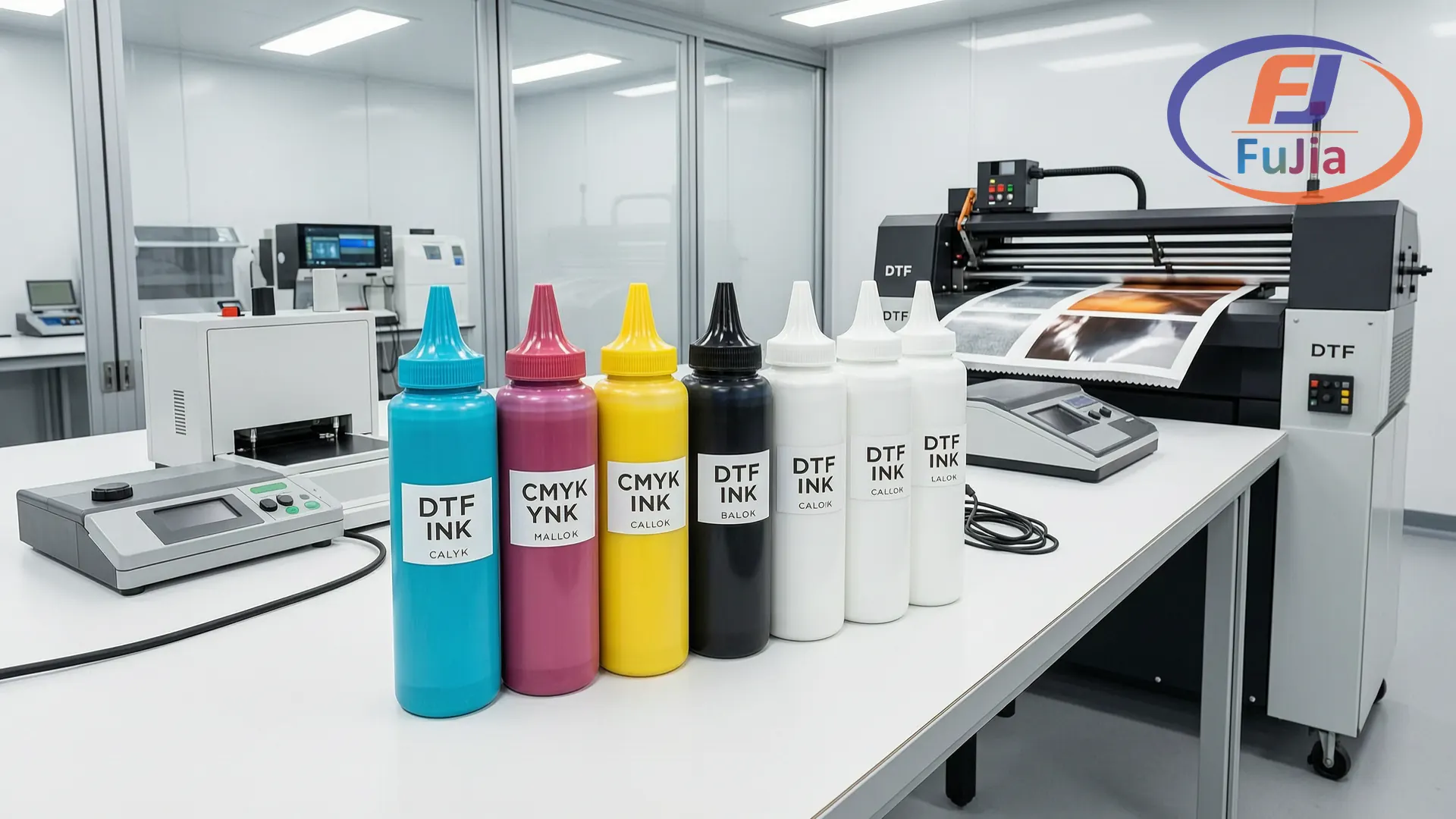
Looking for a reliable DTF ink supplier with factory-direct pricing and Oeko-Tex certified formulas? Guangzhou Fujia Digital Technology Co., Ltd. (Fujia Print) manufactures DTF inks in-house alongside our printer production line. CMYK + White ink, bulk wholesale, OEM private label available. Contact us for a sample batch — we’ll send test prints so you can verify quality before you commit.
DTF Ink Types: CMYK vs White, What Actually Matters
The global digital textile ink market was valued at $1.6 billion in 2025 and is projected to reach $3.2 billion by 2032 (Grand View Research). DTF ink represents the fastest-growing segment within this market.
DTF printing uses two fundamentally different ink types. They’re not interchangeable, and the quality requirements for each are different.
CMYK Inks: The Color Foundation
These four colors (Cyan, Magenta, Yellow, Black) print the visible design. Quality factors:
| Factor | What to Look For | Why It Matters |
|---|---|---|
| Particle size | <200 nanometers | Smaller particles = smoother ink flow, less nozzle clogging, better color consistency |
| Viscosity | 3–5 cP (centipoise) at 25°C | Too thick = poor droplet formation. Too thin = bleeding on transfer film |
| Color gamut | 80%+ Adobe RGB coverage | Wider gamut = more vibrant prints without ICC profile gymnastics |
| Curing temp | 130–160°C | Lower temp = less energy, faster production, safer for heat-sensitive media |
| Drying speed | Fast flash-off, no tackiness | Wet ink smears during powder application and ruins the transfer |
The single most important spec: nano-grade particle dispersion. Cheap ink uses micron-level pigments (500nm+) that settle in dampers and wear down printhead nozzles over time. Quality manufacturers use triple-roll milling or bead milling to achieve consistent sub-200nm dispersion. Ask your supplier for a particle size distribution report — if they can’t provide one, walk away.
White Ink: The Hardest Ink to Get Right
DTF white ink is more demanding than CMYK by an order of magnitude. Here’s why:
- Titanium dioxide (TiO₂) loading: 15–25% by weight. TiO₂ is dense (specific gravity ~4.2) and settles fast — within 2–4 hours without circulation.
- Particle suspension: Requires specialized dispersants and rheology modifiers to keep TiO₂ particles from clumping. Bad white ink turns into toothpaste in your dampers within 48 hours.
- Opacity: Measured by hiding power (contrast ratio). Good DTF white ink should achieve >85% opacity at 1440×720 DPI with a single pass.
- Flow stability: The ink must stay fluid enough to print after 12+ hours in the system, but thick enough to deliver coverage.
What separates good white ink from the cheap stuff:
| Quality Level | Particle Size | Settling Time (no circulation) | Opacity (single pass) | Typical Price/Liter |
|---|---|---|---|---|
| Premium nano-grade | <250nm | 48–72 hours before noticeable sediment | >90% | $25–$40 |
| Standard commercial | 250–400nm | 24–48 hours | 80–90% | $15–$25 |
| Budget/bulk | 400–800nm | 8–24 hours | 60–80% | $8–$15 |
If you’re running production volumes, cheap white ink costs more in the long run. The $10/liter savings evaporates the first time you replace a $900 printhead that clogged from TiO₂ sediment.
Fujia Print’s DTF white ink uses nano-grade TiO₂ with proprietary dispersion technology. Particle size consistently under 200nm. Oeko-Tex Standard 100 certified. Available in 1L bottles to 20L bulk containers. Request a sample and technical data sheet.
How to Test DTF Ink Quality Before You Commit
Don’t trust a spec sheet. Test the ink yourself. Here’s a practical 4-test protocol you can run in under 2 hours:
Test 1: Nozzle Check Pattern (15 minutes)
Print a full CMYK+W nozzle check on transfer film. Look for:
– Complete, unbroken lines in every channel
– No gaps, deflection, or “spitting” in the white channel
– Consistent line weight across all channels
A good ink prints a clean pattern on the first nozzle check. If you need 3+ cleaning cycles after installing fresh ink, the formula isn’t optimized for your printhead.
Test 2: Sedimentation Test (24 hours)
Pour 100ml of white ink into a clear graduated cylinder. Mark the level. Check after 24 hours:
– Good: No visible separation, ink looks uniform top to bottom
– Acceptable: <2mm clear layer at top, ink re-mixes easily with gentle agitation
– Fail: >5mm clear layer, thick sediment at bottom that requires vigorous shaking
Test 3: Wash Fastness (3 washes minimum)
Print a test design on cotton (Gildan 5000 or equivalent), cure properly, then wash 3 times (cold water, standard cycle). Inspect after each wash:
– No cracking or peeling of the print surface
– Color fade less than 10% (compare side-by-side with an unwashed print)
– White ink base remains fully opaque
This matters because customers wash their shirts. If your ink fails at 3 washes, it’ll fail your customers at 5.
Test 4: Stretch Recovery
Print on cotton, cure, then stretch the printed area 20% and hold for 10 seconds. Release. The print should return to its original appearance with no cracking. This tests the ink’s elasticity — critical for activewear and fitted garments.
OEM and Private Label: Build Your Own Ink Brand
Many DTF equipment distributors want to sell branded ink alongside their printers. It builds customer loyalty and creates recurring revenue. The right manufacturer makes this straightforward.
What a Good Ink OEM Partner Provides
| Service | What to Expect | Red Flag |
|---|---|---|
| Custom formulation | Ink tuned to your specific printer models and printhead types | “One formula fits all” — different printheads (XP600, i3200, 4720) have different optimal ink viscosities |
| Private label packaging | Your brand on bottles, boxes, and MSDS sheets | No packaging customization, or minimum order quantities above 500L |
| Color profile support | ICC profiles pre-made for your machines | “Just use the generic profile” — generic profiles leave 10–15% color gamut on the table |
| Batch consistency testing | Certificate of Analysis (CoA) with each batch showing particle size, viscosity, pH, surface tension | No CoA provided — you’re gambling on every shipment |
| Sample program | 1–5L free or discounted test batch | Charging full retail for samples or refusing to send any |
| Technical support | Engineer on call during your business hours for color/profile issues | “Contact sales” for technical questions |
Minimum Order Quantities
Realistic MOQs for OEM/private label DTF ink:
– Sample/testing phase: 1–5 liters per color (most manufacturers waive this)
– Small brand launch: 50–100L total (CMYK + W), typically 10–20L per color
– Established brand: 200–500L per order, with quarterly or monthly deliveries
Be skeptical of manufacturers pushing MOQs above 500L for a first order. They’re prioritizing their production efficiency over your business. A good partner starts small, proves quality, then scales with you.
Fujia Print offers DTF ink OEM/private label with no minimum order quantity for initial sample batches. We’ll match your printer specs (XP600, i3200, 4720 compatible), provide ICC profiles, and ship with your branding. Lab reports included with every batch. Discuss your OEM requirements with our team.
Oeko-Tex and Environmental Compliance
If you’re selling printed garments to Europe, North America, or any major brand, Oeko-Tex Standard 100 certification isn’t optional — it’s table stakes.
Oeko-Tex certifies that the ink contains no harmful substances at levels that could affect human health. It covers:
– Heavy metals (lead, cadmium, mercury — all prohibited)
– Formaldehyde (restricted to <16 ppm for direct skin contact)
– Phthalates (restricted in children’s products)
– Azo dyes that release carcinogenic amines
Ask your ink supplier these two questions:
1. “Can you provide your Oeko-Tex certificate number?” — A legitimate supplier gives you the number immediately. You can verify it at oeko-tex.com.
2. “Do you have REACH compliance documentation for EU customers?” — REACH (Registration, Evaluation, Authorisation of Chemicals) is required for selling into the EU market.
If the answer to either is “we’re working on it” or a vague yes without documentation, find another supplier.
How Ink Manufacturers Cut Corners (and How to Spot It)
After years in DTF manufacturing, we’ve seen every trick in the book. Here’s what cheap ink actually costs you:
Corner #1: Recycled Solvent Base
Some manufacturers use recovered/recycled solvents as the ink carrier. It’s cheaper, but the solvent purity varies batch to batch. Result: inconsistent viscosity, unpredictable drying times, and occasional chemical reactions that produce printhead-clogging residue.
How to spot it: Ask for the solvent source. Quality ink uses virgin ethylene glycol or propylene glycol derivatives. If the manufacturer can’t name their solvent supplier, that’s a red flag.
Corner #2: Undersized TiO₂ Dispersion
Cheap white ink skips the nano-grinding step. TiO₂ particles above 500nm settle faster and wear down printhead nozzles through abrasion.
How to spot it: Your white ink dampers turn dark gray within 2–3 weeks of use. That’s TiO₂ sediment packing into the damper mesh.
Corner #3: Filler Pigments
Some manufacturers add cheap calcium carbonate or barium sulfate as “extenders” in CMYK ink. These fillers dilute the color but maintain the same ink volume — so you pay for 1L of ink but get 850ml of active pigment.
How to spot it: Print a solid color block and measure the density with a spectrophotometer. Compare against a known good ink. A difference >10% suggests filler content.
Price Ranges: What You Should Actually Pay
DTF ink pricing follows a simple rule: consistency costs more than the raw materials. Here’s what’s realistic for bulk wholesale (100L+ orders) in 2026:
| Ink Type | Budget Range/L | Mid-Range/L | Premium/L | Notes |
|---|---|---|---|---|
| CMYK (per color) | $8–$12 | $12–$18 | $18–$28 | Premium includes nano-dispersion and custom ICC profiles |
| White ink | $10–$15 | $15–$25 | $25–$40 | White ink is always 20–40% more expensive due to TiO₂ cost |
| Bulk CMYK (500L+) | $6–$9 | $9–$14 | N/A | Volume discounts kick in above 200–300L |
A note on “cheap” ink: We’ve tested $6/liter CMYK ink from multiple suppliers. It prints. The colors are 15–20% less vibrant, the white ink clogs dampers twice as fast, and the wash fastness drops from 20+ cycles to maybe 10. If you’re selling to customers who care about quality, the $3–$5/liter savings disappears into reprints, customer complaints, and premature printhead replacements.
Ink Compatibility: Match Your Ink to Your Printhead
Not all DTF ink works with all printheads. Here’s the practical compatibility guide:
| Printhead | Optimal Viscosity | White Ink Notes | Recommended Ink Type |
|---|---|---|---|
| Epson XP600 | 3–4 cP | Requires daily circulation; use ink with extra dispersant | Standard or premium nano-grade |
| Epson i3200-A1 | 3.5–5 cP | Wider nozzles tolerate slightly larger particles; good with standard grades | Standard commercial grade works well |
| Epson 4720 | 3–4 cP | Narrower channels than i3200; use nano-grade for best results | Premium nano-grade recommended |
| Epson L1800 | 2.5–4 cP | Consumer-level printhead, very sensitive to particle size | Premium nano-grade only |
The universal rule: If your manufacturer says “our ink works with all printheads,” they’re either lying or they don’t understand the engineering. Different printheads have different nozzle diameters (10–40 microns), different firing frequencies, and different ink path geometries. An ink optimized for an i3200 will underperform in an XP600, and vice versa.
Frequently Asked Questions
Q: How long does DTF ink last in storage?
Unopened DTF ink has a shelf life of 12–18 months when stored at 15–30°C, away from direct sunlight. White ink has a shorter effective life — 8–12 months — because the TiO₂ dispersion gradually degrades even in a sealed container. Once opened, use within 6 months. Always check the production date on each bottle.
Q: Can I mix different brands of DTF ink?
No. Different manufacturers use different resin systems, solvent blends, and pigment treatments. Mixing brands can cause chemical reactions that produce gel-like particles — which clog printheads. If you switch brands, flush the entire ink system with cleaning solution first.
Q: What’s the difference between DTF ink and DTG ink?
DTF ink prints onto transfer film and requires a powder adhesive step before heat pressing onto fabric. DTG ink prints directly onto pretreated fabric. They use different resin systems — DTF ink needs to form a flexible film layer, while DTG ink needs to penetrate fabric fibers. They’re not interchangeable.
Q: Is Oeko-Tex certification necessary if I only sell domestically?
Oeko-Tex isn’t legally required in most countries, but it’s increasingly expected by wholesale buyers and end customers. If you sell to schools, hospitals, or companies with ESG policies, Oeko-Tex certification is often a mandatory supplier requirement. Getting certified ink costs 10–20% more but opens up markets that uncertified ink can’t enter.
Q: How do I switch from my current ink supplier without damaging my printer?
Flush the entire ink system with manufacturer-recommended cleaning solution (not generic alcohol). Run cleaning cycles until the output is clear. Replace all dampers. Fill with new ink, run 2–3 cleaning cycles to purge cleaning solution from the printhead, then print a nozzle check. Total process: 1–2 hours. If you’re switching white ink, budget extra time — TiO₂ sediment in old dampers needs thorough flushing.
The Bottom Line
DTF ink isn’t a commodity, even though some manufacturers want you to think it is. The chemistry behind consistent color, clog-free white ink, and wash durability is complex — and the difference between a $10/liter budget ink and a $25/liter premium ink shows up on every shirt you print.
Choose an ink manufacturer the same way you’d choose a printer manufacturer: demand technical documentation, test samples before ordering bulk, and only work with suppliers who answer technical questions directly — not with marketing speak.
If you’re sourcing DTF ink for your print shop or looking to launch a private-label ink brand alongside your equipment sales, start with a sample batch. Test it on your machines, on your fabrics, through your wash cycles. The numbers don’t lie.
Ready to test Fujia Print’s DTF ink on your equipment? We’ll send a free CMYK+White sample kit — enough ink to run a full test protocol so you can verify quality, color gamut, and wash durability before committing. Request your sample kit here. Oeko-Tex certified. Factory-direct pricing. No minimum order for first batch.
