

UV DTF printing is the fastest-growing niche in digital decoration, printing directly onto phone cases, tumblers, acrylic awards, and glass — no pretreatment, no weeding, instant curing. Here is how to choose the right machine.
The global UV-curable ink market is projected to grow at 9.5% CAGR through 2030 (Grand View Research, 2025), driven by demand for personalized products and the short-run customization boom. UV DTF printers sit right at the center of this trend.
But the UV DTF market in 2026 is confusing. Some machines are repurposed traditional DTF printers with UV ink mods. Others are purpose-built UV DTF systems. Prices range from $800 to $5,000 for machines that look nearly identical. This guide sorts it out.
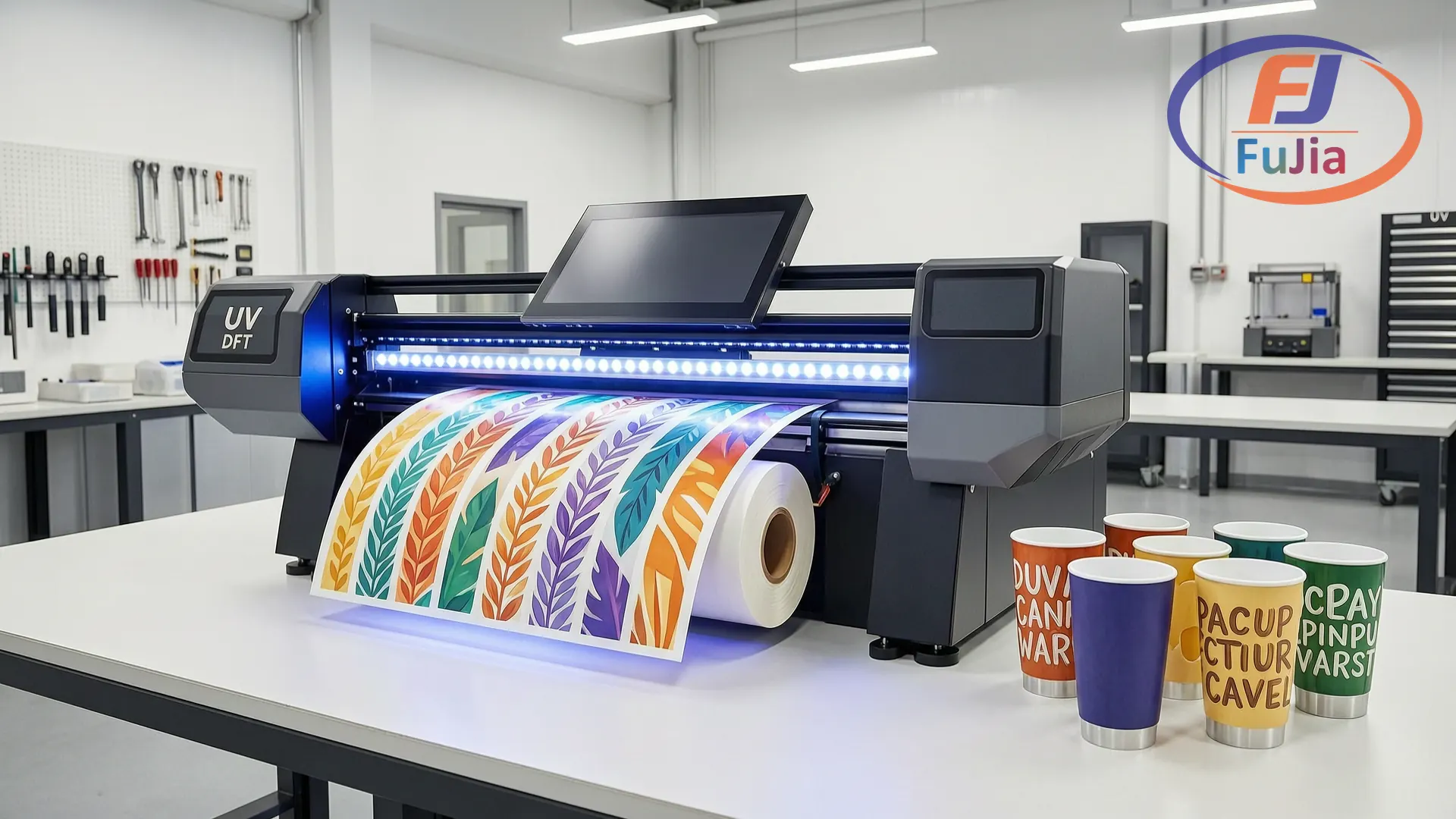
Who this is for: Small business owners looking to add personalized products (cup wraps, phone cases, signage), entrepreneurs entering the customization market, and print shops expanding from fabric into hard-surface decoration.
Guangzhou Fujia Digital Technology (Fujia Print) manufactures purpose-built UV DTF printers — not converted fabric DTF machines. A4 and A3 formats available, both with integrated UV LED curing lamps. Factory-direct pricing. CE + ISO 9001 certified. Request a UV DTF printer quote and we’ll print your design on a sample cup wrap or phone case — free of charge.
What Is UV DTF Printing, and How Is It Different From Regular DTF?
Traditional DTF prints water-based pigment ink onto PET transfer film, applies thermoplastic polyurethane (TPU) powder, melts the powder in a curing oven, then heat-presses the design onto fabric. It’s built for textiles.
UV DTF is fundamentally different:
- Ink: UV-curable ink — not water-based. When exposed to UV LED light (typically 395nm wavelength), the ink polymerizes instantly into a solid film.
- No powder: The UV ink cures directly on the transfer film. No powder application. No curing oven.
- Substrate: UV DTF transfers bond to hard, non-porous surfaces — glass, ceramic, metal, acrylic, wood, plastics, leather. Traditional DTF only bonds to fabric.
- Durability: UV-cured prints are scratch-resistant, waterproof, and UV-stable for outdoor use. Traditional DTF prints are flexible but less durable on hard surfaces.
| Feature | Traditional DTF | UV DTF |
|---|---|---|
| Ink type | Water-based pigment | UV-curable (acrylic resin) |
| Curing method | Heat (oven 130–160°C) | UV LED (395nm) |
| Powder required? | Yes (TPU hot melt) | No |
| Transfer to fabric? | Yes — cotton, polyester, blends | No — not designed for fabric |
| Transfer to hard surfaces? | No | Yes — glass, metal, acrylic, ceramic, wood, plastic |
| Outdoor durability | Moderate (fades in 6–12 months outdoors) | High (UV-stable, 2–3 years outdoor) |
| Wash durability (fabric) | 30–50+ washes | N/A (not for fabric) |
| Print speed (A4) | 3–5 minutes | 4–8 minutes (A film + B film + lamination) |
| Equipment needed | Printer + powder shaker + curing oven + heat press | Printer + UV LED curing lamp (built-in on quality models) |
Sources: MTuTech UV DTF Technical Guide, Epson UV Ink Technology
What Can You Make With a UV DTF Printer?
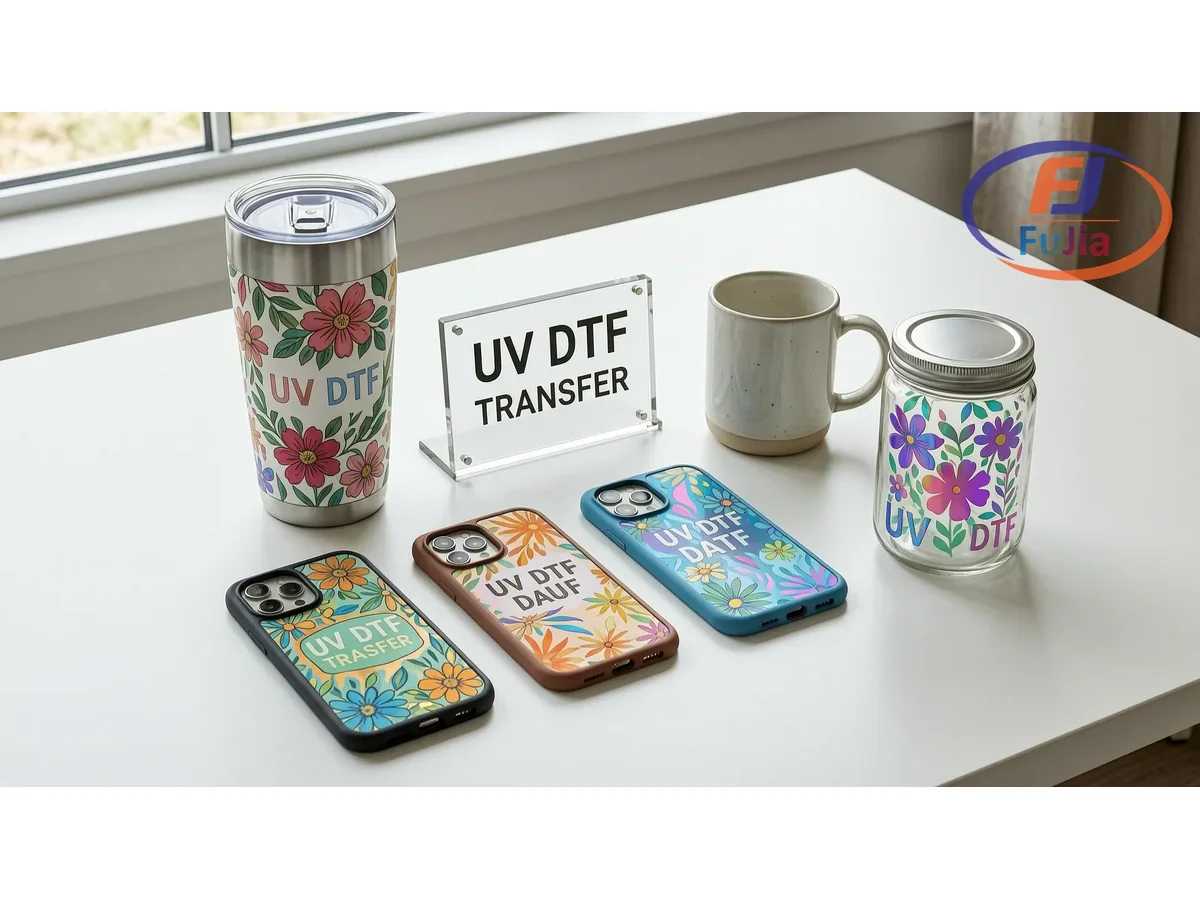
UV DTF opens up product categories that traditional garment printing can’t touch. Here are the highest-margin applications in 2026:
| Product | Material | Average Selling Price | Ink+Film Cost | Profit Margin |
|---|---|---|---|---|
| Custom cup wraps | Plastic/acrylic tumbler | $12–$20 | $1.50–$2.50 | 75–85% |
| Phone cases | Hard plastic, TPU | $15–$25 | $1.00–$1.80 | 80–90% |
| Acrylic signs & awards | Acrylic sheet | $20–$50 | $2.00–$4.00 | 80–90% |
| Ceramic mug wraps | Ceramic | $10–$18 | $1.50–$2.50 | 75–85% |
| Laptop skins & decals | Vinyl to metal/plastic | $15–$30 | $2.00–$3.50 | 80–85% |
| Wood engraving-style plates | Wood | $15–$25 | $1.50–$2.50 | 75–85% |
| Glass decoration | Glass | $18–$35 | $2.00–$4.00 | 80–85% |
Cup wraps are the single biggest UV DTF application in 2026. The personalized tumbler market exploded on TikTok and Etsy — a UV DTF printer can pay for itself with just 100–150 cup wrap orders at $15 average selling price.
UV DTF Printer Types: A4 vs A3
UV DTF printers come in two main formats:
| Size | Max Print Area | Typical Price | Best Applications | Monthly Volume |
|---|---|---|---|---|
| A4 (210×297mm) | Cup wraps, phone cases, small signs | $800–$2,000 | Cup wraps, phone cases, small decor | 50–200 items |
| A3 (297×420mm) | Larger wraps, multiple smaller items on one sheet | $1,500–$5,000 | All of the above + acrylic signs, gang sheets | 200–500 items |
For cup wraps specifically: A4 is usually enough. A standard Starbucks-style tumbler wrap requires roughly 80×220mm of print area — well within A4. But if you plan to print signs, awards, or gang sheets (multiple cup wraps on one film sheet), A3 pays for itself in material efficiency.
What Should a UV DTF Printer Actually Cost?
Price Breakdown by Quality Tier
| Tier | Printer Price | Printhead | UV Curing | RIP Software | Best For |
|---|---|---|---|---|---|
| Budget | $800–$1,200 | XP600 or L1800 | External UV lamp (manual) | Free (AcroRIP) | Hobbyists testing the market |
| Standard | $1,200–$2,500 | XP600 or 4720 | Integrated UV LED (auto sync) | Included | Small businesses, 50–150 items/day |
| Professional | $2,500–$5,000 | i3200 or dual XP600 | Integrated UV LED with intensity control | Included (CadLink or Maintop) | Production shops, 200+ items/day |
The key price differentiator: integrated UV LED curing. Budget machines use a separate UV lamp — you print the film, then manually expose it under the lamp. Standard and professional machines integrate UV LEDs directly into the print carriage so the ink cures as it prints. The integrated approach:
– Eliminates the manual UV exposure step (saves 2–3 minutes per sheet)
– Provides consistent curing intensity (manual lamps degrade unevenly over time)
– Prevents uncured ink from smearing during handling
If you’re producing more than 20 items per day, the $500–$800 premium for integrated UV curing pays for itself in labor savings within 2–3 months.
All Fujia Print UV DTF printers include integrated UV LED curing — no separate UV lamp needed. Ink cures instantly as it prints. Request a sample print on your material of choice.
Key Features to Compare
1. UV LED Curing System
| Type | Curing Speed | Consistency | Lamp Lifespan | Replacement Cost |
|---|---|---|---|---|
| External UV lamp (manual) | 30–90 sec per sheet | Operator-dependent | 500–1,000 hours | $50–$150 |
| Integrated UV LED (single lamp) | Instant (inline) | Good — single pass | 5,000–10,000 hours | $200–$400 |
| Integrated UV LED (dual lamp) | Instant (inline) | Excellent — dual pass for thick ink layers | 5,000–10,000 hours | $400–$800 |
UV LEDs degrade over time — output intensity drops roughly 10–15% after 3,000 hours of operation. Quality machines include an intensity display or automatic compensation. If a manufacturer can’t tell you the UV LED lifespan rating, assume it’s on the low end.
2. A Film + B Film Transfer Process

Unlike traditional DTF (single film), UV DTF uses a two-film process:
- A Film (PET transfer film): The design is printed here, colors first, then white background
- B Film (PET cover film with adhesive): Laminated onto the A film after printing, this carries the adhesive that bonds the design to the final surface
The B film lamination step is unique to UV DTF. Some machines include a built-in laminator. Others require manual lamination using a cold laminator or even a squeegee. For production use, a built-in or semi-auto laminator is worth the extra cost — manual lamination creates bubbles and misalignment that ruin 5–10% of prints.
3. White Ink Underbase (for Transparent and Dark Surfaces)
Just like traditional DTF, UV DTF prints CMYK colors first, then a white underbase layer. The white provides opacity so colors appear vibrant on any surface — clear glass, black phone cases, dark wood.
The white ink challenge in UV DTF is different from fabric DTF. UV-curable white ink contains TiO₂ particles suspended in acrylic monomers. Without circulation, TiO₂ settles in 4–8 hours. But UV ink is thicker (higher viscosity) than water-based DTF ink, so the settling rate is somewhat slower.
Look for:
– Auto circulation pump — standard on quality machines, keeps white ink mixed
– UV ink-specific agitation system — some machines use a vibrating ink tank instead of a pump (quieter, less expensive)
4. Printhead Compatibility
| Printhead | Resolution | UV DTF Suitability | Replacement Cost |
|---|---|---|---|
| Epson XP600 | 1440×1440 DPI | Good for A4, budget-friendly | $150–$250 |
| Epson 4720 | 2400×1200 DPI | Best value for A3, reliable | $200–$350 |
| Epson i3200-U1 | 2400×1200 DPI | Best for production UV, wider nozzles for thicker ink | $500–$800 |
| Epson L1800 | 5760×1440 DPI | Hobby-grade, too slow for business | $80–$120 |
Critical difference: The i3200-U1 (U for UV) is a variant of the i3200-A1 optimized for UV ink viscosity. It has a slightly wider nozzle diameter to handle the thicker UV ink flow. If you see “i3200 UV DTF printer” at $2,000, it’s likely using a standard i3200-A1 (fabric version), not the U1. The A1 works fine, but the U1 is purpose-built for UV. Source: Epson PrecisionCore Printhead Series.
UV DTF vs UV Flatbed: Which One Do You Need?
This is the most common confusion in UV printing. They use the same UV ink technology but serve completely different purposes.
| Feature | UV DTF Printer | UV Flatbed Printer |
|---|---|---|
| Prints on | Transfer film (A + B film) | Directly on the object |
| Object thickness | Any (transfer is thin) | Limited by printhead clearance (usually 0–15cm) |
| Curved surfaces? | Yes — transfer film conforms | No — needs flat surface |
| Cylindrical objects? | Yes — wrap the film around | Only with rotary attachment (extra cost) |
| Production speed | Fast for small items | Fast for large flat items |
| Price range | $800–$5,000 | $3,000–$30,000+ |
| Best for | Small items, cups, phone cases, irregular shapes | Signs, panels, large flat objects |
Decision rule: If you’re printing on cups, phone cases, or oddly shaped objects, UV DTF is the better tool. If you’re printing large flat signs, panels, or direct-to-object marking, a UV flatbed makes more sense.
For a detailed comparison, see our existing article on UV DTF vs UV Flatbed Printer: Full 2026 Comparison Guide.
Where to Buy: Factory Direct vs Alibaba
| Channel | Price Premium | Warranty | Support Quality | Risk |
|---|---|---|---|---|
| Factory direct | 0% | 12–24 months | Direct engineer access via WhatsApp/TeamViewer | Low |
| Alibaba/trading company | 10–25% | Often vague | Forwarded to factory, delayed | Medium–High |
| Amazon/eBay | 50–100% | 30-day return | None — return or rebuy | High |
UV DTF-specific red flags on Alibaba:
– “UV DTF printer” listings with photos showing powder shakers — powder is for fabric DTF, not UV DTF. The seller doesn’t understand their own product.
– UV printer listings with “ECO solvent” in the description — confused keywords, likely a dropshipper
– “Customized UV ink” without listing the UV wavelength (395nm or 385nm are standard; if they can’t name it, avoid)
For a complete supplier vetting framework, read our 12-Point DTF Printer Supplier Evaluation Checklist.
Frequently Asked Questions
Q: What is the best UV DTF printer for cup wraps?
For cup wraps, an A4 UV DTF printer with integrated UV LED curing and a 4720 or XP600 printhead ($1,200–$2,000) is the best value. A4 fits standard tumbler wraps perfectly, and integrated curing eliminates the manual UV lamp step. Look for models that include a semi-auto B film laminator — it saves 2–3 minutes per wrap and reduces lamination errors.
Q: What is the price of a UV DTF printer?
Budget UV DTF printers (XP600/L1800, external UV lamp) cost $800–$1,200. Standard models (XP600/4720, integrated UV LED) run $1,200–$2,500. Professional production models (i3200, dual UV lamp, built-in laminator) cost $2,500–$5,000. All prices are FOB factory. Add $300–$600 for international air freight shipping.
Q: Is UV DTF better than UV flatbed printing?
They serve different purposes. UV DTF is better for small, curved, or irregular objects (cups, phone cases, cylindrical items) because the transfer film conforms to any shape. UV flatbed is better for large flat items (signage, panels, direct-to-object marking) because it prints directly on the surface with no transfer step. Many shops run both: UV DTF for small personalization work, flatbed for production signage.
Q: Can UV DTF print on fabric?
No. UV-curable ink forms a rigid plastic layer on fabric — it cracks when stretched and feels like a sticker. Use traditional DTF with water-based ink and TPU powder for fabric printing. UV DTF is for hard, non-porous surfaces: glass, metal, ceramic, acrylic, wood, plastic, and leather.
Q: Do I need a heat press for UV DTF?
No. UV DTF does not use heat at any stage. The UV ink cures under UV LED light, and the B film adhesive bonds at room temperature with pressure (typically 3–5 kg/cm² applied via a simple roller or squeegee). This is one of UV DTF’s biggest advantages — no heat press, no curing oven, no electricity for heating equipment.
Q: How long do UV DTF prints last?
UV DTF prints are UV-stable (won’t yellow in sunlight for 2–3 years minimum, per ASTM D4329 accelerated weathering standards) and scratch-resistant (pencil hardness 2H–3H on most UV ink formulations). On cups and drinkware, prints withstand 500+ dishwasher cycles when properly applied with edge sealing. For outdoor signage, expect 2–3 years of colorfastness without lamination.
The Bottom Line
UV DTF is the fastest path into the product personalization market. It’s simpler than traditional DTF (no powder, no oven, no heat press), opens up entirely different product categories, and carries higher profit margins per item.
Start with an A4 model if you’re focused on cup wraps and phone cases. Upgrade to A3 when you add signage, awards, and gang sheets. Always buy a machine with integrated UV LED curing — the time savings alone justify the $500 premium. And buy factory direct so you have an engineer who can help when the machine has issues, not a trading company rep who forwards your message and hopes for the best.
A UV DTF printer, properly chosen, earns its cost back in under 200 orders. At $15 average profit per cup wrap, that’s a 3–4 month payback at just 50 orders per month. For the right small business, it’s the best investment you’ll make this year.
Fujia Print UV DTF printers ship with integrated UV LED curing, auto white ink circulation, and RIP software included. A4 and A3 formats. Factory-direct pricing. CE + ISO 9001 certified. Request a quote — we’ll print your design on a sample cup wrap, phone case, or acrylic sign and ship it to you before you pay a deposit.
