

Eco-solvent printers are the workhorses of the sign and graphics industry. Walk into any print shop that makes banners, vehicle wraps, wall decals, or outdoor signage, and you’ll find at least one wide-format eco-solvent machine running 8–12 hours a day.
But the eco-solvent market in 2026 is fragmented. On one end, you have Epson, Roland, and Mimaki selling $15,000–$25,000 machines through authorized dealer networks with technician installation included. On the other, Chinese manufacturers offer functionally identical i3200-powered printers for $3,000–$8,000 — same printhead, same ink chemistry, 60–70% less cost, but factory-direct with WhatsApp support instead of a local technician.
This guide explains exactly what you’re paying for at each price point, which features actually affect your print quality and production speed, and how to evaluate Chinese eco-solvent manufacturers without getting burned.
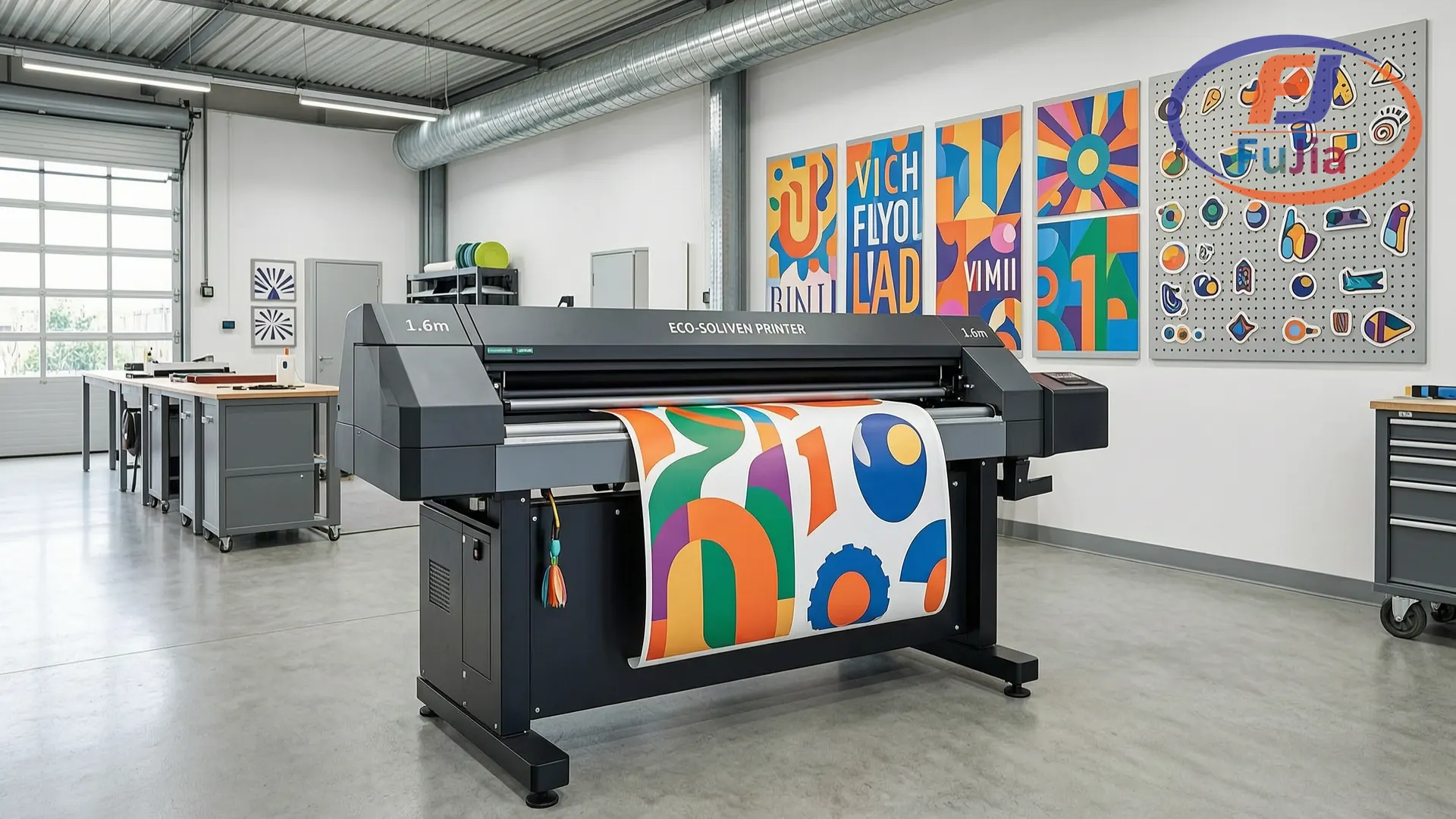
Who this is for: Sign shop owners, vehicle wrap installers, banner and poster printers, and print-on-demand businesses looking to add wide-format outdoor-capable printing. If you’re currently running a DTF or UV printer and want to expand into the signage market, this guide is for you.
Guangzhou Fujia Digital Technology (Fujia Print) manufactures wide-format eco-solvent printers with Epson i3200 printheads — 1.6m and 1.8m print widths, CMYK+W configurations available. Factory-direct pricing at 50–70% less than Japanese brands. CE + ISO 9001 certified. Request an eco-solvent printer quote and we’ll print your test file on our demo machine — free sample shipped to you.
What Is an Eco-Solvent Printer?
An eco-solvent printer uses solvent-based ink where the carrier solvent is a mild glycol ether or glycol ester — not the aggressive cyclohexanone or MEK (methyl ethyl ketone) used in full-solvent (“true solvent”) printers. This matters for three reasons:
- Lower VOCs: Eco-solvent inks emit significantly less volatile organic compounds than full-solvent inks. Most eco-solvent printers can operate in a standard ventilated office without dedicated fume extraction — though the OSHA PEL for glycol ethers still recommends 25–50 ppm limits and active ventilation.
- Outdoor durability: The solvent carrier bites into the surface of vinyl, banner material, and coated media. This creates a mechanical bond that water-based inks (DTF, DTG) cannot achieve. Properly laminated eco-solvent prints last 3–5 years outdoors without significant fading.
- No heat curing required: Unlike UV ink (which cures under UV LED) or water-based DTF ink (which requires oven curing), eco-solvent ink dries through evaporation. The printer includes a built-in heater that accelerates drying, but no external curing equipment is needed.
Eco-Solvent vs Full Solvent vs UV vs Latex

| Technology | Ink Chemistry | Outdoor Durability | Print Speed | Equipment Cost | Best For |
|---|---|---|---|---|---|
| Eco-Solvent | Glycol ether/ester carrier | 3–5 years (laminated) | Medium (8–15 m²/hr) | $2,000–$25,000 | Vinyl stickers, banners, vehicle wraps |
| Full Solvent | Cyclohexanone, MEK | 5–7 years | Fast (15–30 m²/hr) | $10,000–$50,000 | Industrial outdoor signage, billboards |
| UV | Acrylic monomers, UV cure | 3–5 years (no laminate needed) | Fast (15–40 m²/hr) | $8,000–$60,000 | Rigid substrates, short-run packaging |
| Latex | Water-based with latex polymer | 3–5 years (no laminate outdoors) | Fast (12–25 m²/hr) | $10,000–$30,000 | Indoor wallcoverings, odor-sensitive spaces |
Durability data sourced from ASTM D4329 accelerated weathering standards and manufacturer technical data sheets. Actual outdoor lifespan depends on UV exposure, lamination quality, and substrate.
Eco-solvent’s sweet spot: It’s the best price-to-performance option for outdoor vinyl graphics. It’s $5,000–$15,000 cheaper than equivalent-width UV or latex machines, the ink cost per square meter is 30–50% lower, and the print quality on adhesive vinyl is indistinguishable from UV for 90% of applications.
What Can You Print With an Eco-Solvent Printer?
| Application | Media | Average Price (per m²) | Ink Cost (per m²) | Profit Margin |
|---|---|---|---|---|
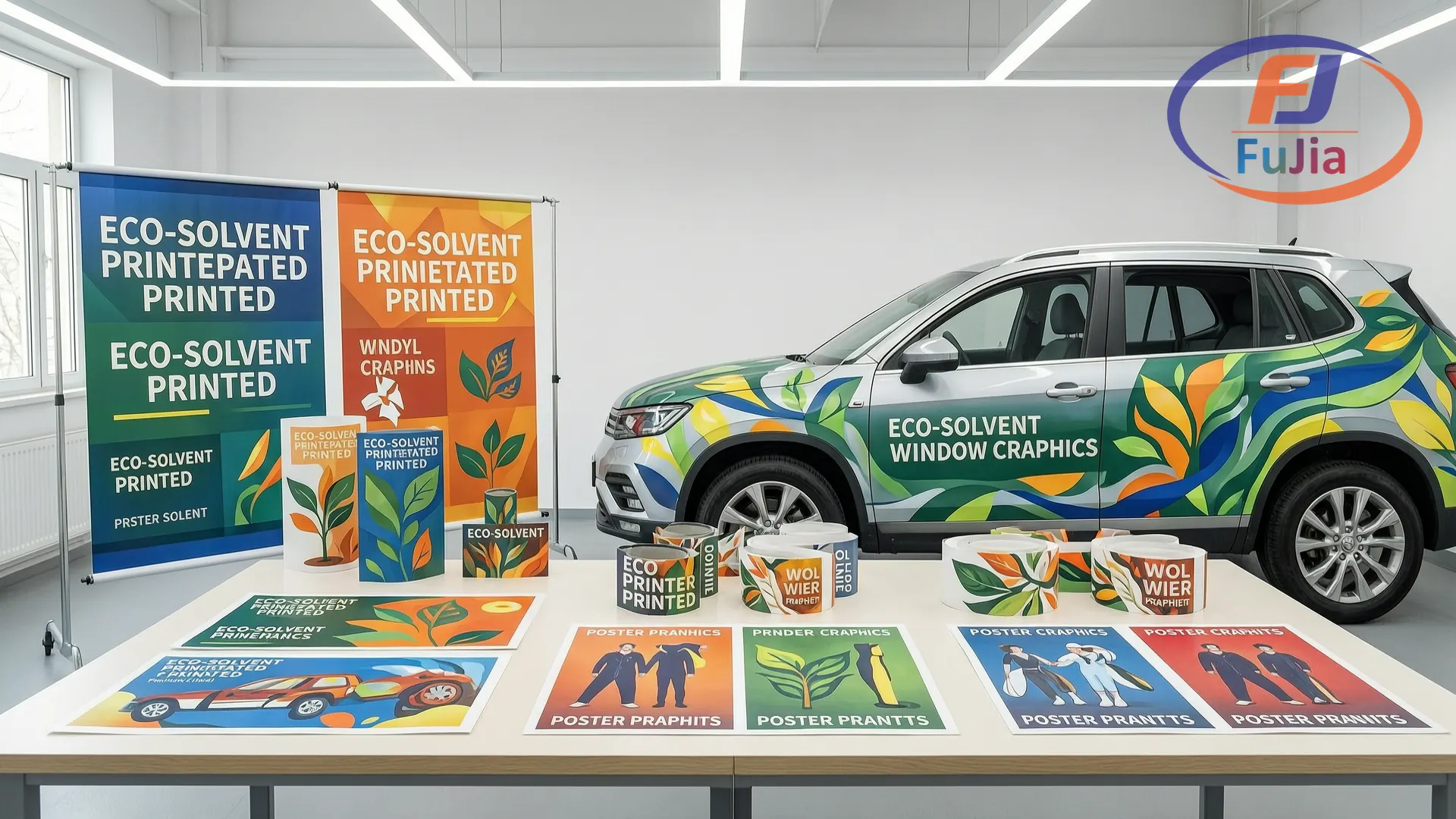
| Vinyl stickers & decals | Cast/calendered vinyl | $15–$30 | $1.50–$2.50 | 80–90% |
| Vehicle wraps (partial) | Cast vinyl + laminate | $40–$80 | $2.00–$3.50 | 85–92% |
| Banners (indoor/outdoor) | PVC banner, 440–510 gsm | $8–$15 | $1.00–$2.00 | 80–85% |
| Wall murals & decals | Wall vinyl, canvas | $20–$50 | $2.00–$3.00 | 85–90% |
| Window graphics | Perforated window film | $25–$50 | $2.00–$3.00 | 85–90% |
| Floor graphics | Anti-slip laminate floor vinyl | $30–$60 | $2.50–$4.00 | 85–90% |
| Poster prints | Photo paper, 180–260 gsm | $8–$20 | $1.00–$1.50 | 80–85% |
The highest-margin application in 2026: Vehicle wraps. A partial vehicle wrap (hood + sides) uses roughly 12–15 m² of vinyl, costs $60–$100 in materials, and sells for $800–$1,500. Even with 4–6 hours of labor (design + print + install), the margin is exceptional.
Market data: The global wide-format printer market is projected to reach $9.2 billion by 2028 at 5.8% CAGR (Grand View Research, 2025), with eco-solvent representing the largest technology segment.
Key Features to Compare When Buying
1. Print Width: 1.6m vs 1.8m vs 2.5m+
| Width | Typical Price (Chinese i3200) | Max Media Width | Best For | Monthly Volume |
|---|---|---|---|---|
| 1.6m (63″) | $3,000–$5,000 | 1,600mm | Banners, posters, stickers | 100–300 m² |
| 1.8m (72″) | $4,000–$8,000 | 1,800mm | Vehicle wraps, large banners | 200–500 m² |
| 2.5m+ (98″+) | $8,000–$25,000 | 2,500–3,200mm | Billboards, fleet graphics | 500+ m² |
For most sign shops and startups, 1.6m is the right starting point. It handles 95% of standard jobs — 4’×8′ banners, vehicle hood wraps, window graphics — without the higher cost and larger footprint of a 1.8m machine. Upgrade to 1.8m only if vehicle wrap clients consistently need full-roof coverage in one piece.
2. Printhead Configuration
Eco-solvent printers almost exclusively use Epson printheads. The i3200 is the standard for 2026 Chinese-manufactured machines.
| Printhead | Nozzle Count | Print Width | Eco-Solvent Suitability | Replacement Cost |
|---|---|---|---|---|
| Epson i3200-E1 | 3,200 (8×400) | 1.6m–1.8m | Purpose-built for eco-solvent | $500–$800 |
| Epson i3200-A1 | 3,200 (8×400) | 1.6m–1.8m | Works but E1 is optimized for solvent | $500–$800 |
| Epson 4720 | 1,600 | 0.6m–1.2m | Suitable for desktop/small format | $200–$350 |
| Epson XP600 | 1,440 | 0.6m max | Not recommended for eco-solvent — nozzles too fine | $150–$250 |
Critical difference: The i3200-E1 is the eco-solvent variant of the i3200. The “E” stands for Eco-solvent. It has:
– Chemical-resistant nozzle plate coating (glycol ether doesn’t degrade the plate as it does on the A1 over time)
– Slightly wider ink channels to handle thicker solvent ink viscosity (6–8 cP vs 3–5 cP for water-based)
– Longer lifespan in solvent environments (12–18 months for E1 vs 8–12 for A1)
If a manufacturer says “our printer uses the i3200 printhead” but won’t specify E1 vs A1, they’re likely using the cheaper A1. It’ll work, but you’ll replace printheads more frequently. Source: Epson PrecisionCore Printhead Series.
3. Ink Configuration: CMYK vs CMYK+W vs CMYKLcLm+W
| Configuration | Colors | White Ink? | Light Colors? | Best For | Price Premium |
|---|---|---|---|---|---|
| 4-color (CMYK) | 4 | No | No | Standard vinyl graphics, banners | Baseline |
| 6-color (CMYKLcLm) | 6 | No | Yes (light cyan, light magenta) | Photo-quality prints, fine gradients | +$500–$1,000 |
| 4-color + White (CMYK+W) | 5 | Yes | No | Transparent media, dark vinyl, window graphics | +$800–$1,500 |
| 6-color + White (CMYKLcLm+W) | 7 | Yes | Yes | Maximum versatility | +$1,500–$2,500 |
For most sign shops, CMYK is enough. The additional light cyan/light magenta channels produce smoother gradients in photo prints, but 90% of sign work (logos, text, vector graphics) doesn’t need them. White ink is valuable if you print on clear window film or dark vinyl — but adds $800–$1,500 and requires daily white ink maintenance.
4. Built-in Heater and Drying System
Eco-solvent ink dries through evaporation. The printer’s built-in heating system — usually a three-stage setup (pre-heater, platen heater, post-heater) — accelerates this.
| Heater Configuration | Drying Speed | Power Consumption | Best For |
|---|---|---|---|
| Platen heater only (basic) | Slow — 30+ min for full dry | 500–800W | Low-volume, indoor posters |
| Pre + platen + post heater (standard) | Medium — 10–15 min | 1,200–2,000W | Standard production |
| Triple heater + external dryer (production) | Fast — 5–10 min | 2,000–3,000W | High-volume, take-up reel operation |
The heater isn’t just about drying speed. If the ink doesn’t dry fast enough before the media winds onto the take-up reel, the print face contacts the media backing — causing offset marks and ruined prints. For anything above 50 m²/day, external drying (a standalone IR dryer or heated take-up system) is worth the investment.
What Should an Eco-Solvent Printer Cost?
Price Tiers: Chinese Factory vs Japanese Brand
| Feature | Chinese i3200 Factory | Japanese Brand (Epson/Mimaki/Roland) |
|---|---|---|
| 1.6m 4-color printer | $3,000–$5,000 | $12,000–$18,000 |
| 1.8m 4-color printer | $4,000–$8,000 | $18,000–$25,000 |
| CMYK+W configuration | +$800–$1,500 | +$3,000–$5,000 |
| RIP software | Included (Maintop, PhotoPRINT) | $500–$2,000 extra (Onyx, Caldera) |
| Installation | Self-install with video guide + WhatsApp support | Dealer technician on-site ($500–$1,500) |
| Warranty | 12–24 months, remote support | 12–24 months, local dealer support |
| Printhead replacement | $500–$800 (buy from factory or separately) | $800–$1,200 (dealer installed) |
| Ink cost per liter | $25–$45/L (factory-branded) | $60–$120/L (OEM-branded) |
The Chinese factory advantage is real but comes with trade-offs:
– You save $8,000–$15,000 upfront on a 1.6m machine
– You save 40–60% on ink costs long-term
– But you install it yourself (or hire a local tech)
– But your support is WhatsApp/TeamViewer, not a van that shows up in 2 hours
For a sign shop in a major metro area where a local wide-format tech charges $150/hour, the Japanese dealer model makes sense if you value immediate on-site service. For everyone else — especially shops outside tier-1 cities, or in developing markets where there are no Roland/Mimaki dealers within 500 km — the Chinese factory model is almost always the better financial decision.
Fujia Print eco-solvent printers use genuine Epson i3200-E1 printheads. CMYK and CMYK+W configurations. 1.6m and 1.8m print widths. Three-stage heating. RIP software included. Compare our eco-solvent models and get a quote with DDP shipping to your country.
Eco-Solvent Ink: What to Look For
Eco-solvent ink quality varies dramatically because it’s less standardized than water-based ink. The carrier solvent chemistry is proprietary to each manufacturer.
Key Ink Quality Factors
| Factor | Good Ink | Cheap Ink | How to Test |
|---|---|---|---|
| Color gamut | 85%+ Adobe RGB | 65–75% Adobe RGB | Print a CMYK color chart; measure with spectrophotometer |
| Outdoor fade resistance | 3–5 years (laminated) | 1–2 years | Print, laminate, expose to outdoor sun for 30 days |
| Vinyl adhesion | Passes cross-hatch tape test on cast vinyl | Fails — flakes off under tape | ASTM D3359 cross-hatch adhesion test |
| Odor level | Low — glycol ether only | High — contains cyclohexanone “boosters” | Open a sealed bottle and smell — cheap ink smells like nail polish remover |
| Clogging rate | 1–2 cleanings per week (daily use) | Daily cleaning, often 3+ cycles | Track cleaning cycles over 2 weeks |
The biggest scam in eco-solvent ink: Some manufacturers spike their “eco-solvent” ink with full-solvent carriers (cyclohexanone) to improve vinyl bite and drying speed, then label it “mild solvent” or “eco-friendly.” It’s not eco and it’s not friendly. It off-gasses toxic fumes and will give your operators headaches within weeks.
How to verify: Request the Safety Data Sheet (SDS) for the ink. Look at Section 3 (Composition/Ingredients). If you see “cyclohexanone” or “MEK” listed at >5%, it’s full-solvent ink with an eco label. Genuine eco-solvent ink uses glycol ethers and glycol ether acetates as primary solvents.
Where to Buy: Factory Direct vs Dealer
| Factor | Factory Direct (China) | Authorized Dealer (Local) |
|---|---|---|
| Machine price | $3,000–$8,000 | $12,000–$25,000 |
| Ink lock-in? | No — use any compatible eco-solvent ink | Often yes — warranty void if non-OEM ink |
| Installation | Self-install or hire local tech ($200–$500) | Included in price (on-site) |
| Training | Video guide + WhatsApp/TeamViewer sessions | 1–2 day on-site training |
| Warranty service | Ship replacement part + video guide to install | Dealer technician visits |
| Long-term ink cost | $25–$45/L | $60–$120/L |
Decision rule: If you or someone on your team is comfortable following video instructions, changing a printhead, and troubleshooting basic mechanical issues, buy factory direct. You’ll save $8,000+ upfront and thousands more on ink over the machine’s life. If you need white-glove service and immediate on-site support, the dealer premium may be worth it.
For a detailed supplier evaluation framework, see our 12-Point Printer Supplier Evaluation Checklist — the same principles apply to eco-solvent manufacturers.
Frequently Asked Questions
Q: How much does an eco-solvent printer cost?
Chinese factory-direct eco-solvent printers range from $3,000–$8,000 for a 1.6m–1.8m i3200-powered machine with CMYK configuration. Japanese brands (Epson SureColor S-Series, Roland TrueVIS, Mimaki JV Series) cost $12,000–$25,000 for equivalent print widths. Add $800–$1,500 for white ink capability and $500–$2,000 for RIP software (if not included).
Q: What is the best eco-solvent printer for vinyl?
For vinyl applications specifically, look for a 1.6m i3200-E1 powered machine with three-stage heating ($3,500–$5,000 factory direct). The E1 printhead is optimized for eco-solvent ink chemistry, the triple heater ensures ink dries before the vinyl hits the take-up reel, and the 1.6m width handles standard 54″ vinyl rolls. Chinese manufacturers like Fujia Print, MTuTech, and Siyin offer competitive options.
Q: Eco-solvent vs latex printer — which should I choose?
Eco-solvent wins on cost (50–60% cheaper machine, 40–50% cheaper ink per m²) and print quality on vinyl. Latex wins on odor (water-based, no solvent smell — safe for hospitals and schools), instant drying (no outgassing wait time), and scratch resistance without lamination. For outdoor signage where cost matters, choose eco-solvent. For indoor wallcoverings in occupied spaces, choose latex.
Q: Can I print vehicle wraps with an eco-solvent printer?
Yes — eco-solvent is the most common technology for vehicle wrap printing, especially at the 1.6m width. Use cast vinyl (not calendered) for wraps — it conforms to vehicle curves without lifting. Always laminate with cast overlaminate. Expect 3–5 years of outdoor durability with proper lamination (per ASTM D4329 weathering standards).
Q: Do I need ventilation for an eco-solvent printer?
Yes. While eco-solvent inks emit less VOCs than full-solvent, the glycol ether carrier still produces detectable odor during printing. Minimum requirements: a window with exhaust fan (200–300 CFM) positioned near the printer’s output side. For enclosed spaces or rooms without windows, install a ducted fume extraction system. Never operate an eco-solvent printer in a sealed room without ventilation. Reference: OSHA chemical exposure guidelines for glycol ethers.
Q: How long does eco-solvent ink last before clogging?
With daily use, genuine eco-solvent ink goes 1–2 weeks between cleanings. Unlike DTF white ink (which settles in hours), eco-solvent CMYK ink is chemically stable — the pigment particles are dissolved in the solvent carrier, not suspended. The main clogging risk is the solvent evaporating from nozzles during idle periods. If you won’t print for 3+ days, run a cleaning cycle and park the head in the capping station. For longer idle periods (1+ weeks), flush the ink lines with cleaning solution.
The Bottom Line
Eco-solvent printing is the most cost-effective way to produce outdoor-durable graphics. It’s cheaper than UV, more versatile than latex for outdoor work, and the Chinese factory-direct ecosystem has matured to the point where a $4,000 i3200 machine competes head-to-head with a $15,000 Japanese printer on print quality.
Choose 1.6m CMYK for a sign shop or sticker business. Upgrade to 1.8m CMYK+W if vehicle wraps are your primary revenue. Buy factory direct if you’re comfortable with basic maintenance. Insist on the i3200-E1 printhead specifically — not the A1. Test the ink before committing to bulk orders. And never run the machine without ventilation, no matter how “eco” the ink claims to be.
An eco-solvent printer, properly chosen and maintained, prints profitably for 5–7 years. At $30–$80/m² average selling price vs. $2–$4/m² total cost, the ROI is compelling from day one.
Fujia Print eco-solvent printers: Epson i3200-E1 printheads, 1.6m and 1.8m, 3-stage heating, RIP software included. CE + ISO 9001 certified. Factory-direct pricing. DDP shipping worldwide. Request a quote — we’ll print your test file and ship the sample with your quote.
