

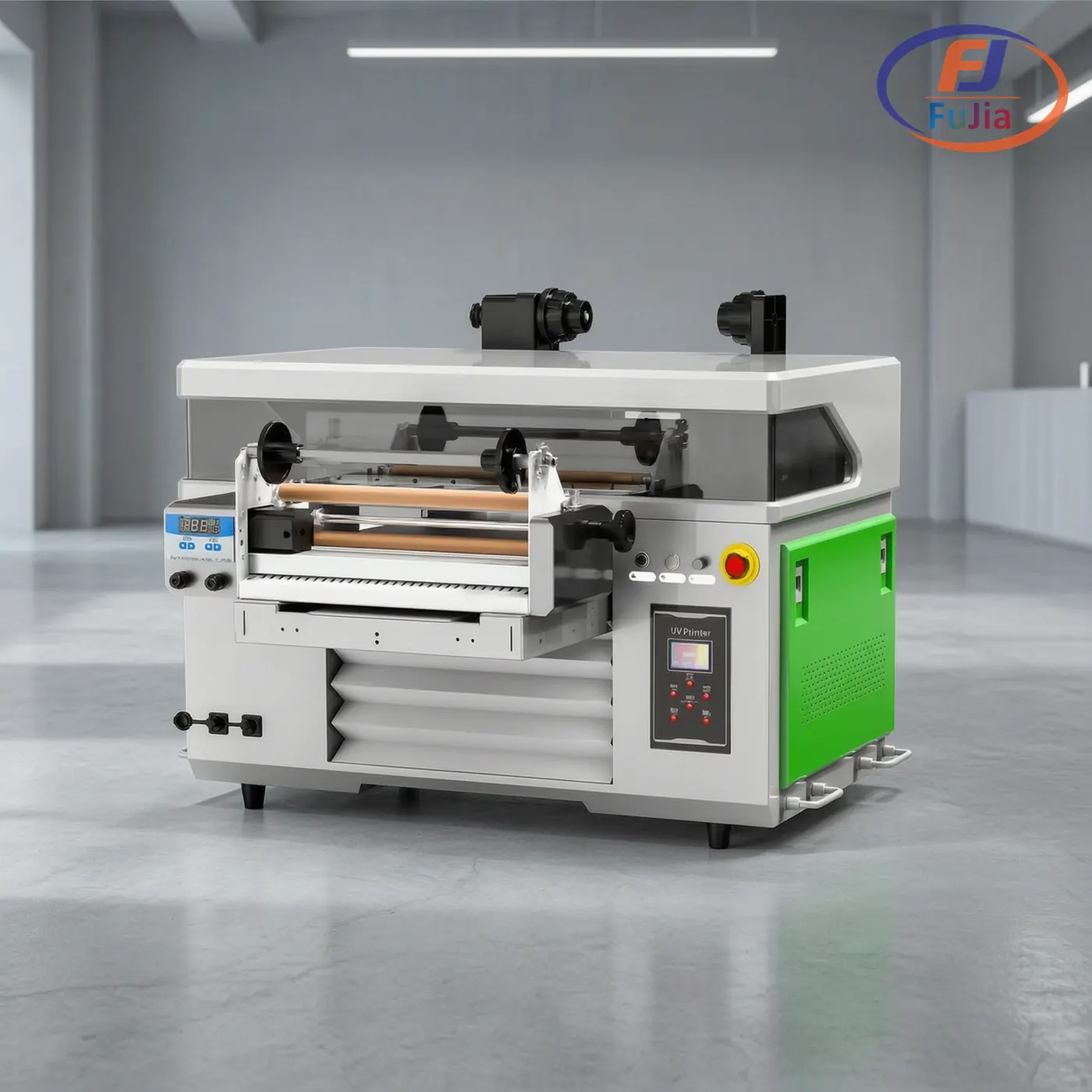
A UV printing machine is a digital printer that uses ultraviolet LED light to cure (harden) specially formulated liquid ink the instant it touches a surface. Unlike conventional inkjet printers that rely on heat or air drying, a UV printing machine bonds ink directly to rigid materials such as glass, metal, wood, acrylic, and ceramic in a single pass. The global UV printer market reached USD 1.02 billion in 2025 and is projected to grow to USD 1.58 billion by 2031 at a CAGR of 7.59%, according to Mordor Intelligence.
Key Takeaways
- A UV printing machine instantly cures ink with UV LED light, enabling direct printing on nearly any rigid or semi-rigid surface without pre-treatment
- Prices range from USD 2,500 for entry-level desktop models to USD 50,000+ for industrial flatbed systems, with annual maintenance costs of USD 1,000 to USD 5,000
- CMYK + White + Varnish ink configurations produce 3D embossed textures up to 0.8 mm in physical relief height
- UV printers serve businesses in promotional products, signage, packaging, phone case customization, and industrial part marking
What Is a UV Printing Machine?
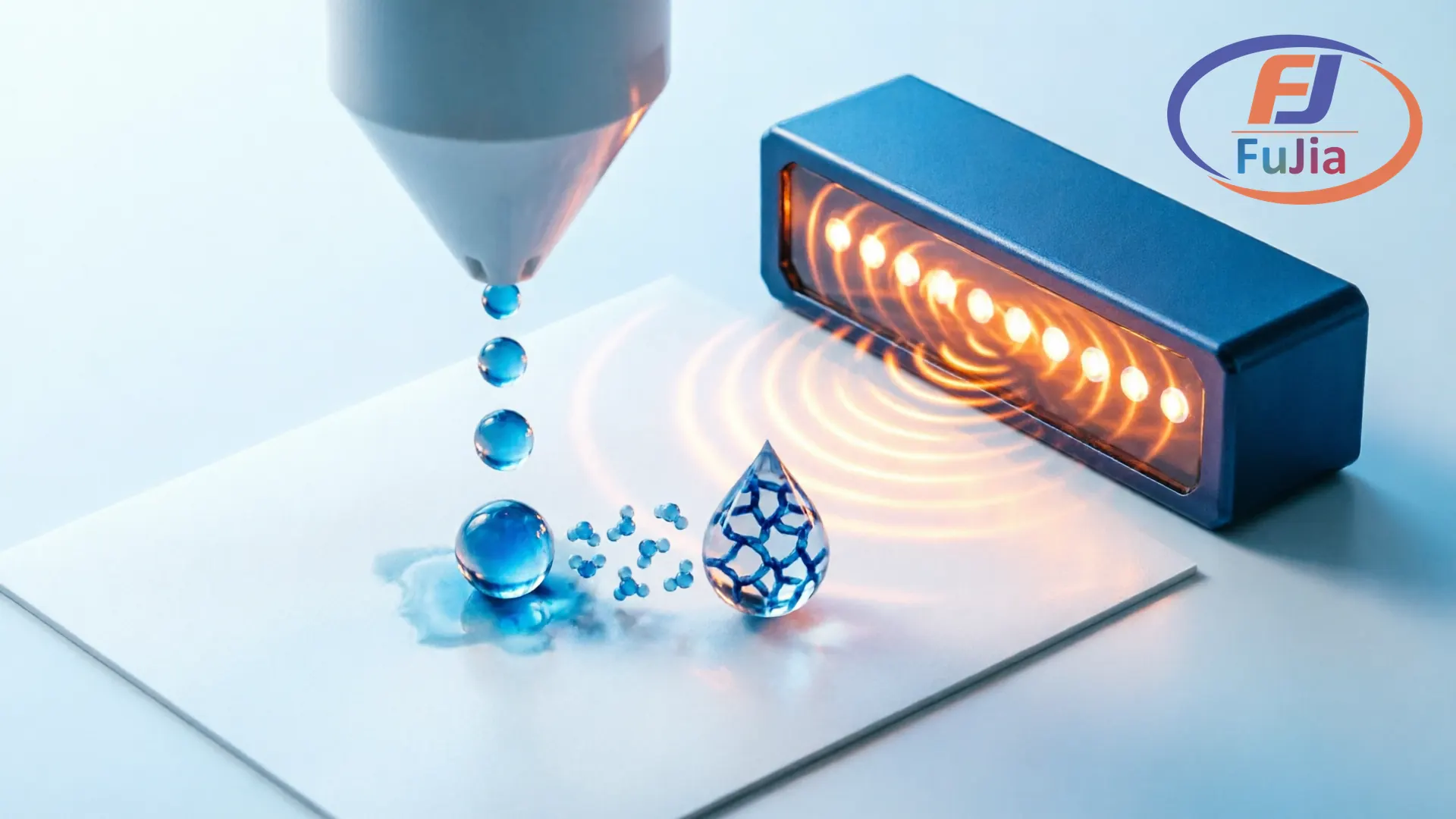
A UV printing machine is an industrial digital printer that deposits UV-curable ink onto a substrate and immediately cures each droplet using integrated UV LED lamps positioned next to the printhead. The ink contains photo-initiators that undergo polymerization when exposed to UV light at wavelengths of 365 nm or 395 nm, transforming from liquid to solid film in milliseconds. This photochemical reaction means the ink never penetrates the material surface, resulting in exceptionally sharp detail and vibrant color saturation on substrates that traditional printers cannot handle.
Modern UV printing machines support CMYK + White + Varnish (CMYK+W+V) ink channels. White ink provides opaque base layers for printing on dark or transparent materials, while clear varnish enables glossy, matte, or textured finishes. A typical industrial UV printer achieves resolutions up to 1200 x 1440 DPI and produces 3D embossed effects by stacking multiple white ink layers.
How UV LED Curing Works
The core of UV printing technology is the photochemical curing process. Understanding this mechanism explains why UV printers can print on materials that no other digital printer can handle.
Step 1: Ink Deposition
The printhead — typically an Epson i3200, Ricoh Gen5, or Ricoh Gen6 — deposits micro-droplets of UV-curable ink onto the substrate surface. The printhead controls droplet size, placement precision, and layering sequence. A CMYK+W+V configuration uses separate channels for cyan, magenta, yellow, black, white, and varnish, enabling complex multi-layer prints in a single pass.
Step 2: UV LED Exposure
UV LED lamps mounted adjacent to the printhead emit ultraviolet light at 365 nm or 395 nm wavelengths. The ink contains photo-initiators that absorb this UV energy and trigger a polymerization reaction. The ink transitions from liquid to solid in milliseconds, bonding directly to the substrate without spreading, soaking, or smearing. The ISO 2409 cross-cut adhesion test is the industry standard for measuring this bond strength on coated surfaces.
Step 3: Instant Curing and Handling
Because the ink cures on contact, printed items are fully dry and ready for immediate handling the moment they leave the print area. No drying racks, no waiting time, no post-print coating. This instant-cure capability makes UV printing machines significantly faster than traditional screen printing for short runs and custom orders.
Types of UV Printing Machines
UV printing machines fall into three primary categories based on substrate handling and production scale. Each type serves distinct business needs.
| Type | Substrate Handling | Print Area | Typical Price Range | Best For |
|---|---|---|---|---|
| Flatbed UV Printer | Rigid materials on vacuum table | A3 (29×42cm) to 2×3m | USD 2,500 – USD 50,000+ | Phone cases, signage, acrylic, wood panels |
| Roll-to-Roll UV Printer | Flexible materials on rolls | 1.6m – 3.2m width | USD 8,000 – USD 40,000 | Banners, vinyl, film, flexible packaging |
| Hybrid UV Printer | Both rigid and flexible | Up to 2.5m width | USD 15,000 – USD 60,000 | Print shops handling mixed jobs |
Flatbed UV Printers
Flatbed UV printers hold rigid materials stationary on a vacuum table while a moving printhead applies ink. The vacuum platform uses honeycomb suction to keep materials perfectly flat, achieving positioning accuracy of 0.1 mm. Flatbed models handle items up to several centimeters thick, including phone cases, glass panels, ceramic tiles, wooden plaques, and metal nameplates.
Most flatbed UV printers support rotary attachments for cylindrical objects such as bottles, tumblers, and candles. Many also include UV DTF AB film printing mode, enabling the same machine to produce crystal label transfers for irregular surfaces.
Roll-to-Roll UV Printers
Roll-to-roll UV printers feed flexible substrates — vinyl, banner material, PET film, and flexible packaging stock — from a roll through the print area to a take-up roll. These machines excel at wide-format production for outdoor advertising, vehicle wraps, and soft signage where high-speed continuous printing is essential.
What Can a UV Printing Machine Print On?
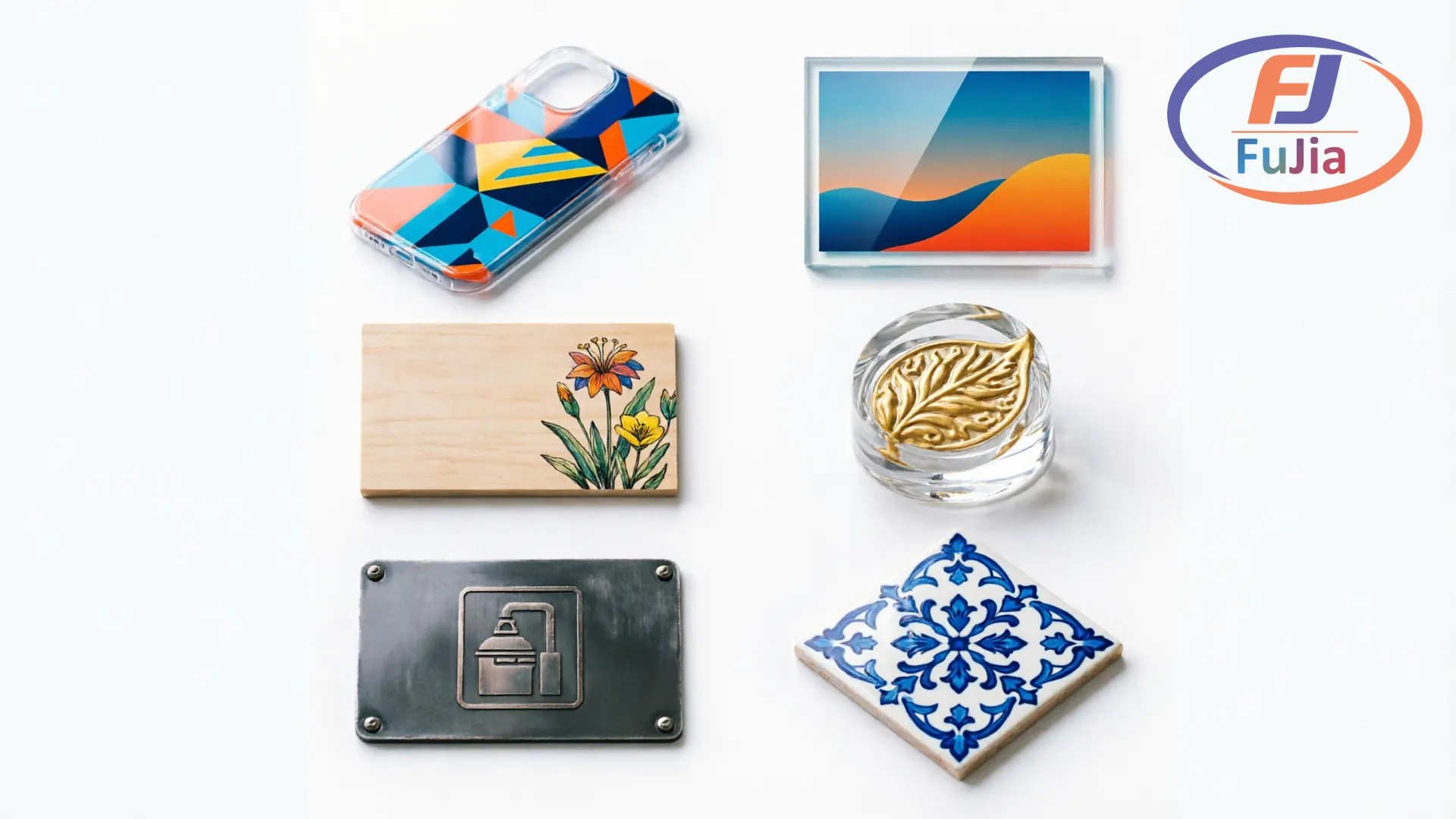
UV printing machines print directly on virtually any rigid or semi-rigid surface without pre-treatment, coating, or primer. This material versatility is the single greatest advantage over every other digital printing technology.
| Material | Common Applications | Special Considerations |
|---|---|---|
| Acrylic | Signage, display panels, awards, photo frames | Supports white ink and reverse printing for glass-like depth |
| Wood | Plaques, wall art, coasters, decorative items | Plywood, MDF, bamboo, sealed hardwoods retain natural grain |
| Glass | Decorative panels, mirrors, awards | Reverse printing protects artwork from scratching |
| Coated Metal | Nameplates, control panels, industrial labels | Anodized aluminum, coated steel, painted metal sheets |
| Plastic (PVC, ABS, Polycarbonate) | Phone cases, electronics enclosures, promotional products | Polycarbonate has limited adhesion without primer |
| Ceramic and Tile | Murals, backsplashes, decorative installations | Decorative use only, not food-contact certified |
| Leather | Wallets, notebook covers, labels | Not suitable for items requiring heavy flexing |
UV printing machines cannot print effectively on pure textiles (which require DTG or DTF printing), materials with extremely high oil content, or raw silicone without specialized silicone ink. For fabric printing applications, DTF printing machines remain the superior choice.
UV Printing Machine Price: What to Expect in 2026
UV printing machine prices span a wide range depending on print area, printhead configuration, curing system, and production capacity. The market offers options from entry-level desktop units to full industrial production lines.
Price Tiers Breakdown
| Tier | Print Area | Printheads | Curing | Price Range (USD) |
|---|---|---|---|---|
| Entry-Level Desktop | A3 (29×42cm) | 1–2 (XP600) | Air-cooled LED | USD 2,500 – USD 6,000 |
| Mid-Range Flatbed | A2 (40×60cm) | 2–3 (XP600/i3200) | Air-cooled LED | USD 6,000 – USD 15,000 |
| Industrial Flatbed | A1 (60×90cm) or larger | 3–4 (Epson i3200/Ricoh Gen5) | Water-cooled LED | USD 15,000 – USD 50,000+ |
| Roll-to-Roll / Hybrid | 1.6m – 3.2m width | 3–6 (Ricoh/Kyocera) | Water-cooled LED | USD 20,000 – USD 60,000+ |
Running Costs
Beyond the initial machine purchase, UV printing involves ongoing consumable and maintenance expenses. Understanding these costs determines true return on investment.
| Cost Category | Amount (USD) |
|---|---|
| UV ink (CMYK+W+V) per A4 print | ~USD 0.12 |
| Substrate/material per A4 print | ~USD 0.15 |
| Electricity and labor per A4 print | ~USD 0.08 |
| Total cost per A4 print | ~USD 0.35 |
| Average selling price per A4 item | USD 1.00 – USD 4.00 |
| Annual maintenance | USD 1,000 – USD 5,000 |
A single UV printing machine operated at moderate capacity produces 50 to 150 printed items per day. At an average margin of USD 0.65 to USD 3.65 per item, daily gross profit ranges from USD 32 to USD 547. A mid-range flatbed printer at USD 10,000 can recover its cost in 3 to 6 months under typical production conditions.
UV Printer Applications by Industry
UV printing machines serve diverse industries where direct-to-substrate printing on rigid or irregular materials creates value.
Promotional Products and Personalization
Phone case printing represents one of the largest application segments. A UV flatbed printer produces full-color custom phone cases with white ink underbase and glossy varnish topcoat in 30 to 60 seconds per unit. Other promotional applications include USB drives, pens, keychains, lighters, and corporate gifts.
Signage and Display
UV printing produces durable outdoor and indoor signage on acrylic, PVC, aluminum composite panels, and glass. UV-cured ink resists water, UV fading, and physical abrasion, making it suitable for long-term display applications. Spot UV varnish effects create premium matte-gloss contrasts for high-end retail signage.
Industrial Part Marking
Manufacturers use UV printing machines to print serial numbers, barcodes, logos, and safety labels directly on metal parts, control panels, and electronic enclosures. UV ink adhesion on properly prepared metal surfaces achieves Grade 0 (highest) on the ISO 2409 cross-cut adhesion test. The CE marking framework requires industrial printing equipment sold in the European Union to meet specific safety and emissions standards, which professional UV printer manufacturers comply with.
Packaging and Decoration
UV printing enables short-run custom packaging, gift box decoration, and promotional packaging samples without the setup costs of traditional printing methods. The 3D embossing capability adds tactile premium finishes to luxury packaging.
UV Printing vs Other Printing Technologies
| Feature | UV Printing Machine | Eco-Solvent Printer | DTG Printer | DTF Printer |
|---|---|---|---|---|
| Curing Method | UV LED instant cure | Heat evaporation | Heat curing | Heat press transfer |
| Substrate Type | Rigid surfaces (glass, metal, wood) | Flexible (vinyl, banner) | Textiles only | Textiles only |
| Pre-treatment | None required | None | Pre-treatment fluid | Powder + heat press |
| Color Configuration | CMYK + White + Varnish | CMYK | CMYK + White | CMYK + White |
| Special Effects | 3D embossing, spot UV | Flat only | Flat only | Flat only |
| Best For | Rigid materials, customization | Outdoor signage | T-shirt printing | Garment decoration |
UV printing machines excel where the substrate is rigid, irregular, or requires specialty finishes. For textile and garment applications, DTG and DTF printers remain the appropriate technology.
What to Consider When Buying a UV Printing Machine
Selecting the right UV printing machine requires evaluating five key factors that determine production capability, cost of ownership, and business fit.
1. Print Area and Substrate Size
Match the print bed to your most common products. A phone case business needs only A3 (29×42cm) capacity, while a signage company requires A1 (60×90cm) or larger. Measure your largest anticipated product before selecting a model.
2. Printhead Configuration
Printheads determine print resolution, speed, and ink compatibility. The Epson i3200 offers excellent resolution at competitive cost. The Ricoh Gen5 and Gen6 provide industrial durability for 24/7 production. A 2-head configuration (CMYK + White) handles most applications; 3 to 4 heads add varnish and increased speed for high-volume operations.
3. Curing System
Air-cooled UV LED systems suit intermittent production and small shops. Water-cooled systems maintain stable output during continuous 24/7 operation and are essential for industrial-scale production. Water cooling also extends LED lifespan and maintains consistent curing across long print runs.
4. Ink Channels
A CMYK-only configuration limits printing to white or light-colored substrates. Adding White ink enables printing on dark and transparent materials. Adding Varnish enables glossy, matte, and 3D textured finishes. Most commercial UV printers use CMYK + White + Varnish (6+ channels).
5. After-Sales Support
UV printing machines require periodic printhead cleaning, calibration, and component replacement. Verify that the manufacturer offers warranty coverage, remote technical support, and spare parts availability. A UV printer supplier with dedicated after-sales teams reduces downtime and extends machine life, which typically ranges from 5 to 8 years with proper maintenance.
Frequently Asked Questions
Q: What is a UV printing machine?
A UV printing machine is a digital printer that uses ultraviolet LED light to instantly cure specially formulated liquid ink as it deposits onto a surface. Unlike traditional inkjet or eco-solvent printers that rely on heat or air drying, UV printers trigger a photochemical reaction called polymerization within the ink. Photo-initiators in the UV-curable ink absorb UV energy at wavelengths of 365 nm or 395 nm and transform from liquid to solid in milliseconds. This instant curing means the ink never penetrates or spreads on the material surface, producing exceptionally sharp images with vibrant color saturation. UV printing machines print directly on rigid and semi-rigid materials including glass, metal, wood, acrylic, ceramic, plastic, and leather without any pre-treatment or coating. Most modern UV printers use a CMYK + White + Varnish ink configuration, enabling opaque white underbases for dark substrates and glossy varnish topcoats for premium finishes. Industrial-grade UV printers achieve resolutions up to 1200 x 1440 DPI and can produce 3D embossed textures by stacking multiple layers of white ink to physical relief heights of 0.8 mm.
Q: How much does a UV printing machine cost?
UV printing machine prices range from USD 2,500 for entry-level desktop models to USD 50,000 or more for industrial flatbed systems. Entry-level A3 desktop UV printers with 1 to 2 printheads and air-cooled LED curing cost between USD 2,500 and USD 6,000, suitable for small shops printing phone cases and promotional items. Mid-range A2 flatbed printers with 2 to 3 printheads cost USD 6,000 to USD 15,000, offering larger print areas and UV DTF AB film capability. Industrial A1 flatbed printers with 3 to 4 printheads, water-cooled curing, and 3D embossing capability range from USD 15,000 to USD 50,000 or more. Beyond the initial purchase, ongoing costs include UV ink at approximately USD 0.12 per A4 print, substrate materials at USD 0.15 per print, and annual maintenance of USD 1,000 to USD 5,000. With daily output of 50 to 150 items and average selling prices of USD 1.00 to USD 4.00 per item, most UV printing machines recover their purchase cost within 3 to 6 months of operation.
Q: Can you UV print on any material?
UV printing machines print on nearly any rigid or semi-rigid surface, including glass, metal, wood, acrylic, PVC, ABS, polycarbonate, ceramic tiles, leather, coated paper, and treated stone. The UV-curable ink bonds directly to the substrate without requiring pre-treatment or primer on most materials. However, UV printing has limitations. Pure textiles and fabrics require DTG or DTF printing technology, not UV printing. Materials with extremely high oil content may resist ink adhesion. Raw silicone requires specialized silicone ink formulations to prevent a chemical “poisoning” effect that prevents curing. Coated metals such as anodized aluminum and painted steel accept UV ink well, achieving Grade 0 (highest) on the ISO 2409 cross-cut adhesion test. Cylindrical objects including bottles, tumblers, and candles can be printed using a rotary attachment that rotates the item beneath the printhead. UV printing machines cannot print on food-contact surfaces unless using certified food-safe UV ink formulations that meet FDA or equivalent regulatory standards.
Q: Are UV printers worth the investment?
UV printers are worth the investment for businesses that produce customized products on rigid materials, promotional items, signage, or industrial part marking. The global UV printer market was valued at USD 1.02 billion in 2025 and is projected to reach USD 1.58 billion by 2031, growing at a CAGR of 7.59%, reflecting strong and sustained demand across multiple industries. The primary financial advantage is low per-unit cost: each A4 print costs approximately USD 0.35 in ink, substrate, and electricity, while the finished product sells for USD 1.00 to USD 4.00. A UV printing machine producing 50 to 150 items per day generates gross profit of USD 32 to USD 547 daily. A mid-range flatbed printer at USD 10,000 recovers its cost in 3 to 6 months under typical production conditions. UV printers also offer operational advantages: instant curing eliminates drying time, the CMYK+W+V configuration enables premium 3D and spot-UV effects that command higher prices, and the ability to print on diverse materials without setup changes reduces production bottlenecks. With proper maintenance, industrial UV printers last 5 to 8 years.
Conclusion
A UV printing machine transforms how businesses decorate rigid products, from phone cases to industrial signage. The combination of instant UV LED curing, multi-material capability, and CMYK+W+V ink configurations makes UV printing the most versatile digital decoration technology available in 2026. For factory-direct UV printer pricing and free sample inquiries, contact Fujia Print.
