

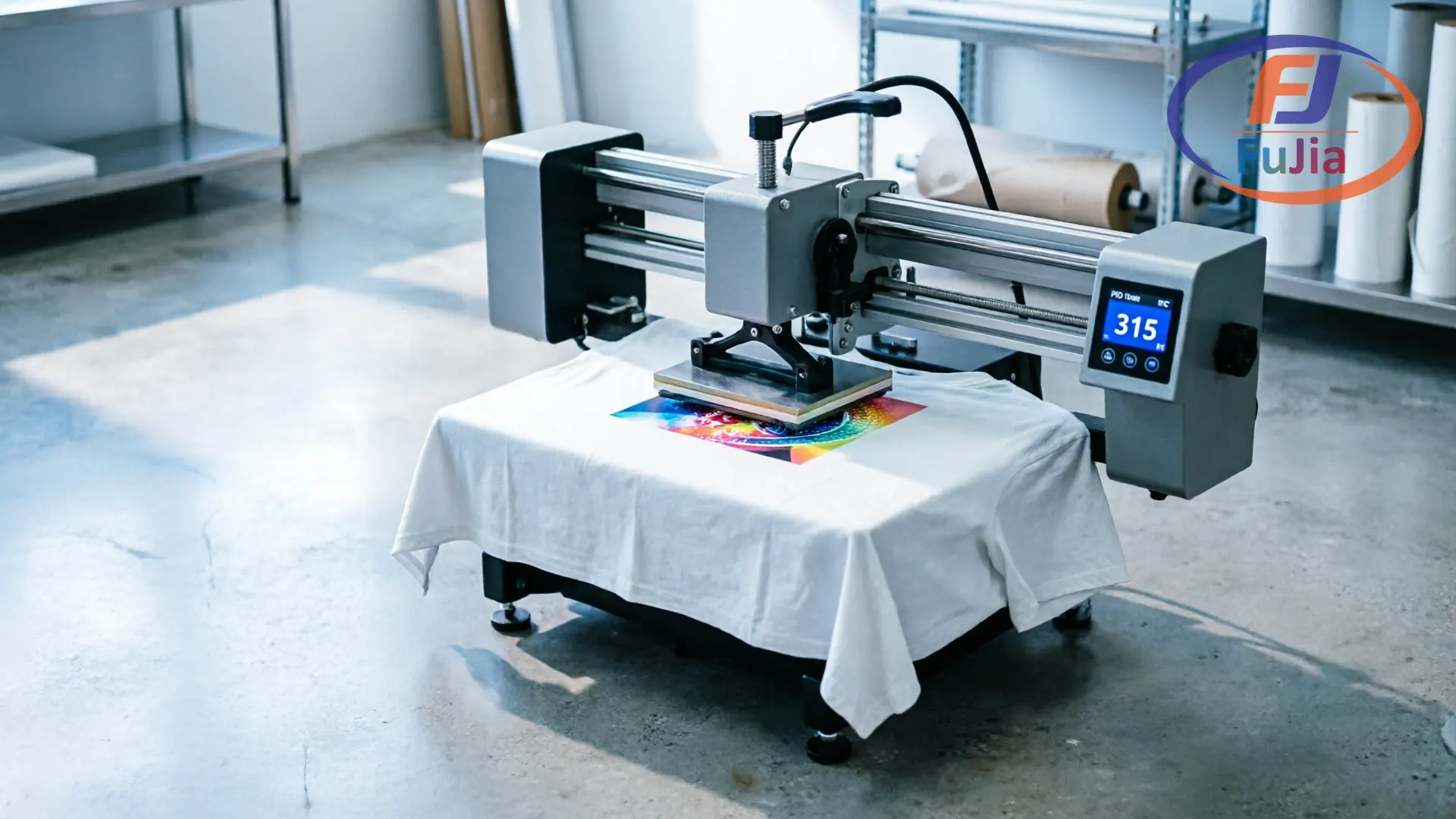
A DTF heat press is the machine that bonds direct-to-film transfers onto garments using controlled heat (300 to 325 degrees Fahrenheit) and medium-firm pressure for 10 to 15 seconds. Unlike sublimation, which requires 385 to 400 degrees Fahrenheit, DTF adhesive powder melts at a lower temperature range, making the heat press the single most critical variable for transfer durability and wash resistance.
Key Takeaways
- DTF transfers bond at 300 to 325 degrees Fahrenheit for 10 to 15 seconds with medium-firm pressure, significantly lower than sublimation’s 385 to 400 degrees Fahrenheit range.
- Swing-away presses are recommended for DTF because they deliver even downward pressure, which prevents edge lifting on transfers. Clamshell presses are acceptable for budget setups but can produce uneven pressure.
- The DTF heat press market is part of the broader direct-to-film printing industry, valued at $2.72 billion in 2024 according to Grand View Research.
- Budget entry-level presses start at $150; production-grade swing-away presses range from $500 to $1,500; commercial auto-open units exceed $2,000.
- A pre-press of 3 to 5 seconds removes moisture and wrinkles before applying the transfer, preventing adhesive failures that cause peeling after the first wash.
What Is a DTF Heat Press?
A DTF heat press bonds direct-to-film printed transfers onto fabric by melting the hot-melt adhesive powder that coats the back of the DTF film. When heat and pressure are applied together, the adhesive powder melts, penetrates the garment fibers, and solidifies as it cools, creating a permanent bond that withstands 50 or more wash cycles. The hot-melt adhesive used in DTF transfers is typically a polyurethane-based thermoplastic powder, as documented by ASM International‘s materials reference library.
The DTF process differs from sublimation in a critical way: sublimation ink turns to gas and bonds at the molecular level with polyester fibers, requiring 385 to 400 degrees Fahrenheit. DTF adhesive powder melts at a lower range (300 to 325 degrees Fahrenheit) and bonds mechanically with the fabric surface. This means DTF works on cotton, polyester, blends, and even nylon, while sublimation only works on polyester or polymer-coated substrates. For a detailed comparison, see our guide on DTF vs sublimation printing.
DTF heat presses share the same physical design as sublimation heat presses (clamshell, swing-away, multi-function), but the temperature requirements are different. A press calibrated for sublimation at 400 degrees Fahrenheit may drift at 315 degrees Fahrenheit, producing inconsistent DTF results. Temperature accuracy across the full range, not just the top end, is what separates a good DTF press from a mediocre one.
DTF Heat Press Temperature and Time Settings
Getting temperature, time, and pressure right is the difference between a transfer that lasts 50 washes and one that peels after the first laundry cycle.
Standard DTF Press Settings
| Setting | Range | Why It Matters |
|---|---|---|
| Temperature | 300 to 325 degrees F (149 to 163 degrees C) | Adhesive powder fully melts in this range; too low and bonding is incomplete |
| Press time | 10 to 15 seconds | 10 seconds is the minimum for full adhesion; 15 seconds provides a safety margin on thick fabrics |
| Pressure | Medium-firm (40 to 60 PSI) | Enough to push the film into fabric fibers without crushing them |
| Peel | Cold peel (wait until room temperature) | Peeling too warm causes ink to lift with the film |
| Re-press | 5 seconds with Teflon sheet | Smooths the finish and locks in durability |
Settings by Fabric Type
| Fabric | Temperature | Time | Pressure | Notes |
|---|---|---|---|---|
| 100% Cotton | 310 to 325 degrees F | 12 to 15 sec | Medium-firm | Cotton tolerates higher heat; cold peel |
| Cotton-Poly Blend (50/50) | 300 to 315 degrees F | 10 to 13 sec | Medium-firm | Middle ground balancing both materials |
| 100% Polyester | 280 to 300 degrees F | 8 to 12 sec | Medium | Lower temp prevents scorching and dye migration |
| Tri-Blends | 280 to 300 degrees F | 8 to 12 sec | Medium | Synthetic content requires gentle heat |
| Hoodies and Fleece | 310 to 325 degrees F | 15 to 18 sec | Medium-firm | Thick fabric needs extra seconds for heat penetration |
| Nylon and Canvas | 280 to 290 degrees F | 12 sec | Medium | High temps scorch nylon; lighter pressure avoids seam marks |
Polyester fabrics require the most careful temperature control. Dye migration (where polyester fabric dye bleeds into the transfer) begins at approximately 300 degrees Fahrenheit. Pressing polyester at 280 to 290 degrees Fahrenheit for 10 to 12 seconds minimizes this risk while still activating the adhesive fully. For more on DTF press parameters, see our DTF heat press settings guide.
Best Heat Press Types for DTF Printing
Clamshell Press: Budget Entry Point
| Feature | Clamshell for DTF |
|---|---|
| Best for | T-shirts, flat cotton garments, beginners |
| Price range | $150 to $500 |
| Advantage | Compact, fast operation, affordable |
| Limitation | Pressure can be uneven; upper platen stays hot over workspace |
Clamshell presses work for DTF operators pressing fewer than 20 pieces per week. The key limitation is pressure consistency: when closing a clamshell, slight forward lean shifts pressure toward the rear of the platen, which can cause edge lifting on transfers positioned near the front.
Swing-Away Press: Recommended for DTF
| Feature | Swing-Away for DTF |
|---|---|
| Best for | DTF transfers, hoodies, thick garments, production shops |
| Price range | $400 to $1,500 |
| Advantage | Even downward pressure, heat-free workspace, safer operation |
| Limitation | Requires more space; slower cycle time |
Swing-away presses are the recommended choice for DTF because they apply pressure straight down rather than at an angle. This produces uniform contact between the transfer film and fabric, which is critical for preventing the most common DTF failure: edge lifting after washing.
Auto-Open Press: High-Volume Production
| Feature | Auto-Open for DTF |
|---|---|
| Best for | Shops pressing 100+ garments per day |
| Price range | $1,000 to $3,000 |
| Advantage | Magnetic auto-open prevents over-pressing; digital pressure readout |
| Limitation | Higher cost; requires air compressor (pneumatic models) |
Auto-open presses eliminate the human error of holding the press too long. For DTF, over-pressing beyond 15 seconds can over-cure the adhesive, making the transfer brittle and prone to cracking. Auto-open solves this by releasing at the set time automatically.
How to Choose a DTF Heat Press
Step 1: Match the Press to Your Volume
| Weekly Volume | Recommended Press | Budget |
|---|---|---|
| Under 20 pieces | 15×15 clamshell | $150 to $400 |
| 20 to 50 pieces | 15×15 swing-away | $400 to $800 |
| 50 to 150 pieces | 16×20 swing-away with PID control | $800 to $1,500 |
| 150+ pieces | 16×20 auto-open pneumatic | $1,500 to $3,000 |
Step 2: Verify Temperature Accuracy
Temperature accuracy is the single most important specification for a DTF heat press. Budget presses use basic thermostats that can swing plus or minus 15 degrees Fahrenheit at 320 degrees. Production presses use PID (Proportional-Integral-Derivative) controllers that maintain plus or minus 2 to 3 degrees across the entire platen. For DTF, where the adhesive activation window is only 25 degrees wide (300 to 325 degrees Fahrenheit), a 15-degree swing means some areas of the transfer bond properly while others fail.
Test temperature accuracy with an infrared thermometer or thermal test strips. Measure all four corners and the center of the platen at operating temperature. Any reading more than 5 degrees from the set point indicates a cold spot that will produce inconsistent transfers. Stahls, a leading heat press manufacturer, publishes detailed temperature consistency specifications for all production-grade presses.
Step 3: Check Platen Size
A 15×15 inch platen handles standard adult t-shirts up to XL. A 16×20 inch platen accommodates 2XL and larger garments, full-front designs, and allows pressing multiple small items simultaneously. Buying a press with a platen smaller than your largest garment forces multi-step pressing, which creates visible seams in the transfer.
Step 4: Consider Heated Upper Platen
Presses with a heated upper platen deliver heat from both directions, which reduces pre-press time and produces more consistent results on thick fabrics like hoodies and fleece. Single-platen presses (unheated upper) rely on the lower platen alone, meaning the upper platen acts as a heat sink that pulls warmth away from the transfer. For DTF shops pressing hoodies and sweatshirts, a dual-heated platen is worth the investment.
Common DTF Heat Press Problems
| Problem | Likely Cause | Solution |
|---|---|---|
| Transfer peeling after first wash | Temperature too low or press time too short | Increase to 315 degrees F for 15 sec; verify with infrared thermometer |
| Edge lifting | Uneven pressure or transfer shifted during press | Use swing-away press; tape corners with heat-resistant tape |
| Stiff, rubbery hand feel | Over-cured adhesive from too much time or heat | Reduce to 10 sec at 310 degrees F; do not exceed 15 sec |
| Dye migration on polyester | Temperature too high for synthetic fabric | Lower to 280 to 290 degrees F; reduce dwell time to 10 sec |
| Scorching on fabric | Temperature above 330 degrees F | Drop by 10 degrees F; use Teflon or parchment sheet as barrier |
| Ink smear or ghosting | Peeling too warm or transfer moved | Wait until garment reaches room temperature before peeling |
Most DTF transfer failures trace back to temperature inaccuracy. Before adjusting any other variable, verify that the actual platen surface temperature matches the digital display. A $20 infrared thermometer saves hundreds of dollars in ruined garments.
DTF vs Sublimation Heat Press Requirements
| Factor | DTF Heat Press | Sublimation Heat Press |
|---|---|---|
| Temperature | 300 to 325 degrees F | 385 to 400 degrees F |
| Press time | 10 to 15 seconds | 45 to 60 seconds (fabric) |
| Pressure | Medium-firm | Medium |
| Compatible fabrics | Cotton, polyester, blends, nylon | Polyester only |
| Peel timing | Cold peel | Hot or warm peel |
| Ink bonding | Mechanical (adhesive powder) | Molecular (dye gas) |
DTF and sublimation require different heat press settings, but the same physical machine can handle both if it maintains accurate temperature across the full range (280 to 400 degrees Fahrenheit). Fuji Print manufactures DTF printers and tests each unit with calibrated heat presses before shipment to ensure compatibility across the full temperature spectrum. For more on choosing the right printer to pair with your heat press, see our DTF printer buying guide.
What temperature should a heat press be for DTF printing?
Set your heat press to 300 to 325 degrees Fahrenheit (149 to 163 degrees Celsius) for DTF transfers on cotton and cotton-poly blend garments. The standard starting point is 315 degrees Fahrenheit for 12 to 15 seconds with medium-firm pressure. Polyester fabrics require lower temperatures of 280 to 300 degrees Fahrenheit to prevent scorching and dye migration. The hot-melt adhesive powder on DTF film activates fully within this range, bonding the ink to the fabric fibers. Pressing below 300 degrees Fahrenheit risks incomplete adhesive melting, causing transfers to peel after washing. Pressing above 330 degrees Fahrenheit can over-cure the adhesive, making the transfer brittle and prone to cracking. Always verify actual platen temperature with an infrared thermometer, as budget presses can swing plus or minus 15 degrees from the digital readout.
Can I use a Cricut EasyPress for DTF transfers?
A Cricut EasyPress can handle small, simple DTF transfers but is not suitable for production DTF work because it lacks the consistent pressure control that DTF adhesive requires. The EasyPress provides adequate temperature control (within 5 degrees Fahrenheit) but relies on manual pressure applied by the operator, which varies with each press. DTF adhesive needs medium-firm pressure of 40 to 60 PSI evenly across the entire transfer area. Manual pressure from a handheld device cannot reliably replicate this consistency, leading to edge lifting and incomplete bonding. For occasional craft projects on small cotton items, the EasyPress works adequately. For any commercial DTF operation producing more than 5 to 10 garments per week, a dedicated heat press with adjustable pressure settings is essential for consistent wash-durable results.
Do I need a special heat press for DTF printing?
No, DTF printing does not require a special type of heat press. Any standard clamshell, swing-away, or multi-function heat press that maintains accurate temperature at 300 to 325 degrees Fahrenheit will work for DTF transfers. The key requirement is temperature consistency within plus or minus 5 degrees across the platen, which most production-grade presses deliver. Swing-away presses are recommended over clamshells for DTF because they provide more even downward pressure, reducing edge lifting on transfers. The press must also reach at least 350 degrees Fahrenheit to handle the re-press step effectively. If you already own a sublimation heat press, the same machine will work for DTF as long as it maintains accuracy at the lower DTF temperature range. No specialized platen coating or attachment is needed.
How much does a DTF heat press cost?
DTF heat press prices range from $150 for entry-level clamshell models to over $3,000 for commercial auto-open pneumatic presses. A 15×15 inch clamshell suitable for beginners costs $150 to $400. A 15×15 inch swing-away press, recommended for consistent DTF results, costs $400 to $800. Mid-range production presses with PID temperature control and 16×20 inch platens cost $800 to $1,500. Professional auto-open presses with magnetic release and digital pressure readout cost $1,500 to $3,000. For most DTF businesses pressing 20 to 100 garments per week, a $500 to $800 swing-away press represents the best balance of quality, durability, and value. Cheaper presses under $200 often have temperature swings of 15 degrees or more, which causes inconsistent DTF adhesion.
What is the difference between hot peel and cold peel for DTF?
Hot peel DTF films can be removed immediately after opening the press, while cold peel films must cool to room temperature before peeling. Hot peel films produce a slightly glossy finish and are faster for production workflows, allowing the operator to load the next garment without waiting. Cold peel films produce a matte finish and generally provide stronger adhesion because the adhesive has fully solidified before the film is removed. For DTF transfers on cotton garments, cold peeling is recommended because it produces the most durable bond and prevents ink from lifting with the film. Peeling a cold-peel film while warm is the most common cause of ink smear and partial transfer loss. Always check the film manufacturer specification to confirm whether the film is hot peel or cold peel before pressing.
Conclusion
A DTF heat press is the make-or-break variable in direct-to-film printing. Getting temperature, time, and pressure right determines whether transfers survive 50 washes or peel after the first cycle. Choose a press that maintains accurate temperature at 300 to 325 degrees Fahrenheit, and verify with an infrared thermometer before trusting the digital display. For factory-direct DTF printer pricing and free sample inquiries, contact Fujia Print.
