

If you’re trying to figure out which T-shirt printing method to invest in, the short answer depends on three numbers: your order volume, your budget, and the fabric types your customers want.
For 1-200 custom shirts in any fabric, DTF is the most versatile and cost-effective method right now. For 50+ identical cotton shirts, screen printing wins on unit cost. For all-over polyester prints, sublimation is the only game in town. For single-color names and numbers, vinyl is unbeatable at speed and simplicity.
This guide compares all six methods with real numbers. Not “it depends” hand-waving. Actual equipment costs, per-print costs, durability data, and a decision framework that tells you which machine matches your business model.
We build DTF and UV printing equipment in our factory. We also use screen printing, sublimation, and heat press techniques in our own production lines. This article draws from hands-on experience across all six methods, not just the ones we sell.
Not sure which printing method fits your volume? Tell us what you’re planning to print and we’ll send you a customized equipment recommendation with factory-direct pricing.
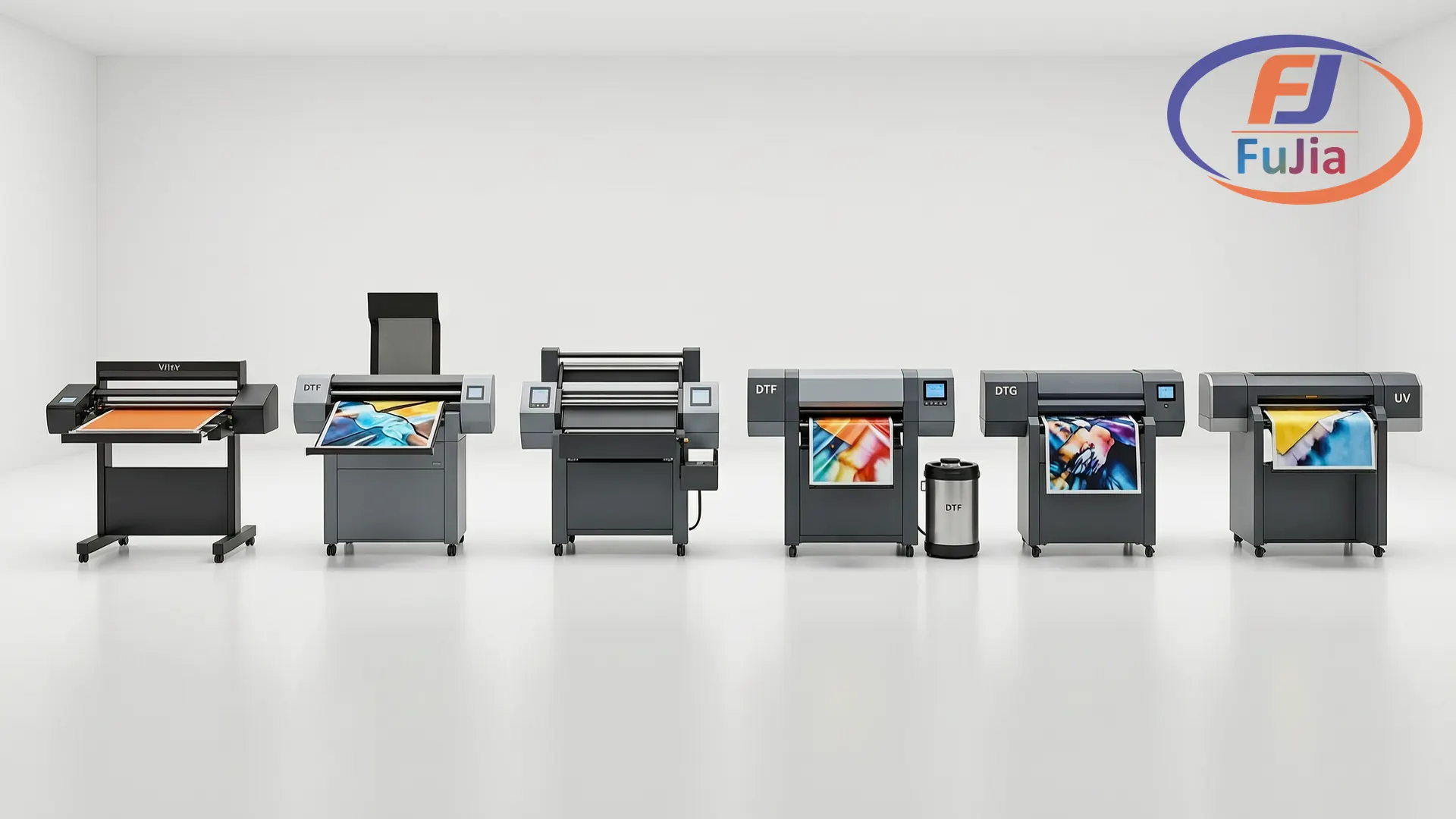
At a Glance: All 6 Methods Compared
Before diving into each method, here’s the overview table most guides skip. These numbers reflect real-world costs for a small business setup in 2026.
| Method | Startup Cost | Per-Print Cost | Best Order Size | Fabric Compatibility | Print Feel | Durability | Speed (1-10) |
|---|---|---|---|---|---|---|---|
| ——– | ————- | —————- | —————– | ——————— | ———— | ———— | ————– |
| DTF | $2,000-$15,000 | $0.50-$1.80 + shirt | 1-200 pcs | Cotton, polyester, blends, nylon, leather | Slight texture | 50-60+ washes | 7 |
| DTG | $8,000-$25,000 | $1.00-$3.00 + shirt | 1-50 pcs | Cotton best; blends OK | Soft, no feel | 40-50+ washes | 5 |
| Screen Printing | $500-$50,000 | $0.30-$1.00 + shirt | 50-5,000+ pcs | Cotton best; polyester OK | Soft (plastisol) or no feel (water-based) | 50-100+ washes | 10 (at volume) |
| Sublimation | $500-$3,000 | $0.50-$1.50 + shirt | 1-100 pcs | Polyester ONLY (light colors) | Zero feel (dye bonds) | Permanent (fades before cracking) | 6 |
| HTV (Vinyl) | $300-$1,000 | $1.00-$3.00 + vinyl + shirt | 1-20 pcs | Cotton, polyester, blends | Raised texture | 40-50+ washes | 3 |
| UV DTF | $3,000-$12,000 | $0.80-$2.50 + item | 1-100 pcs | Any hard surface, fabric, leather | Raised 3D effect | 30-50+ washes | 5 |

DTF (Direct to Film) Printing
DTF prints your design onto a PET film, applies hot melt powder, cures it, then heat-presses the result onto the garment. The process works on practically any fabric, which is why small shops are switching to DTF faster than any other method — industry data shows DTF adoption grew 45% among small businesses in 2022 alone.
How it works in four steps: 1. Printer lays CMYK + white ink onto PET transfer film 2. Hot melt powder is applied to the wet ink and shaken off the non-printed areas 3. The film passes through a curing oven (or tunnel) to melt the powder into an adhesive layer 4. The finished transfer is heat-pressed onto the garment at 160°C/320°F for 15-20 seconds, then cold-peeled
Equipment you need:
- DTF printer (A3 minimum, with white ink circulation)
- Powder shaker and curing oven (or all-in-one unit)
- Heat press
- RIP software
Real costs for a small business: A complete A3 DTF setup runs $2,600-$5,500 for entry-to-mid-range. Each A3 sheet of consumables costs $0.57-$1.21 in ink, film, and powder combined. On a Gildan 5000 blank at $3.50, your total cost per shirt lands between $4.07 and $4.71. Selling at $20, that’s a 76-80% gross margin.
The full breakdown on startup costs, per-print economics, and machine recommendations is in our dedicated DTF printer buyer’s guide. If you’re new to DTF entirely, start with our DTF printer introduction guide.
When DTF wins:
- You print on mixed fabrics (cotton one order, polyester the next, nylon after that)
- Order sizes vary from 1 to 200 pieces
- You need photorealistic full-color prints without minimum-order headaches
- You want one machine that handles 90% of what customers ask for
When DTF loses:
- 500+ identical shirts (screen printing is cheaper per unit at scale)
- You need the softest possible hand feel (DTF has a slight texture)
- You’re doing simple one-color text (vinyl is faster and cheaper)
DTG (Direct to Garment) Printing
DTG prints ink directly onto the fabric, like an inkjet printer for T-shirts. The machine sprays CMYK + white ink through printheads onto the garment sitting on a platen.
How it works: 1. Pre-treat the garment with a bonding solution (required for dark fabrics) 2. Load the shirt onto the DTG printer platen 3. The printer lays down a white underbase first, then CMYK on top 4. Heat-press or conveyor-dry to cure the ink
Equipment you need:
- DTG printer (single platen: $8,000-$15,000; dual platen: $15,000-$25,000+)
- Pre-treatment machine or spray station ($500-$1,500)
- Heat press or conveyor dryer
- RIP software
Real costs: DTG ink costs run $0.30-$0.60 per print for light garments and $0.80-$1.50 for dark garments (because of the white underbase). Pre-treatment solution adds $0.20-$0.40 per dark shirt. Total consumable cost: roughly $1.00-$2.00 per print before factoring the shirt cost.
The real DTG pain point isn’t the ink cost. It’s maintenance. DTG printheads clog if the machine sits idle for more than a day. Budget $50-$100/month just in cleaning fluid and head flushes if you’re not printing daily.
When DTG wins:
- You’re printing 5-15 garments per day, mostly cotton, mostly complex full-color designs
- Hand feel matters more than versatility (DTG is softer than DTF)
- You’re a print-on-demand shop where each order is a different design
When DTG loses:
- Your order volume varies wildly (idle machines clog)
- You print on polyester, blends, or anything not cotton-heavy
- You need to print on non-garment items (bags, caps, shoes)
- Startup budget is under $8,000
Screen Printing
Screen printing pushes ink through a mesh stencil onto the garment. Each color requires a separate screen, which means setup time scales with design complexity.
How it works: 1. Create a screen for each color in the design (emulsion coating, exposure, washout) 2. Mix ink colors for the job 3. Load shirt onto the press platen 4. Pull/push the squeegee, forcing ink through the screen mesh onto the fabric 5. Flash-cure between colors, final cure in a conveyor dryer
Equipment you need:
- Screen printing press (manual 4-color: $300-$1,500; automatic multi-station: $15,000-$50,000+)
- Exposure unit for burning screens ($200-$1,500)
- Flash cure unit ($200-$800)
- Conveyor dryer ($1,500-$5,000)
- Washout booth and screen reclaiming supplies
Real costs: Per-print consumable cost is the lowest of any method: $0.15-$0.40 per print on a one-color design, $0.30-$0.80 for 4-6 colors. But screen setup costs $15-$25 per screen in emulsion, film positives, and labor. Those setup costs get amortized across the order — doing the math for 100 shirts with a 4-color design: $80 in screen setup + $40 in ink = $1.20 per shirt in printing consumables. At 500 shirts, that drops to $0.28 per shirt.
When screen printing wins:
- 50+ identical shirts (the breakeven point where unit cost drops below DTF)
- Simple 1-3 color designs on cotton
- Spot color accuracy is critical (Pantone matching)
- You want the absolute lowest unit cost at scale
When screen printing loses:
- Under 50 pieces per design (setup costs eat your margin)
- Full-color photographs or gradients (requires expensive simulated process or CMYK separations)
- Mixed fabric types in one order
- You don’t have space for a washout booth, dryer, and screen storage
Sublimation Printing
Sublimation uses heat to turn solid dye into a gas that bonds permanently into polyester fibers. The result is a zero-texture print that won’t crack, peel, or fade. The trade-off: it only works on polyester and polyester-coated surfaces, and only on white or light-colored substrates.
How it works: 1. Print your design onto sublimation transfer paper using sublimation ink 2. Position the paper on the polyester garment or coated blank 3. Heat-press at 200°C/390°F for 45-60 seconds 4. The dye gasifies and bonds into the polyester fibers
Equipment you need:
- Sublimation printer (converted Epson EcoTank or dedicated model: $300-$800)
- Sublimation ink (CMYK only, no white — $80-$150 per 4-color set)
- Sublimation transfer paper
- Heat press (flat press for shirts, mug press for drinkware)
- Polyester blanks (shirts, mugs, phone cases, mouse pads — all must be poly-coated)
Real costs: Consumables per A4 print run $0.50-$0.80. But you must factor in substrate costs: sublimation blanks are more expensive than standard cotton shirts. A polyester performance tee costs $6-$10 vs $3-$5 for cotton. And sublimation paper and ink are consumables on top.
When sublimation wins:
- All-over prints (the only method that seamlessly covers an entire garment)
- Polyester sportswear and performance apparel
- Hard goods (mugs, phone cases, puzzles, metal panels)
- Photo-quality detail with zero hand feel
When sublimation loses:
- Cotton or cotton-blend garments (the dye won’t bond)
- Dark-colored substrates (white ink doesn’t exist in sublimation)
- Small batch same-day orders (press time is 45-60 seconds per item)
HTV (Heat Transfer Vinyl)
HTV uses a cutting machine to slice designs from colored vinyl sheets, which are then heat-pressed onto garments. It’s the simplest method, the cheapest to start, and the slowest per unit.
How it works: 1. Design in vector software (Silhouette Studio, Cricut Design Space, Illustrator) 2. Load vinyl sheet into the cutting machine 3. Weed away excess vinyl, leaving only the design 4. Position on the garment and heat-press at 150-160°C/300-320°F for 10-15 seconds 5. Peel the carrier sheet (hot or cold, depending on vinyl type)
Equipment you need:
- Vinyl cutter (Cricut: $200-$400; Silhouette: $200-$500; commercial Graphtec/Roland: $1,500-$5,000)
- Heat press ($200-$600)
- Vinyl sheets ($2-$8 per 12″x12″ sheet, depending on type and brand)
- Weeding tools
Real costs: Vinyl costs $2-$8 per sheet for specialty types (glitter, holographic, reflective) and $1-$3 for basic colors. A typical chest logo uses about half a sheet. Plus weeding time: 2-10 minutes per design depending on complexity.
HTV has the lowest equipment cost but the highest per-unit labor cost. At $20/shirt selling price with $2 vinyl + $3.50 shirt + 5 minutes of labor at $20/hour ($1.67 labor cost), your cost is $7.17 per shirt with a 64% margin. At 50 shirts, DTF pulls ahead on labor alone.
When HTV wins:
- Names, numbers, and single-color team uniforms (a heat press and vinyl cutter are the standard setup)
- Startup budget under $500
- Glitter, metallic, reflective, and puff effects (vinyl does textures no other method matches)
- Hobby and craft-level production
When HTV loses:
- Multi-color or photorealistic designs (layering vinyl is a nightmare)
- More than 10-15 shirts per order (weeding time kills you)
- Small text or fine details (weeding tiny pieces is tedious and error-prone)
UV DTF Printing (The Emerging Option)
UV DTF is a newer hybrid that combines UV-curable ink with a transfer process. It prints onto a PET film like DTF, but uses UV-LED curing instead of powder and heat. The result is a raised, glossy 3D print that bonds to hard surfaces as well as fabric.
This method is still maturing, but it’s carving out a niche where neither traditional DTF nor UV flatbed printing fits: high-detail raised prints on objects like phone cases, water bottles, leather goods, and premium packaging.
Equipment you need:
- UV DTF printer (A3 entry-level: $3,000-$6,000; 24″ production: $8,000-$12,000)
- UV-curable ink set (CMYK + white + varnish)
- UV transfer film (specially coated for UV ink release)
- Laminator (for applying the B-film protective layer)
When UV DTF currently makes sense:
- You sell premium branded merchandise (the 3D gloss look commands higher pricing)
- You print on hard goods, not just fabric
- Your market values visual impact over cost-per-unit
If you’re comparing UV DTF to standard DTF or UV flatbed printing in detail, we covered those differences in our UV DTF vs UV flatbed comparison guide. For a broader look at UV equipment economics, our UV printing costs breakdown covers the real numbers.
Which Method Should You Choose? A Decision Framework
Stop reading here if you want the one-sentence answer. Otherwise, work through these three questions:
Question 1: What’s your typical order size?
| Order Size | Best Method | Why |
|---|---|---|
| ———— | ————- | —– |
| 1-20 pieces | DTF or HTV | Low setup, any design, any fabric |
| 20-200 pieces | DTF | Best balance of speed, cost, and versatility |
| 50-500 pieces | Screen printing (if design is simple) or DTF (if design is complex) | Screen wins on unit cost; DTF wins on flexibility |
| 500+ pieces | Screen printing | Unit cost drops to $0.15-0.30 per print |
Question 2: What fabrics are you printing on?
| Fabric | Best Method(s) | Avoid |
|---|---|---|
| ——– | ————— | ——- |
| 100% Cotton | All methods work | None |
| Polyester / Performance | Sublimation (if white/light) or DTF | DTG (poor adhesion), Screen printing (needs special ink) |
| Cotton/Poly Blends | DTF | Sublimation (only bonds to poly portion) |
| Nylon / Leather | DTF | Sublimation, DTG |
| Hard goods (mugs, metal) | Sublimation or UV DTF | DTG, screen printing |
Question 3: What’s your startup budget?
| Budget | What You Can Get | Recommended Method |
|---|---|---|
| ——– | —————– | ——————- |
| Under $1,000 | Vinyl cutter + heat press | HTV (single-color) |
| $2,000-$4,000 | Complete A3 DTF system or sublimation setup | DTF (most versatile) or Sublimation (if polyester-only) |
| $5,000-$10,000 | Mid-range DTF with i3200 printhead or entry DTG | DTF (production-grade) |
| $10,000-$25,000 | DTG printer or automatic screen press | Depends on volume — see Question 1 |
| $25,000+ | Multi-method shop | Combine DTF + screen printing for maximum flexibility |
Equipment Investment: Startup Cost by Method
Here are the actual numbers to get printing tomorrow, including everything you need to produce your first sellable shirt:
| Method | Printer | Press | Curing | RIP/Software | Consumables | Workspace | TOTAL |
|---|---|---|---|---|---|---|---|
| ——– | ——— | ——- | ——– | ————- | ————- | ———– | ———– |
| DTF | $2,000-$5,500 | $400-$600 | $150-$900 | $200-$500 | $400-$600 | $100-$250 | $3,250-$8,350 |
| DTG | $8,000-$15,000 | $600-$1,200 | $500-$1,500 | $500-$1,000 | $500-$800 | $300-$500 | $10,400-$19,000 |
| Screen | $300-$1,500 | Flash: $200-$800 | Dryer: $1,500-$5,000 | N/A | $200-$500 | $500-$1,500 | $2,700-$9,300 |
| Sublimation | $300-$800 | $400-$600 | Built into press | N/A | $200-$400 | $100-$200 | $1,000-$2,000 |
| HTV | $200-$500 | $200-$600 | Built into press | Vector software: free-$60/mo | $100-$200 | $50-$100 | $550-$1,460 |
| UV DTF | $3,000-$8,000 | $400-$600 | UV-LED built in | $200-$500 | $400-$700 | $100-$250 | $4,100-$10,050 |
Screen printing equipment cost variance is enormous because it scales from a single-station manual press in a garage to a 12-station automatic with IR dryer. The low end ($2,700) is realistic for a one-person manual operation. For a deeper look at how DTF compares to UV printing specifically, our UV vs UV DTF guide covers the numbers in detail.
This per-method cost data aligns with published startup cost breakdowns from print shop operators, adjusted for 2026 equipment pricing.
The Numbers That Matter: Real Cost Per Shirt
Here’s the math that determines your margins. Based on a Gildan 5000 blank ($3.50) sold at $20:
| Method | Consumables | Labor (per shirt) | Total Cost | Gross Profit | Margin |
|---|---|---|---|---|---|
| ——– | ————- | ——————- | ———— | ————- | ——– |
| DTF (single sheet) | $1.34 | $0.50 | $5.34 | $14.66 | 73% |
| DTF (nested/ganged) | $0.89 | $0.50 | $4.89 | $15.11 | 76% |
| DTG (dark shirt) | $1.50 | $0.40 | $5.40 | $14.60 | 73% |
| Screen (50 pcs, 4-color) | $1.20 | $0.30 | $5.00 | $15.00 | 75% |
| Screen (500 pcs, 4-color) | $0.28 | $0.15 | $3.93 | $16.07 | 80% |
| Sublimation | $0.65 | $0.50 | $10.65* | $9.35 | 47%* |
| HTV (single-color text) | $2.00 | $1.67 | $7.17 | $12.83 | 64% |
*Sublimation total cost includes a $6.50 polyester performance tee instead of the $3.50 cotton blank.
The headline: DTF delivers the highest margin for small-to-medium runs. Screen printing wins at scale. Sublimation margins look low on paper but the end product commands a higher selling price (performance apparel retails at $25-35 vs $20 for cotton tees).
FAQ
Q: What is the best T-shirt printing machine for a startup in 2026?
For most startups, an A3 DTF printer in the $2,000-$3,500 range (complete system with shaker and oven) is the best single-machine investment. It prints on any fabric, handles orders from 1 to 200 pieces efficiently, and delivers the highest margin for mixed-volume shops. If your niche is exclusively polyester sportswear, buy a sublimation setup instead. If you’re only doing simple team uniforms with names and numbers, buy a vinyl cutter and heat press.
Q: DTF vs screen printing: which is more cost-effective?
At 50 or fewer shirts, DTF is always cheaper per unit because screen printing has $15-25 per screen setup costs. At 100-500 shirts depends on design complexity: simple 1-2 color designs favor screen printing; full-color photos favor DTF. At 500+, screen printing’s unit cost drops below DTF in almost all cases.
Q: Can I use one machine for multiple printing methods?
A DTF printer is the closest to a swiss army knife. It prints transfers for cotton, polyester, blends, nylon, leather, and hard goods. A heat press works for DTF, HTV, and sublimation. But a DTG printer only does DTG, and a screen printing press only does screen printing. If you can only afford one printing device, buy a DTF printer and a heat press.
Q: What’s the difference between DTF and sublimation?
DTF uses ink + powder on a transfer film that bonds to the surface of any fabric. Sublimation uses dye that gasifies and bonds into polyester fibers at a molecular level. DTF works on any material; sublimation only works on polyester and poly-coated surfaces. DTF has a slight texture; sublimation has zero texture. DTF can print white; sublimation cannot. DTF is more versatile; sublimation produces a superior result — on polyester only.
Q: How long do these printing methods last on a shirt?
Screen printing 50-100+ washes. DTF 50-60+ washes. DTG 40-50+ washes. HTV 40-50+ washes. Sublimation is permanent: the print fades only when the fabric itself degrades. The real variable is not the printing method but the cure: properly cured ink/powder/vinyl outlasts poorly cured by a factor of 2-3x, according to durability testing from print shops.
Q: Which method has the lowest startup cost?
HTV with a hobby-grade vinyl cutter and heat press: $550-$800 total. Sublimation is next at $1,000-$2,000. But lowest startup cost doesn’t mean best business decision. HTV’s labor cost limits you to roughly 5-10 shirts per hour per person. A $2,600 DTF setup produces 15-25 shirts per hour. If you value your time at $20/hour, the DTF setup pays for itself in labor savings within 200 hours of operation.
Our factory builds DTF printers for small businesses and production shops. Send us your design and get a free sample print, or request a quote for a complete setup with training included.
Last updated: June 2026. Equipment pricing reflects publicly available data and factory-direct quotes. Individual supplier pricing may vary.
Related Reading
Factory-Direct Printing Equipment – Talk to the Source
Fujia Print manufactures DTF and UV printers in Guangzhou. Not a trading company, not a middleman. One supplier for your printer, consumables, and after-sales. Factory-direct pricing, in-house R&D, real support that answers the phone.
