

Key Takeaways
- UV DTF printers transfer designs via AB film onto curved and irregular surfaces — ideal for phone cases, cups, and giftware — with equipment starting at $300.
- UV Flatbed printers print directly onto rigid flat materials — signs, plaques, panels — with superior durability and multi-layer effects starting at $5,000.
- UV DTF produces a glossy, single-layer finish on almost any shape. UV Flatbed delivers matte/gloss control, 5-15 layer stacking, and braille-grade Z-axis depth.
- The two technologies are complementary, not competing. Most growing print businesses eventually run both.
- A combined setup covering UV DTF for curved items + UV Flatbed for flat production gives you the widest product range at the lowest total equipment cost.
You sell custom-printed products. Someone asks for branded phone cases — UV DTF handles the curves. Someone else wants engraved-effect plaques — UV Flatbed handles the depth. Same ink technology, completely different production logic.
If you pick the wrong one for your product mix, you end up with a machine that collects dust. Pick the right one — or both — and you open categories your competitors cannot touch.
We make both types of printers at our Guangzhou factory — UV DTF and UV Flatbed printers — so we are not here to sell you one over the other. This is a straight comparison with real numbers.

What Is a UV DTF Printer?
UV DTF (Direct-to-Film) printing uses a two-film transfer process. Your design prints onto a special A film (release paper) in reverse order: adhesive layer first, then white underbase, then CMYK color, topped with varnish. After UV LED curing, a B film (transfer film) is laminated on top. The finished “crystal label” transfer can be stored, shipped, or applied immediately.
To apply, you peel the A film, position the transfer on the target object, press firmly, then peel the B film. The design stays on the object — a glossy, durable print that conforms to curved surfaces.
The UV DTF process stands out for one reason: it prints on shapes a flatbed cannot physically reach. Phone cases with raised edges, tapered water bottles, hexagonal jars, golf balls — if the object is irregular, UV DTF is almost always the answer.
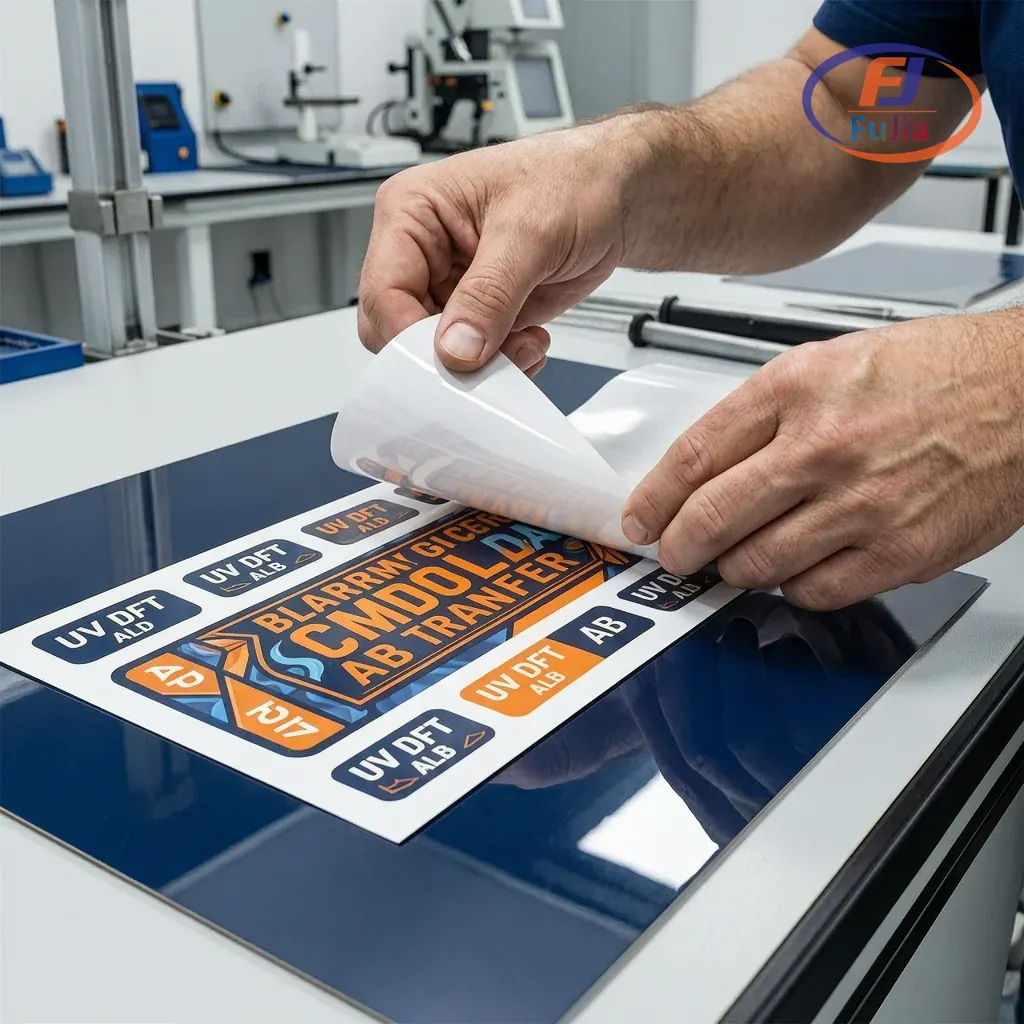
Typical UV DTF Applications
- Phone cases and tablet covers
- Drinkware: cups, mugs, tumblers, water bottles
- Giftware: keychains, ornaments, awards
- Cosmetic packaging: lipstick tubes, compact cases
- Promotional products: pens, USBs, irregular-shaped giveaways
- Glass and ceramic decoration
UV DTF Equipment Costs
| Tier | Price | Capability |
|---|---|---|
| Entry-level A3 | $300–$1,500 | Hobbyist, sample production |
| Mid-range A2/A1 | $2,000–$5,000 | Small business, Etsy sellers |
| Industrial roll-fed | $8,000–$15,000 | High-volume transfer production |
Consumable cost per A4 transfer: roughly $0.50–$2.00 depending on ink coverage and film quality. Finished transfers sell for $3.00–$8.00 in most markets, generating 60-80% gross margins for in-house production (DTF Database).
What Is a UV Flatbed Printer?
A UV Flatbed printer prints directly onto the substrate — no transfer film, no lamination step. The object sits on a flat vacuum bed. The printhead carriage moves across it, jetting UV-curable ink that cures instantly under LED lamps positioned next to the printheads. When the carriage finishes a pass, the ink is already dry.
This direct-cure mechanism enables capabilities no transfer method can match: multi-layer stacking (5–15 passes on the same area for raised textures), gloss-matte contrast (separate varnish layer applied selectively), and printing on substrates up to several inches thick.
The limitation: the object must be flat or nearly flat. Cylindrical items need a rotary attachment, and even then only uniform cylinders work — no tapers, no handles, no irregular curves.
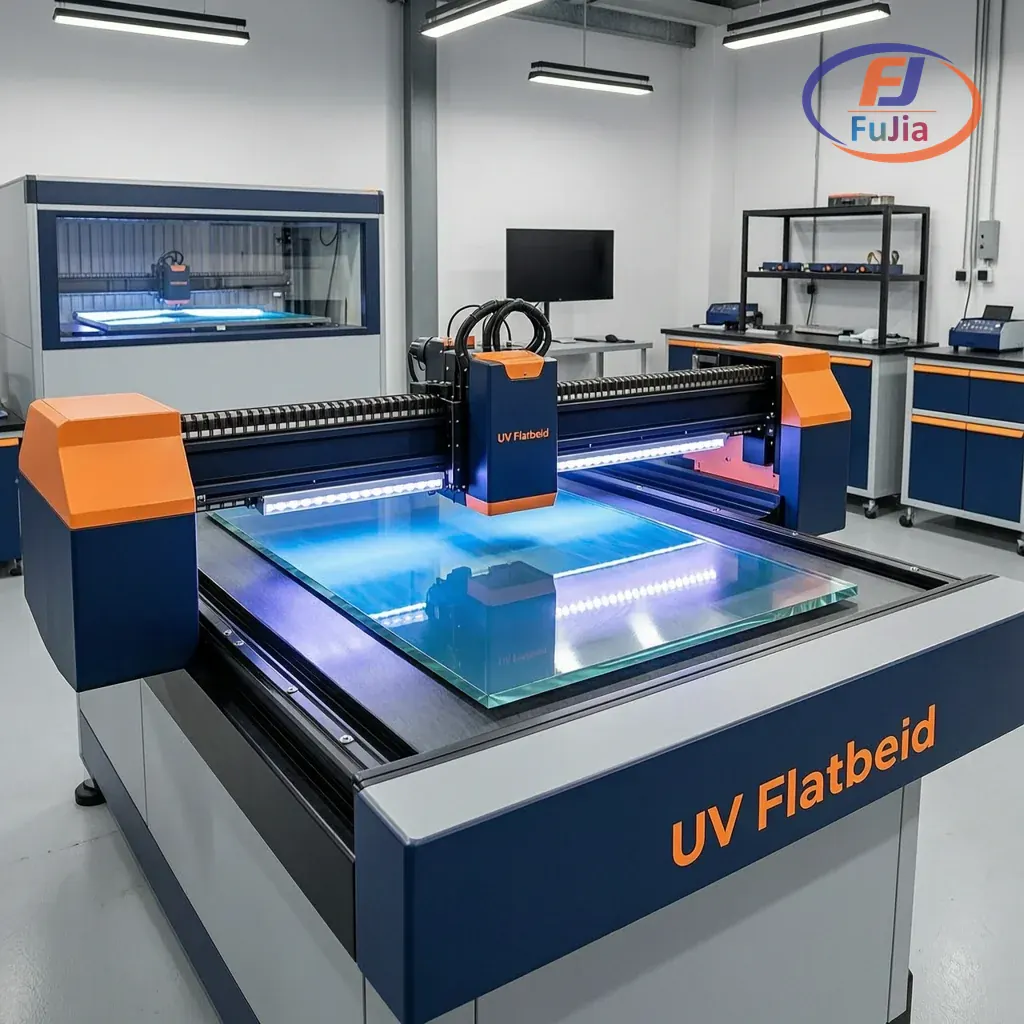
Typical UV Flatbed Applications
- Signage and displays: acrylic, PVC, aluminum composite
- Awards and plaques: wood, glass, metal
- Branded packaging: rigid boxes, point-of-sale displays
- Industrial labeling: control panels, nameplates
- Custom tiles and home décor
UV Flatbed Equipment Costs
| Tier | Price | Bed Size | Best For |
|---|---|---|---|
| Desktop (A3/A2) | $5,000–$12,000 | 30×40cm | Small items, samples |
| Mid-size (6040/6090) | $12,000–$25,000 | 60×40cm / 60×90cm | Print shops, signage |
| Industrial (9060+) | $25,000–$80,000+ | 90×60cm+ | High-volume production |
Most small-to-medium print businesses find the sweet spot in the 6090 model range ($12,000–$25,000), which balances bed size with investment (Dowin Digital).
Side-by-Side Comparison
| Factor | UV DTF | UV Flatbed |
|---|---|---|
| Equipment cost | $300–$15,000 | $5,000–$80,000+ |
| Per-print consumables | $0.50–$2.00 (A4, including AB film) | $0.15–$0.80 (ink only) |
| Print process | Indirect: print → laminate → transfer | Direct: print on substrate, instant cure |
| Surface types | Curved, irregular, textured, cylindrical | Flat or near-flat only |
| Layer stacking | Single layer only | 5–15 layers, raised texture, braille |
| Default finish | Glossy only | Matte (controllable gloss via varnish) |
| Durability | Good (depends on substrate bond) | Excellent (ink chemically bonds to surface) |
| Outdoor UV resistance | Medium (adhesive layer degrades first) | High (ink directly cured into substrate) |
| Production logic | Batch — pre-print transfers, apply later | Sequential — one item at a time on bed |
| Learning curve | Shorter (2-4 weeks) | Longer (4-8 weeks, more variables) |
Sources: DTF Database, Dowin Digital
When to Choose UV DTF
Choose UV DTF if any of these describe your business:
- Your products are curved or irregular. Phone cases, cups, cosmetic containers, golf accessories — if the surface is not flat, UV DTF is your answer.
- You serve small-batch, high-variety orders. Print 10 transfers today, 50 tomorrow, each with a different design. No bed loading/unloading between items.
- You want to test the market with low upfront cost. An entry-level UV DTF setup costs under $2,000 all-in.
- Your customers are promotional product distributors. Logo-branded items across dozens of SKUs — cups, pens, keychains, USBs — all handled by one printing method.
- You sell finished transfers, not printed goods. UV DTF crystal labels can be produced in bulk, packaged, and shipped to end users who apply them with nothing more than hand pressure.

When to Choose UV Flatbed
- You print flat, rigid items at volume. Signs, plaques, panels, tiles, packaging — the output is ready to ship the moment it comes off the bed.
- You need multi-layer effects. Raised text, braille signage, textured logos, spot gloss over matte backgrounds — these require Z-axis stacking only a flatbed can deliver.
- Durability is non-negotiable. Outdoor signs, industrial labels, architectural panels — UV Flatbed ink bonds directly to the substrate and outlasts any adhesive-based transfer.
- Your per-unit margins depend on eliminating consumables. Flatbed ink and substrate are your only costs. No AB film, no lamination step, no transfer waste.
- You already have consistent orders for flat products. If 80% of your revenue comes from flat items, a flatbed is the right primary machine.
The Smart Strategy: Run Both
Here is what successful print shops do in 2026:
Invest in both technologies — staggered over time. Start with whichever machine matches 80% of your current orders. Once that machine is profitable (typically 6-12 months), add the other.
A combined setup — entry-level UV DTF ($2,000) + mid-size UV Flatbed 6090 ($15,000) — costs under $20,000 total and lets you say “yes” to virtually any custom-printed product inquiry:
| Customer asks for… | You use… |
|---|---|
| Branded phone cases (curved) | UV DTF |
| Acrylic award plaques | UV Flatbed |
| Custom water bottles | UV DTF |
| Point-of-sale display panels | UV Flatbed |
| Cosmetic compact cases | UV DTF |
| Industrial control panel labels | UV Flatbed |
No single printing technology covers all of these. Two machines under $20,000 do. The combination is what separates a limited print shop from a full-service production partner that never turns down an order.
Common Mistakes to Avoid
- Buying a flatbed for curved products. Someone buys a $15,000 flatbed, then discovers their main product (phone cases with raised edges) cannot sit flat on the bed. If curved items are your core business, start with UV DTF.
- Buying UV DTF for outdoor signage. UV DTF transfers rely on an adhesive bond. On rough or outdoor-exposed surfaces, the adhesive degrades. If the product lives outdoors, use a flatbed.
- Underestimating the flatbed learning curve. Budget 4-8 weeks of trial and error before production-grade output. UV DTF is more forgiving — 2-4 weeks to dial in.
- Ignoring ventilation requirements. UV-curable inks release mild fumes during curing. Budget for proper extraction in any production space.
FAQ
Q: Can UV DTF print on textiles or fabric?
A: No. UV DTF transfers do not bond well to fabric fibers. The adhesive-backed film sits on the surface rather than penetrating fibers, and it cracks when stretched or washed. For textiles, use regular (water-based) DTF printing, not UV DTF.
Q: How long do UV DTF transfers last?
A: On smooth, non-porous surfaces like glass, ceramic, and coated metal, UV DTF transfers can last 2-5+ years indoors with normal handling. Outdoor exposure and rough surfaces shorten lifespan significantly compared to UV Flatbed direct prints.
Q: Can I print white ink with both technologies?
A: Yes. Both UV DTF and UV Flatbed printers include white ink channels. UV DTF uses white as an underbase layer for opacity on transparent or dark surfaces. UV Flatbed can print white as a base layer or as a standalone color on dark substrates.
Q: Which has lower operating costs per print?
A: UV Flatbed has lower consumable cost per print ($0.15-$0.80 in ink only) because it eliminates AB film ($0.20-$0.60 per sheet). However, flatbed equipment amortization is much higher. For low-to-medium volumes, UV DTF often has a lower total cost of ownership despite higher per-print consumables (DTF Database).
Q: Do I need special training to operate these printers?
A: UV DTF: basic graphic design skills + 2-4 weeks of hands-on practice. UV Flatbed: graphic design + RIP software proficiency + 4-8 weeks of practice including material testing. Both benefit from manufacturer training, and most reputable suppliers include it with purchase.
Q: What is the typical print resolution?
A: 720×720 DPI to 1440×1440 DPI for production mode on both technologies, using Epson i3200 or equivalent printheads. 720×720 DPI is the standard for most commercial work on both platforms.
Q: Can UV DTF and UV Flatbed share the same inks?
A: Partially. Both use UV-curable inks, but UV DTF requires specific formulation for AB film adhesion and flexibility on curved surfaces. Some manufacturers offer compatible ink sets that work across both platforms, but always verify with the ink supplier before mixing.
Which UV Printer Should You Get?
If you print curved and irregular objects — phone cases, drinkware, cosmetic packaging, promotional gifts — get a UV DTF printer. The low entry cost ($2,000-$5,000 for a capable setup) makes it a low-risk way to start or expand.
If you print flat, rigid products — signs, plaques, panels, packaging — get a UV Flatbed. The higher upfront investment ($12,000-$25,000 for a 6090) pays back through lower per-unit costs and higher throughput on flat production.
If your product range spans both categories — and most growing print businesses eventually get there — plan to run both. The combined capability means you never turn down an order because of surface shape.
We manufacture both UV DTF and UV Flatbed printers. Contact us — tell us what you want to print, we will recommend the right machine and send you a free test print on your actual product.
Related Reading
Factory-Direct Printing Equipment – Talk to the Source
Fujia Print manufactures DTF and UV printers in Guangzhou. Not a trading company, not a middleman. One supplier for your printer, consumables, and after-sales. Factory-direct pricing, in-house R&D, real support that answers the phone.
