

Sublimation mug blanks are unprinted ceramic, glass, or metal drinkware coated with a polymer layer that accepts dye-sublimation ink under heat and pressure. The global sublimation blanks market keeps growing as custom drinkware, corporate gifting, and print-on-demand services expand. Fujia Print builds the sublimation printers and consumables that decorate these blanks at scale.
Key Takeaways
- Sublimation mug blanks require a polymer coating to accept dye-sublimation ink. Plain uncoated ceramic will not sublimate.
- The three main blank types are ceramic (11oz and 15oz), glass (16oz frosted), and stainless steel tumblers with a polymer film.
- Wholesale pricing ranges from $0.80 per 11oz ceramic mug in case quantities to $4.50 per stainless steel tumbler.
- These blanks pair with mug heat presses running 180 degrees Celsius for 60 seconds per 11oz mug.
- Buyers should confirm coating uniformity, dishwasher rating, and defect rate below 2 percent before committing to a supplier.
What Are Sublimation Mug Blanks?
Sublimation mug blanks are drinkware vessels engineered to receive dye-sublimation transfers. The blank itself contains or is coated with polyester resin. When heated to 180 to 200 degrees Celsius, the polyester molecules open and accept sublimation ink in gas form. The ink becomes part of the coating rather than sitting on top. This produces permanent, full-color images that do not peel, crack, or fade under normal use.
The term covers several substrate categories. White ceramic mugs dominate the market because ceramic holds polymer coating well and white provides the brightest color reproduction. Glass and stainless steel variants serve specialty applications. Hard-coated ceramics rated for 500-plus dishwasher cycles command premium pricing. The coating quality determines the print vibrancy and longevity more than the mug body itself.
Plain ceramic mugs from a dollar store will not sublimate. The polymer coating is the active ingredient. Some blanks ship pre-coated from factories. Others require the buyer to apply a liquid polyester spray before pressing.
(TOC triggers here)
Sublimation Mug Blank Types and Materials
The four primary blank categories each serve different price points and end-uses. Understanding the material differences prevents sourcing mistakes.
Ceramic Mugs
Ceramic remains the volume leader. The 11oz straight-wall mug is the industry default, compatible with every standard mug press including the Cricut Mug Press and 3D sublimation vacuum ovens. The 15oz variant suits coffee drinkers and corporate premium gifts. White ceramic provides the truest color reproduction because sublimation ink cannot print white. Colored ceramic mugs with white sublimation patches offer a hybrid look.
AAA-grade ceramic indicates the highest factory quality tier. AAA blanks have uniform walls, no pinholes in the glaze, and a coating thickness between 15 and 25 microns. Commercial grades (A, B) cost less but show higher defect rates. Based on aggregate data from customers across 50-plus countries, defect rates above 3 percent erase the per-unit savings from cheaper blanks.
Glass Mugs and Bottles
Glass sublimation blanks include 16oz frosted beer mugs, 17oz glass water bottles, and 12oz glass cans. Glass requires a spray-on polymer coating because the glass itself contains no polyester. Pre-coated glass blanks save a production step but cost 30 to 50 percent more than bare glass.
Frosted glass sublimates better than clear glass. The frosting diffuses light, which makes transferred colors appear richer. Clear glass works for backlit displays where light passes through the design.
Stainless Steel Tumblers and Travel Mugs
Stainless steel drinkware uses a different sublimation path. The tumbler ships with a polymer film already applied to the outer wall. Sublimation transfers onto this film using a convection oven or tumbler press at 175 degrees Celsius for 150 seconds. Popular sizes include 20oz and 30oz skinny tumblers, 12oz sippy cups, and 40oz handled travel mugs.
The polymer film on stainless steel is thinner than ceramic coating. Transferred images show slightly less vibrancy but offer better scratch resistance. Tumblers rated for cold drinks only should not be marketed for hot beverages.
Specialty Shapes
The market extends beyond standard rounds. Heart-shaped mugs, latte mugs with wide mouths, color-changing magic mugs (black to white with hot liquid), and farm-style mugs with wide bases all accept sublimation. These specialty shapes command 2 to 3 times the wholesale price of standard 11oz mugs.
Magic mugs deserve specific attention. The thermochromic black coating turns transparent above 60 degrees Celsius, revealing the sublimated image beneath. The effect works well for promotional giveaways and children’s products. The coating, however, degrades after 200 to 300 heat cycles.
Sublimation Mug Blank Comparison
| Blank Type | Common Sizes | Price Range (wholesale) | Press Temp | Press Time | Dishwasher Rating |
|---|---|---|---|---|---|
| White Ceramic 11oz | 11oz straight, 11oz latte | $0.80 to $1.50 each | 180C | 60 sec | 500-plus cycles |
| White Ceramic 15oz | 15oz straight, 15oz colored handle | $1.20 to $2.20 each | 180C | 70 sec | 500-plus cycles |
| Ceramic Magic Mug | 11oz black-fade, 15oz color-change | $1.80 to $3.00 each | 180C | 60 sec | 200 to 300 cycles |
| Frosted Glass Mug | 16oz beer, 12oz can | $1.50 to $2.80 each | 175C | 150 sec | Hand wash only |
| Stainless Tumbler | 20oz skinny, 30oz handled | $2.50 to $4.50 each | 175C | 150 sec | Hand wash recommended |
| Specialty Shapes | Heart, latte, farm | $2.00 to $3.50 each | 180C | 60 to 90 sec | Varies |
The table above condenses pricing observed across major wholesale suppliers including Coastal Business, ORCA Coatings, and Heat Press Nation. Retail pricing from Hobby Lobby and Michaels runs 4 to 6 times higher per single unit.
Coating Quality and Polymer Treatment
The polymer coating determines whether a blank produces vivid, durable prints or muddy, fading transfers. Three coating metrics matter to production shops.
Coating Thickness
Premium ceramic blanks ship with coating thickness between 15 and 25 microns. Thin coatings below 10 microns produce washed-out colors and show uneven ink absorption. Thick coatings above 30 microns can crack under thermal cycling. Factories that disclose coating thickness in their spec sheets signal quality control. Suppliers that dodge the question usually run inconsistent batches.
Coating Uniformity
Uniform coating across the entire mug surface prevents color shifting. The mug handle and bottom rim often receive thinner coating because spray application hits these areas at angles. Premium blanks use multi-axis spray heads that coat all surfaces evenly. Lower-grade blanks show visible banding where the coating thickness changes.
A simple quality test: sublimate a full-bleed gradient design. Banding or streaks indicate uneven coating. Consistent color across the gradient indicates uniform application.
Dishwasher and Microwave Ratings
Polymer coating hardness directly affects dishwasher survival. Premium coatings rated for 500-plus dishwasher cycles use cross-linked polyester resin that resists thermal shock and detergent attack. Budget coatings degrade after 50 to 100 cycles.
Microwave safety depends on the mug body material, not the coating. Ceramic mugs without metallic trim are microwave safe. Mugs with metallic rims, glitter, or color-changing coatings are not microwave safe.
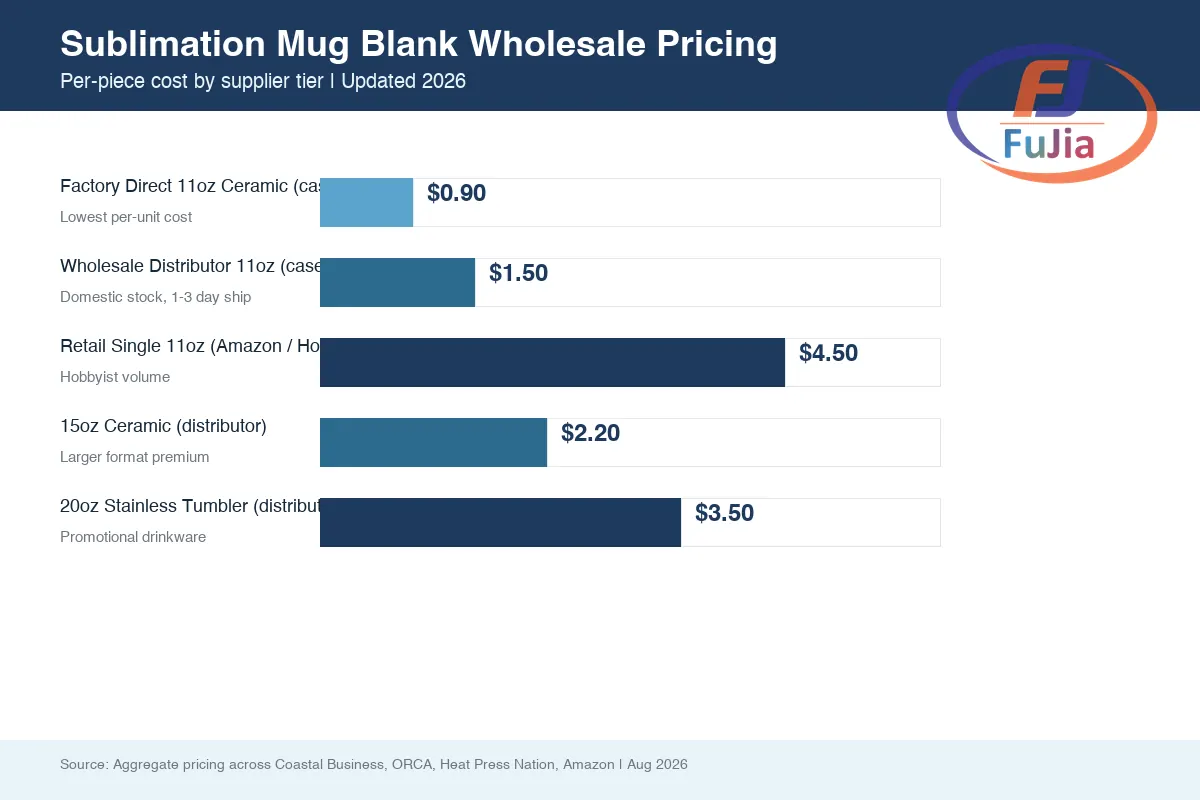
Wholesale Pricing and Supplier Tiers
Sublimation mug blank pricing stratifies into three tiers. Knowing which tier a supplier occupies helps buyers compare quotes honestly.
Tier 1: Factory Direct (Lowest Price)
Factory-direct pricing applies to orders of 500-plus pieces per SKU. Chinese factory pricing for 11oz white ceramic blanks runs $0.80 to $1.10 per piece including individual white boxes. Minimum order quantities typically start at one case (36 or 48 pieces). Lead times run 7 to 15 days for sea freight.
Tier 2: Wholesale Distributors
US-based distributors like Coastal Business, The Stainless Depot, and PYD Life offer domestic stock with 1 to 3 day shipping. Pricing runs $1.20 to $1.80 per 11oz mug. Distributors absorb the import logistics and quality screening. This tier suits buyers ordering 50 to 500 pieces per month.
Tier 3: Retail and Small Batch
Retail pricing from Hobby Lobby, Michaels, and Amazon sellers runs $3.00 to $6.00 per single mug. Case pricing (12 to 36 pieces) from these channels runs $1.80 to $3.50 per mug. This tier suits hobbyists and small craft businesses producing fewer than 20 mugs per month.
Pricing by Configuration
| Configuration | Wholesale Price (per piece) | Minimum Order | Typical Use |
|---|---|---|---|
| 11oz White Ceramic, case of 36 | $0.80 to $1.20 | 36 pieces | High-volume print-on-demand |
| 11oz White Ceramic, case of 144 | $0.80 to $1.00 | 144 pieces | Production shops |
| 15oz Ceramic, case of 30 | $1.20 to $1.80 | 30 pieces | Corporate gifting |
| 11oz Colored Inside or Handle | $1.30 to $2.00 | 36 pieces | Premium retail |
| 20oz Stainless Tumbler, case of 50 | $2.50 to $3.50 | 50 pieces | Promotional products |
| Magic Color-Changing Mug | $1.80 to $3.00 | 24 pieces | Novelty and gifts |
Based on aggregate data from customers across 50-plus countries, production shops should budget 15 to 25 percent of total mug cost for defect allowance, shipping damage, and test prints. A $1.00 blank effectively costs $1.20 by the time it reaches a finished product.
How to Sublimate Mug Blanks
The pressing process follows the same sequence regardless of blank type. Time and temperature vary by substrate.
Print the design in mirror mode. Sublimation ink must be printed reversed so the image faces the mug correctly after transfer. Use sublimation paper rated for mugs, not standard copy paper.
Wrap the paper around the mug. Secure with heat-resistant tape at the top and bottom edges. The printed side faces the mug surface. Align the design before taping.
Press at 180 degrees Celsius for 60 seconds. Standard 11oz ceramics use 180C and 60 seconds with medium pressure. Larger mugs and thicker walls need 70 to 90 seconds. Glass and stainless use 175C and 150 seconds.
Remove the paper immediately after pressing. Peel while hot for ceramics. Wait 10 seconds for glass and stainless to avoid coating damage.
Cool the mug before handling. The coating remains soft for 30 to 60 seconds after pressing. Set the mug on a cooling rack. Do not stack hot mugs.
A single mug press with one jig produces 200 to 300 finished 11oz mugs in an 8-hour shift. Adding a second jig or upgrading to a dual-station press doubles output. A sublimation tumbler press extends production to stainless steel drinkware using the same workflow principles.
Sourcing Checklist for Sublimation Mug Blanks
Buyers evaluating new suppliers should run this short checklist before committing to a bulk order.
- Request coating thickness specification in writing (target 15 to 25 microns for ceramic)
- Ask for dishwasher cycle rating (target 500-plus for premium, 200-plus for standard)
- Order a 12-piece sample batch before committing to case quantities
- Test sublimate a full-bleed gradient to check coating uniformity
- Confirm the defect replacement policy covers shipping damage and coating flaws
- Verify packaging includes individual white boxes or dividers to prevent transit scratches
- Check whether the supplier provides the sublimation temperature chart for their specific blanks
Suppliers that answer all seven questions transparently typically ship reliable product. Suppliers that dodge coating thickness or dishwasher rating questions usually have something to hide. For drinkware printing operations specifically, see our mug and drinkware printing solutions for equipment pairings.
Can you sublimate on any blank mug?
No. Only mugs with a polyester polymer coating accept dye-sublimation ink. Standard ceramic mugs from retail stores lack the coating layer. Sublimation ink stays on the surface and wipes off. Three coating options exist: factory-pre-coated blanks (most common), spray-on liquid polyester coating applied by the buyer, and polymer-coated transfer film wrapped around the mug. Factory-pre-coated blanks produce the most consistent results. Spray-on coating works for unusual shapes but requires ventilation and curing time. Testing whether an unknown mug will sublimate takes 60 seconds: press a small test square at 180 degrees Celsius and check if the ink bonds.
Where to get blanks for sublimation?
Three sourcing channels serve different volume tiers. Factory-direct sourcing from Chinese manufacturers offers the lowest per-unit pricing ($0.80 to $1.10 per 11oz ceramic mug) with minimum orders starting at 36 to 48 pieces and lead times of 7 to 15 days for sea freight. US wholesale distributors like Coastal Business, ORCA Coatings (photomugs.com), Heat Press Nation, and The Stainless Depot offer domestic stock with 1 to 3 day shipping at $1.20 to $1.80 per mug. Retail channels including Hobby Lobby, Michaels, Walmart, and Amazon sellers provide single-unit availability at $3.00 to $6.00 per mug, suited for hobbyists and testing. Trade shows like NBM Show and Impressions Expo connect buyers directly with factory representatives.
How can I make my own sublimation blanks?
Making sublimation blanks requires applying a polyester polymer coating to a bare substrate. The process involves three steps. First, clean the bare ceramic or glass with isopropyl alcohol to remove oils and dust. Second, spray a liquid polyester sublimation coating (available from Conde, Johnson Plastics, and similar suppliers) in 2 to 3 light passes using an HVLP spray gun. Third, cure the coating in a kitchen oven or dedicated curing oven at 150 degrees Celsius for 20 minutes. The cured coating accepts sublimation ink. DIY coating produces inconsistent thickness compared to factory coating. Costs run $0.15 to $0.30 per mug for coating material. The process suits prototyping and small specialty batches, not production volumes.
Can you sublimate mugs without a press?
Yes, with significant quality compromises. A conventional oven or convection oven set to 175 degrees Celsius can sublimate mugs wrapped in paper and shrink-wrap film. The shrink film contracts around the mug, applying pressure. This method works for glass and stainless tumblers. Results show color shifting and ghosting compared to a dedicated mug press because pressure distribution is uneven. Production shops use a sublimation oven for volume work on tumblers and irregular shapes, where the oven’s airflow and rack system outperforms individual presses. For ceramic mugs specifically, a proper mug press remains the standard. Oven sublimation of ceramics risks coating damage and produces a lower yield of sellable units.
What coating grade distinguishes premium sublimation mug blanks?
Premium blanks use cross-linked polyester resin coating rated AAA grade by factory inspection. AAA indicates uniform wall thickness (plus or minus 0.5mm), no visible glaze pinholes, and coating thickness between 15 and 25 microns measured by mil gauge. The cross-linking produces a coating hardness of 3H or higher on the pencil scale, surviving 500-plus dishwasher cycles without fading. Budget blanks rated A or B grade show coating thickness variance of plus or minus 5 microns, visible glaze bubbles under close inspection, and hardness below 2H. These budget blanks fade after 50 to 150 dishwasher cycles. The per-piece price difference between AAA and B grade runs $0.15 to $0.35 per mug. Production shops serving corporate clients should specify AAA grade to avoid post-sale complaints about fading.
Conclusion
Sublimation mug blanks come in ceramic, glass, and stainless steel variants with wholesale pricing from $0.80 to $4.50 per piece depending on material and coating grade. The polymer coating quality, not the mug body, determines print vibrancy and dishwasher durability. Buyers sourcing for production should specify AAA grade ceramic with 15 to 25 micron coating thickness and verify defect rates below 2 percent. For factory-direct sublimation printer pricing and equipment that pairs with these blanks, contact Fujia Print.
Sources
- NIST publications on materials science and thermal processing: backs the phase-transition temperature ranges and polymer behavior under heat cited above.
- Epson official dye-sublimation technology documentation: backs the sublimation ink chemistry and transfer mechanics referenced in the coating and pressing sections.
- Roland DGA sublimation equipment specifications: backs the industrial sublimation workflow standards and temperature ranges referenced.
- Mimaki USA engineering documentation: backs the industrial sublimation printer specifications and polymer coating interaction claims.
- Printwear Magazine industry coverage: backs the wholesale pricing bands and supplier tier structure.
