

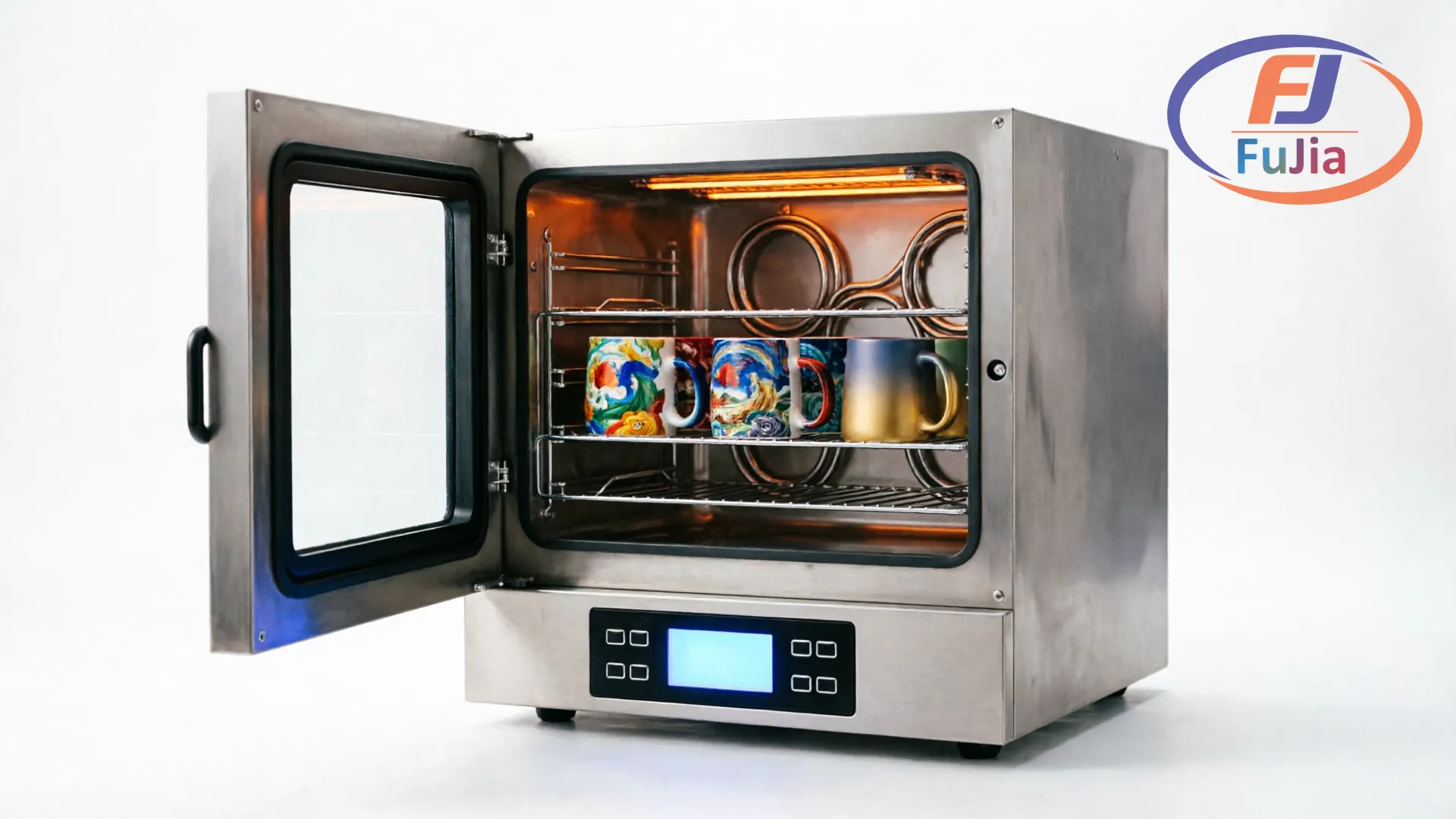
A sublimation oven is a convection-style oven designed specifically for dye-sublimation transfer onto 3D objects like mugs, tumblers, water bottles, and ceramics. Unlike a mug press that applies flat heat and pressure to one surface, a sublimation oven uses 360-degree hot air circulation to wrap sublimation ink around curved and irregular shapes. For businesses producing custom drinkware, a sublimation oven is the most efficient way to batch-print multiple items simultaneously.
Key Takeaways
- A sublimation oven uses 360-degree convection heating to transfer dye onto curved objects — mugs, tumblers, bottles, plates, and more
- Typical settings: 350°F–400°F (175°C–200°C) for 12–18 minutes depending on substrate
- Batch capacity ranges from 4–12 items per cycle, making ovens far more productive than single-item mug presses
- Dedicated sublimation ovens ($150–$500) outperform kitchen convection ovens ($80–$200) in temperature precision and consistency
- Sublimation ovens handle irregular shapes that mug presses cannot — tapered tumblers, water bottles, pens, and ceramic plates
What Is a Sublimation Oven?
A sublimation oven is a specialized convection oven engineered for dye-sublimation heat transfer. Standard convection ovens circulate hot air for cooking, but sublimation ovens add features critical for consistent ink transfer: precise temperature control (within 5°F), uniform 360-degree air circulation, timers calibrated for sublimation timeframes, and insulated chambers that maintain stable internal temperatures.
The sublimation process works by heating solid dye particles until they vaporize (sublime) and bond with polyester-coated surfaces. According to the Science History Institute’s explanation of dye sublimation, the phase transition from solid directly to gas occurs at specific temperatures depending on the dye formulation. For 3D objects, this requires surrounding the entire item with even heat — something a flat heat press or mug press cannot achieve. Sublimation ovens solve this by using top and bottom heating elements plus a rear fan that creates a vortex of hot air inside the chamber.
Objects prepared for oven sublimation are wrapped with sublimation paper (printed design facing the substrate), secured with heat-resistant tape, then encased in either a shrink-wrap film or a silicone wrap. This wrapping creates the pressure needed for ink transfer — the oven provides heat, and the wrap provides pressure. This two-component system is what makes oven sublimation fundamentally different from press-based sublimation. The Sublimation Council of SGIA provides industry standards for heat transfer processes.
How Sublimation Ovens Work
The oven sublimation workflow has six steps:
- Print design on sublimation paper using sublimation ink and a compatible printer
- Wrap the substrate — position the printed paper against the polyester-coated surface, secure with heat tape, then encase in shrink film or a silicone wrap
- Load the oven — place wrapped items on the rack with adequate spacing for airflow
- Set temperature and time — typically 350°F–400°F for 12–18 minutes depending on the substrate
- Bake — the oven’s convection fan circulates hot air evenly around all items
- Remove and cool — carefully remove hot items with gloves, peel the paper, and let cool
The shrink film or silicone wrap tightens as it heats, applying consistent pressure across the entire surface of the object. This pressure is essential — without it, sublimation dye would vaporize and dissipate without bonding to the substrate. The quality of the wrap directly affects print quality; wrinkles or gaps in the film produce ghosting or incomplete transfers.
Temperature and Time Settings by Substrate
Different substrates require different temperature and time combinations. Higher temperatures and longer times produce more complete dye transfer but risk scorching. The table below covers the most common oven sublimation substrates:
| Substrate | Temperature | Time | Notes |
|---|---|---|---|
| 11 oz ceramic mug | 360°F (182°C) | 15 min | Most common drinkware item |
| 15 oz ceramic mug | 365°F (185°C) | 15 min | Slightly thicker ceramic |
| 20 oz stainless tumbler | 365°F (185°C) | 12–15 min | Use silicone wrap for even pressure |
| 30 oz stainless tumbler | 375°F (190°C) | 15–18 min | Larger surface area needs more time |
| Water bottle (400–600 ml) | 375°F (190°C) | 15 min | Ensure shrink film covers full print area |
| Ceramic plate | 400°F (200°C) | 12–15 min | Use plate-specific silicone wrap |
| Ceramic tile | 400°F (200°C) | 12 min | Flat items work in ovens or flat presses |
| Oven mitts / textiles | 365°F (185°C) | 8–10 min | Must be polyester or poly-rich fabric |
These settings serve as starting points. Always test with your specific substrates and adjust based on results. Altitude, oven calibration, and substrate coating quality all affect optimal parameters. For a comprehensive guide on sublimation temperature and pressure across all methods, see our sublimation temperature chart.
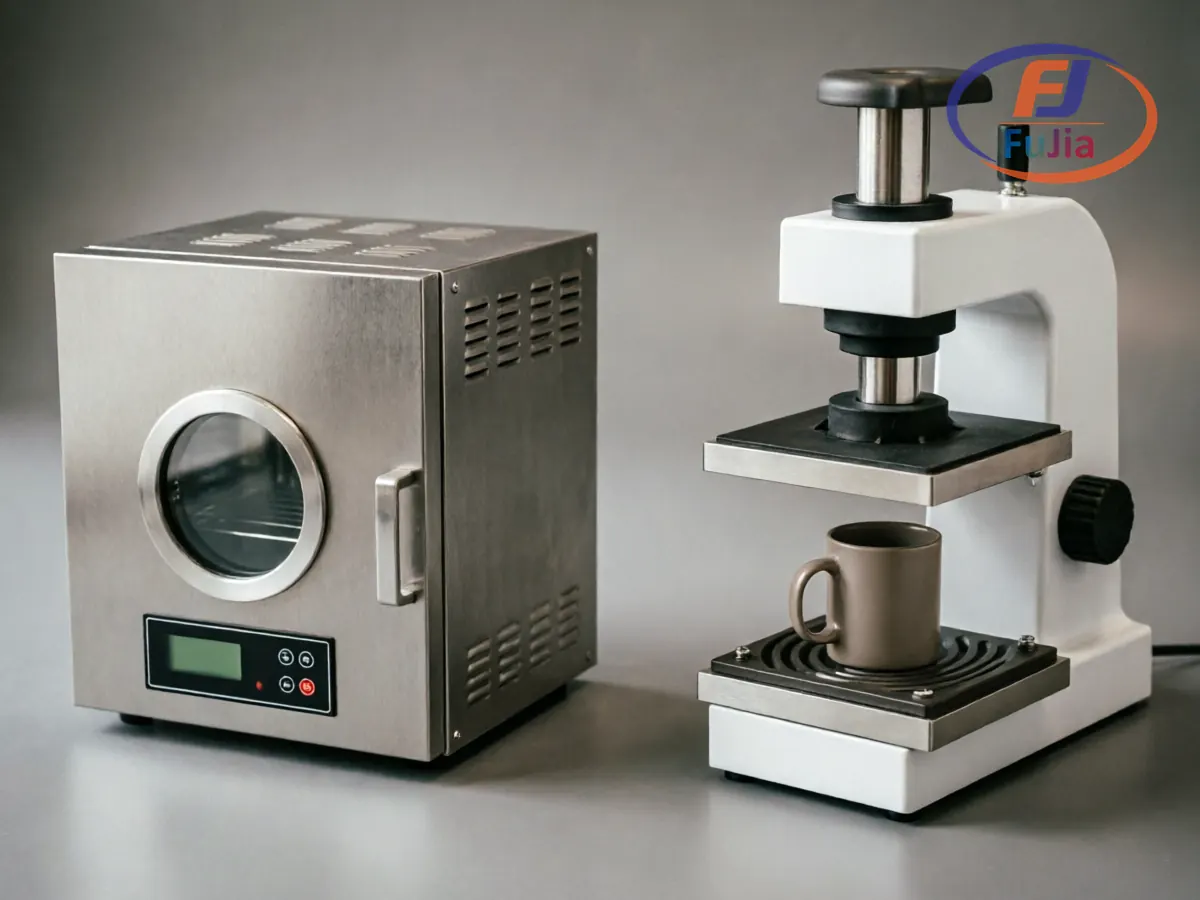
Sublimation Oven vs Mug Press: Which Is Better?
The choice between a sublimation oven and a mug press is one of the most common decisions for drinkware businesses. Each tool has distinct advantages:
| Feature | Sublimation Oven | Mug Press |
|---|---|---|
| Batch capacity | 4–12 items per cycle | 1 item per cycle |
| Cycle time | 12–18 min (all items simultaneously) | 3–5 min per item |
| Throughput per hour | 20–48 items | 12–20 items |
| Shape compatibility | Mugs, tumblers, bottles, plates, pens | Standard mugs and straight tumblers only |
| Tapered item support | Excellent (wrap conforms to shape) | Limited (heating element must match taper) |
| Full-wrap printing | Yes (360-degree coverage) | No (typically one side at a time) |
| Pressure control | Via shrink film/silicone wrap tightness | Direct mechanical pressure |
| Learning curve | Moderate (wrap technique matters) | Low (clamp and press) |
| Equipment cost | $150–$500 | $100–$300 |
| Best for | High-volume drinkware, irregular shapes | Low-volume standard mugs, beginners |
Mug presses win on simplicity and per-item speed for standard cylindrical mugs. Sublimation ovens win on throughput, shape versatility, and full-wrap capability. For businesses producing more than 20 mugs per day or working with tumblers and bottles, the oven’s batch advantage is decisive.
Sublimation Oven vs Kitchen Convection Oven
A common question is whether a standard kitchen convection oven can serve as a sublimation oven. The short answer: it can work, but with significant compromises.
| Factor | Dedicated Sublimation Oven | Kitchen Convection Oven |
|---|---|---|
| Temperature accuracy | ±5°F (precise digital control) | ±15–25°F (inconsistent) |
| Heat distribution | Engineered for 360° uniformity | Hot spots common |
| Timer range | 1–60 min, sublimation-optimized | Designed for cooking timeframes |
| Safety for sublimation | Built for chemical vapors | Not designed for dye vapors |
| Food safety after use | Never use for food | Never use for food after sublimation |
| Price | $150–$500 | $80–$200 |
The most critical safety note: once an oven is used for sublimation, it must never be used for food preparation. Sublimation dye vapors deposit residue inside the oven chamber that is unsafe for consumption. The FDA’s guidance on food-safe equipment strongly discourages repurposing food-contact surfaces for chemical processes. This rule applies equally to dedicated sublimation ovens and kitchen ovens repurposed for crafting.
Dedicated sublimation ovens deliver superior print consistency because they maintain tighter temperature tolerances. A 10-degree fluctuation in a kitchen oven can produce noticeable color shifts between batches. For businesses where color consistency matters — branded merchandise, corporate orders, retail products — the precision of a dedicated oven justifies the investment.
Key Features to Look For
When choosing a sublimation oven, six specifications matter most:
1. Capacity (Liters or Quarts) Capacity determines batch size. A 20L oven fits 4–6 standard mugs; a 25L oven fits 6–8; a 32Qt (30L) oven fits 8–12. Consider your peak production volume and choose accordingly.
2. Temperature Range and Accuracy Look for ovens with a range of 140°F–450°F and digital controls that maintain ±5°F accuracy. Analog dial ovens are less consistent and produce variable results.
3. Heating Element Configuration Multiple heating tubes (top + bottom) with a rear convection fan produce the most uniform heat distribution. Single-element ovens create hot spots that cause uneven color transfer.
4. Timer Precision Sublimation requires exact timing. A digital timer with 1-minute increments is essential. Ovens with preset sublimation programs (e.g., one-touch 365°F for 15 minutes) simplify workflow for repeat jobs.
5. Build Quality and Insulation Double-wall insulation with tempered glass doors retains heat efficiently and keeps exterior surfaces safe to touch. Ceramic enamel interiors resist dye staining and simplify cleaning.
6. Included Accessories Many sublimation ovens ship with starter kits — shrink wrap rolls, heat tape, heat-resistant gloves, and silicone wraps. These accessories reduce initial setup costs, though you will need to replenish consumables over time.
Popular Sublimation Oven Models Compared
| Model | Capacity | Power | Temp Range | Key Feature | Approx. Price |
|---|---|---|---|---|---|
| PYD Life 25L | 25 L | 1600 W | 140–446°F | Ceramic enamel interior | $250–$350 |
| OMPERIO 32Qt | 30 L | 1800 W | 140–390°F | 360° air circulation system | $300–$450 |
| TaiyeHao 22L | 22 L | 1500 W | 140–390°F | 4 heating tubes (2 top, 2 bottom) | $200–$300 |
| OFFNOVA 20L | 20 L | 1250 W | 140–390°F | One-touch preset (365°F/15 min) | $180–$280 |
Prices are approximate retail ranges as of July 2026 and may vary by retailer and promotions.
For businesses scaling beyond desktop equipment, Fujia Print also offers industrial sublimation printers designed for roll-to-roll fabric sublimation at production volumes.
Frequently Asked Questions
Can you use a regular oven for sublimation?
A regular kitchen convection oven can physically reach the temperatures needed for sublimation (350°F–400°F), but it is not recommended for consistent production. Kitchen ovens have wider temperature fluctuations (±15–25°F compared to ±5°F in dedicated sublimation ovens), which causes color inconsistency between batches. Hot spots in kitchen ovens produce uneven transfers where some areas of the design appear darker or lighter. Additionally, once any oven has been used for sublimation, the dye vapor residue makes it permanently unsafe for food preparation. For hobbyists doing occasional crafts, a kitchen oven works adequately with an external thermometer for monitoring. For businesses requiring consistent, repeatable results, a dedicated sublimation oven is a necessary investment that pays for itself through reduced waste and higher quality output.
How long do you sublimate mugs in an oven?
Standard 11 oz ceramic mugs sublimate at 360°F (182°C) for approximately 15 minutes in a dedicated sublimation oven. Larger mugs (15 oz) may require the same temperature but benefit from 1–2 additional minutes. Stainless steel tumblers (20–30 oz) typically require 365°F–375°F for 12–18 minutes, with larger sizes needing more time for complete ink transfer. The exact time depends on several variables: oven calibration, substrate coating quality, shrink wrap tightness, and ambient temperature. Always run test batches when using new substrates or a new oven. The goal is the shortest time that produces full, vibrant color transfer — over-baking beyond the point of complete transfer does not improve quality and can scorch lighter substrates.
Is a sublimation oven better than a mug press?
A sublimation oven is better than a mug press for businesses that produce more than 20 drinkware items per day or work with varied shapes like tumblers, water bottles, and plates. The oven’s batch capacity (4–12 items per cycle versus 1 item per press cycle) makes it significantly more productive at volume. The oven also handles tapered and irregular shapes that mug presses cannot accommodate. A mug press is better for businesses producing fewer than 20 standard cylindrical mugs per day, where simplicity and low equipment cost matter more than throughput. Mug presses also produce slightly crisper results on flat surfaces because mechanical pressure is more controllable than wrap-based pressure. Many successful drinkware businesses own both: a mug press for single-item rush orders and an oven for batch production.
What temperature do you use for sublimation in an oven?
Sublimation oven temperatures range from 350°F to 400°F (175°C to 200°C) depending on the substrate. Ceramic mugs sublimate at 360°F (182°C), stainless tumblers at 365°F–375°F (185°C–190°C), ceramic plates at 400°F (200°C), and polyester fabric items at 365°F (185°C). The critical factor is not just reaching the target temperature but maintaining it consistently throughout the entire cycle. Temperature drops of even 10°F during baking produce visible color shifts. Preheating the oven for 5–10 minutes before loading items ensures the chamber is at full temperature when sublimation begins. Using an independent oven thermometer to verify the internal temperature is recommended, as built-in thermostats can drift by 5–10°F over time.
What can you sublimate in an oven besides mugs?
Sublimation ovens handle a wide range of 3D objects beyond ceramic mugs, including stainless steel tumblers, water bottles, ceramic plates, ceramic tiles, oven mitts, mouse pads, coasters, keychains, pens, and polyester-rich textiles. Any item with a polyester coating or polyester content can be sublimated. The key requirement is that the object fits inside the oven chamber with adequate air circulation space, and that a shrink wrap or silicone wrap can conform to its shape to provide even pressure. Irregular shapes like tapered tumblers, bullet-shaped bottles, and square coasters are where oven sublimation truly outperforms presses. The oven’s 360-degree heating wraps dye completely around curves, edges, and contours that a flat press or mug press simply cannot reach.
Conclusion
A sublimation oven unlocks 3D sublimation capabilities that flat presses cannot match — batch processing, full-wrap printing, and compatibility with irregular shapes. For drinkware businesses scaling beyond hobby volumes, the throughput and versatility advantages make a dedicated oven essential. For sublimation ink, paper, and blanks, contact Fujia Print for factory-direct consumables pricing.
