

A DTF printer and oven combo pairs an inkjet printer that lays CMYK plus white ink onto PET film with a curing oven that melts adhesive powder into the wet ink. Most buyers choose the combo over a standalone printer because the oven handles powder curing in a continuous pass rather than requiring a manual heat press step for each sheet. Fujia Print builds factory-direct DTF printer and shaker-oven lines that span A3 desktop through A1 four-head industrial widths.
Key Takeaways
- A DTF printer and oven combo bundles the inkjet printing stage with the powder-curing stage so one operator can run a full transfer line.
- Entry A4 bundles start near $1,399, mid-range A3 combos run $2,099 to $3,299, and industrial A1 shaker-oven lines reach $6,690 to $8,199.
- Curing ovens hold 120 to 160 degrees Celsius and fully melt powder adhesive in roughly 2 to 5 minutes.
- Buyers evaluating a dtf printer and oven should match print width, printhead type, and daily square-meter throughput before comparing price.
- Fujia Print’s A1 four-head line prints up to 27 square meters per hour at 4Pass and pairs with a 2,300-watt shaker-oven for continuous curing.
What Is a DTF Printer and Oven Combo?
A DTF printer and oven combo is a two-piece transfer production line. The printer deposits CMYK ink plus a white ink underbase onto PET film at resolutions up to 1440 by 1440 dpi on desktop models and 720 by 2400 dpi on industrial models, and the oven then cures the hot-melt adhesive powder at 140 to 160 degrees Celsius. The cured film is ready to be heat pressed onto cotton, polyester, blends, nylon, and leather substrates.
The oven serves one specific role: melt the powder so it bonds with the white ink layer. Without that melt step the powder stays granular and the transfer washes off within 5 to 10 laundry cycles. The oven replaces the older workaround of pressing each printed sheet under a heat press for 15 to 20 seconds just to gel the powder, a method that caps output near 180 sheets per hour once loading and unloading are included.
Combos ship in three layouts. A standalone oven sits beside the printer and the operator feeds each sheet manually. A shaker-and-oven unit adds an automated powder hopper and conveyor so powder, shake, and cure happen in one pass. An all-in-one machine integrates the printer, shaker, and oven into a single frame, which saves floor space at the cost of a higher purchase price.
How the Print-Cure Workflow Works
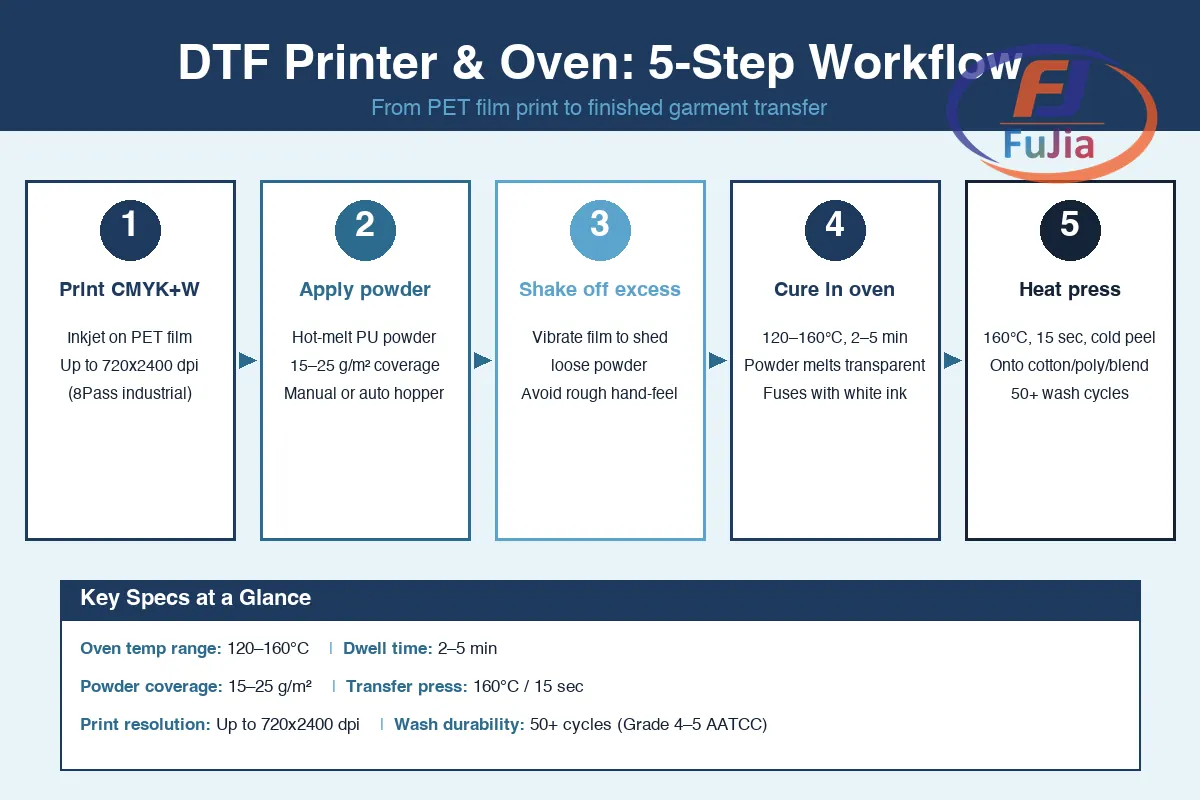
The dtf printer and oven workflow runs in five steps, and each step has a measurable parameter that determines transfer quality.
- Print CMYK plus white onto PET film. The printer lays color ink face-up on the film, then deposits a white ink layer on top that will become the visible backing after transfer. Print resolution on industrial machines reaches 720 by 2400 dpi at 8Pass.
- Apply adhesive powder. Hot-melt polyurethane powder is spread across the wet ink, either by hand for small batches or by an automated hopper on shaker-oven units. Powder consumption runs 15 to 25 grams per square meter of printed film.
- Remove excess powder. The shaker vibrates the film to shed loose powder that did not bond to wet ink. Leftover powder causes a rough hand feel and visible residue after transfer.
- Cure in the oven. The film passes through a heated chamber at 120 to 160 degrees Celsius for 2 to 5 minutes. The powder melts, turns transparent, and fuses with the white ink layer.
- Heat press onto the garment. The cured film is placed face-down on the fabric and pressed at 160 degrees Celsius for 15 seconds. Cold peel separates the PET carrier from the transferred ink.
The finished transfer survives 50 plus heavy machine washes when the curing and pressing parameters are held to spec. AATCC color fastness testing places properly cured DTF transfers at Grade 4 to Grade 5.
DTF Printer and Oven Combo Cost (2026 Prices)
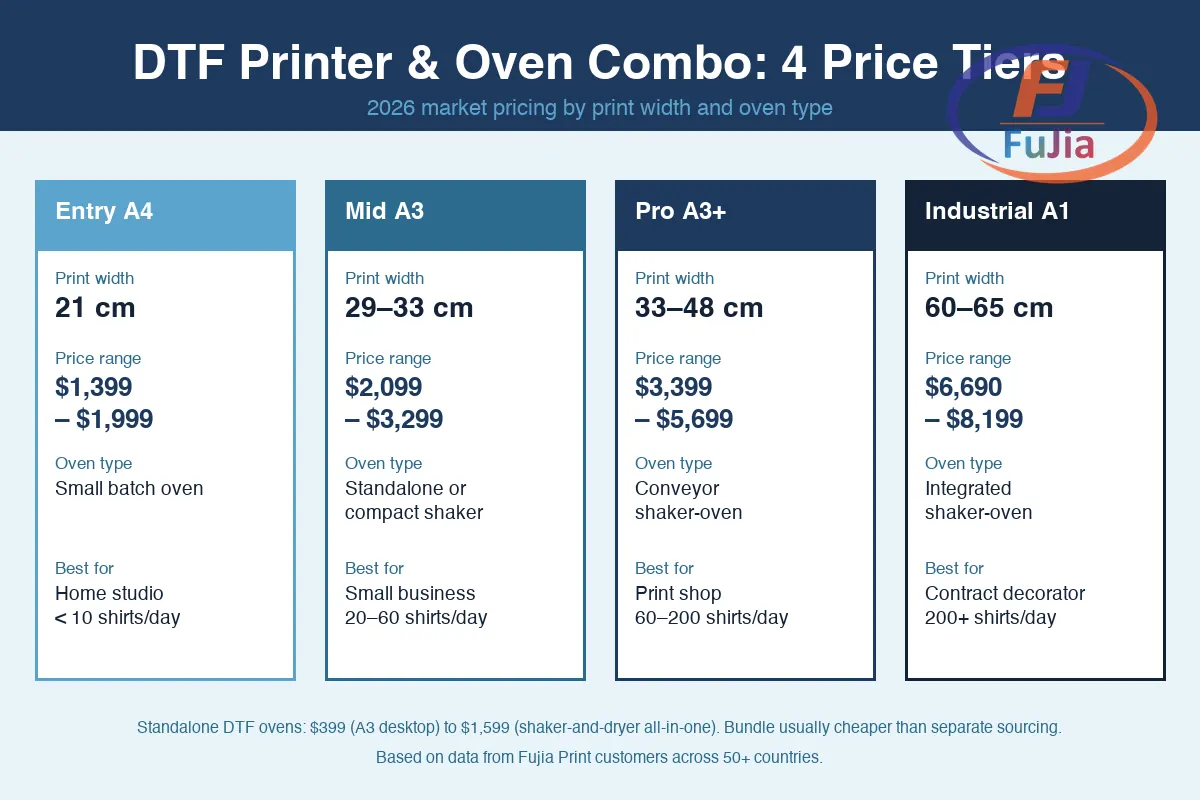
Combo pricing scales with print width, printhead count, and whether the oven is a standalone box or a conveyor-fed shaker-oven. The table below maps the current market across four tiers.
| Tier | Print width | Typical price | Oven type | Best for |
|---|---|---|---|---|
| Entry A4 | 21 cm | $1,399 to $1,999 | Small batch oven | Home studio, under 10 shirts per day |
| Mid A3 | 29 to 33 cm | $2,099 to $3,299 | Standalone or compact shaker-oven | Small business, 20 to 60 shirts per day |
| Pro A3 plus | 33 to 48 cm | $3,399 to $5,699 | Conveyor shaker-oven | Print shop, 60 to 200 shirts per day |
| Industrial A1 | 60 to 65 cm | $6,690 to $8,199 | Integrated shaker-oven | Contract decorator, 200 plus shirts per day |
Standalone DTF curing ovens sell separately from $399 for an A3 desktop model up to roughly $1,599 for a powder-shaker-and-dryer all-in-one. Buying the oven as part of a bundle usually costs less than sourcing printer and oven from two vendors, because the supplier pre-matches the conveyor speed to the printer output rate.
Based on data from our customers across 50+ countries, an in-house DTF transfer line reaches break-even at roughly 80 to 150 printed square meters per week. Below that volume the powder and film consumables cost eats into margin. Above that volume the line pays back the hardware investment in 3 to 8 months depending on local labor rates. Break-even points also vary by region: developed markets with higher labor costs see faster payback because each printed square meter carries more finished-goods margin.
What to Look for in a DTF Oven
The oven is the component that most often decides whether transfers stick or wash out. Five specs separate a reliable oven from a cheap one.
Temperature range and stability. The oven must hold 120 to 160 degrees Celsius with less than 5 degrees of drift. Powder adhesive melts fully at 130 degrees but reaches optimal bond strength closer to 150 to 160 degrees. Ovens with a single heating element often develop hot spots that over-cure one edge and under-cure the other.
Conveyor speed control. A shaker-oven with adjustable belt speed lets the operator tune dwell time to the powder load. Heavy ink coverage needs 4 to 5 minutes, light coverage cures in 2 minutes. Fixed-speed ovens force a single dwell time that wastes throughput on simple prints.
Filtration. Curing powder releases fumes and stray particles. Filtered ovens route exhaust through a replaceable filter cartridge. Unfiltered ovens vent directly into the workspace, which is a problem for operators running the line indoors.
Powder hopper capacity. Automated shaker-ovens carry 1 to 5 kilograms of powder in the hopper. A 1 kg hopper needs refilling every 40 to 60 square meters of film. Larger hoppers cut operator intervention on long runs.
Build weight and insulation. A well-insulated oven holds heat inside the chamber and stays cool on the exterior. Industrial shaker-oven units weigh 118 to 230 kilograms because the housing carries dense insulation. Lightweight ovens under 20 kg usually lack the thermal mass for stable curing.
Fujia Print Combo Specs
Fujia Print builds DTF printer and shaker-oven combos across three widths. Every machine uses a Honson mainboard, Leadshine servo motor, and THK silent guide rail as the transmission stack, which is a component combination competitors rarely name in their spec sheets.
| Model | Width | Printheads | Speed | Shaker-oven power |
|---|---|---|---|---|
| A3 DTF 1-Head (FJ-A30) | 30 cm | 1 Epson XP600 | 2 to 3 m²/hr | Compact oven |
| A1 DTF 2-Head | 65 cm | 2 Epson I3200 | 8 to 13 m²/hr @ 4Pass | 2,300 W |
| A1 DTF 4-Head | 65 cm | 4 Epson I3200 | 27 m²/hr @ 4Pass | 2,300 W |
The white ink system on every Fujia DTF printer uses an auto power-off circulation loop that prevents titanium dioxide from settling in the lines, including during a power outage. DTF transfers produced on these machines hold to Grade 4-5 AATCC color fastness and survive 50 plus wash cycles when pressed at 160 degrees Celsius for 15 seconds. For full lineup details, see the DTF printer lineup on our product page.
Fujia backs every printer with a 12-month warranty, 48-hour parts dispatch, and a 3-day remote onboarding sequence that covers hardware setup, RIP and ICC profiling, and the first production-grade print. If the workflow is primarily garment decoration, the apparel printing solutions page maps the right machine width to common product types. For more on the curing stage specifically, our DTF curing oven article breaks down temperature profiles in detail, and the DTF shaker machine article covers the powder application step.
Do I need a DTF oven if I already have a heat press?
A dedicated DTF curing oven is strongly recommended over using a heat press to melt powder, even though a heat press can technically gel the adhesive. A heat press cures one sheet at a time at roughly 15 to 20 seconds per press, which caps output at 180 to 240 sheets per hour in theory and far less in practice once loading and unloading are included. A conveyor shaker-oven cures film continuously as the printer feeds it, so throughput matches the printer rather than the press cycle. Heat presses also apply top-down pressure that can flatten the powder layer unevenly, leaving shiny spots and matte spots on the same transfer. Ovens use radiant and convective heat without contact, producing a uniform melt across the full print width. For anyone running more than 20 prints per day, the oven pays for itself within the first month of production.
What temperature should a DTF curing oven be set to?
Most DTF curing ovens run between 140 and 160 degrees Celsius, with 150 degrees being the most common target for standard hot-melt polyurethane powder. The powder begins to melt at roughly 130 degrees but needs the higher range to fully fuse with the white ink layer. Dwell time at 150 degrees is typically 2 to 3 minutes on a conveyor oven and 3 to 5 minutes in a batch oven. Setting the oven above 170 degrees risks over-curing, which makes the transferred film brittle and prone to cracking after 10 to 20 washes. Setting the temperature below 130 degrees leaves powder granular and the transfer will flake off the garment after the first wash. The correct setting depends on powder type, ink load, and film speed, so the best practice is to run a test strip and check whether the cured powder is fully transparent before starting a production run.
Can I buy the DTF printer and oven separately?
Yes, DTF printers and ovens are sold both as bundles and as standalone units, and mixing brands is common at the entry level. A standalone A3 DTF curing oven from HTVRONT sells for around $399, and a powder-shaker-and-dryer all-in-one runs closer to $1,599. The trade-off with mixing is that the operator must manually match conveyor speed to printer output and calibrate powder load to the ink coverage of each design. Bundles from a single supplier remove that calibration work because the vendor pre-tunes the two units to run together. The other consideration is warranty and support: a single supplier covers both machines under one policy, while two vendors can each point at the other when a transfer defect appears. For buyers prioritizing lowest upfront cost, separate purchase works. For buyers prioritizing uptime, a factory-direct bundle is the safer path.
How long does a DTF printer and oven combo last?
A well-maintained DTF printer and oven combo typically runs 5 to 8 years before major component replacement, with the oven usually outlasting the printer because the oven has fewer moving parts. The printhead is the most common replacement item on the printer side, with service life ranging from 6 to 18 months depending on ink volume and maintenance discipline. The heating elements and conveyor belt on the oven side typically last 3 to 5 years before needing service. Daily maintenance of 3 to 5 minutes, primarily wiping the capping station and running a nozzle check, is the single biggest factor in reaching the upper end of that lifespan. Fujia Print covers its printers with a 12-month warranty and ships common replacement parts within 48 hours, which keeps downtime measured in days rather than weeks.
Conclusion
A DTF printer and oven combo is the core of a self-contained transfer line, and the right choice comes down to matching print width, daily throughput, and oven curing capacity to the actual order volume. For factory-direct pricing on DTF printer and shaker-oven combos, contact Fujia Print.
Sources
- Textile printing overview: reference for DTF within the broader digital textile printing category.
- AATCC test methods: basis for the Grade 4-5 wash fastness and color fastness claims cited above.
- ISO 9001 quality management: standard under which Fujia Print’s 3,500 square meter Guangzhou factory operates.
