

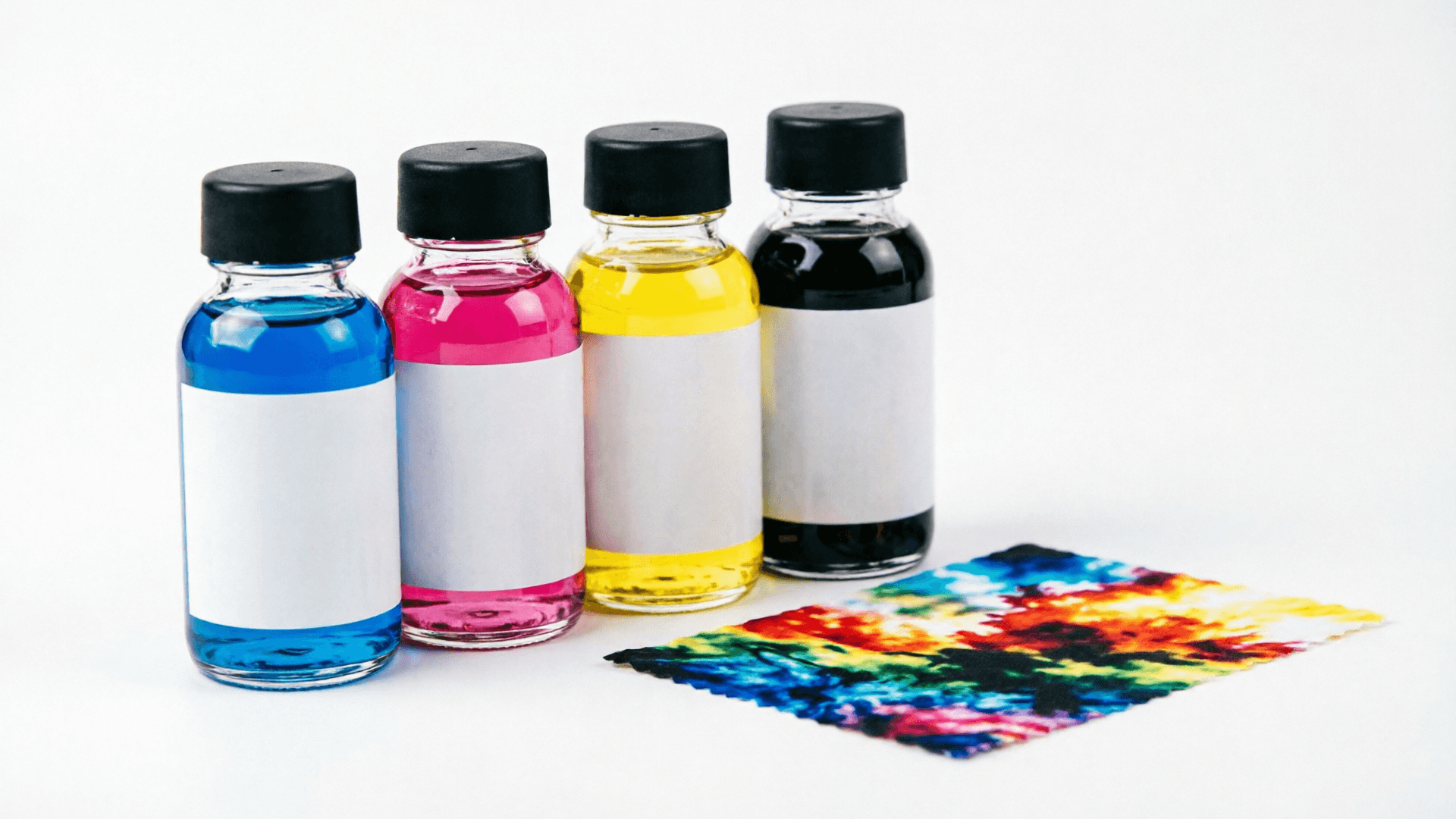
Sublimation ink is a specialized dye-based ink formulation containing disperse dye particles that sublimate — transform from solid to gas without passing through liquid — at temperatures between 175 and 215 degrees Celsius. When heated under pressure, the gaseous dye penetrates polyester polymer structures and bonds permanently upon cooling, producing full-color prints that do not crack, peel, or fade. The global dye sublimation inks market was valued at $950.75 million in 2025 and is projected to reach $1.85 billion by 2033, growing at a CAGR of 8.65%, according to Future Market Report.
Key Takeaways
- Sublimation ink uses disperse dye particles (0.2-2.0 microns) suspended in water or solvent carrier fluid
- Disperse dyes account for 68% of the global sublimation ink market by dye type
- Textile printing consumes 52.6% of all sublimation ink produced worldwide
- Price range: $30-$120 per liter depending on brand, type, and formulation
- Compatible printers: Epson Micro Piezo inkjet (EcoTank, SureColor), Sawgrass, and Brother models
- Required substrate: minimum 65% polyester for textiles; polymer-coated blanks for hard goods
- Asia-Pacific dominates production with 38.7% market share, led by China at 22.4%
What Is Sublimation Ink?
Sublimation ink is a liquid ink formulation designed for digital inkjet printing onto transfer paper, which is then heat-pressed onto polyester-based substrates. Unlike pigment inks that sit on the surface of materials, sublimation ink contains disperse dye molecules that chemically bond with polyester polymer chains at the molecular level.
The ink consists of three primary components:
| Component | Percentage | Function |
|---|---|---|
| Disperse dye particles | 5-15% | Provide color; sublimate at 175-215 degrees Celsius |
| Carrier fluid (water or solvent) | 70-85% | Suspends dye particles; delivers through printhead |
| Additives (surfactants, humectants, biocides) | 2-5% | Control viscosity, prevent drying, inhibit bacterial growth |
Sublimation ink is fundamentally different from other digital printing inks. Pigment inks use ground mineral particles that sit on the substrate surface. Dye-based aqueous inks dissolve colorant molecules in water that absorb into paper fibers. Solvent inks use petroleum-based carriers that evaporate. Sublimation ink alone combines the property of solid-to-gas phase transition with permanent polyester bonding, producing prints that outlast the substrate itself.
The International Organization for Standardization defines ISO 105-X10 as the standard test method for assessing color migration and sublimation fastness in dyed textiles, providing a benchmark for evaluating sublimation ink performance across different fabric types.
Sublimation Ink Types
Sublimation ink is categorized by carrier fluid type and dye formulation. The three primary types serve different printing applications and equipment.
| Ink Type | Carrier Fluid | Printhead Compatibility | Price per Liter | Best Application |
|---|---|---|---|---|
| Water-based | Deionized water | Epson Micro Piezo, Sawgrass | $30-80 | Textile transfer, soft signage |
| Solvent-based | Organic solvent | Industrial piezoelectric | $50-120 | High-speed roll-to-roll production |
| Eco-solvent | Bio-derived solvent | Selected industrial heads | $60-100 | Outdoor-durable applications |
Water-Based Sublimation Ink
Water-based sublimation ink is the most common type, accounting for the majority of global market volume due to its environmental profile and compatibility with desktop inkjet printers. The deionized water carrier evaporates during the transfer paper drying process, leaving solid dye particles on the paper surface ready for sublimation. Water-based ink is the standard formulation for Epson EcoTank conversions, Sawgrass Virtuoso printers, and most desktop sublimation setups.
Solvent-Based Sublimation Ink
Solvent-based sublimation ink uses organic solvents as the carrier fluid, enabling faster drying times and better performance on industrial roll-to-roll transfer paper machines. The solvent evaporates more quickly than water, allowing higher printing speeds. Solvent formulations also produce better outdoor durability for applications such as flags, banners, and trade show graphics. However, solvent-based ink emits VOCs during drying, requiring ventilation in production environments. The U.S. Environmental Protection Agency regulates VOC emissions from printing operations under the Clean Air Act, with specific thresholds for solvent-based inkjet facilities.
Eco-Solvent Sublimation Ink
Eco-solvent sublimation ink uses bio-derived solvents with lower VOC profiles than traditional solvent formulations. This type bridges the gap between water-based ink’s environmental safety and solvent-based ink’s production speed. Eco-solvent sublimation ink is gaining market share in regions with strict environmental regulations, particularly the European Union and North America.
Sublimation Ink Market Data
The dye sublimation inks market is experiencing significant growth driven by textile printing, personalized products, and e-commerce customization. The table below summarizes key market metrics from Future Market Report and Emergen Research.
| Metric | Value | Source |
|---|---|---|
| 2025 market size | $950.75 million | Future Market Report |
| 2033 projection | $1,845.88 million | Future Market Report |
| CAGR (2026-2033) | 8.65% | Future Market Report |
| Disperse dye segment share | 68% | Emergen Research |
| Textile printing application share | 52.6% | Future Market Report |
| Asia-Pacific regional share | 38.7% | Future Market Report |
| China country share | 22.4% | Future Market Report |
Textile printing dominates sublimation ink consumption at 52.6% of global revenue, driven by sportswear, fashion apparel, and soft signage production. The Asia-Pacific region leads production at 38.7% market share, with China alone accounting for 22.4% — reflecting its position as both the largest manufacturer and consumer of sublimation ink. The bluesign criteria mandating PFAS-free inks from January 2025 is accelerating the shift toward water-based formulations in regulated markets.
Sublimation Ink for Epson Printers
Epson is the dominant printer brand in the sublimation market because its Micro Piezo printhead technology is ideally suited for sublimation ink delivery. Unlike thermal inkjet printheads (used in HP and Canon printers) that heat ink during ejection, Micro Piezo printheads use mechanical piezoelectric crystals to eject droplets without applying heat, preventing premature sublimation dye activation inside the printhead.
| Epson Model | Printhead Type | Sublimation Ink Compatibility | Price Range |
|---|---|---|---|
| EcoTank ET-2800 | Micro Piezo 4-color | Converted (aftermarket ink) | $250-$350 |
| EcoTank ET-2803 | Micro Piezo 4-color | Converted (aftermarket ink) | $250-$350 |
| EcoTank ET-15000 | Micro Piezo 5-color (wide) | Converted (aftermarket ink) | $400-$550 |
| EcoTank ET-8550 | Micro Piezo 6-color (wide) | Converted (aftermarket ink) | $600-$850 |
| SureColor F170 | PrecisionCore (dedicated) | Factory sublimation | $400-$500 |
| SureColor F570 | PrecisionCore 24-inch (dedicated) | Factory sublimation | $1,000-$1,500 |
| SureColor F10070 | PrecisionCore industrial | Factory sublimation | $15,000+ |
Converting an Epson EcoTank for Sublimation
Many sublimation businesses start by converting a standard Epson EcoTank printer by flushing the original ink and filling the tanks with aftermarket sublimation ink. The conversion process takes approximately 30 minutes and requires:
- Complete ink flush — drain and flush the ink delivery system with cleaning solution
- Printhead priming — fill the system with sublimation ink until clean color flows
- ICC profile installation — load a color profile specific to the ink and paper combination
- Test printing — produce test transfers to verify color accuracy and density
The conversion costs $60-$120 for a sublimation ink bottle set plus $15-$30 for cleaning solution. However, converted printers void the Epson warranty and may experience printhead clogging if the ink is not used regularly. For businesses requiring reliability, dedicated sublimation printers like the Epson SureColor F170 ($400-$500) are the recommended starting point.
Sublimation Ink Price Guide
Sublimation ink pricing varies by brand reputation, formulation type, and purchase volume. The table below shows 2025 market pricing across common categories.
| Brand / Type | Price per Liter | Cartridge Type | Printer Compatibility |
|---|---|---|---|
| Epson UltraChrome DS (OEM) | $80-120 | Cartridge | SureColor F-series |
| Sawgrass SubliJet (OEM) | $90-130 | Cartridge | Sawgrass Virtuoso |
| Hiipoo (third-party) | $35-55 | Bottle | Epson EcoTank |
| Printers Jack (third-party) | $30-50 | Bottle | Epson EcoTank |
| Cosmos (third-party) | $35-55 | Bottle | Epson EcoTank |
| InkTec (third-party) | $50-80 | Bottle | Epson, Roland |
| Bulk / wholesale (1L+) | $25-40 | Bottle | Universal (Epson) |
| Industrial (5L+) | $20-35 | Drum | Industrial piezoelectric |
OEM inks from Epson and Sawgrass cost $80-$130 per liter but provide guaranteed color consistency, manufacturer warranty coverage, and pre-calibrated ICC profiles. Third-party inks from brands like Hiipoo, Printers Jack, and Cosmos cost $30-$55 per liter — approximately 50-60% less than OEM — but require manual ICC profile tuning and may void printer warranties. For high-volume production, bulk purchasing at $20-$35 per liter from manufacturers offers the lowest per-print cost.
Sublimation Ink vs Other Ink Types
| Property | Sublimation Ink | Pigment Ink | Solvent Ink | DTG Ink |
|---|---|---|---|---|
| Colorant type | Disperse dye | Mineral pigment | Pigment in solvent | Reactive dye |
| Bonding mechanism | Sublimation into polymer | Surface adhesion | Solvent evaporation | Fabric absorption |
| Substrate | Polyester only | Any fabric | Vinyl, coated media | Cotton, blends |
| Feel | Zero texture | Slight texture | Smooth | Soft hand |
| Wash durability | 100+ washes | 30-50 washes | 40-60 washes | 50+ washes |
| Color vibrancy | High on polyester | Moderate | High | High on cotton |
| Dark fabric | Not compatible | Compatible | Compatible | Compatible |
| Cost per liter | $30-120 | $40-80 | $30-80 | $50-100 |
Sublimation ink’s unique advantage is permanent polyester bonding with zero surface texture. No other ink type achieves this combination. The limitation is substrate restriction: sublimation works only on polyester and polymer-coated surfaces, and only on light-colored materials. For printing on cotton or dark fabrics, explore our DTF printing guide or the DTF vs sublimation comparison.
How to Choose Sublimation Ink
| If You Need… | Recommended Ink | Key Specification |
|---|---|---|
| Start a home sublimation business | Water-based third-party (Hiipoo, Printers Jack) | $35-55/L, Epson EcoTank compatible |
| Professional production with warranty | OEM (Epson UltraChrome DS, Sawgrass SubliJet) | $80-130/L, ICC profile included |
| High-volume textile production | Water-based bulk from manufacturer | $20-35/L, 5L+ drum pricing |
| Outdoor signage and flags | Eco-solvent formulation | Lower VOC, weather-resistant |
| Ceramics and hard goods | Standard water-based (any brand) | Works on polymer-coated substrates |
Three purchasing principles reduce risk:
- Request an ICC profile — without the correct color profile for your printer and paper combination, colors will not match screen previews
- Test printhead compatibility — not all third-party inks flow through all printhead types without clogging; test with a small quantity before bulk purchase
- Check expiration date — sublimation ink has a shelf life of 12-24 months when stored at room temperature away from direct sunlight; expired ink may lose vibrancy or clog printheads
For factory-direct sublimation ink supply compatible with Epson I3200, XP600, and DX7 printheads, explore Fujia Print ink products.
Sublimation Ink Applications
| Application | Ink Volume per Unit | Substrate | Market Share |
|---|---|---|---|
| T-shirt (full front) | 8-15 ml | 100% polyester fabric | 35% |
| Mug (full wrap) | 3-5 ml | Polymer-coated ceramic | 15% |
| Tumbler (full wrap) | 5-8 ml | Polymer-coated steel | 10% |
| Sportswear jersey | 15-25 ml | Polyester mesh fabric | 15% |
| Soft signage (1 sqm) | 15-30 ml | Polyester fabric | 10% |
| Phone case | 1-3 ml | Polymer-coated plastic | 5% |
| Metal panel (1 sqm) | 20-35 ml | Polymer-coated aluminum | 5% |
The apparel segment accounts for the largest share of sublimation ink consumption, with full-front T-shirt prints requiring 8-15 milliliters of ink per garment at a cost of $0.25-$1.80 per print depending on ink brand and coverage area. For detailed sublimation process instructions, see our guide to how sublimation printing works.

Frequently Asked Questions
Can you use sublimation ink in any printer?
Sublimation ink cannot be used in every printer. Sublimation ink requires a printer with piezoelectric printhead technology, which ejects ink droplets using mechanical pressure rather than heat. Thermal inkjet printheads used in most HP and Canon consumer printers heat the ink during ejection, which can prematurely activate the sublimation dye inside the printhead nozzle and cause irreversible clogging. Epson printers use Micro Piezo or PrecisionCore printheads that do not apply heat, making them the dominant brand for sublimation printing. The Epson EcoTank series (ET-2800, ET-15000, ET-8550) can be converted to sublimation by flushing original ink and filling with aftermarket sublimation ink for approximately $60-$120. Dedicated sublimation printers from Epson SureColor F-series and Sawgrass Virtuoso series come factory-loaded with sublimation ink and include calibrated ICC profiles. Attempting to use sublimation ink in a thermal inkjet printer will void the warranty and likely destroy the printhead within days.
How long does sublimation ink last on a shirt?
Sublimation ink lasts for the functional life of the polyester garment, typically rated at 100-plus wash cycles without visible color degradation. Because the disperse dye molecules bond permanently with polyester polymer chains at the molecular level, the color cannot crack, peel, or fade through normal washing and drying. Standard home washing at 40 degrees Celsius with regular detergent does not affect sublimated prints. Tumble drying on medium heat is safe. Bleach and harsh chemicals may gradually reduce color vibrancy over extended periods, but sublimation prints consistently outperform all other fabric decoration methods in wash durability. The American Association of Textile Chemists and Colorists maintains standardized test methods including AATCC TM135 for dimensional changes and TM150 for colorfastness that benchmark sublimation print durability against industry baselines. For comparison, heat transfer vinyl lasts 20-30 washes before peeling, screen printing lasts 40-50 washes before cracking, and DTF printing lasts 50-plus washes before degradation begins. This permanence advantage is why sublimation remains the preferred method for team jerseys, activewear, and performance apparel where repeated washing is expected.
What is the difference between sublimation ink and regular ink?
Sublimation ink differs from regular ink in three fundamental ways. First, sublimation ink uses disperse dye particles that sublimate (transform from solid to gas) at 175-215 degrees Celsius, while regular ink uses pigments or dyes that remain in liquid or solid form throughout the printing process. Second, sublimation ink bonds permanently with polyester polymer molecules by penetrating the fiber structure under heat and pressure, while regular ink adheres to the surface of paper or fabric through absorption or adhesive chemistry. Third, sublimation ink works only on polyester or polymer-coated substrates and only on light-colored materials, while regular ink works on virtually any paper or fabric type and on any color. Sublimation ink costs $30-$120 per liter compared to $10-$30 per liter for standard inkjet ink, reflecting the specialized dye chemistry and lower production volumes. However, sublimation produces permanent, zero-texture prints that no regular ink can achieve.
Does sublimation ink expire?
Sublimation ink has a shelf life of 12 to 24 months when stored properly at room temperature between 15 and 25 degrees Celsius, away from direct sunlight and UV exposure. The disperse dye particles in sublimation ink gradually settle and agglomerate over time, increasing the risk of printhead clogging. Ink stored beyond 24 months may still produce visible prints but with reduced color vibrancy and density. Signs of expired sublimation ink include visible sedimentation in the bottle, grainy print output, inconsistent color density across the print width, and frequent printhead clogging requiring repeated cleaning cycles. To maximize shelf life, store sublimation ink bottles in a dark, cool cabinet and gently invert each bottle once per month to redistribute dye particles. Never shake sublimation ink vigorously, as this introduces air bubbles that can cause printhead priming issues. Once loaded into a printer, sublimation ink should be used at least once per week to prevent drying in the printhead nozzles.
How much sublimation ink do I need per print?
Sublimation ink consumption ranges from 1 to 35 milliliters per print depending on design size, substrate type, and ink coverage density. A full-front T-shirt design covering approximately 30 x 30 centimeters consumes 8-15 milliliters of ink across CMYK colors. A standard mug wrap uses 3-5 milliliters. A phone case uses 1-3 milliliters. A one-square-meter soft signage banner consumes 15-30 milliliters. At typical third-party ink pricing of $40 per liter, a full-front T-shirt costs $0.30-$0.60 in ink per garment, a mug costs $0.12-$0.20, and a phone case costs $0.04-$0.12. These costs assume CMYK printing only; white ink, if used as an underbase for dark substrates (not standard in sublimation), would roughly double consumption. Accurate ink consumption tracking requires a printer with ink level monitoring and consistent ICC profile settings across all print jobs.
Conclusion
Sublimation ink delivers permanent, full-color prints on polyester through molecular-level dye bonding. With the global market growing at 8.65% CAGR toward $1.85 billion by 2033, water-based formulations dominate due to environmental safety and Epson printer compatibility. For factory-direct sublimation ink supply with Epson printhead compatibility and REACH-compliant documentation, contact Fujia Print.
