

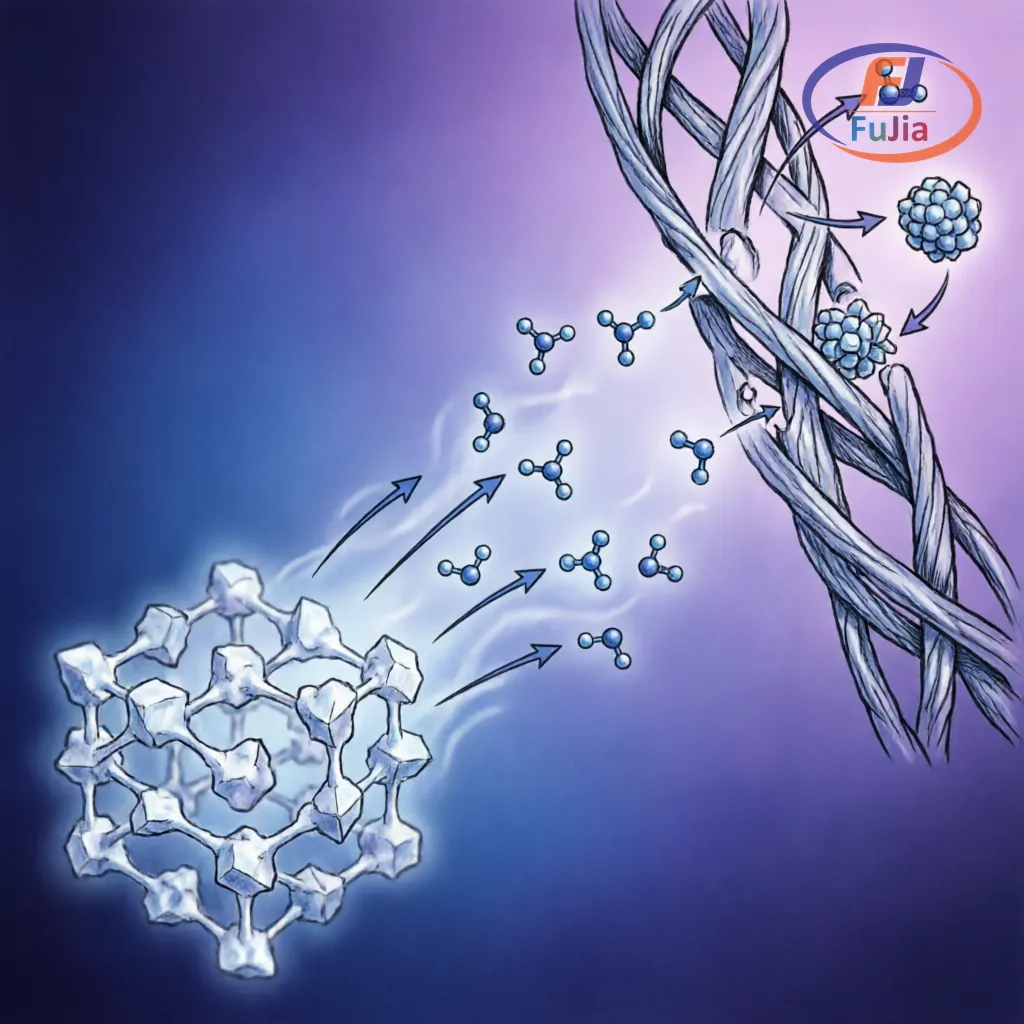
Sublimation printing works by using heat at 190 to 200 degrees Celsius and firm pressure to turn solid dye-based ink into gas, which then permeates polyester fibers or polymer coatings and bonds permanently as it cools. The process skips the liquid phase entirely — the solid dye sublimates directly to gas, infuses into the substrate’s open polymer pores, and solidifies within the material structure as temperatures drop. The global dye sublimation printing market was valued at $42.95 billion in 2024 and is projected to reach $92.86 billion by 2035 at a CAGR of 7.26%, according to Market Research Future.

Key Takeaways
- Core science: solid dye turns to gas at 190-200 degrees Celsius, skipping the liquid phase (sublimation), and infuses into polyester polymer pores
- Required conditions: 190-200 degrees Celsius, 30-40 PSI pressure, 45-90 seconds depending on substrate
- Material requirement: minimum 65% polyester content for textiles; polymer-coated substrates for hard goods
- Market scale: $42.95 billion in 2024, growing to $92.86 billion by 2035 at 7.26% CAGR
- Apparel dominates: the textile segment was worth $15 billion in 2024, projected to reach $32 billion by 2035
- Permanence: the dye becomes part of the substrate molecular structure — prints do not crack, peel, or fade
What Is Sublimation in Chemistry?
Sublimation is a phase transition in which a solid substance transforms directly into a gas without passing through the liquid state. The reverse process, where a gas transforms directly into a solid, is called deposition. Sublimation occurs when the vapor pressure of a solid exceeds the partial pressure of the surrounding gas, causing molecules to escape from the solid lattice into the gas phase.
According to Wikipedia’s definition of sublimation, all solids can technically sublime, but most do so at negligible rates under normal conditions. Common substances that sublime at observable rates include dry ice (solid carbon dioxide, which sublimes at minus 78.5 degrees Celsius at standard atmospheric pressure), iodine, naphthalene (mothballs), and camphor. The enthalpy of sublimation equals the sum of the enthalpy of fusion and the enthalpy of vaporization, meaning sublimation requires more energy per molecule than either melting or boiling alone.
In printing, sublimation refers to the behavior of disperse dyes — solid pigment particles suspended in a liquid carrier fluid. These dyes are formulated to sublime at temperatures between 175 and 215 degrees Celsius, which is achievable with standard heat press equipment. When the solid dye particles receive sufficient thermal energy, their molecular bonds break and they transition directly to a gaseous state.
The Sublimation Printing Process Step by Step
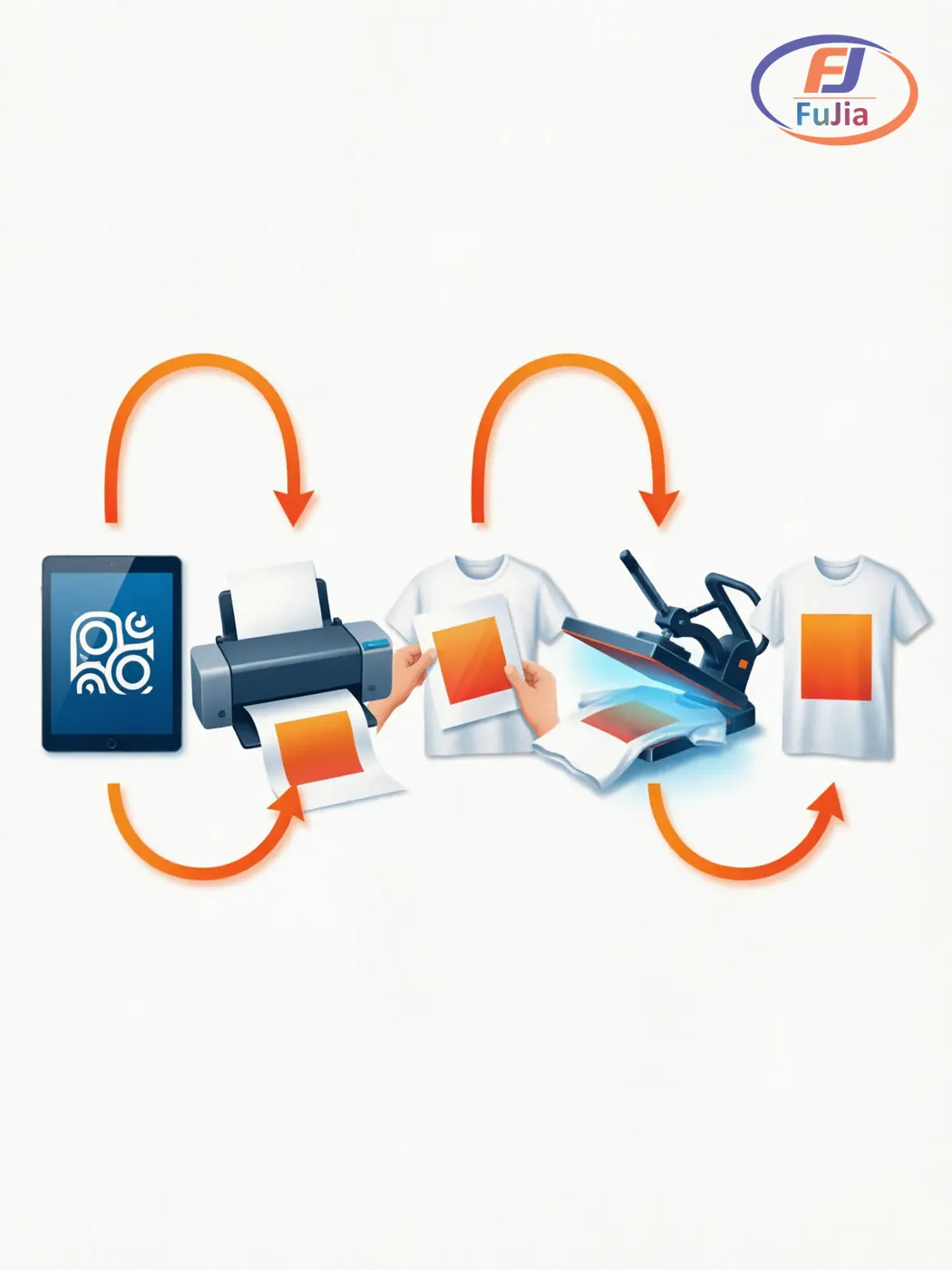
Sublimation printing consists of five sequential steps, each requiring specific equipment and parameters. The table below provides the production-ready settings for the most common substrates.
| Step | Action | Key Parameters | Equipment |
|---|---|---|---|
| 1. Design creation | Create digital artwork at 300 DPI minimum | RGB color profile, mirrored output | Design software (Photoshop, Illustrator) |
| 2. Printing | Print design onto sublimation transfer paper | Sublimation ink, correct paper side up | Sublimation printer (Epson SureColor, Sawgrass) |
| 3. Substrate preparation | Clean and pre-press the blank item | Lint-free cloth, pre-press 5 seconds | Heat press, lint roller |
| 4. Heat transfer | Press paper onto substrate with heat and pressure | 190-200 degrees C, 30-40 PSI, 45-90 seconds | Heat press (flatbed, mug, cap) |
| 5. Cooling and reveal | Remove from press, peel paper, cool | Peel hot or cold depending on paper type | Heat-resistant gloves |
Step 1: Design Creation
The sublimation workflow begins with digital artwork created at a minimum resolution of 300 dots per inch (DPI). Images must be saved in RGB color mode because sublimation printers process color differently from CMYK offset printing. Text and directional elements must be mirrored (horizontally flipped) before printing, because the transfer process applies the design face-down onto the substrate.
Step 2: Printing onto Sublimation Paper
A sublimation printer deposits disperse dye ink onto specially coated sublimation transfer paper. This paper has a polymer coating on one side that holds the solid dye particles on the surface rather than absorbing them into the paper fibers. The coated side typically appears brighter and smoother than the uncoated side. Standard sublimation printers use piezoelectric inkjet printheads — Epson PrecisionCore and Sawgrass models are the most common in commercial use.
Sublimation ink is fundamentally different from pigment ink or dye-based aqueous ink. It consists of solid disperse dye particles measuring 0.2 to 2.0 microns in diameter, suspended in a liquid carrier fluid (typically water or glycol). When the ink dries on the transfer paper, the carrier evaporates, leaving only the solid dye particles resting on the paper’s coating surface, ready for the sublimation phase. The American Association of Textile Chemists and Colorists (AATCC) provides standardized test methods for evaluating sublimation fastness and color transfer on textile substrates.
Step 3: Substrate Preparation
The blank substrate must contain polyester or a polymer coating. For textiles, a minimum polyester content of 65% is required for visible color transfer, with 100% polyester producing the most vibrant and durable results. For hard goods such as mugs, tumblers, ceramic tiles, metal panels, and phone cases, the surface must have a polymer coating applied during manufacturing.
Pre-pressing the substrate for 3 to 5 seconds removes residual moisture and wrinkles that can cause sublimation defects. Even a single lint fiber or dust particle on the substrate surface creates a visible white or blue blemish in the final print, as the fiber blocks dye penetration at that point.
Step 4: Heat Transfer
The heat transfer is where the science of sublimation occurs. The printed paper is secured to the substrate with heat-resistant tape and placed in a heat press. Standard parameters vary by substrate type:
| Substrate | Temperature | Time | Pressure |
|---|---|---|---|
| Polyester fabric (T-shirts) | 190-200 degrees C | 45-60 seconds | 30-40 PSI |
| Ceramic mugs | 180-190 degrees C | 150-180 seconds | Medium |
| Metal panels | 200-205 degrees C | 60-75 seconds | 40 PSI |
| Phone cases (polymer-coated) | 190 degrees C | 60 seconds | Medium |
| Ceramic tiles | 200 degrees C | 60-90 seconds | 40 PSI |
When the heat press reaches 190 degrees Celsius, two simultaneous reactions occur:
- Dye sublimation: the solid disperse dye particles on the transfer paper absorb sufficient thermal energy to break their intermolecular bonds and transform directly into gas
- Polymer pore opening: the polyester fibers or polymer coating on the substrate soften and their molecular pores expand, creating physical pathways for the gaseous dye molecules to enter
The firm pressure (30-40 PSI) forces the gaseous dye into these open pores. The dye molecules penetrate into the polymer structure rather than sitting on the surface. This is the fundamental difference between sublimation and other printing methods such as heat transfer vinyl (HTV), screen printing, or UV printing, which deposit ink on top of the substrate surface.
Step 5: Cooling and Bond Formation
When the heat press opens and the substrate begins cooling below 175 degrees Celsius, the polymer pores contract and close, trapping the now-solid dye molecules within the material structure. The dye has become physically integrated into the substrate at the molecular level. This is why sublimated prints cannot be felt by touch — there is no ink layer on the surface — and why the prints resist cracking, peeling, and fading for the life of the product.
What Materials Can Be Sublimated?
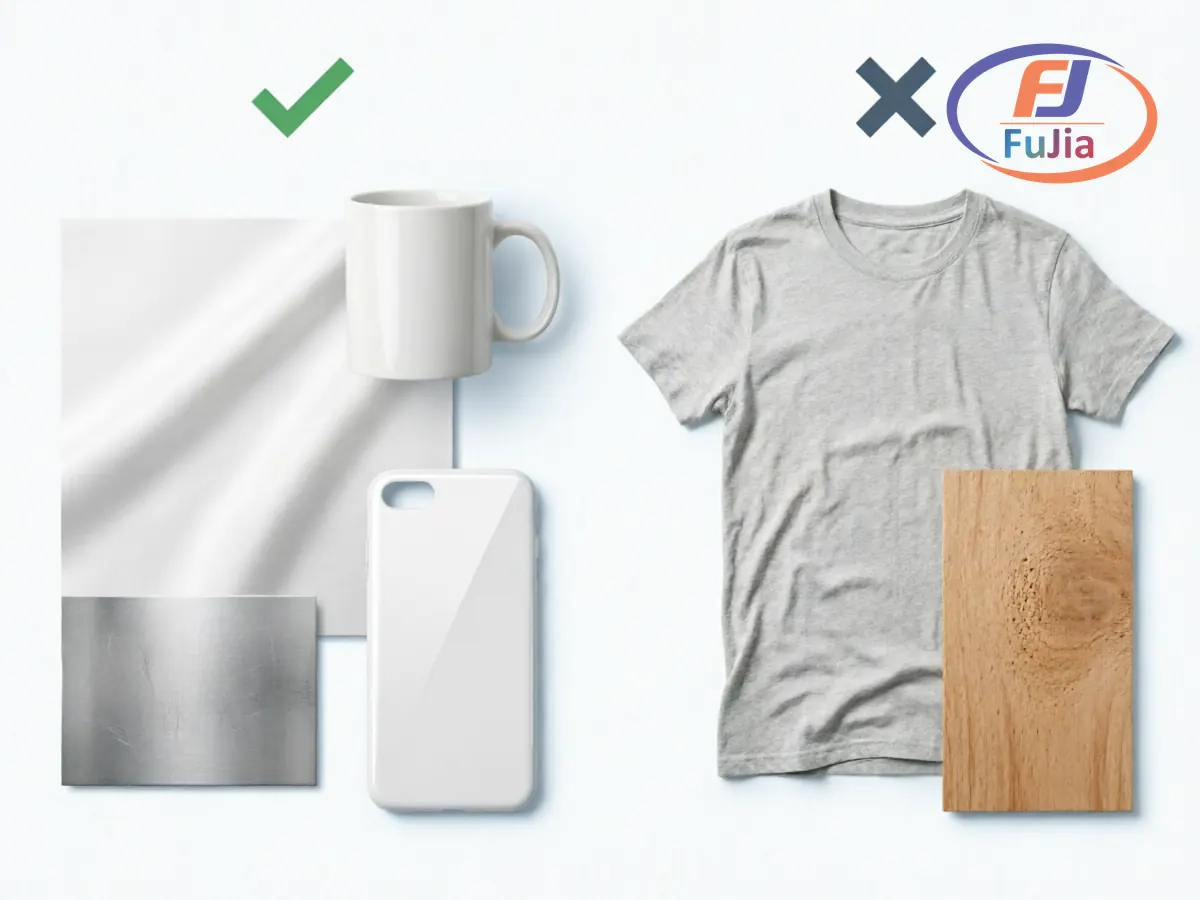
Sublimation works exclusively on polyester or polymer-coated surfaces. The table below categorizes substrate compatibility:
| Material Type | Sublimation Result | Polyester Content Required |
|---|---|---|
| Polyester fabric | Excellent — full color, permanent | 100% (minimum 65%) |
| Poly-cotton blend | Fair — muted colors, reduced durability | 50-65% (not recommended) |
| 100% cotton | Fails — dye cannot bond | 0% polyester |
| Ceramic (polymer-coated) | Excellent — dishwasher safe | Polymer coating required |
| Metal (polymer-coated aluminum) | Excellent — UV resistant | Polymer coating required |
| Hardboard / MDF (coated) | Good — indoor use | Polymer coating required |
| Glass (coated) | Good — decorative | Polymer coating required |
| Uncoated plastic | Fails — no polymer to accept dye | 0% polymer |
Why Polyester Is Required
Sublimation dye bonds only with synthetic polymer molecules. Polyester (polyethylene terephthalate, or PET) has a molecular structure that softens at 190-200 degrees Celsius, opening pores large enough for dye gas molecules (0.2-2.0 microns) to penetrate. Natural fibers such as cotton, wool, silk, and rayon do not contain polymer chains, so their fibers cannot accept or retain sublimation dye. When sublimation is attempted on pure cotton, the dye gas simply bounces off the fiber surface and washes away.
For cotton-polyester blends, the dye bonds only with the polyester portion. A 50/50 blend produces approximately 50% color saturation compared to 100% polyester, resulting in faded, washed-out colors. This is why most sublimation businesses use 100% polyester garments, and why “sublimation blanks” (mugs, tiles, metal panels) are always pre-coated with a polymer layer at the factory. The ISO 105-X10 standard specifies test methods for assessing color migration and sublimation fastness in dyed textiles.
Sublimation Printing vs Other Methods
| Property | Sublimation | DTF Printing | UV DTF Printing | Screen Printing | Heat Transfer Vinyl |
|---|---|---|---|---|---|
| Ink position | Inside fibers | On surface (adhesive) | On surface (UV cured) | On surface (ink layer) | On surface (vinyl layer) |
| Feel | Zero texture | Slight texture | Raised texture | Moderate texture | Heavy, plastic feel |
| Durability | Permanent (no fade) | 50+ washes | Permanent (hard surface) | 40-50 washes | 20-30 washes (peels) |
| Best substrate | Polyester fabric | Any fabric | Hard surfaces | Cotton, blends | Cotton, blends |
| Color limitation | Light fabrics only | Any fabric color | Any surface | Any fabric | Solid colors only |
| Setup cost | Low ($300-$500) | Medium ($2,000+) | High ($3,000+) | High ($500+ per color) | Low ($200+) |
| Minimum order | 1 piece | 1 piece | 1 piece | 50+ pieces (setup cost) | 1 piece |
Sublimation’s unique advantage is the zero-texture, permanent bond with polyester. No other common printing method achieves this combination. For a detailed comparison of sublimation versus DTF, see our DTF vs sublimation guide.
What Equipment Do You Need for Sublimation Printing?
| Equipment | Purpose | Price Range |
|---|---|---|
| Sublimation printer | Prints dye ink onto transfer paper | $300-$3,000 |
| Sublimation ink (CMYK) | Disperse dye in liquid carrier | $50-$120/liter |
| Sublimation transfer paper | Holds dye on coated surface | $0.05-$0.20/sheet |
| Heat press (flatbed) | Applies heat and pressure for transfer | $250-$1,500 |
| Mug press attachment | Transfers onto cylindrical items | $100-$400 |
| Heat-resistant tape | Secures paper to substrate | $10-$20/roll |
| Lint roller | Removes dust from fabric blanks | $5-$10 |
| Polyester blanks | T-shirts, mugs, tiles, metal panels | $1.50-$8.00/unit |
A complete startup sublimation setup costs between $500 and $2,000, depending on printer quality and heat press type. This low entry cost has driven the growth of home-based sublimation businesses, contributing to the personalized products market which is projected to grow at a CAGR of 10% through 2035.
Sublimation Printing Applications and Market Data
| Application | 2024 Market Size | 2035 Projection | Notes |
|---|---|---|---|
| Textile and apparel | $15.0 billion | $32.0 billion | Largest segment (jerseys, activewear) |
| Sublimation ink | $8.0 billion | $18.0 billion | Consumable growth follows equipment |
| Fabric substrate | $15.0 billion | $35.0 billion | Polyester fabric demand |
| Personalized products | Growing fastest | N/A | Custom gifts, home decor |
| Signage and display | Significant segment | N/A | Flags, banners, trade show graphics |
Geographically, North America holds approximately 40% of the dye sublimation market share, followed by Europe at 30% and Asia-Pacific at 25%. The Asia-Pacific region is the fastest-growing market due to expanding textile manufacturing in China, India, and Bangladesh. For an overview of our sublimation printer lineup suited for these applications, explore our dye sublimation printer guide.
Frequently Asked Questions
What are the disadvantages of sublimation printing?
Sublimation printing has four main disadvantages. First, sublimation works only on polyester or polymer-coated substrates — it cannot bond to cotton, natural fibers, or uncoated hard surfaces. Second, sublimation produces visible colors only on white or light-colored substrates; the translucent dye cannot cover dark backgrounds, meaning black T-shirts cannot be sublimated without a white underbase layer. Third, sublimation requires specialized equipment including a sublimation printer, disperse dye ink, coated transfer paper, and a heat press, representing an initial investment of $500 to $2,000. Fourth, the process consumes transfer paper as a single-use consumable, generating paper waste at a rate of one sheet per printed item. Despite these limitations, the $42.95 billion global sublimation market in 2024 demonstrates that the advantages — permanent full-color prints with zero texture — outweigh the constraints for businesses focused on polyester products and custom merchandise.
What is required for sublimation printing?
Sublimation printing requires five essential components: a sublimation printer (piezoelectric inkjet, such as Epson SureColor or Sawgrass models, priced $300 to $3,000), sublimation ink containing disperse dye particles in a liquid carrier ($50 to $120 per liter), sublimation transfer paper with a polymer coating on one side ($0.05 to $0.20 per sheet), a heat press capable of reaching 190 to 200 degrees Celsius at 30 to 40 PSI ($250 to $1,500), and polyester or polymer-coated blank substrates ($1.50 to $8.00 per unit). The substrate must contain a minimum of 65% polyester for textiles, or a factory-applied polymer coating for hard goods such as mugs, tiles, and metal panels. Without the correct substrate polymer content, the dye gas cannot bond and the transfer will fail. A complete starter setup totals $500 to $2,000 depending on equipment quality and is sufficient for producing custom T-shirts, mugs, and promotional products from a home workshop.
Can you do sublimation printing with any printer?
Sublimation printing cannot be done with any standard inkjet or laser printer. Sublimation requires a printer that uses piezoelectric printhead technology to deposit disperse dye ink onto transfer paper. Thermal inkjet printheads (used in most HP and Canon consumer printers) heat the ink during ejection, which can prematurely activate the sublimation dye inside the printhead and cause clogging. The most common sublimation-compatible printers are Epson SureColor models (which use Micro Piezo printheads) and dedicated Sawgrass sublimation printers. Some users convert standard Epson EcoTank printers by flushing the original ink and filling with sublimation ink, which costs $200 to $400 for the printer plus $60 to $100 for the ink conversion kit. However, converted printers may void the manufacturer warranty and require regular printhead maintenance to prevent clogging from the viscous disperse dye formulation. Dedicated sublimation printers from Sawgrass ($500 to $2,500) include optimized printhead drivers and color management software calibrated specifically for sublimation ink.
What lasts longer, DTF or sublimation?
Sublimation prints last longer than DTF prints on compatible substrates. Sublimation dye bonds permanently with polyester at the molecular level, producing prints that do not crack, peel, or fade for the functional life of the substrate, typically rated at 100-plus wash cycles without visible degradation. DTF prints sit on the fabric surface bonded by a polyurethane adhesive layer, which gradually degrades through repeated washing and drying cycles, with typical durability ratings of 50-plus washes before visible cracking begins. However, DTF offers broader substrate compatibility: DTF works on cotton, polyester, blends, and dark-colored fabrics, while sublimation is restricted to polyester (minimum 65%) and light-colored substrates only. The choice depends on the application: for 100% polyester apparel and polymer-coated hard goods where maximum durability is required, sublimation is superior. For cotton garments, dark fabrics, or mixed-material orders, DTF is the practical choice. Our DTF vs sublimation comparison provides a detailed decision framework.
Does sublimation printing work on cotton?
Sublimation printing does not work on 100% cotton fabric. The disperse dye used in sublimation can only bond with polyester polymer molecules, and cotton fibers contain no polymer chains. When sublimation is attempted on cotton, the gaseous dye molecules cannot penetrate or bond with the cellulose fiber structure, resulting in a transfer that washes out completely after one or two wash cycles. For cotton-polyester blends, the dye bonds only with the polyester portion of the blend. A 50/50 cotton-polyester shirt produces approximately 50% color saturation compared to 100% polyester, resulting in muted, washed-out colors. Businesses that need to print on cotton use alternative methods such as DTF printing (which uses adhesive to bond ink to any fabric) or screen printing (which deposits a thick ink layer on the surface). Some manufacturers offer polyester-coating sprays that can be applied to cotton before sublimation, but these add cost and produce inconsistent results compared to using proper polyester substrates.
Conclusion
Sublimation printing works by transforming solid dye into gas at 190-200 degrees Celsius, bonding it permanently into polyester polymer structures. The result is zero-texture, full-color prints that outlast the substrate itself. For factory-direct sublimation printers, ink, and transfer paper backed by 7×24 engineering support, contact Fujia Print.
