

A dye sublimation printer uses heat to turn solid ink into a gas that permanently bonds with polyester fibers — creating prints that never crack, peel, or fade. Unlike DTF or DTG, sublimation ink becomes part of the fabric rather than sitting on top. This makes sublimation the go-to method for sportswear, uniforms, soft signage, and personalized polyester products.

Key Takeaways
- A dye sublimation printer transforms solid dye into gas using heat — the gas bonds with polyester at the molecular level, making the print permanently durable (never fades, cracks, or peels).
- Sublimation only works on polyester and poly-coated surfaces — it cannot print on cotton, dark fabrics, or natural fibers without a polyester coating.
- The cost per print is the lowest among digital garment printing methods ($0.30–0.80 per A4 print), and entry-level equipment starts at $2,000–4,000.
- Best for: sportswear, team uniforms, promotional polyester products, home textiles, and soft signage — businesses that run high-volume polyester printing.
- If you print on mixed fabric types (cotton, polyester, blends, darks), DTF offers more versatility; if you need the softest feel on cotton, choose DTG.
What Is a Dye Sublimation Printer?
A dye sublimation printer is a digital printer that uses heat to transfer dye onto polyester fabric or poly-coated surfaces. Instead of laying ink on top of the material like an inkjet printer, a dye sublimation printer uses a two-step process: it first prints a design onto transfer paper with special sublimation ink, then uses a heat press at around 200°C (392°F) to turn the ink into a gas. This gas penetrates the polyester fibers and solidifies inside them as they cool.
The result is a print that is physically part of the material — not a layer on top. This is why sublimation prints cannot be felt with your fingers (zero hand-feel), cannot crack when stretched, and do not fade even after hundreds of industrial wash cycles.
Sublimation printing is not new. It has been the industry standard for sportswear and promotional products for over two decades. What has changed in recent years is the drop in equipment cost — desktop sublimation printers now start around $300, making the technology accessible to small shops and even home businesses. On the industrial end, wide-format roll-to-roll sublimation printers (up to 3.2 meters wide) serve high-volume textile and soft signage factories.
How Dye Sublimation Printing Works

The dye sublimation process happens in four stages. Understanding each stage matters because most print quality problems trace back to a single stage done incorrectly — usually insufficient heat-press pressure or wrong temperature.
Stage 1 — Design and Print: Your design is printed in reverse (mirrored) onto transfer paper using sublimation ink. The printer applies CMYK ink precisely. Unlike DTF, there is no white ink — sublimation printers do not print white. White areas in your design simply show the fabric color underneath.
Stage 2 — Heat Press Transfer: The printed transfer paper is placed face-down on the polyester material and pressed at 190–210°C (374–410°F) for 35–60 seconds. Under this heat and pressure, the solid dye particles on the paper turn directly into gas — skipping the liquid phase entirely. This is the “sublimation” transformation.
Stage 3 — Gas Penetration: The gaseous dye penetrates the polyester fibers. Polyester is the only common fabric that allows dye gas to enter its molecular structure. Cotton, nylon, and other natural fibers have closed molecular structures that block the gas.
Stage 4 — Cooling and Bonding: When the heat press opens, the polyester fibers cool and close — trapping the dye permanently inside. The print cannot be washed out, scraped off, or faded by UV light in any meaningful way. This is why sublimation prints consistently score Grade 5 (the highest) on wash fastness tests.
What Materials Can You Print On With Dye Sublimation?
The short answer: polyester and only polyester. But there is nuance to this that determines whether sublimation fits your business.
| Material | Works With Sublimation? | Quality | Notes |
|---|---|---|---|
| 100% Polyester (white/light) | ✅ Yes | Excellent | Best results — vibrant colors, no hand-feel |
| Poly-blend (65%+ poly) | ⚠️ Partial | Good | Colors slightly muted; cotton fibers won’t take dye |
| Poly-blend (under 50% poly) | ❌ No | Poor | Gives a faded, vintage look — intentional only |
| 100% Cotton | ❌ No | N/A | Dye gas cannot penetrate cotton. Use DTF instead. |
| Nylon, Denim, Canvas | ❌ No | N/A | Molecular structure won’t accept dye gas |
| Dark polyester | ❌ No | N/A | Sublimation has no white ink — dark base shows through |
| Poly-coated hard surfaces | ✅ Yes | Excellent | Mugs, phone cases, metal panels — any poly-coated item |
This material restriction is the single biggest limitation of sublimation. You cannot print on a black cotton t-shirt with a dye sublimation printer. The technology simply does not support it. If your product mix includes cotton, dark fabrics, or mixed materials, you need DTF or DTG — not sublimation.
For polyester garments, however, sublimation is unbeatable. The zero hand-feel matters enormously for sportswear — athletes do not want a plastic-feeling print sticking to their skin during a game. Sublimation prints are as breathable as the fabric itself.
Dye Sublimation vs DTF vs DTG: Comparison
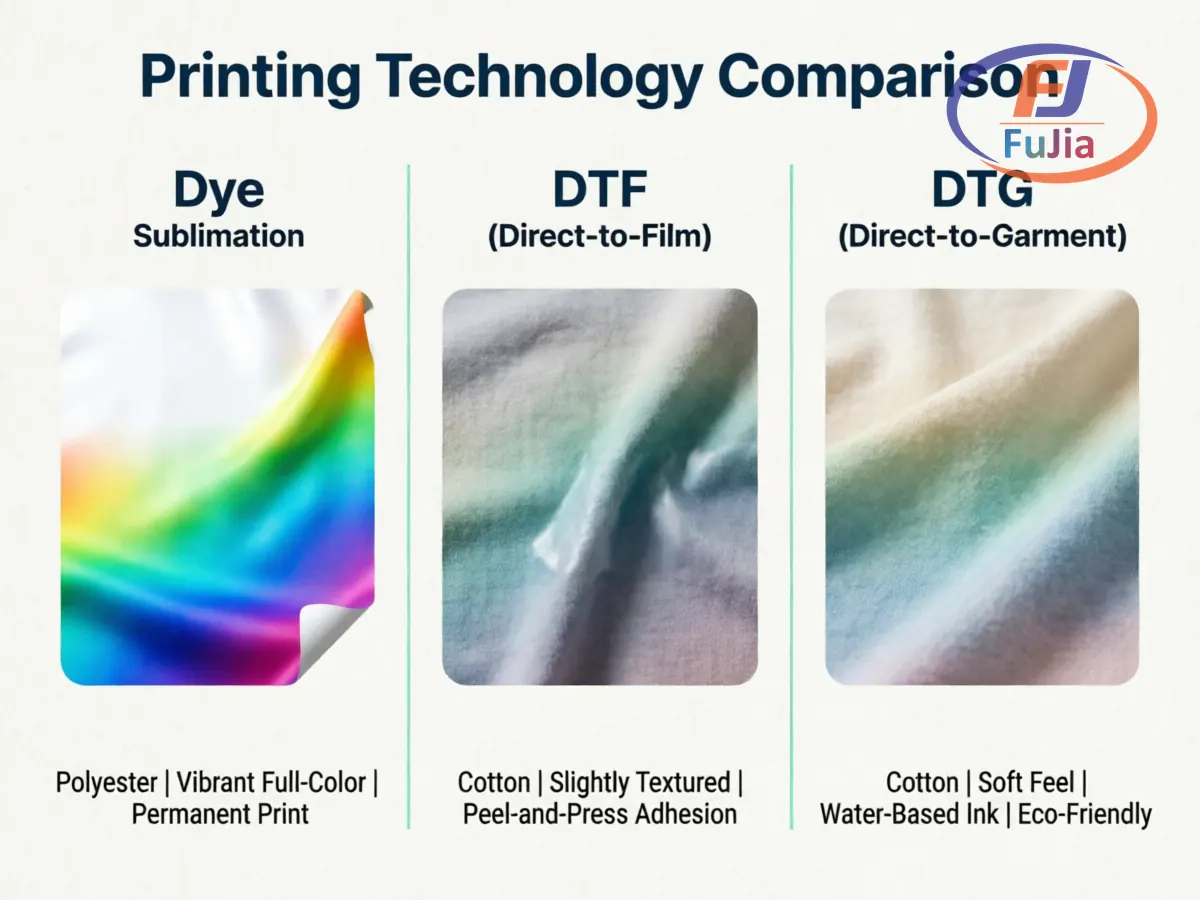
If you are shopping for a garment printer, you will encounter three main technologies: dye sublimation, DTF (Direct-to-Film), and DTG (Direct-to-Garment). Each has a fundamentally different ink chemistry and use case. Here is how they compare across the dimensions that matter to a print shop.
| Dimension | Dye Sublimation | DTF | DTG |
|---|---|---|---|
| Fabric Compatibility | Polyester only | All fabrics (cotton, poly, blends, nylon, denim) | Cotton best; cotton blends with pre-treatment |
| Dark Fabric Capability | ❌ No | ✅ Yes (white ink underbase) | ✅ Yes (white ink underbase) |
| Print Hand-Feel | Perfect — zero texture | Good — slight texture | Excellent — very soft |
| Durability | Grade 5 — permanent | Grade 4–5 — 50+ washes | Grade 4 — 40+ washes |
| Cost Per Print (A4) | $0.30–0.80 | $0.50–1.50 | $1.00–3.00 |
| Equipment Entry Cost | $2,000–10,000 | $3,000–15,000 | $8,000–25,000 |
| Production Speed | Fast — paper + heat press | Medium — film + powder + curing | Slow — pre-treatment + print + cure |
| White Ink Printing | ❌ Not available | ✅ Full white ink | ✅ Full white ink |
| Best For | Polyester sportswear, uniforms, signage | Versatile small-medium runs, all fabric types | Premium cotton, boutique brands |
Which Should You Choose? If you only print polyester sportswear and promotional items, a dye sublimation printer gives you the lowest running costs and most durable output. If your orders span cotton, polyester, blends, and dark fabrics, DTF is the most versatile single-machine solution. If your brand sells premium cotton t-shirts and hand-feel is a differentiator, DTG is worth the higher per-print cost. The data in the table above comes from industry-average figures verified across supplier comparisons in 2026.
Dye Sublimation Printer Costs: Complete Breakdown
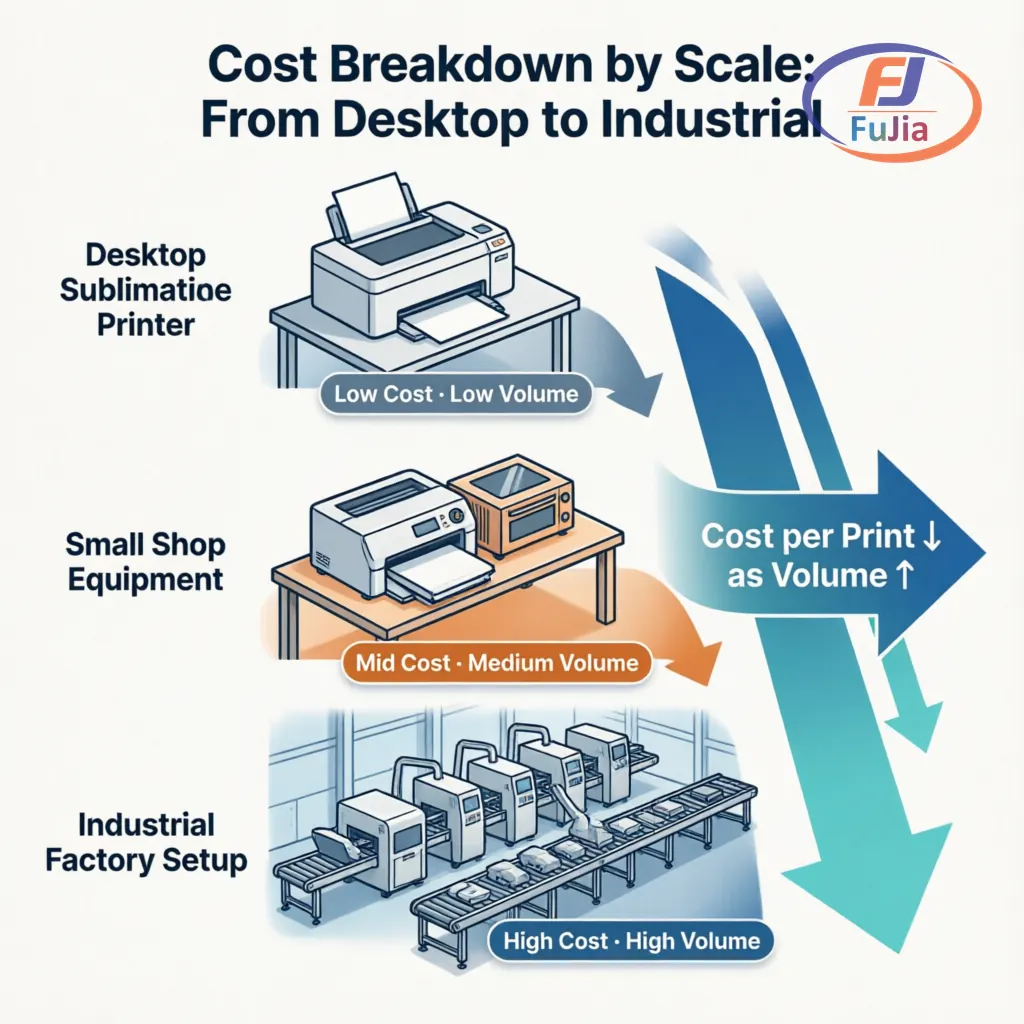
Sublimation has the lowest total cost of ownership among digital garment printing methods, but your costs still depend heavily on your production volume and the equipment tier you choose.
| Cost Component | Entry-Level (Desktop) | Mid-Range (Small Shop) | Industrial (Factory) |
|---|---|---|---|
| Printer | $300–800 (modified Epson) | $2,000–5,000 (dedicated wide-format) | $8,000–25,000+ (1.6m–3.2m width) |
| Heat Press | $200–500 (clamshell A3) | $500–2,000 (swing-away A2) | $3,000–8,000 (calendar/pneumatic) |
| Ink (per liter) | $30–80 | $25–60 | $18–40 (bulk pricing) |
| Transfer Paper (100 sheets) | $10–20 | $8–15 | $5–12 |
| Consumable Cost Per A4 Print | $0.50–0.80 | $0.35–0.60 | $0.20–0.40 |
| Total Startup Investment | $500–1,500 | $3,000–8,000 | $15,000–40,000+ |
| Monthly Running Cost (100 prints/day) | $1,500–2,400 | $1,050–1,800 | $600–1,200 |
At the entry level, a $300 modified Epson EcoTank and a $200 heat press is enough to start printing polyester t-shirts and mugs at home. At the factory level, a 1.8-meter roll-to-roll dye sublimation printer feeding a continuous calendar heat press can output 200–500 linear meters per day — running costs drop to as low as $0.20 per A4 equivalent.
The key cost driver is volume. Sublimation scales well: once you pass 50 prints per day, the per-unit cost drops rapidly because the largest expense (the printer) gets amortized over more prints. This is why most successful sublimation businesses focus on bulk orders — team uniforms, event merchandise, and promotional product runs of 100+ units.
Best Use Cases for Dye Sublimation Printing
Sublimation dominates specific niches where no other printing method comes close. Understanding these use cases helps you decide if the polyester-only limitation is a dealbreaker or irrelevant to your business.
Sportswear and Team Uniforms. Sublimation is the standard for professional and amateur sports teams worldwide. Soccer jerseys, basketball uniforms, cycling kits, and running singlets are almost all sublimated. The reasons: zero hand-feel (athletes move freely), full-coverage prints (the entire shirt becomes the design — no rectangular print area), and permanent durability through dozens of aggressive laundry cycles.
Soft Signage and Trade Show Displays. Wide-format dye sublimation on polyester fabric produces lightweight, wrinkle-resistant banners and backdrops. Unlike vinyl banners, sublimated fabric signage can be folded, machine-washed, and packed into a suitcase. Trade show exhibitors and event companies prefer sublimated fabric because it looks more premium than PVC and ships at a fraction of the weight.
Home Textiles. Cushion covers, curtains, tablecloths, bed sheets, and blankets printed with dye sublimation offer full-color designs with zero change to fabric texture. This matters for products people touch and sleep on — nobody wants a printed logo that feels like a sticker on their pillowcase.
Personalized Polyester Products. Mugs, phone cases, mouse pads, keychains, puzzles, and photo panels — these are all poly-coated items that accept sublimation prints. The entry barrier is low: a $500 setup (printer + mug press) can start a personalized gift business from a spare room.
Frequently Asked Questions
Can a dye sublimation printer print on cotton t-shirts?
No. A standard dye sublimation printer cannot print directly on 100% cotton because cotton fibers lack the molecular structure to accept sublimation dye gas. When the dye turns to gas during heat pressing and encounters cotton, the pores in cotton fibers close instead of opening — the dye sits on the surface and washes out in the first laundry cycle. There are workarounds: you can apply a polyester coating spray to cotton garments, or use sublimation transfer papers designed for cotton-poly blends (50/50 minimum polyester content). But these hybrids produce a less durable, more expensive result. If printing on cotton is essential to your business, a DTF or DTG printer is the correct tool — not a sublimation printer. Both DTF and DTG use pigment inks that bond to cotton fibers at the surface level rather than requiring polyester penetration.
How much does a good dye sublimation printer cost for a small business?
For a small business producing 20–100 items per day, expect to spend $2,000–5,000 on a dedicated wide-format sublimation printer (such as an Epson F570 or Sawgrass SG1000), plus $500–1,500 for a quality swing-away heat press (15×15 or 16×20 inches). Total startup: $3,000–7,000. At this tier, you are buying a purpose-built sublimation printer — not a modified desktop inkjet — which means dedicated sublimation ink channels (no clogging from converted systems), manufacturer warranty, and ICC color profiles that give consistent output. The Sawgrass SG1000 at approximately $1,500 is the most common entry point for small shops; the Epson F-series starts around $2,000 for desktop models. At the low end, a $300 converted Epson EcoTank can print sublimation — but expect head clogging, color inconsistency, and zero warranty support. If your business depends on the printer running reliably every day, skip the converted machines and buy a dedicated sublimation printer.
What is the difference between sublimation ink and regular inkjet ink?
Sublimation ink contains dispersed dye particles suspended in a liquid carrier. When heated to 190–210°C, these dye particles transform from solid directly to gas — skipping the liquid phase — and bond with polyester polymer chains. Regular inkjet ink contains pigment or dye particles in a water-based solution that dries on the surface of the paper or fabric through evaporation. Sublimation ink cannot be used in a regular inkjet printer (it will clog standard printheads optimized for water-based inks), and regular ink cannot produce sublimation results (it will not gasify at heat-press temperatures). This is why dedicated sublimation printers use printheads engineered for the higher viscosity and different drying behavior of sublimation ink. Using the wrong ink type in either direction will destroy the printhead — this is not a compatibility issue you can work around.
Is a dye sublimation printer better than DTF for a startup print shop?
It depends entirely on what your customers order. If your startup focuses on sportswear, team uniforms, personalized mugs, or polyester promotional products, a dye sublimation printer is the better choice — lower cost per print ($0.30–0.80 vs DTF’s $0.50–1.50), simpler workflow (no powder application step), and permanently durable output. However, DTF is the objectively better choice for a generalist startup that cannot predict whether tomorrow’s order will be cotton t-shirts, polyester jerseys, denim jackets, or dark hoodies. DTF prints on all of these materials without modification. A startup doing mixed garment orders should buy DTF first and add sublimation later when polyester-specific volume justifies a second machine. Sublimation’s polyester-only limitation means it cannot serve as your only printer unless you have guaranteed demand for polyester products.
Is a Dye Sublimation Printer Right for Your Business?
A dye sublimation printer produces the most durable, lowest-cost prints of any digital garment printing method — but only on polyester. If your business prints sportswear, uniforms, soft signage, or personalized polyester products, sublimation is the best tool for the job. If your orders span cotton, darks, and mixed materials, DTF gives you the versatility you need at a slightly higher per-print cost. Either way, the gap between entry-level and industrial equipment has narrowed dramatically in the last three years — making 2026 the most accessible time to start printing. For factory-direct dye sublimation printer pricing, specifications, and free sample prints, contact Fujia Print.

[…] For a detailed overview of the technology, read our dye sublimation printer guide. […]