

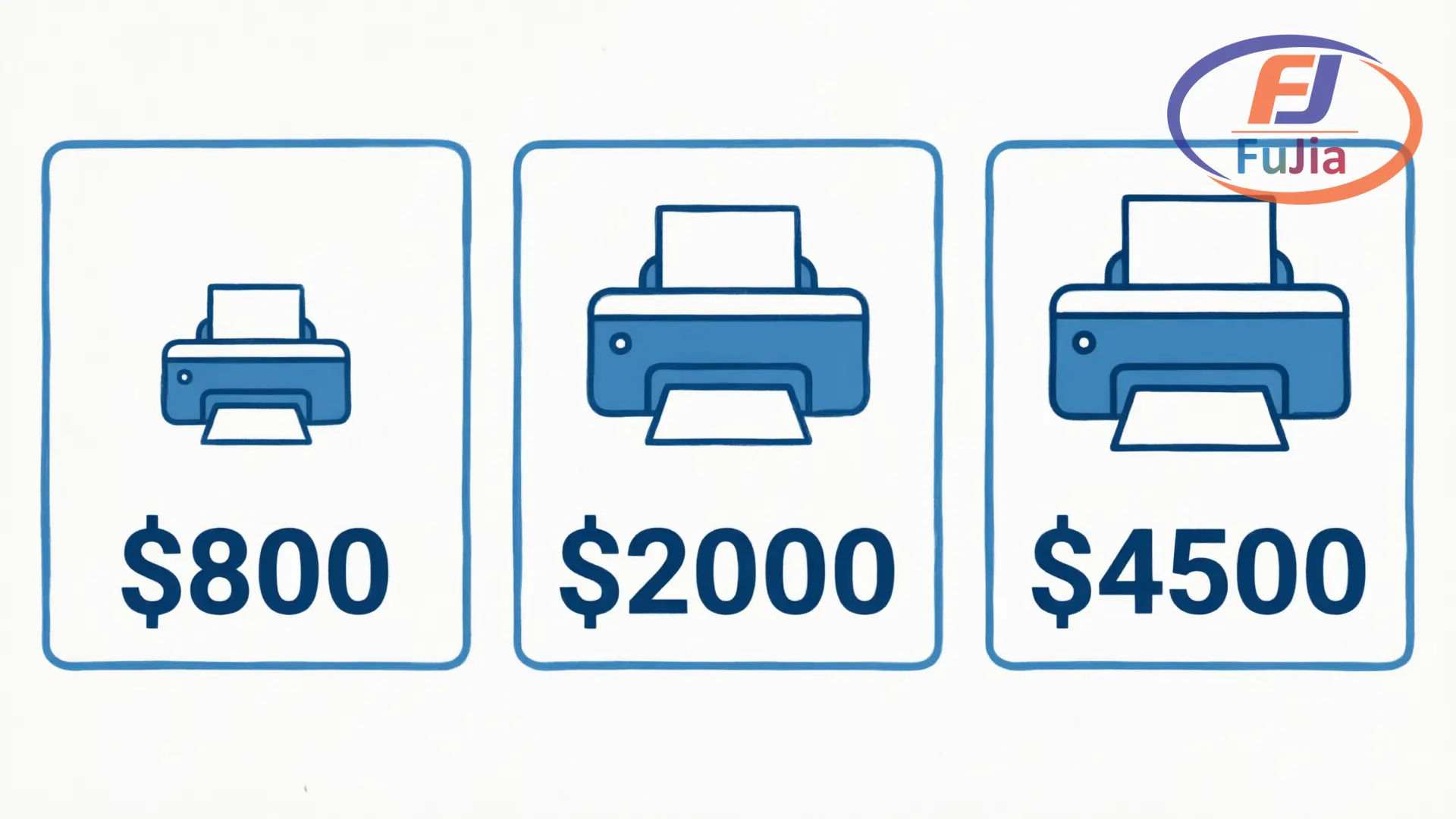
A cheap DTF printer is an entry-level direct-to-film printing machine priced between $800 and $4,500, designed for small businesses and home operations that need full-color garment decoration without the $10,000+ price tag of industrial equipment. This guide compares the real budget models on the market, breaks down what you actually get at each price point, and shows which corners manufacturers cut to reach lower costs.
Key Takeaways
- Entry-level DTF printers start at $800-$1,200 for converted Epson desktop models, mid-range all-in-one packages cost $1,500-$3,000, and A3 dual-printhead models push toward $4,500
- The biggest price driver is print width: A4 (8.3 inch) printers are cheapest, A3 (13 inch) adds $1,000-$2,000
- Converted printers are the cheapest option but lack manufacturer warranty and bundled support; all-in-one packages cost more upfront but include calibrated RIP software and consumables
- For small businesses printing 10-50 shirts a week, a $1,500-$2,000 A4 all-in-one DTF printer is the sweet spot between investment and capability
- Total cost of ownership over 12 months is roughly 2x the printer price when you include ink, film, powder, and maintenance parts
What Is a Cheap DTF Printer?
A cheap DTF printer is a direct-to-film printing machine priced under $5,000, typically using a converted Epson inkjet chassis paired with DTF-specific ink and RIP software. Unlike industrial DTF printers that cost $15,000-$50,000, budget models trade speed, print width, and warranty coverage for a lower entry price. The cheapest options are converted desktop printers — an Epson L805 or L1800 with DTF ink cartridges, a modified ink delivery system, and third-party RIP software — sold as kits for $800-$1,200.
At this price point, the compromises are real. A $1,000 converted L805 prints at A4 width (8.3 inches) only, requires manual white ink circulation, and comes with variable after-sales support. A $2,500 all-in-one DTF printer like the Procolored F8 series adds heated film curing, enclosed white ink circulation, factory calibration, and a 12-month warranty. A $4,000+ A3 model adds dual printheads, 13-inch print width, and higher throughput for small print shops.
The key distinction is between converted printers (cheapest, no warranty, DIY maintenance) and purpose-built DTF printers (higher cost, integrated curing, manufacturer support). The global DTF printing market was valued at $2.72 billion in 2024 and is projected to reach $3.92 billion by 2030, growing at a CAGR of 6.0%, according to Grand View Research’s direct-to-film printing market report.
Budget DTF Printer Price Tiers
| Tier | Price Range | Print Width | Type | Best For |
|---|---|---|---|---|
| Entry Converted | $800-$1,200 | A4 (8.3″) | Epson L805 conversion kit | Hobbyists, testing the market |
| Entry All-in-One | $1,500-$2,600 | A4 (8.3″) | Purpose-built with curing | Small business, 10-50 shirts/week |
| Mid-Range A3 | $2,500-$4,500 | A3 (13″) | Dual printhead DTF | Growing print shop, 50+ shirts/week |
Prices based on publicly listed MSRP from major DTF printer retailers as of early 2026. Actual pricing varies by supplier and region.
Top 5 Budget DTF Printers
Epson L805 DTF Conversion Kit — $800-$1,200
The Epson L805 is the most common starting point for budget DTF printing. Suppliers convert a standard Epson desktop inkjet into a DTF printer by replacing the ink system with CMYK plus white DTF ink, adding a modified waste ink tank, and bundling RIP software like AcroRIP. At $800-$1,200 complete, it is the cheapest way to enter DTF printing.
The L805 prints at A4 width with 1440×720 DPI resolution. Print speed is slow — typically 1-2 feet per minute. White ink must be manually agitated before each session because the converted ink delivery system lacks automatic circulation. The printer ships without a curing oven, so you also need a separate heat press or curing unit ($200-$300 additional).
Best for hobbyists testing the waters or side-hustle sellers doing under 20 shirts a week. Not suitable for production work. If you’re considering this tier but want to understand total startup costs including consumables and workspace setup, see our DTF printer cost breakdown.
Procolored F8 Panda A4 — $1,800-$2,600
The Procolored F8 Panda is a purpose-built A4 DTF printer with an integrated powder curing module, enclosed white ink circulation, and factory-calibrated RIP software. It eliminates the two biggest pain points of converted printers — manual white ink agitation and separate curing equipment.
At $1,800-$2,600, the F8 sits at the sweet spot for a small business doing 10-50 shirts a week. The built-in curing oven means you feed film in, get cured transfers out — no separate equipment needed. White ink circulates automatically, preventing the sedimentation problem that plagues conversion kits. Procolored provides a 12-month warranty and technical support, which converted printer resellers typically do not.
The main limitation is print width. At A4 (8.3 inches), full-size chest prints on XL+ garments require a step-up to A3. For small designs and youth sizes, A4 is sufficient.
PUNEHOD A3 L1800 — $2,000-$4,000
The PUNEHOD A3 DTF L1800 uses a converted Epson L1800 chassis with a larger 13-inch print width. The wider format handles full-back prints and XL garment decoration that A4 printers can’t. It runs on the same Epson MicroPiezo printhead technology as the L805 but at a larger scale.
At $2,000-$4,000 depending on options, the price gap from A4 to A3 is substantial. The extra $1,000-$2,000 buys you print width and nothing else — the underlying technology is identical to the L805 conversion. The L1800 conversion also lacks factory calibration and integrated curing, meaning you still need a separate heat press or oven.
For businesses that need A3 prints but can’t afford a $5,000+ purpose-built A3 machine. For operations doing both small and large prints, an A4 + A3 combination can cover all sizes at lower total cost than a single industrial machine. For a broader comparison of DTF printers across all price tiers including wholesale factory-direct pricing, see our best DTF printer for small business guide.
ULtra A3 XP600 — $2,500-$4,500
The ULtra A3 XP600 is a purpose-built dual-printhead DTF printer designed for small to mid-size print shops. Two Epson XP600 printheads run simultaneously, roughly doubling throughput compared to single-head printers. Print speed reaches 3-4 feet per minute at 1440×720 DPI.
The XP600 printhead is widely available and relatively inexpensive to replace ($150-$250 per head), keeping maintenance costs manageable. The printer supports 13-inch wide film rolls, handles high-volume white ink without manual agitation, and ships with manufacturer warranty and calibration.
At $2,500-$4,500, this is the upper end of “budget” territory. For a print shop doing consistent 50+ shirt orders per week, the speed difference pays for the price premium within 3-4 months through increased throughput.
FCOLOR A4 DTF Bundle — $1,500-$2,000
FCOLOR offers a turnkey A4 DTF bundle at $1,500-$2,000 that includes the printer, starter ink set, film, powder, and RIP software. The bundle approach is designed for first-time DTF buyers who want everything in one box without sourcing components separately. The printer uses an Epson-based chassis with factory-installed DTF conversion and comes with basic warranty coverage.
Performance is comparable to the Procolored F8 — A4 width, 1440×720 DPI, integrated white ink circulation. The main difference is brand support. Procolored has a larger English-language support network, while FCOLOR’s strength is competitive pricing through direct-from-China distribution. For a broader comparison of printing methods including DTF vs screen printing cost analysis, see Printify’s DTF vs screen printing breakdown.
For startup businesses on a tight capital budget, the all-in-one bundle eliminates the hidden costs of piecing together a DIY setup. The starter supply kit typically covers 200-300 test prints, giving you enough material to validate the business before reordering consumables.
What to Look for When Buying a Cheap DTF Printer
When shopping for a budget DTF printer, the difference between a successful investment and an expensive paperweight comes down to five factors beyond the sticker price.
Print width is the biggest price driver and the first compromise on cheap models. A4 (8.3 inches) handles logos, pocket prints, and youth sizes. A3 (13 inches) handles full-size adult chest and back prints. If your target market is adult apparel, A4 will frustrate you within weeks. Factor in $1,000-$2,000 more for A3.
White ink circulation separates frustration from workflow. Converted printers lack automatic white ink circulation, so the titanium dioxide pigment settles to the tank bottom within 8-12 hours. Every printing session starts with 2-3 minutes of manual agitation. Purpose-built printers include a circulation pump that handles this automatically. If you print daily, the time savings from auto-circulation pays for the price difference within 3 months.
Integrated curing eliminates the need for a separate heat press or oven. Purpose-built DTF printers with built-in powder curing modules save $200-$300 in equipment cost and 5-10 minutes per batch in workflow time. Converted printers require a standalone curing setup.
Warranty and support are where converted printers fall short. An $800 conversion kit from a small reseller typically comes with 30-90 day limited warranty and email-only support. A $2,000+ purpose-built machine includes 12-month warranty with phone/video support. For a machine that runs daily and generates revenue, the support difference alone can justify the price gap.
Total cost of ownership over 12 months is roughly 2x the sticker price. A $1,500 printer will consume $1,200-$1,800 in ink, film, powder, and replacement parts annually. Budget $200-$400 per month for consumables at moderate production volumes (30-50 shirts/week). The cheapest printer with the highest consumable costs can end up more expensive than a mid-range machine with efficient ink usage.
Frequently Asked Questions
What is the best cheap DTF printer for a small business?
The best cheap DTF printer for a small business doing 10-50 shirts per week is a purpose-built A4 all-in-one machine in the $1,500-$2,600 range, such as the Procolored F8 Panda or FCOLOR A4 bundle. These printers include automatic white ink circulation, integrated powder curing, factory calibration, and a 12-month warranty — features that converted $800 printers lack. The price premium over a conversion kit pays back within 2-3 months through reduced maintenance time and fewer failed prints. For businesses that need A3 prints (13-inch width), the minimum viable budget jumps to $2,500-$4,500 for a dual-printhead model like the ULtra XP600. The specific model matters less than choosing a machine with automatic circulation, integrated curing, and manufacturer support — these three features determine whether the printer becomes a revenue generator or a maintenance headache.
Can you convert a regular printer to DTF?
You can convert certain Epson inkjet printers — primarily the L805 (A4) and L1800 (A3) — to DTF printing using conversion kits that include DTF-specific ink cartridges, modified waste ink tanks, and RIP software. The conversion replaces standard ink with CMYK plus white DTF ink and redirects the ink delivery path for the thicker DTF ink formulation. Total kit cost is $800-$1,200 complete. Converted printers are the cheapest way to start DTF printing but come with significant trade-offs: no manufacturer warranty, manual white ink agitation required, no integrated curing module, and variable quality depending on the conversion kit supplier. Conversion is viable for hobbyists and market testing but not recommended for production businesses. Purpose-built DTF printers in the $1,500-$3,000 range provide better reliability, faster setup, and ongoing support that justify the higher initial cost for any operation generating revenue.
Is it worth buying a cheap DTF printer?
Buying a cheap DTF printer is worth it if you plan to print 10-50 shirts per week and can recover the investment within 3-6 months. At $1,500-$2,500 for a quality A4 all-in-one DTF printer, the breakeven point is roughly 150-300 shirts sold at $15-$25 each — achievable within a quarter for an active small business. The math changes for $800 conversion kits: the lower upfront cost is offset by $200-$300 in additional equipment (heat press, consumables) and 2-5 hours per week in manual maintenance that a purpose-built machine automates. If you treat DTF printing as a business rather than a hobby, the mid-range $1,500-$2,500 segment provides the best return on investment. Cheap DTF printers are a business enabler, not a luxury purchase — the question is whether your order volume justifies the monthly cost, not whether the printer is “cheap” in absolute terms. For a detailed analysis of per-unit cost comparisons across printing methods, see Printful’s DTF vs screen printing guide.
Final Recommendation
A cheap DTF printer in the $1,500-$2,500 range is the right entry point for a small apparel business printing 10-50 shirts per week. Below that, the compromises in print width, white ink handling, and warranty coverage make the $800 conversion kits a false economy for anyone serious about turning a profit. Choose based on print width (A4 vs A3), automatic white ink circulation, and manufacturer support — the brand matters less than these three features.
For factory-direct DTF printer pricing with pre-calibrated RIP software and consumable bundles at wholesale rates, contact Fujia Print.
