

Starting a custom apparel printing business is hard — especially when you’re dependent on third-party print shops for every order. A small creative studio in São Paulo, Brazil, faced exactly this challenge: high outsourcing costs, slow turnaround, and zero control over print quality. The studio invested in the FUJIA FJ-A30 A3 Desktop DTF Printer — and within six months, tripled their break-even speed, slashed per-order costs by 64%, and built a profitable in-house production line from a single compact machine.
| Location | Brazil |
| Product | FUJIA FJ-A30 A3 Desktop DTF Printer (1-Head XP600) |
| Industry | Custom Apparel Printing Studio / Creative Startup |
| Applications | T-shirts, hoodies, tote bags, caps, custom team uniforms, influencer merchandise |
| Objective | Bring DTF printing in-house, eliminate outsourcing costs, maximize profit on small-batch custom orders |
Customer Background
The customer is a creative print studio founded by two designers in São Paulo, Brazil’s largest city and creative capital. Their clients include local influencers, streetwear brands, fitness communities, and corporate teams needing small-batch custom apparel — anywhere from 5 to 50 pieces per order. Before acquiring the FJ-A30, the studio designed artwork in-house but outsourced all DTF printing to commercial print shops, paying premium per-sheet rates and waiting 3–5 days for every batch.
Challenges
- Crushing Outsourcing Costs – Commercial DTF shops charged R$15–22 per A3 sheet. After shipping and coordination, the studio’s real cost per order reached R$18 — eating over 60% of their unit margin.
- 3–5 Day Turnaround Gap – Outsourced shops had their own queue priorities. Rush jobs for influencer launches or event deadlines were impossible without paying 2× surge pricing.
- Quality Control Zero – Every third-party batch had issues: off-registration prints, incorrect white underbase density, or color mismatch. The studio had no way to catch errors before the client saw them.
- Space Constraints – The studio operated from a 20 m² workspace. Full-size industrial DTF machines (A1 width) wouldn’t fit — they needed something desktop-sized that could still deliver production quality.
- Startup Cash Flow – As a bootstrapped studio, they couldn’t afford a R$40,000+ commercial DTF setup. They needed a machine that would pay for itself quickly, not drain their runway.
Solution: FUJIA FJ-A30 A3 Desktop DTF Printer
FUJIA recommended the FJ-A30 A3 Desktop DTF Printer — a compact, single-head DTF printer powered by the Epson XP600 printhead, purpose-built for entry-level studios and small-batch production. The unit was installed on a standard workbench in the studio’s 20 m² space, turning their design station into a complete in-house print production line.
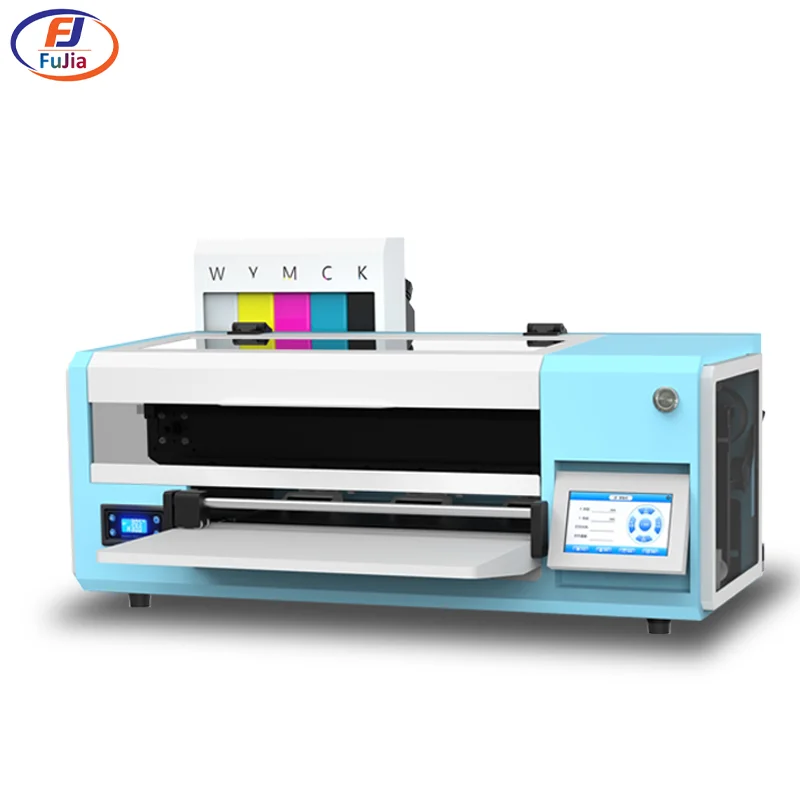
- 30cm (A3) print width — perfect for standard apparel panel sizes without wasting film on small runs
- Single Epson XP600 printhead with CMYK + White channels — proven reliability for studio-grade output
- Desktop footprint (fits on a 120cm workbench) — no factory floor or dedicated room needed
- Entry-level investment that pays for itself in months, not years
- Simple one-person operation: design on the computer, send to printer, powder-shake-cure, press — complete in under 30 minutes
Product Specifications
| Specification | FUJIA FJ-A30 A3 Desktop DTF Printer |
|---|---|
| Print Width | Up to 300 mm (A3) — desktop format |
| Printhead | 1 × Epson XP600 |
| Print Speed | 2–3 m²/hr (production mode) |
| Resolution | 720 × 1200 dpi to 1440 × 1440 dpi |
| Ink Channels | CMYK + White (5-channel) |
| Media | PET Transfer Film (roll-fed) |
| Machine Dimensions | Compact desktop form factor — fits standard workbench |
| Compatible Fabrics | Cotton, polyester, blends, denim, canvas, nylon, leather |
Key Advantages
- 64% Lower Per-Order Cost – Printing in-house dropped cost from R$18 to R$6.5 per order. The machine paid for itself in under 6 months — 3× faster than projected.
- Same-Day or Next-Day Turnaround – No more waiting on third-party queues. The studio now delivers most orders within 24 hours, a key competitive advantage for event and influencer clients.
- Desktop Footprint, Studio-Grade Output – The FJ-A30 sits on a standard workbench in a 20 m² room, yet delivers 1440 × 1440 dpi photo-quality prints. No factory lease, no infrastructure upgrade.
- Quality in Their Own Hands – Every print is inspected before it reaches the client. White underbase density, color accuracy, and transfer adhesion are all dialed in exactly as designed.
- Scalable from Day One – As order volume grows, the studio can add a second FJ-A30 (or upgrade to a dual-head model) without replacing their workflow. The learning curve is already behind them.
Results & Customer Feedback
Before vs. After — At a Glance
| Metric | Before FJ-A30 | After FJ-A30 | Change |
|---|---|---|---|
| Order Fulfillment Rate | ~15 orders/week | ~22 orders/week | 🔺 +45% |
| Per-Order Cost | R$18 (outsourced) | R$6.5 (in-house) | 🔻 -64% |
| Profit per Order | R$12 | R$23.5 | 🔺 +96% |
| Break-Even Timeline | 18 months (projected) | 5.5 months (actual) | 🔺 3× faster |
“We were spending 60% of our revenue just on outsourcing. Every order felt like we were working for the print shop, not for ourselves. The FJ-A30 changed the math completely — our per-order profit nearly doubled, we deliver faster than any outsourcing shop ever could, and we finally have full control over quality. For a two-person creative studio with limited space and a tight budget, this machine was the perfect entry point into in-house production. It paid for itself in under six months.”
— Co-Founder, São Paulo-based Creative Print Studio
*Client identity withheld per NDA. All performance figures verified by FUJIA post-installation support audit. Results may vary based on order volume, operator skill, and production environment.
Brazil garment decoration market data sourced from Grand View Research custom t-shirt printing market report.
