

A no powder DTF printer produces direct-to-film transfers without the hot-melt adhesive powder step that traditional DTF requires, replacing it with an adhesive built into the ink, the film, or a liquid glue applied by the printer itself. The result is a cleaner workflow, no airborne powder dust, and a thinner, softer print. As of 2026 the technology is real and improving fast, but wash durability still trails standard powder-based DTF for high-volume production. This guide explains how it works, where it wins, where it does not, and how Fujia’s own powderless R&D compares to the leading industrial solution.
Key Takeaways
- What it is: A DTF printer that skips the adhesive powder stage entirely, using integrated-adhesive ink, pre-coated film, or a liquid glue system instead.
- Main benefits: No powder dust, softer hand feel, fewer production steps, smaller equipment footprint.
- Main trade-off: Current powderless systems reach roughly 30 to 40 wash cycles versus 50 to 100+ for traditional DTF.
- Industry proof: Israel’s Kornit Digital already sells a single-step, no-powder direct-to-fabric system, confirming this is where the industry is heading.
- Fujia status: We have run powderless DTF R&D since 2022 and reached a working machine solution in 2025, currently in private-client use.
What Is a No Powder DTF Printer?
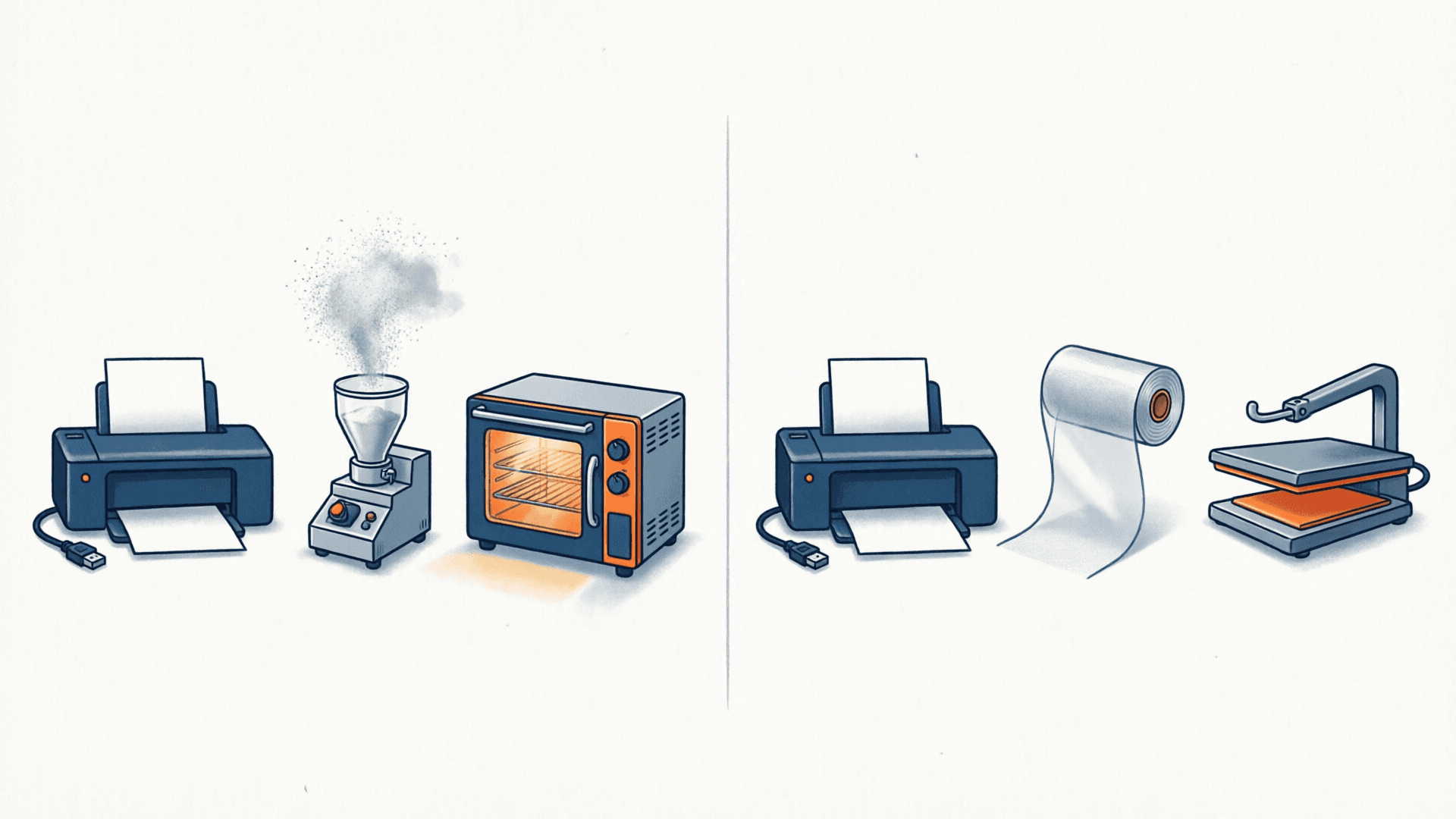
A no powder DTF printer is a direct-to-film printer that transfers designs onto fabric without applying hot-melt adhesive powder to the wet ink. In standard DTF, the printer lays down ink on PET film, then a shaker coats that ink with TPU adhesive powder, which is cured in an oven before heat pressing. A powderless system removes that middle stage. The adhesive is delivered another way, so the operator prints, cures, and presses without ever touching loose powder.
The term “powderless DTF printer” and “no powder DTF printer” describe the same thing. Both refer to eliminating the granular TPU powder that gives traditional DTF its bond to fabric. If you are new to the underlying process, our guide on what is a DTF printer covers the standard workflow first, which makes the powderless difference easier to follow.
Powder is not a minor detail in traditional DTF. It is the layer that actually bonds ink to cloth, and it is also the messiest, most maintenance-heavy part of the process. Removing it changes the machine design, the consumables, and the economics all at once. That is why “no powder” is treated as a distinct category rather than a small tweak.
How Powderless DTF Printing Works
There is no single powderless method. Three technical routes exist, and each replaces the powder in a different way.
1. Integrated-adhesive ink. The adhesive is formulated directly into the ink. As the printed layer dries, it becomes heat-activated on its own, ready to transfer without any separate coating step. This is the cleanest approach but the hardest to engineer, because the ink must jet reliably through the printhead while also carrying bonding chemistry.
2. Pre-coated adhesive film. A specialized DTF film already carries an adhesive layer. When ink is printed onto it, the two interact to form a bondable surface under heat. The complexity moves from the printer to the consumable, which raises film cost but simplifies the machine.
3. Liquid adhesive system. The printer applies white ink, color ink, and a liquid glue in a controlled sequence onto the film. This is the closest analog to standard DTF, just with liquid glue replacing powder shaking. It keeps color performance familiar while removing the dust.
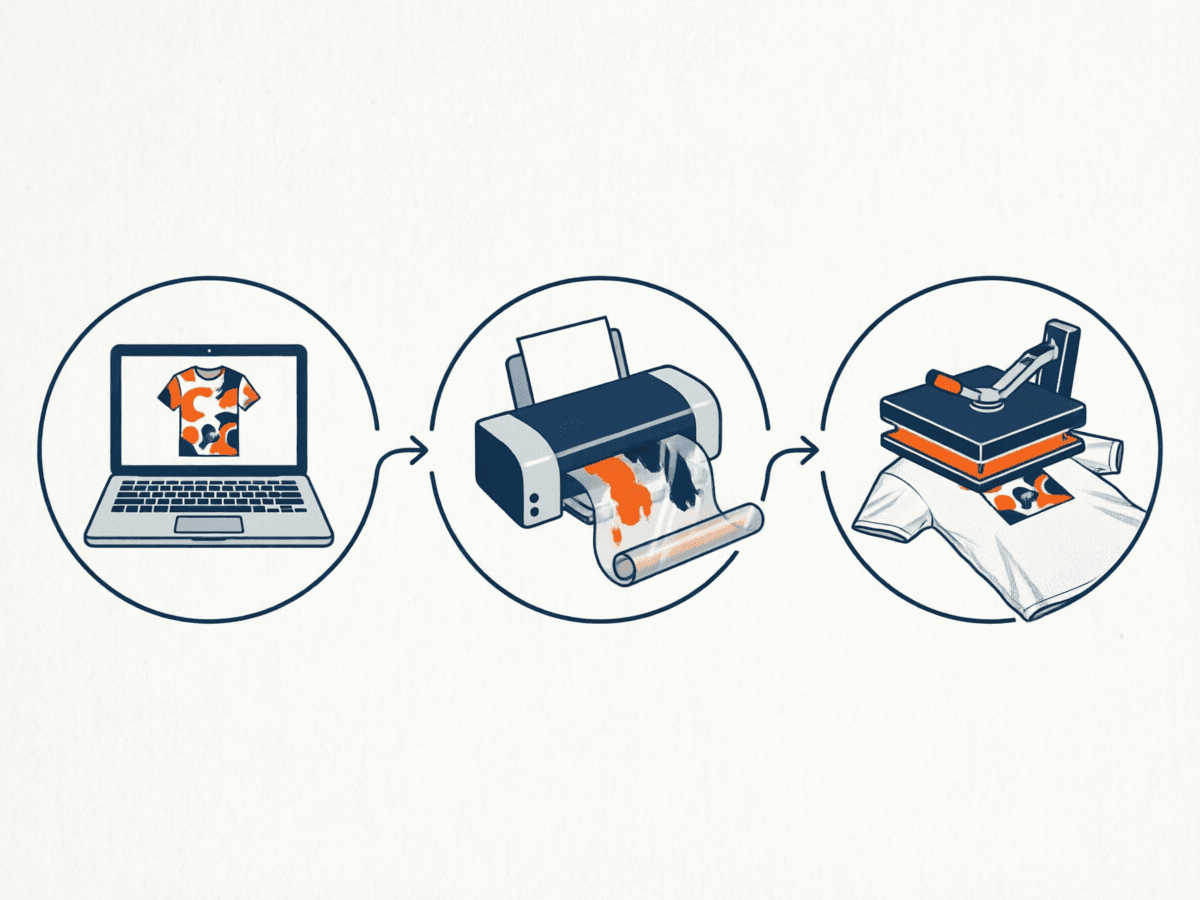
Whichever route is used, the operator workflow collapses to three steps: design, print (ink plus integrated adhesive), and heat press. There is no shaker to load, no powder to recover, and no dedicated curing tunnel needed for powder fusion. For a shop running out of a small studio, that footprint reduction is the headline benefit.
No Powder DTF vs Traditional DTF: Side-by-Side
| Feature | Traditional DTF (with powder) | No Powder DTF |
|---|---|---|
| Adhesive method | TPU powder applied by shaker | Integrated ink, coated film, or liquid glue |
| Workflow steps | Print, powder, cure, press | Print, cure, press |
| Airborne dust | Yes (requires ventilation) | None |
| Equipment footprint | Larger (shaker + curing tunnel) | Smaller |
| Hand feel | Standard, slightly firm | Thinner, softer |
| Wash durability | 50 to 100+ cycles | ~30 to 40 cycles (current systems) |
| High-temp wash (>40°C) | Tolerant | Can degrade faster |
| Production speed | High with automated shaker | Optimized for lower volume today |
| Consumable cost | Ink + film + powder | Depends on route (special ink/film) |
| Maturity (2026) | Mature, industry standard | Emerging, active development |
Durability figures reflect independent field testing patterns reported across the industry and evaluated against AATCC wash-fastness standards. Last updated: July 2026.
The honest read on this table: powderless wins on cleanliness, footprint, and feel, while traditional powder DTF still wins on proven durability and throughput. If you print thousands of shirts a month that must survive heavy laundering, standard DTF remains the safer commercial bet in 2026. If you run short runs, premium soft-feel apparel, or work in a space where powder dust is a real problem, powderless earns its place.
Why Remove the Powder At All?
Three problems drive the whole powderless movement.
Health and workspace safety. TPU powder goes airborne easily. Fine particulate in a print shop is both a cleaning burden and a respiratory concern, which is why powder-based operations need proper ventilation. Workplace dust exposure is a recognized occupational hazard, and guidance from bodies such as OSHA treats airborne particulate control as a genuine safety issue. Removing powder removes that exposure at the source.
Hand feel and breathability. Granular powder builds a measurable layer on the fabric. Prints can feel plasticky and sit stiff on the shirt. Powderless routes typically apply a thinner bonding layer, so the design integrates more into the fibers, giving a softer, more breathable result that premium apparel buyers notice.
Process simplification and cost. Powder means a shaker, a recovery system, a curing tunnel, and a recurring powder line item. Every one of those is a point of maintenance and failure. Cutting the powder step cuts labor, machine complexity, and material waste. For operations that already track sustainability against standards like OEKO-TEX, less waste and fewer airborne particles are a real advantage.
None of this makes powder obsolete overnight. It explains why serious manufacturers keep investing in getting rid of it.
The Israel Benchmark: Kornit’s No-Powder Direction
The strongest proof that no-powder printing is the industry’s direction comes from Israel. Kornit Digital, a global leader in sustainable textile printing, markets its Presto MAX as a single-step direct-to-fabric solution that eliminates the need for pre-treatment and powder entirely. Kornit’s own materials describe it as an on-demand, single-step process using water-based NeoPigment inks certified to GOTS and ECO Passport standards. You can see the system on the Kornit Presto MAX page.
Kornit’s approach validates the concept at the highest end of the market. But it is worth being clear about scale. Presto MAX is an industrial roll-to-roll machine printing up to 180 cm wide at hundreds of square meters per hour, priced as an enterprise capital investment. It proves the direction is sound. It does not put no-powder printing within reach of a typical DTF shop.
That gap, between a proven enterprise-scale concept and an accessible machine, is exactly where the interesting work is happening.
Fujia’s Powderless DTF R&D: 2022 to Today
We did not wait for the market to tell us powder was a problem. Our customers told us first, every time they complained about dust, stiff hand feel, and the maintenance load of a shaker line.
Fujia started powderless DTF research in 2022. The problem is not one part, it is a system. To remove powder cleanly you have to re-coordinate the DTF ink, the DTF film, the printer mechanics, and the printhead together, because the adhesive function that powder used to provide now has to live somewhere else without breaking jetting reliability or color.
By 2025 we reached a working solution: a DTF printer configuration that removes the hot-melt powder step. It currently runs with a select group of our private clients rather than as an open catalog product. We are treating it the way any responsible manufacturer should treat an emerging process, proving durability and consistency in real production before putting it in front of the whole market.
We will say plainly what it is and is not. In principle our solution addresses the same no-powder goal that the Israeli industrial systems pursue. In practice it is early, it is private, and standard powder-based DTF is still what we recommend for most buyers who need proven, high-volume wash durability today. If you want to understand the machines that are ready now, the DTF printer for beginners guide is the right starting point, and the DTF powder buying guide explains the consumable that powderless printing aims to replace.
Should You Buy a No Powder DTF Printer in 2026?
Match the technology to your real workload rather than the hype.
Choose traditional DTF if you need proven durability at volume, you laundry-test to 50+ cycles, or you already run a stable powder line. It is mature, well supported, and predictable.
Consider powderless DTF if dust control is a serious constraint in your space, you sell premium soft-feel apparel in shorter runs, or you want the simplest possible operator workflow and can accept current durability limits.
Watch this space if you are a high-volume producer. The durability gap is closing, and the manufacturers with in-house ink, film, printer, and printhead capability are the ones most likely to close it first. That full-stack control is the whole reason powderless is hard, and the reason it will eventually be solved.
For businesses that want early visibility into powderless DTF or a factory-direct standard DTF system that ships today, contact Fujia Print for specifications and private-access inquiries.
Can you print DTF without powder?
Yes, you can print DTF without powder, but the adhesive function still has to come from somewhere. Powderless DTF systems replace the hot-melt TPU powder with one of three alternatives: an ink that has adhesive built into its formulation, a film that is pre-coated with an adhesive layer, or a liquid glue that the printer applies in a controlled pass. In every case the goal is the same bond that powder normally provides, delivered without loose dust. The practical result is a cleaner, shorter workflow of print, cure, and press. The trade-off in 2026 is durability. Independent field testing suggests current powderless prints hold up for roughly 30 to 40 wash cycles, while traditional powder-based DTF commonly reaches 50 to 100 or more, so heavy-laundering applications still favor powder today.
Is DTF powder required for good wash durability?
Right now, for maximum wash durability, powder still has the edge. Traditional DTF using TPU hot-melt powder consistently reaches 50 to 100+ wash cycles because the cured powder forms a robust, well-understood bonding layer between ink and fabric. Powderless systems currently trail this, with many formulations showing wear after 30 to 40 cycles and greater sensitivity to high-temperature washing above 40°C. That said, powder is not the only path to durability, it is simply the most mature one. The adhesive chemistry in powderless ink and film is improving quickly, and the gap is narrower than it was even a year ago. If your products face frequent, hot, or industrial laundering, choose powder-based DTF for now. If your prints see gentler home laundering and you value hand feel and a clean shop, powderless durability may already be sufficient for your use case.
What can I use instead of DTF powder?
There are three established alternatives to loose DTF powder, and they map to the three powderless routes. First, adhesive-integrated ink builds the bonding agent into the ink itself, so no separate coating step is needed. Second, pre-coated adhesive film carries the bonding layer on the consumable, so the film does the job the powder used to do. Third, a liquid adhesive system lets the printer lay down glue in a precise pass instead of shaking on granules. Each option removes airborne dust and shortens the workflow. What you should not do is simply skip powder on a standard DTF setup and hope for a bond, because a conventional machine and ink are designed to rely on that powder layer. Going powderless properly means using a system where the ink, film, and printer are engineered together for it, which is why it is treated as its own equipment category.
Is powderless DTF the same as DTG or the Kornit process?
They share a goal but are not identical. Direct-to-garment (DTG) printing sprays ink straight onto the fabric and usually needs pretreatment, while DTF and powderless DTF print onto a film that is then transferred. Kornit’s Israeli systems, such as the Presto MAX, are single-step direct-to-fabric machines that also eliminate powder and pretreatment, which is why they are often cited as the benchmark for no-powder printing. The key differences are scale and method. Kornit’s platforms are large industrial roll-to-roll systems built for enterprise volume and priced accordingly. Most powderless DTF printers aimed at ordinary shops keep the film-transfer model but remove the powder stage, targeting a far more accessible price point. So powderless DTF borrows the same no-powder principle proven at industrial scale, adapted toward the equipment size and budget a typical decorator can actually use.
When will no powder DTF printers be mainstream?
No powder DTF is emerging rather than mainstream in 2026, and the timeline depends on one thing above all: durability parity at production volume. The cleanliness, footprint, and hand-feel advantages are already real and shipping. What holds powderless back from replacing standard DTF is wash performance under heavy laundering, and that is a chemistry and systems-integration problem, not a marketing one. The manufacturers most likely to solve it are those that control ink, film, printer, and printhead development together, because the adhesive that powder used to provide has to be redistributed across all of those parts without breaking reliability. Expect steady, incremental gains rather than a single overnight switch. As formulations mature and independent testing confirms durability closer to powder-based results, adoption will move from private and premium use toward the general market. For now, treat powderless as a strong emerging option and standard DTF as the proven default.
