

A UV DTF printer bundle combines a UV DTF printer with the AB film, UV ink, and software needed to produce crystal-clear transfers for glass, metal, and wood on day one. This guide breaks down exactly what a complete bundle includes, what it costs in 2026, and how to choose the right configuration for your shop.

Key Takeaways
- A UV DTF printer bundle typically includes the printer, A film, B film, UV ink, and RIP software, with an optional laminator for roll-to-roll work.
- A1 production bundles print 65 cm wide with 3-4 heads; A3 desktop bundles print 30 cm wide with 1-2 heads.
- 2026 market prices run from $2,099 for entry desktop units to $17,104 for 17-inch roll-to-roll production systems.
- UV DTF transfers apply by hand in 10-15 seconds and reach full cure in 24 hours, with no powder or heat press required.
- Fujia UV DTF bundles add a 12-month warranty, 48-hour parts dispatch, and 3-day remote onboarding.
What Is a UV DTF Printer Bundle?
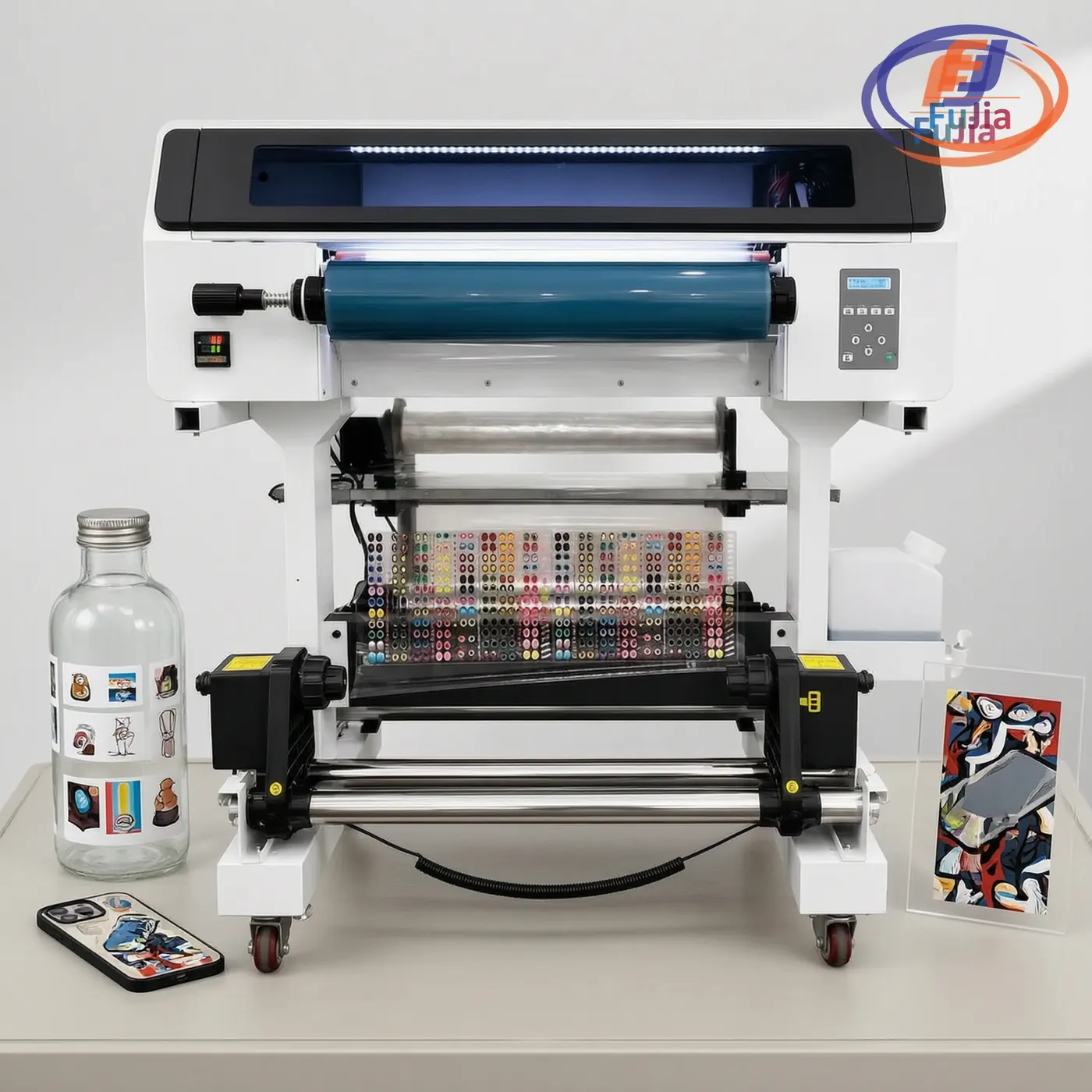
A UV DTF printer bundle is a ready-to-run package centered on a UV DTF printer, a machine that prints full-color artwork plus white and varnish onto a special two-layer “AB film” and cures it instantly with a UV-LED lamp. The finished A+B film is then pressed by hand onto hard surfaces such as glass, acrylic, metal, wood, and phone cases. Unlike regular DTF, the UV DTF process needs no hot-melt powder and no heat press for rigid items.
The Fujia UV DTF printer lineup ships in two width classes: A1 units at 65 cm for production and A3 units at 30 cm for desktop use. Both classes share the same AB-film workflow, so the bundle question is really about which width, how many printheads, and which consumables are pre-included.
| Feature | UV DTF bundle | Regular DTF bundle |
|---|---|---|
| Transfer film | AB film (A + B, no powder) | PET film + hot-melt powder |
| Target surfaces | Glass, metal, wood, acrylic, phone cases | Fabric (cotton, polyester blends) |
| Curing method | UV-LED instant cure | Heat press at 160°C for 15s, cold peel |
| Apply method | Hand press 10-15s, 24h full cure | Heat press, then peel |
| Typical width | 30 cm or 65 cm | 30 cm, 42 cm, or 65 cm |
What’s Inside a UV DTF Printer Bundle
A complete bundle goes beyond the printer body. The table below lists the standard components and the Fujia specifications you should expect at each slot.
| Component | Role | Fujia spec |
|---|---|---|
| Printer | Prints color + white + varnish onto A film | UVDTF-A1-3-4H, 65 cm, 3-4 heads |
| A film | Print-receptive PET layer | ABF-A1, 60 cm, 75-100 μm thickness |
| B film | Adhesive transfer layer laminated to A | PET + paper construction |
| UV ink | CMYK + White + Varnish, custom formula | UVI-STD, low-VOC solvent-free |
| RIP software | Color management and ICC profiles | Maintop / Photoprint |
| Laminator (optional) | Bonds A + B for roll-to-roll output | Included on some bundles |
Most UV DTF bundles run on Epson I3200 or XP600 printheads (Epson), the same industrial heads used across the Fujia DTF and UV lines. The UV DTF AB film itself is the real consumable cost driver: a 60 cm A1 roll at 75-100 μm supports both crystal-label and flat application work. Fujia’s UV ink uses a custom high-end formula compatible with roll-to-roll, flatbed, and UV DTF printers, which simplifies inventory for shops running more than one technology.
How Much Does a UV DTF Printer Bundle Cost?
Live 2026 listings show a wide spread. The table below quotes competitor bundles pulled from current search results so you can benchmark against the Fujia range.
| Bundle | Width | 2026 price | Source |
|---|---|---|---|
| eufyMake E1 UV DTF + rotary & laminator | Desktop | $2,099-$2,899 | eufyMake (SERP) |
| Inksonic DTF bundle (reference, regular DTF) | 30 cm | $2,199-$3,899 | Inksonic (SERP) |
| Heatpressnation UV 12″ DTF bundle | 12 in | $17,103.95 | Heatpressnation (SERP) |
| Uninet 3000 UV DTF | 17 in roll-to-roll | Quote only | Uninet (SERP) |
Fujia’s own bundles follow the same width logic. Based on data from our customers across 50+ countries, complete A1 UV DTF bundles (65 cm, 3-4 heads) typically land in the $8,000-$18,000 range, while A3 desktop bundles (30 cm, 1-2 heads) run $2,000-$3,500. The UV DTF printer price guide tracks current Fujia configurations in more detail. The headline number rarely tells the whole story: warranty length, parts dispatch speed, and included consumable quantities shift the real cost per finished label by a wide margin.
UV inks are low-VOC and solvent-free, which lowers workshop emissions and simplifies compliance in enclosed spaces (EPA). That environmental profile is one reason UV DTF has displaced pad printing and screen printing in many gift and label shops.
Is a UV DTF Printer Bundle Worth It?
The payback case is strong for shops producing short runs on hard items. The Fujia customer base shows UV printing needs $0 setup versus $150-400 per screen for traditional screen printing, loads a design in 30 seconds versus 2-3 hours of screen setup, and accepts an MOQ of 1 versus 500+ for screen. In the product-labeling segment, UV DTF label cost runs $0.02-0.05 per label at throughput of 1,000-5,000+ labels per day.
Across the 500+ print businesses Fujia serves, UV DTF payback typically falls within 3-8 months once daily label or sticker volume clears a few hundred pieces. The Kenya glassware workshop case study recorded +50% daily output (200 to 300 pieces per day) and -40% material waste (15% to 9%) after switching to UV printing. For a shop already outsourcing crystal labels or screen-printed tags, bringing the work in-house removes the per-order markup that erodes margin on small batches.
Can a Regular DTF Printer Print UV DTF?
A regular DTF printer cannot produce UV DTF transfers without major modification. Regular DTF deposits CMYK + white ink onto PET film, coats it with hot-melt powder, cures the powder, and presses the design onto fabric at 160°C for 15 seconds with a cold peel. UV DTF instead prints onto A film, laminates a B adhesive film on top, and cures with a UV-LED lamp, then transfers to rigid surfaces by hand pressure.
The film, ink chemistry, and curing hardware are different enough that the two workflows do not share consumables. Shops wanting both fabric DTF and hard-surface UV DTF normally run two separate machines. The UV DTF vs UV flatbed guide explains how UV DTF compares to a flatbed that prints directly onto objects, a useful distinction when allocating floor space.
Is There a Printer That Does DTF and UV DTF?
A small number of hybrid units claim to do both. The eufyMake E1, for example, is marketed as a UV DTF and direct-to-object printer with an optional rotary and laminator at $2,899. These combos work for very low volume and mixed materials, but production shops hit limits on width and speed quickly.
Most growing businesses run a dedicated DTF printer for apparel and a dedicated UV DTF printer for hard goods, sourcing both from one factory to keep training, parts, and support under a single accountable supplier. Fujia manufactures both lines in the same 3,500 m² Guangzhou facility, which the China factory sourcing guide covers in practical detail. Consolidating suppliers also shortens delivery: standard machines ship within 7 days of order confirmation.
How to Choose the Right UV DTF Printer Bundle
Width and head count drive both price and capacity. A 30 cm A3 bundle suits Etsy sellers and sample studios; a 65 cm A1 bundle with 3-4 heads suits decor, gift, and label production. Check the included consumable quantities, because a cheap printer with a thin film allowance costs more per label than a complete bundle.
Fujia’s differentiators matter for uptime. The transmission stack uses Honson mainboards, Leadshine servo motors, and THK silent guide rails, the same component trio behind 12-hour continuous DTF runs at the Turkish garment factory. The UV line supports 300+ tested substrates and reaches 3H+ pencil hardness with varnish, while transfers apply in 10-15 seconds and cure fully in 24 hours. Fujia holds ISO 9001 and CE certifications (ISO), and backs every printer with a 12-month warranty, 48-hour parts dispatch, and a 3-day remote onboarding plan (Day 1 hardware, Day 2 RIP + ICC, Day 3 first perfect print).
The UV DTF printer buying guide walks through head configurations, bed options, and workflow layout for specific shop sizes.
How much does a UV DTF printer cost?
UV DTF printer pricing in 2026 spans a wide range tied directly to width and printhead count. Entry desktop hybrids like the eufyMake E1 list between $2,099 and $2,899 with a rotary and laminator included. Mid-size 12-inch UV DTF bundles from US resellers reach $17,103.95, while 17-inch roll-to-roll production systems such as the Uninet 3000 are quote-only. Fujia’s own A3 desktop bundles (30 cm, 1-2 heads) typically run $2,000-$3,500, and A1 production bundles (65 cm, 3-4 heads) land in the $8,000-$18,000 band based on data from our customers across 50+ countries. The sticker price is only part of the math: warranty length, parts dispatch speed, and the amount of AB film and UV ink pre-included shift the real cost per finished label. Shops should also budget for RIP software and, on roll-to-roll units, a laminator. Comparing the per-label cost against outsourced screen printing usually shows payback inside 3-8 months once daily volume clears a few hundred pieces.
Is a UV DTF printer worth it?
A UV DTF printer is worth it for shops producing short runs of stickers, labels, and hard-surface decor where screen printing or outsourcing adds setup cost and delay. The Fujia customer base shows UV printing needs $0 setup versus $150-400 per screen, loads a design in 30 seconds versus 2-3 hours of screen prep, and accepts an MOQ of 1 versus 500+ for traditional screen work. Per-label cost runs $0.02-0.05 at throughput of 1,000-5,000+ labels per day, and the Kenya glassware workshop recorded +50% daily output and -40% material waste after switching. Payback across the 500+ print businesses Fujia serves typically falls within 3-8 months. The main caveat is volume: below a few hundred labels per day, the fixed cost of the bundle outweighs the savings, and a hybrid desktop unit may be the better first step. For decor, gift, and product-labeling shops, the no-powder, no-heat-press workflow also cuts labor and floor-space requirements.
Is there a printer that does DTF and UV DTF?
A few hybrid printers claim to handle both DTF and UV DTF in one machine. The eufyMake E1 is the best-known example, sold as a UV DTF and direct-to-object printer with an optional rotary and laminator at $2,899. These units suit very low volume and makers who print on mixed materials, but they cap out on width and speed quickly and are not built for production throughput. Most growing businesses instead run a dedicated DTF printer for apparel and a dedicated UV DTF printer for hard goods, sourcing both from a single factory to keep training, parts, and support under one accountable supplier. Fujia manufactures both lines in the same 3,500 m² Guangzhou facility, which simplifies warranty, onboarding, and consumable reordering. The practical takeaway is that true “both in one” machines exist but serve the entry tier, while scaling shops benefit from two specialized machines.
Can a regular DTF printer print UV DTF?
A regular DTF printer cannot print UV DTF transfers without substantial hardware and consumable changes. Regular DTF lays CMYK and white ink onto PET film, shakes hot-melt powder across it, cures the powder, and presses the design onto fabric at 160°C for 15 seconds with a cold peel. UV DTF uses a different film pair, a different ink chemistry, and a UV-LED curing lamp, then transfers to rigid surfaces by hand pressure in 10-15 seconds with a 24-hour full cure. The film, ink, and curing systems do not share components, so the two workflows stay separate in practice. Shops wanting both fabric and hard-surface decoration normally operate two machines rather than converting one. The UV DTF vs UV flatbed comparison is also worth reading, because a flatbed prints directly onto objects while UV DTF prints onto film first, and the right choice depends on whether you need dimensional objects or flat stickers and labels.
What comes in a UV DTF printer bundle?
A complete UV DTF printer bundle includes more than the printer body. The core components are the UV DTF printer itself, A film (the print-receptive PET layer, 60 cm wide on A1 units at 75-100 μm), B film (the adhesive transfer layer), UV ink in CMYK plus white and varnish, and RIP software for color management and ICC profiles. Some roll-to-roll bundles add a laminator that bonds the A and B films automatically. Fujia’s A1 bundle centers on the UVDTF-A1-3-4H at 65 cm with 3-4 heads, while the A3 bundle uses 30 cm width with 1-2 heads. The UV ink is a custom low-VOC formula compatible with roll-to-roll, flatbed, and UV DTF printers, which helps shops standardize inventory. Beyond hardware, Fujia bundles include a 12-month warranty, 48-hour parts dispatch, and a 3-day remote onboarding plan. Buyers should confirm the included film and ink quantities, because a low printer price with minimal consumables raises the true cost per label.
Start Your UV DTF Bundle With a Free Sample
Fujia has built UV DTF and DTF printers in its 3,500 m² Guangzhou factory since 2011, serving 500+ print businesses across 50+ countries with ISO 9001 and CE certified quality. Every bundle ships with a 12-month warranty, 48-hour parts dispatch, and 3-day remote onboarding led by real engineers. Send us your design and a sample material and we will print it on our UV DTF line, record the process, and ship the sample back at no cost. Contact the Fujia team today to match a 30 cm desktop or 65 cm production bundle to your shop.
