

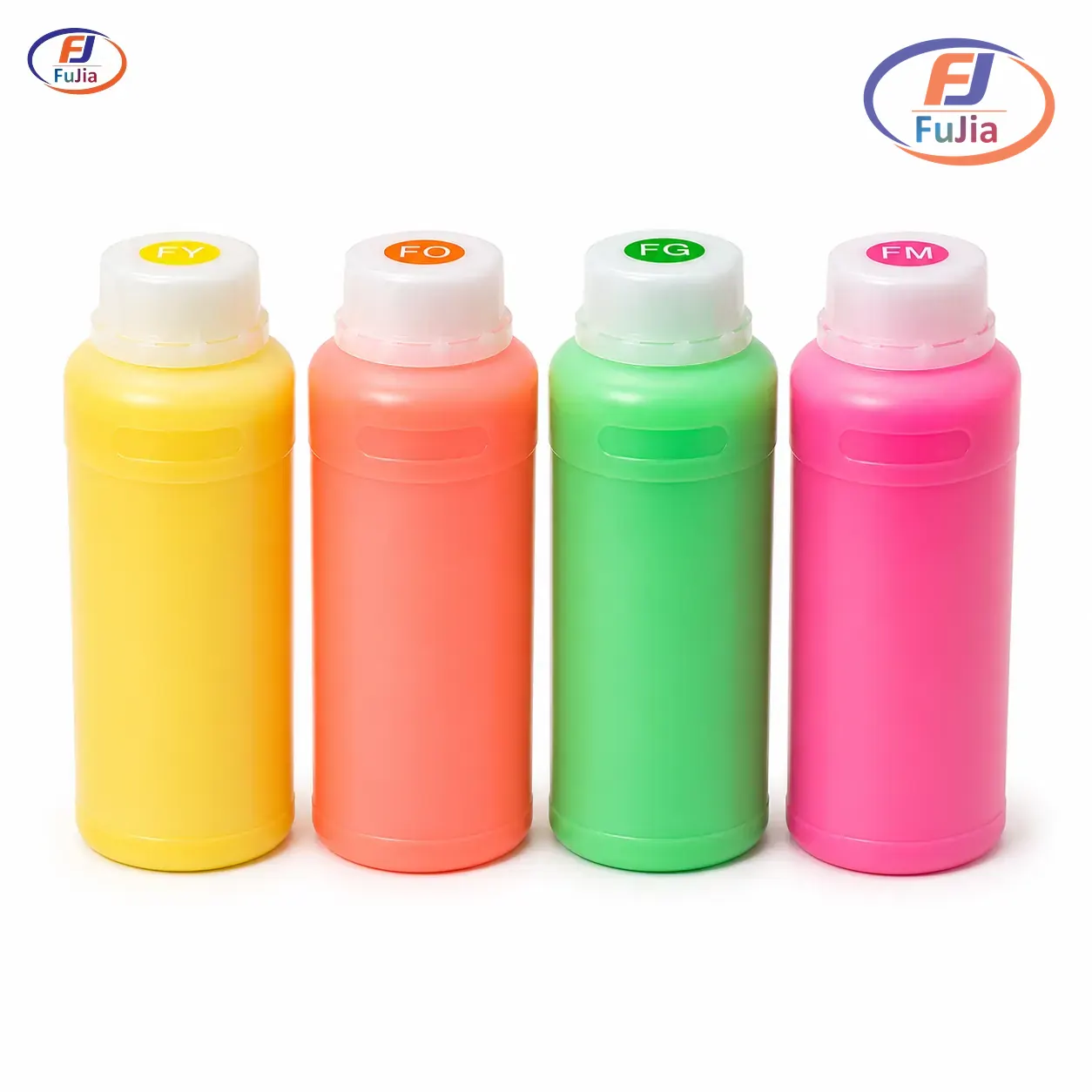
DTF fluorescent ink is a neon pigment ink that produces vivid colors in normal light and glows under UV or blacklight, letting shops add high-visibility designs to apparel and hard goods. This guide covers how it works, printer compatibility, wash life, and how Fujia’s DTI-FLR formula performs in production.
Key Takeaways
- DTF fluorescent ink glows under UV or blacklight but is not a true glow-in-the-dark ink.
- Fujia’s DTI-FLR runs inside the 13-color DTF system (CMYK + LC/LM + Orange/Red/Green/Blue).
- The formula uses imported premium resin and pigment for high concentration and smooth jetting.
- Wash durability reaches 50+ heavy machine washes at AATCC Grade 4-5 when paired with Fujia film.
- Fujia backs DTI-FLR with ISO 9001 and CE certification, a 2-year warranty, and 48-hour parts dispatch.
What Is DTF Fluorescent Ink?

DTF fluorescent ink is a pigment ink loaded with neon colorants that absorb UV or blacklight energy and re-emit it as bright visible light. Under ordinary lighting the colors look saturated and punchy; under a UV or blacklight booth they glow. The ink prints onto DTF PET film through the same printheads as standard DTF ink, then transfers to fabric with hot-melt powder at 160°C for 15 seconds using a cold peel. Fujia’s full DTF printer lineup and the DTF ink types guide cover compatible hardware and the broader ink range.
The difference from regular DTF ink is the colorant chemistry. Standard CMYK inks use conventional pigments for accurate reproduction, while fluorescent inks trade some tonal accuracy for eye-catching brightness. Most shops run fluorescent ink as spot colors alongside the core CMYK set rather than as a full replacement.
| Property | Fluorescent DTF ink | Standard DTF ink |
|---|---|---|
| Light behavior | Glows under UV/blacklight | No glow |
| Typical use | Spot neon colors, accents | Full-color base artwork |
| Printheads | Epson I3200 / XP600 / I1600 | Same |
| Transfer process | 160°C, 15s, cold peel | 160°C, 15s, cold peel |
| Color system slot | Added to 13-color set | CMYK + LC/LM base |
How DTF Fluorescent Ink Works
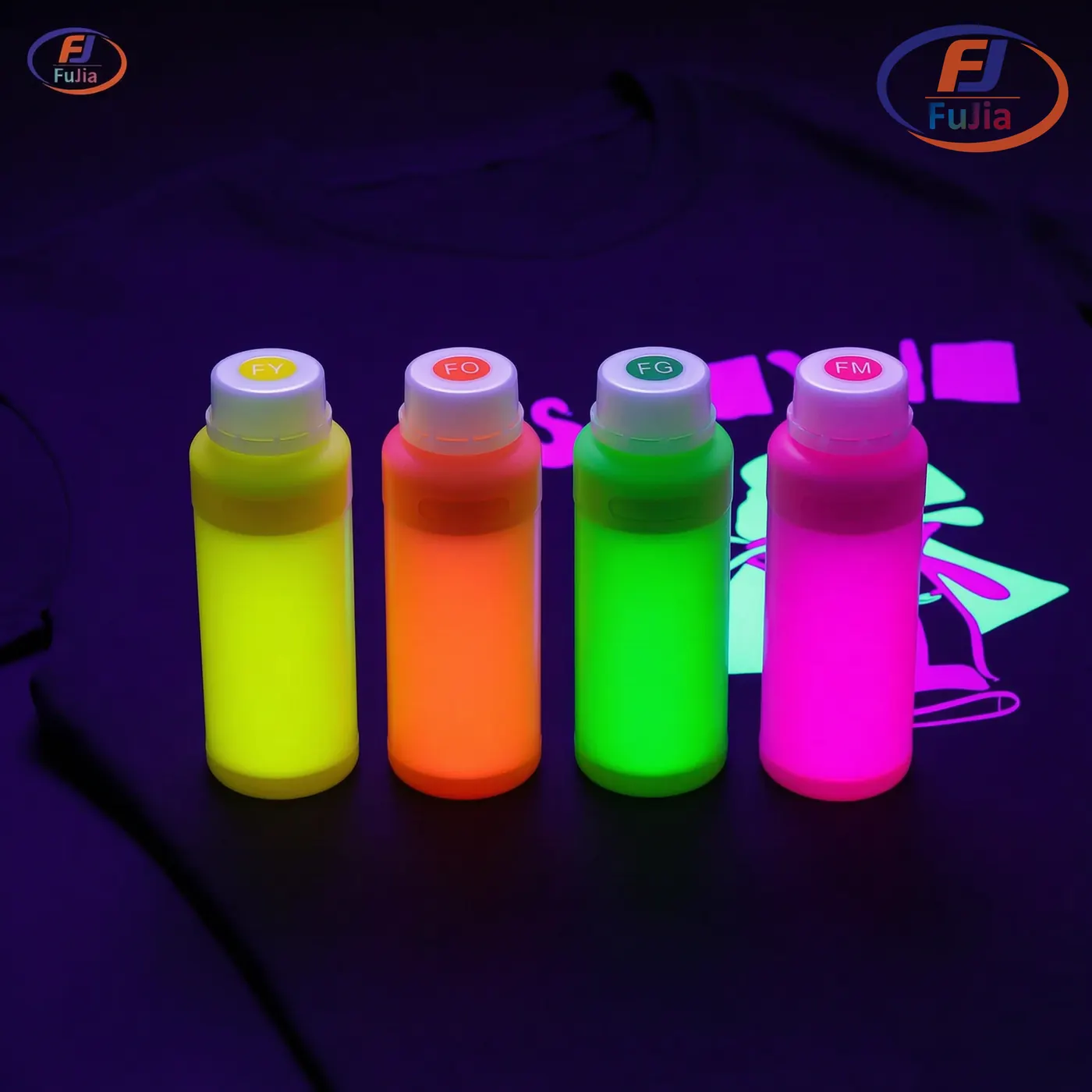
Fujia’s DTI-FLR fluorescent ink sits inside the brand’s 13-color DTF system: CMYK plus Light Cyan and Light Magenta, then Orange, Red, Green, and Blue. Fluorescent colors extend that palette for neon yellow, pink, orange, and green effects that would be impossible with standard inks alone. The ink uses imported premium resin and pigment raw materials with high concentration, uniform particle size, and smooth viscosity, which keeps nozzles from clogging during long runs.
The printhead and ink supply matter for consistency. Fujia DTF printers use a siphon plus positive-pressure supply holding 1,000-1,500 ml per color in a continuous ink system, and an auto white-ink circulation system prevents pigment precipitation during idle time. Those engineering details protect fluorescent output because neon pigments are denser and settle faster than standard colorants.
Printer Compatibility
DTF fluorescent ink works on any DTF printer built around Epson printheads, which covers the vast majority of desktop and production DTF machines (Epson). Fujia’s own range uses Epson I3200 on A1 units and configurable Epson heads on A2/A3 models, all fed through the same CISS architecture. The key requirement is a clean, dedicated channel or spot-color slot so fluorescent ink never mixes with the CMYK lines.
Shops should confirm the RIP software maps the fluorescent channel correctly. Maintop, Photoprint, Flexi, and RIIN all support extra spot colors, and Fujia supplies ICC profiles tuned for the DTI-FLR formula. Running a nozzle check before a neon job avoids banding, because fluorescent inks show density variations more obviously than standard colors under normal light.
Wash Durability and Adhesion
Wash life depends on the film and powder as much as the ink. Fujia’s DTF transfer film uses a self-developed, 5-year-iterated Hengli virgin PET base with a proprietary coating, and the combination with DTI-FLR holds up to 50+ heavy machine washes. Color fastness measures AATCC Grade 4-5, the same rating Fujia quotes across its apparel case studies (AATCC).
For fluorescent designs, two habits protect durability. First, cure the powder fully so the adhesive bonds before the cold peel. Second, avoid overloading neon areas, because thick fluorescent layers can crack sooner than a balanced CMYK base. Across the 500+ print businesses Fujia serves, apparel decorated with fluorescent accents typically keeps its glow through the same 50+ wash window as the surrounding artwork.
Is DTF Fluorescent Ink Worth It?
Fluorescent ink pays off for shops serving nightlife, sports, music, safety, and promotional markets where visibility sells the product. A custom apparel brand can add a neon SKU line without buying a second printer, and event merch gains a blacklight-friendly option that standard inks cannot match. The Brazilian creative studio case study shows how one extra capability expanded a small shop’s order mix after switching to in-house DTF.
Based on data from our customers across 50+ countries, shops that add fluorescent ink report the strongest return when they already run steady DTF volume and simply slot neon jobs into existing capacity. The incremental cost is the ink itself plus a dedicated channel, not new hardware. For purely corporate or muted-brand work, fluorescent adds little, so the worth-it question really hinges on whether the customer base values standout color.
How to Use DTF Fluorescent Ink
Treat fluorescent ink as a spot color, never a blend inside a CMYK channel. Load it into a clean dedicated slot, run a nozzle check, and print neon areas as solid spot fills or highlights rather than gradients. Keep the white-ink base layer under neon colors because the glow reads strongest over an opaque white ground on dark garments.
Daily maintenance stays simple: a 3-5 minute wipe of the capping station plus a nozzle check, supported by Fujia’s automatic sealed moisturizing system. The DTF printer maintenance guide covers the full routine that keeps fluorescent channels firing. Because neon pigments are denser, the auto circulation feature matters more for fluorescent stock than for standard colors.
What is DTF fluorescent ink?
DTF fluorescent ink is a pigment-based Direct-to-Film ink containing neon colorants that absorb UV or blacklight energy and re-emit it as bright visible light. In normal room lighting the colors appear saturated and vivid; under a UV or blacklight booth they glow. The ink prints through the same Epson printheads as standard DTF ink onto PET film, then transfers to fabric with hot-melt powder at 160°C for 15 seconds using a cold peel. Fujia’s DTI-FLR version sits inside a 13-color DTF system that pairs CMYK and Light Cyan/Light Magenta with Orange, Red, Green, Blue, and fluorescent spot colors. The formula uses imported premium resin and pigment with uniform particle size and smooth viscosity to keep nozzles clear during long runs. Shops typically treat fluorescent ink as a spot color for accents and neon highlights rather than a full replacement for the CMYK base.
Does DTF fluorescent ink glow in the dark?
DTF fluorescent ink glows under UV light or blacklight, but it is not a true glow-in-the-dark ink. A genuine glow-in-the-dark effect needs phosphorescent material that stores light and releases it slowly in total darkness, whereas fluorescent ink only emits while a UV or blacklight source is shining on it. Once the UV source is removed, the glow stops. This distinction matters for buyers: fluorescent DTF transfers are perfect for clubs, concerts, gyms, and trade-show booths with blacklight fixtures, but they will not glow on a dark shelf with no UV source. For designs that must shine without any light, a shop would need a separate phosphorescent or reflective additive, not standard fluorescent DTF ink. Most apparel and hard-goods decorators choose fluorescent specifically because the UV-reactive pop is exactly the effect their customers want.
Is DTF fluorescent ink compatible with my DTF printer?
DTF fluorescent ink works on any DTF printer built around Epson printheads, which includes the large majority of desktop and production DTF machines on the market. Fujia’s own printers use Epson I3200 on A1 units and configurable Epson heads on A2 and A3 models, all fed through a continuous ink system that holds 1,000-1,500 ml per color. The main requirement is a clean, dedicated channel or spot-color slot so fluorescent ink never mixes with the CMYK lines. RIP software such as Maintop, Photoprint, Flexi, and RIIN all support extra spot colors, and Fujia supplies ICC profiles tuned for the DTI-FLR formula. Before a neon job, run a nozzle check because fluorescent inks show density variation more clearly than standard colors. If your printer already runs ordinary DTF ink through Epson heads, adding fluorescent ink is a configuration step, not a hardware change.
How long does DTF fluorescent ink last in the wash?
DTF fluorescent ink lasts as long as the film, powder, and cure quality allow, and Fujia’s matched system holds up to 50+ heavy machine washes. Color fastness measures AATCC Grade 4-5, the same rating Fujia records across its apparel case studies, when DTI-FLR is paired with the brand’s 5-year-iterated Hengli virgin PET film and hot-melt powder. Two habits protect that lifespan: cure the powder fully so the adhesive bonds before the cold peel, and avoid overloading neon areas, because an overly thick fluorescent layer can crack sooner than a balanced CMYK base. Across the 500+ print businesses Fujia serves, apparel decorated with fluorescent accents typically keeps its glow through the same 50+ wash window as the surrounding artwork. As with any DTF print, tumble-dry low and avoid bleach to preserve both color and glow.
Can you mix fluorescent ink with regular DTF ink?
You should not mix fluorescent ink into the same channel as regular DTF ink, because the two have different pigment loads and chemistries that can clog nozzles and shift color. The correct approach is to load fluorescent ink into its own dedicated spot-color channel and print neon areas as separate spot fills or highlights, often over an opaque white base layer on dark garments. The CMYK set stays in its own channels and handles the full-color artwork, while fluorescent ink adds the glow. Fujia’s 13-color system is designed exactly for this: CMYK plus Light Cyan/Light Magenta and Orange/Red/Green/Blue leave a clean slot for fluorescent spot colors without disturbing the base palette. Trying to blend fluorescent pigment into a CMYK cartridge would also waste ink and make color management unpredictable, so a dedicated channel is both cleaner and cheaper in the long run.
Buy Fujia DTI-FLR Fluorescent Ink
Fujia has manufactured DTF ink in its 3,500 m² Guangzhou factory since 2011, serving 500+ print businesses across 50+ countries with ISO 9001 and CE certified quality (ISO). DTI-FLR fluorescent ink ships as part of the 13-color system with imported premium resin and pigment, tuned ICC profiles, and the same 2-year warranty, 48-hour parts dispatch, and 3-day remote onboarding that back every Fujia printer. Send us your neon design and a sample garment and we will print it on our DTF line, record the process, and ship the sample back at no cost. Contact the Fujia team today to add a glowing fluorescent line to your shop.
