

A sign printing machine produces outdoor and indoor signage by depositing ink onto vinyl, banner material, rigid substrates, or film using eco-solvent, UV-curable, or latex ink technology. The right machine depends on sign type (vinyl banners versus rigid boards), production volume, and whether the signs face outdoor weather exposure.
Key Takeaways
- Eco-solvent printers ($2,000-$8,000) dominate vinyl banner and vehicle wrap production with 2+ year outdoor durability
- UV flatbed printers ($2,000-$15,000) handle rigid signs on wood, acrylic, metal, and PVC foam board
- Print-and-cut combo machines ($5,000-$15,000) integrate printing with contour cutting for custom-shaped vinyl decals
- Sign printing profit margins range from 150% to 400%, with break-even at 15-30 jobs for a basic eco-solvent setup
- The global wide-format printer market continues growing as demand for custom signage expands across retail, events, and construction sectors
What Is a Sign Printing Machine?
A sign printing machine is a wide-format inkjet printer designed to produce signage on materials ranging from flexible vinyl and fabric banners to rigid boards and metal sheets. Unlike standard office printers, sign printing machines use durable ink formulations (eco-solvent, UV-curable, or latex) that resist fading, water, and UV exposure for months to years outdoors.
The five primary technologies used in sign production are eco-solvent printing, UV flatbed printing, latex printing, screen printing, and DTF transfer application. Each technology serves different substrate types, production volumes, and durability requirements. Eco-solvent printers lead the flexible signage market (banners, vehicle wraps, window graphics), while UV flatbed printers dominate rigid signage (PVC board, acrylic, aluminum composite), according to Roland DG’s sign printing equipment overview.
Types of Sign Printing Machines
Eco-Solvent Printers
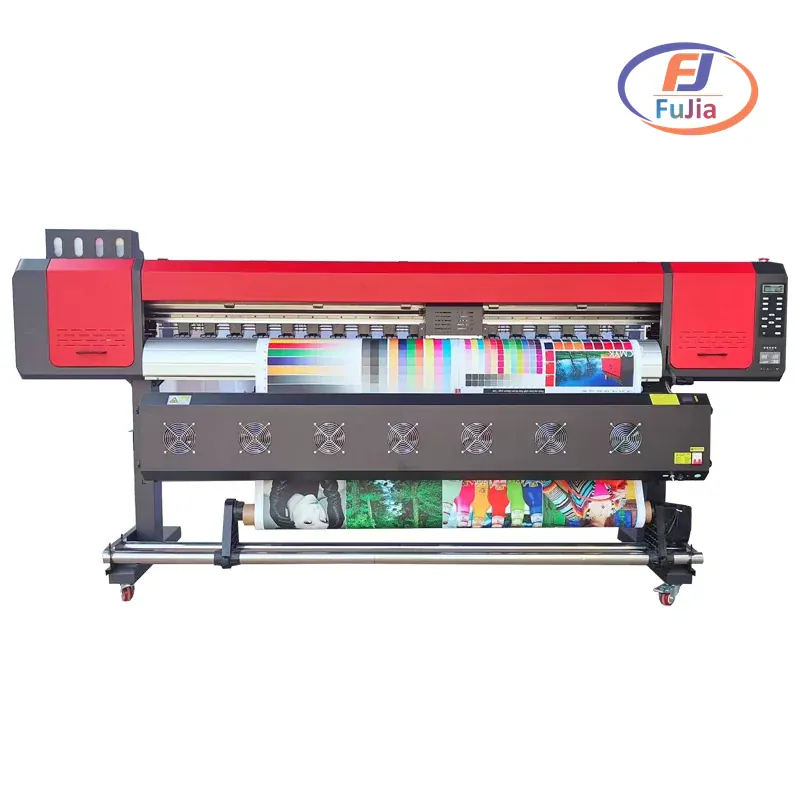
Eco-solvent printers use mild solvent-based ink that bonds with vinyl, banner material, and self-adhesive films. The ink dries through evaporation and heat, producing prints rated for 2+ years of outdoor exposure without lamination. The Fujia Print Eco-Solvent Printer handles rolls up to 1.6 meters wide with a 6-color ink system (CMYK + Light Cyan + Light Magenta), printing 3 meters of banner material in approximately 5 minutes. For a comparison of eco-solvent versus other wide-format technologies, see our eco-solvent printer buying resource.
Key advantages of eco-solvent ink include flexibility across temperatures from -20 to 60 degrees Celsius without cracking, and pre-loaded Pantone-calibrated ICC profiles for accurate color reproduction. Power consumption stays below 1,500 watts for the complete system. Entry-level eco-solvent printers from Roland and Mimaki start around $5,000-$8,000, while the Mimaki JV330 series reaches $18,500 for production-grade configurations.
UV Flatbed Printers
UV flatbed printers deposit UV-curable ink directly onto rigid sign substrates. The Fujia Print FJ-6090 A1 UV Flatbed handles 600x900mm sheets with auto height detection up to 180mm thick. The 6-color ink system (CMYK + White + Varnish) produces signs on acrylic, PVC foam board, aluminum composite, wood, glass, and metal. UV ink cures instantly under water-cooled UV-LED lamps, enabling immediate handling and stacking. Learn more about UV flatbed printer capabilities and applications.
The optional varnish channel adds spot gloss or matte finishes that increase sign value by 30-50%. The material database includes 300+ tested substrates. A single 600x900mm bed cycle fits 4-6 standard A-series signs or 2 large format rigid displays. UV flatbed printers suitable for sign production range from $2,000 for entry-level desktop models to $15,000+ for industrial systems like the Roland EU-1000MF at $79,995.
See the signage and display printing hub for a complete comparison of sign production technologies.
Print-and-Cut Combo Machines
Print-and-cut machines combine wide-format printing with integrated contour cutting in a single device. The Roland TrueVIS VG4 series ($14,238) and Graphtec vinyl cutters ($1,995) represent this category. These machines print the design, then automatically cut along a contour path defined in the RIP software, producing custom-shaped vinyl decals, lettering, and logos without manual cutting.
Screen Printing Presses
Screen printing deposits ink through mesh stencils onto sign substrates. Flatbed screen printing presses handle rigid signs, while cylinder presses accommodate flexible banners. Screen printing delivers the lowest per-unit cost for large sign runs (100+ identical pieces) but requires separate screens for each color and significant setup time. Prices range from $200 for manual tabletop presses to $23,900 for precision graphic screen printing systems from Lawson.
DTF Transfer for Signs
DTF (direct-to-film) transfers apply to fabric signs, flags, and textile banners. The Fujia Print A1 DTF 4-Head printer produces transfer film at 27 square meters per hour using four Epson I3200 printheads. The transfers bond to polyester, cotton, and blended fabrics, making DTF suitable for fabric banner signage, event backdrops, and trade show displays. DTF transfers offer full-color photographic quality without the setup costs of screen printing.
Sign Printing Machine Price Comparison
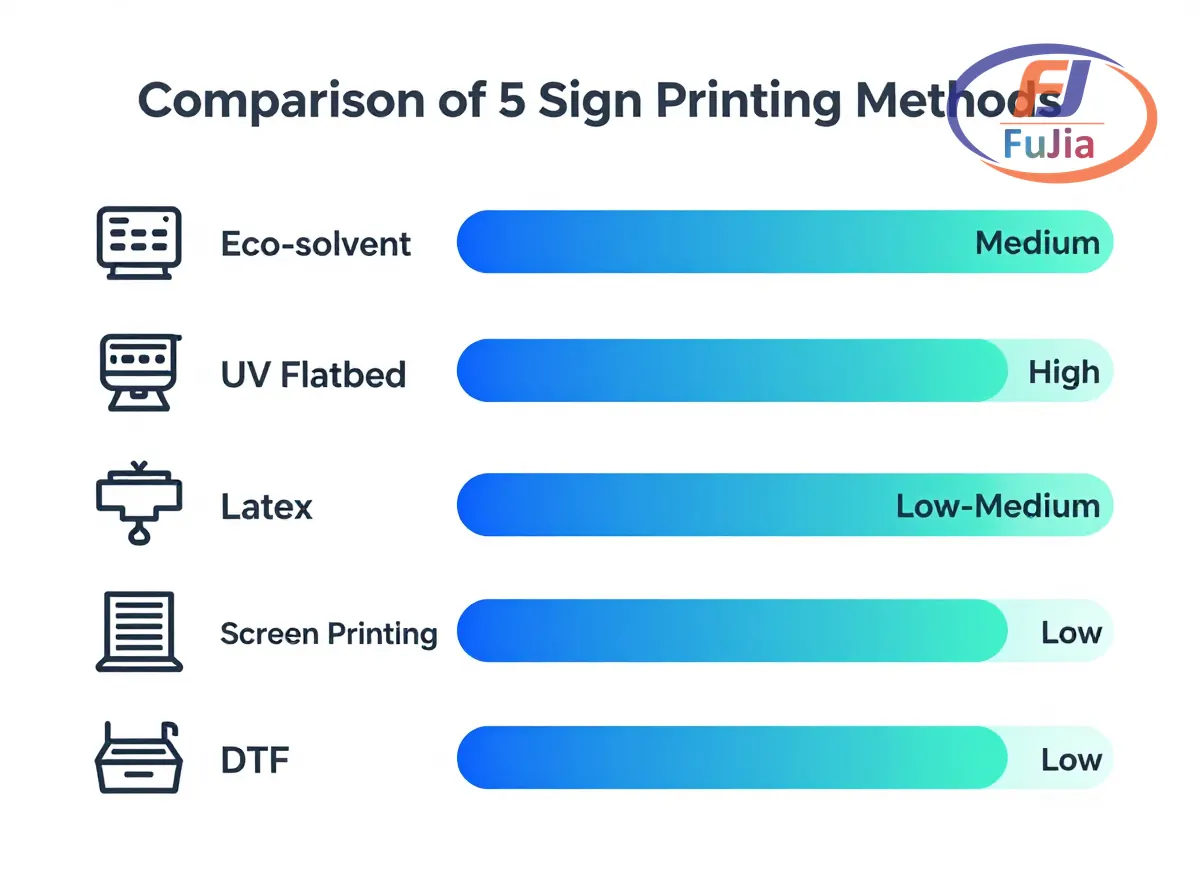
| Machine Type | Entry Price | Production Price | Outdoor Durability | Best Sign Types |
|---|---|---|---|---|
| Eco-solvent printer | $2,000-$5,000 | $5,000-$18,500 | 2-3 years unlaminated | Vinyl banners, vehicle wraps, window graphics |
| UV flatbed printer | $2,000-$5,000 | $5,000-$80,000 | 3-5 years | Rigid signs, acrylic, metal, PVC board |
| Print-and-cut combo | $3,000-$5,000 | $5,000-$15,000 | 1-3 years | Custom-shaped vinyl decals, lettering |
| Screen printing press | $200-$1,000 | $1,500-$23,900 | 3-5 years | Bulk identical signs, traffic signs |
| DTF transfer system | $500-$1,200 | $2,500-$6,000 | 1-2 years | Fabric signs, flags, textile banners |
| Pad printer | $200-$500 | $500-$2,000 | 2-4 years | Small promotional items, 3D objects |
How to Choose a Sign Printing Machine
Step 1: Identify your primary sign material.
Flexible signs (vinyl banners, mesh, fabric) require eco-solvent or latex printers. Rigid signs (acrylic, PVC, aluminum, wood) require UV flatbed printers. If you produce both types, a UV flatbed with roll-to-roll capability handles the widest material range. For fabric signage specifically, DTF transfer systems offer the best color vibrancy and wash durability.
Step 2: Calculate your maximum print width.
Standard vinyl banners require 1.3-1.6 meter print width. Vehicle wraps need 1.37-1.6 meters. Large format outdoor billboards may require 3.2 meter width. The Fujia Print Eco-Solvent Printer covers up to 1.6 meters, suitable for approximately 85% of common sign jobs. For wider formats, consider dual-panel seaming or a 3.2 meter industrial printer.
Step 3: Evaluate ink durability requirements.
Eco-solvent prints last 2-3 years outdoors without lamination, and 5+ years with UV-protective laminate. UV-cured prints last 3-5 years outdoors. Latex prints offer similar durability to eco-solvent with the advantage of water-based ink (no solvent fumes). For permanent outdoor signage like traffic signs or building directories, screen printing with automotive-grade ink delivers 5-10 year outdoor life.
Step 4: Factor in consumable and maintenance costs.
Eco-solvent ink costs $0.15-$0.35 per square foot of printed material. UV ink runs $0.20-$0.50 per square foot. DTF transfer film and ink together cost $0.50-$0.90 per square foot. Printhead replacement every 12-24 months adds $200-$800 per head for Epson-based systems, and $1,000-$3,000 for Ricoh or Konica heads.
Is Sign Printing Profitable?
Sign printing remains one of the most profitable segments in digital printing. A standard 3×6 foot vinyl banner costs $8-$15 in materials (vinyl + ink) and retails for $50-$150, representing a 300-900% gross margin. Based on data from our customers across 50+ countries, sign print shops average 20-40 jobs per week, generating monthly gross profits of $3,000-$8,000 from a single eco-solvent printer.
The Kenya glassware workshop case study documented a Fujia UV flatbed customer who increased daily output from 200 to 300 pieces (+50%) while reducing material waste from 15% to 9%. The same efficiency gains apply to sign production: UV flatbed printing eliminates the cutting and mounting steps required for vinyl applique signs, reducing labor by 40-60% per rigid sign job.
The global wide-format printer market continues expanding, driven by demand from retail signage, event and exhibition graphics, construction site signs, and vehicle fleet branding. Print shops that offer both flexible (eco-solvent) and rigid (UV flatbed) sign production capture a wider client base and achieve higher average order values.
Recommended Sign Printing Setup
| Business Type | Recommended Machine | Budget | Weekly Capacity |
|---|---|---|---|
| Home-based sign maker | Desktop eco-solvent or vinyl cutter | $500-$3,000 | 10-20 signs |
| Sign shop (retail) | 1.6m eco-solvent + UV flatbed | $5,000-$20,000 | 40-80 signs |
| Vehicle wrap specialist | 1.6m eco-solvent print-and-cut | $8,000-$18,000 | 5-10 wraps |
| Industrial / billboard | 3.2m eco-solvent or latex | $15,000-$50,000 | 100+ signs |
| Fabric sign producer | DTF printer + heat press | $2,000-$6,000 | 50-100 fabric signs |
The Fujia Print product line covers both flexible and rigid sign production. The Eco-Solvent Printer handles vinyl banners and vehicle wraps up to 1.6 meters wide. The UV Flatbed Printer series produces rigid signs on acrylic, PVC, and metal substrates up to 180mm thick.
What machine is used to print signs?
The machines most commonly used to print signs are eco-solvent wide-format printers for vinyl banners and flexible signage, UV flatbed printers for rigid signs on acrylic and PVC board, and print-and-cut combo machines for custom-shaped vinyl decals. Eco-solvent printers from Roland (TrueVIS series), Mimaki (JV330), and Fujia Print handle rolls up to 1.6 meters wide with 2-3 year outdoor durability. UV flatbed printers like the Fujia FJ-6090 print directly onto 600x900mm rigid sheets up to 180mm thick, with instant UV-LED curing and optional varnish for premium finishes. For fabric signs and textile banners, DTF transfer printers produce full-color designs that bond to polyester, cotton, and blend fabrics. The choice depends on whether the sign material is flexible (needs eco-solvent) or rigid (needs UV flatbed).
How much does a sign printing machine cost?
Sign printing machine prices range from $200 for manual screen printing presses to $80,000 for industrial UV flatbed systems. Entry-level eco-solvent printers cost $2,000-$5,000, while production-grade models from Roland and Mimaki run $5,000-$18,500. UV flatbed printers for sign production start at $2,000 for A3 desktop models and reach $15,000-$80,000 for full-feature industrial systems. Print-and-cut combo machines like the Roland TrueVIS VG4 cost $14,238. The Brady S3100 sign and label printer targets indoor facility signage at $1,999. A complete sign printing setup including printer, RIP software, initial ink and media inventory, and basic finishing tools (laminator, cutter) totals $3,000-$25,000 depending on technology and format width.
Can I print signs at home?
Yes, you can print signs at home using a desktop eco-solvent printer, a converted inkjet printer with solvent-based ink, or a vinyl cutter paired with pre-printed vinyl. Desktop eco-solvent printers from Roland and Mimaki (13-54 inch width) fit in a home workshop and produce professional-quality vinyl banners, window graphics, and indoor posters. For smaller signs, a letter-size (8.5×11 inch) inkjet printer loaded with waterproof vinyl media produces acceptable short-term indoor signage. Vinyl cutters from Graphtec ($1,995) or Cricut ($200-$400) cut pre-printed vinyl into custom lettering and shapes for application to sign substrates. Home-based sign makers typically start with a vinyl cutter and pre-printed media, upgrading to an eco-solvent printer once monthly order volume exceeds 15-20 signs.
What is the best printer for outdoor signs?
The best printer for outdoor signs is an eco-solvent wide-format printer for flexible signage (vinyl banners, vehicle wraps, mesh) and a UV flatbed printer for rigid signage (PVC board, acrylic, aluminum composite). Eco-solvent ink resists UV fading and water for 2-3 years without lamination and 5+ years with UV-protective laminate, operating across temperature ranges from -20 to 60 degrees Celsius without cracking. UV-cured ink provides 3-5 year outdoor durability with instant curing that enables immediate handling. For maximum outdoor longevity (5-10 years), screen printing with automotive-grade enamel ink remains the industry standard for permanent signage like traffic signs and building directories. The Fujia Print Eco-Solvent Printer offers 1.6 meter print width with 6-color ink and pre-loaded Pantone ICC profiles, suited for approximately 85% of common outdoor sign applications.
Conclusion
Sign printing machines span from $200 vinyl cutters to $80,000 industrial UV flatbed systems, with eco-solvent technology dominating flexible signage and UV flatbeds excelling on rigid substrates. Explore Fujia Print eco-solvent printers for vinyl banner and vehicle wrap production, or browse UV flatbed systems for rigid sign materials.
