

In printing, DTF stands for Direct-to-Film, a heat transfer process where designs are printed onto PET film, coated with adhesive powder, and then heat-pressed onto garments. The term “DTF” also exists as unrelated internet slang, but in the printing and apparel decoration industry, DTF always refers to the Direct-to-Film printing method.
Key Takeaways
- DTF stands for Direct-to-Film, a garment decoration technology that emerged in the early 2020s
- The process prints CMYK + white ink onto PET film, applies hot-melt adhesive powder, and heat-presses the transfer onto fabric at 160-170 degrees Celsius
- DTF works on cotton, polyester, nylon, blends, and dark-colored fabrics without requiring pre-treatment
- A complete DTF setup costs $500-$6,000 depending on print width and number of printheads
- Per-transfer cost ranges from $0.50 to $0.90 per square foot, covering film, ink, and powder
What Does DTF Mean?
DTF is an abbreviation with multiple meanings depending on context. In the printing and textile decoration industry, DTF means Direct-to-Film printing. In internet slang, DTF carries an unrelated colloquial meaning that has no connection to printing technology. This article focuses exclusively on the printing definition.
Direct-to-Film printing is a transfer-based decoration method. The design is first printed in reverse (mirrored) onto a special PET (polyethylene terephthalate) film using water-based pigment inks. Cyan, magenta, yellow, and black (CMYK) layers are printed first, followed by a white ink layer that creates an opaque backing. While the ink is still wet, a fine thermoplastic polyurethane hot-melt powder is applied to the printed areas. The film is then cured, and the transfer is heat-pressed onto the garment at 160-170 degrees Celsius (320-338 degrees Fahrenheit) for 10-15 seconds, according to technical documentation on Direct-to-Film printing from Wikipedia.
The result is a durable, full-color transfer that adheres to virtually any fabric type. Unlike direct-to-garment (DTG) printing, DTF requires no fabric pre-treatment. Unlike dye-sublimation, DTF works on dark fabrics and cotton materials, not just polyester.
How DTF Printing Works: Step by Step
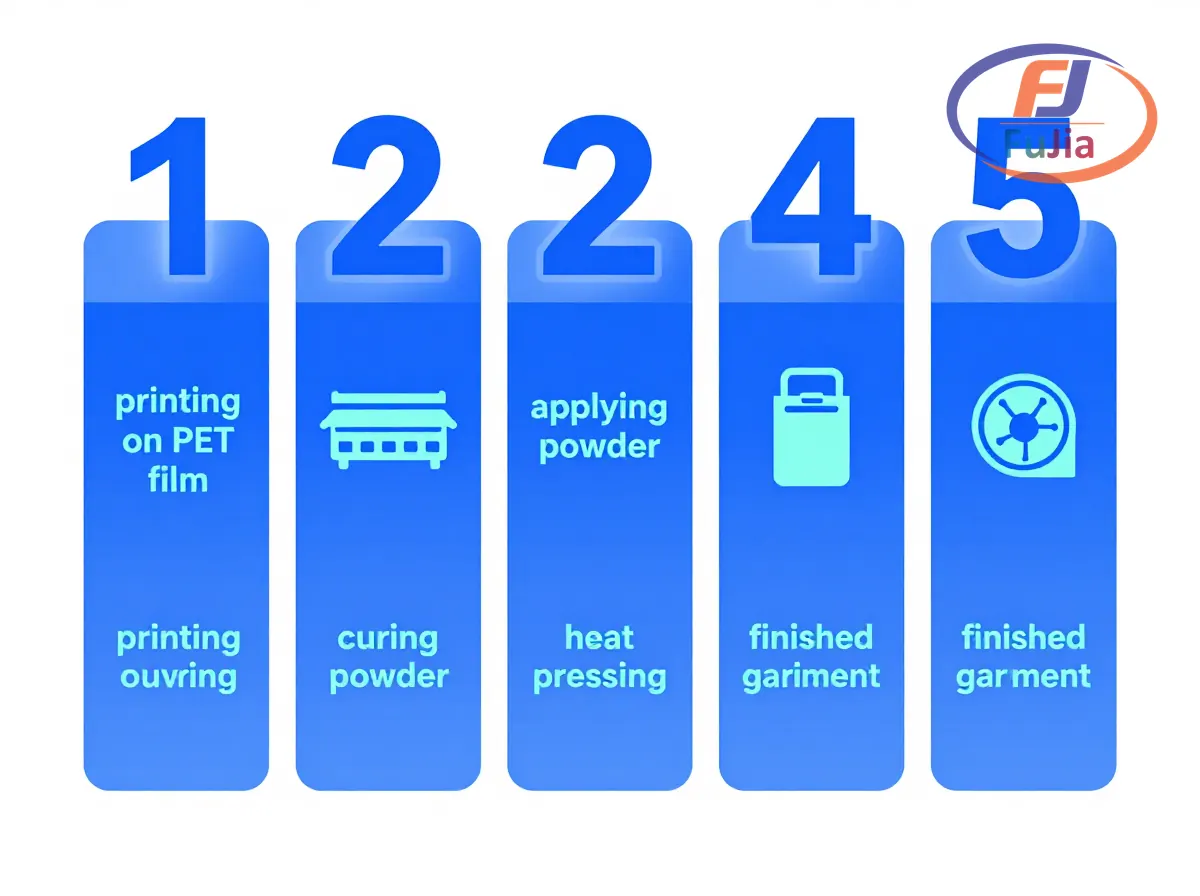
Step 1: Print the design onto PET film.
The DTF printer uses inkjet printheads to deposit CMYK ink layers followed by a white ink underbase onto a roll of PET film. The image is printed mirrored so that it appears correctly when transferred. Print speeds range from 25-35 square feet per hour for entry-level machines to 150+ square feet per hour for industrial systems, based on data from Keypoint Intelligence analysis of the decorated apparel market.
Step 2: Apply adhesive powder.
While the ink is still wet, a hot-melt adhesive powder (thermoplastic polyurethane) is applied to the printed film. The powder sticks only to the printed areas where ink is present. Automatic powder shaker machines apply the powder evenly and remove excess material. For manual operations, powder is applied by hand using a sifter.
Step 3: Cure the powder.
The film passes through a curing unit (often integrated with the powder shaker) that melts the adhesive powder at approximately 160 degrees Celsius. The powder fuses with the ink to create a flexible, rubbery transfer layer. Once cured, the printed film can be stored for days or weeks before pressing, decoupling the printing stage from garment decoration.
Step 4: Heat press onto the garment.
The cured transfer film is placed face-down on the garment and pressed at 160-170 degrees Celsius for 10-15 seconds at medium pressure. The adhesive bonds the design to the fabric fibers. After pressing, the carrier film is peeled away, either while hot (hot peel) or after cooling (cold peel), depending on the film specification.
Step 5: Final press for durability.
A second 5-second press using a silicone paper or Teflon sheet smooths the transfer and improves wash durability. The finished garment can be washed after 24 hours, with transfers rated for 50+ wash cycles when properly applied.
DTF vs Other Printing Methods
| Method | Fabrics Supported | Dark Fabric | Pre-treatment | Cost per sq ft | Wash Durability |
|---|---|---|---|---|---|
| DTF (Direct-to-Film) | Cotton, polyester, nylon, blends | Yes | No | $0.50-$0.90 | 50+ washes |
| DTG (Direct-to-Garment) | Cotton, 50/50 blends | Yes | Yes (required) | $0.30-$1.00 | 40-50 washes |
| Sublimation | Polyester only | No | No | $0.20-$0.50 | 100+ washes |
| Screen printing | Most fabrics | Yes | No | $0.10-$0.30 (bulk) | 80+ washes |
| HTV (Heat Transfer Vinyl) | Cotton, polyester | Yes | No | $0.25-$0.75 | 40-60 washes |
DTF occupies a unique position. It matches screen printing in fabric compatibility and DTG in full-color capability, without requiring pre-treatment. The trade-off is a slightly thicker hand-feel compared to sublimation, since the transfer sits on the fabric surface rather than dyeing the fibers. For a detailed breakdown of how DTF compares to other methods, read our DTF versus DTG comparison guide.
What Equipment Does DTF Require?
A complete DTF setup includes three core components:
DTF Printer
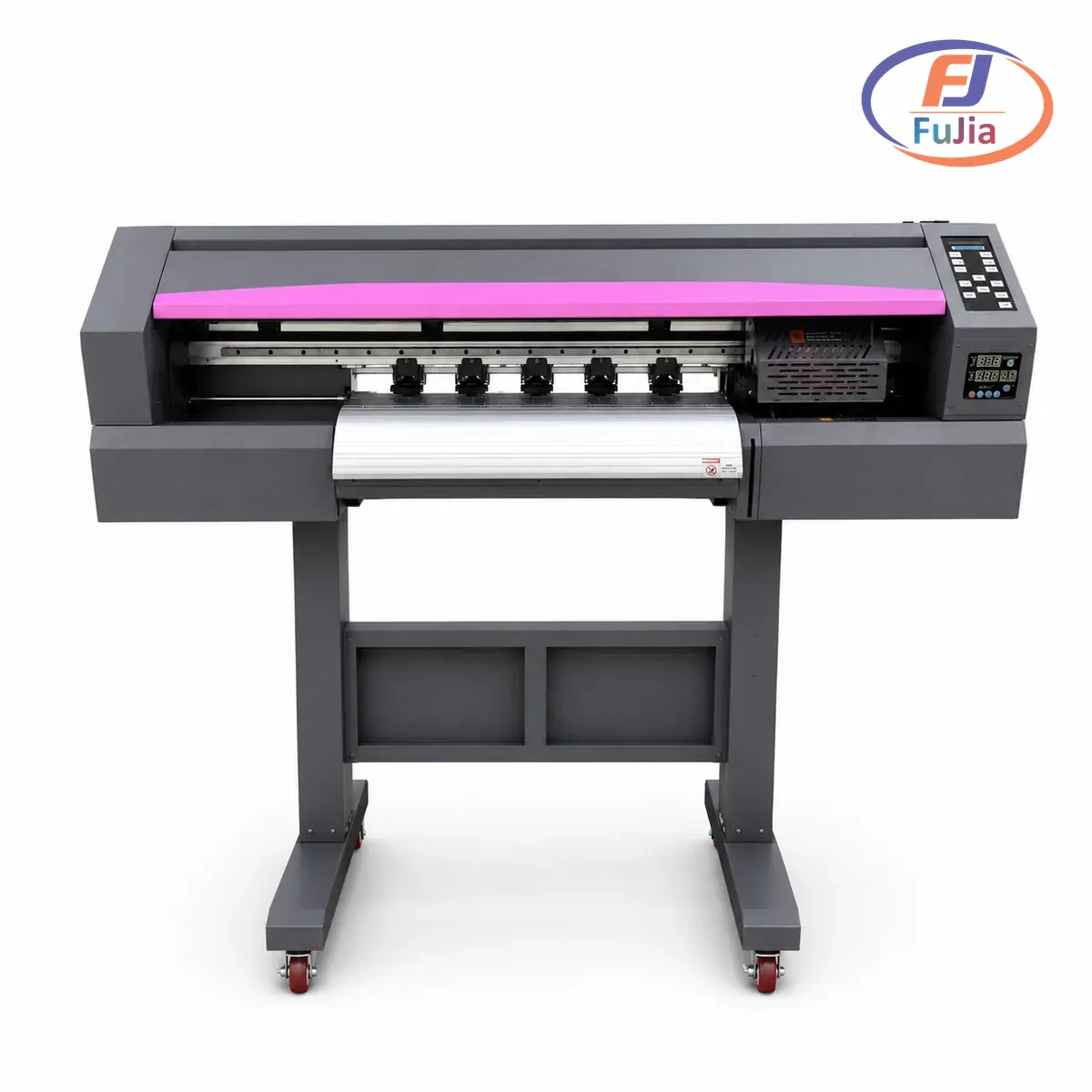
The printer deposits ink onto PET film. Entry-level A3 desktop models (300mm width) use 1-2 Epson XP600 printheads. Professional A1 systems (600-650mm width) use 2-4 Epson I3200 printheads for higher throughput. The Fujia Print A1 DTF 4-Head printer, for example, uses four Epson I3200 heads to deliver 27 square meters per hour at 4-pass quality, with a transmission system built on Honson mainboard, Leadshine servo motor, and THK silent guide rail components. See our complete DTF printer buying guide for detailed specifications across all model tiers.
The full Fujia DTF printer lineup covers entry-level A3 through industrial A1 systems.
Powder Shaker and Curing Unit
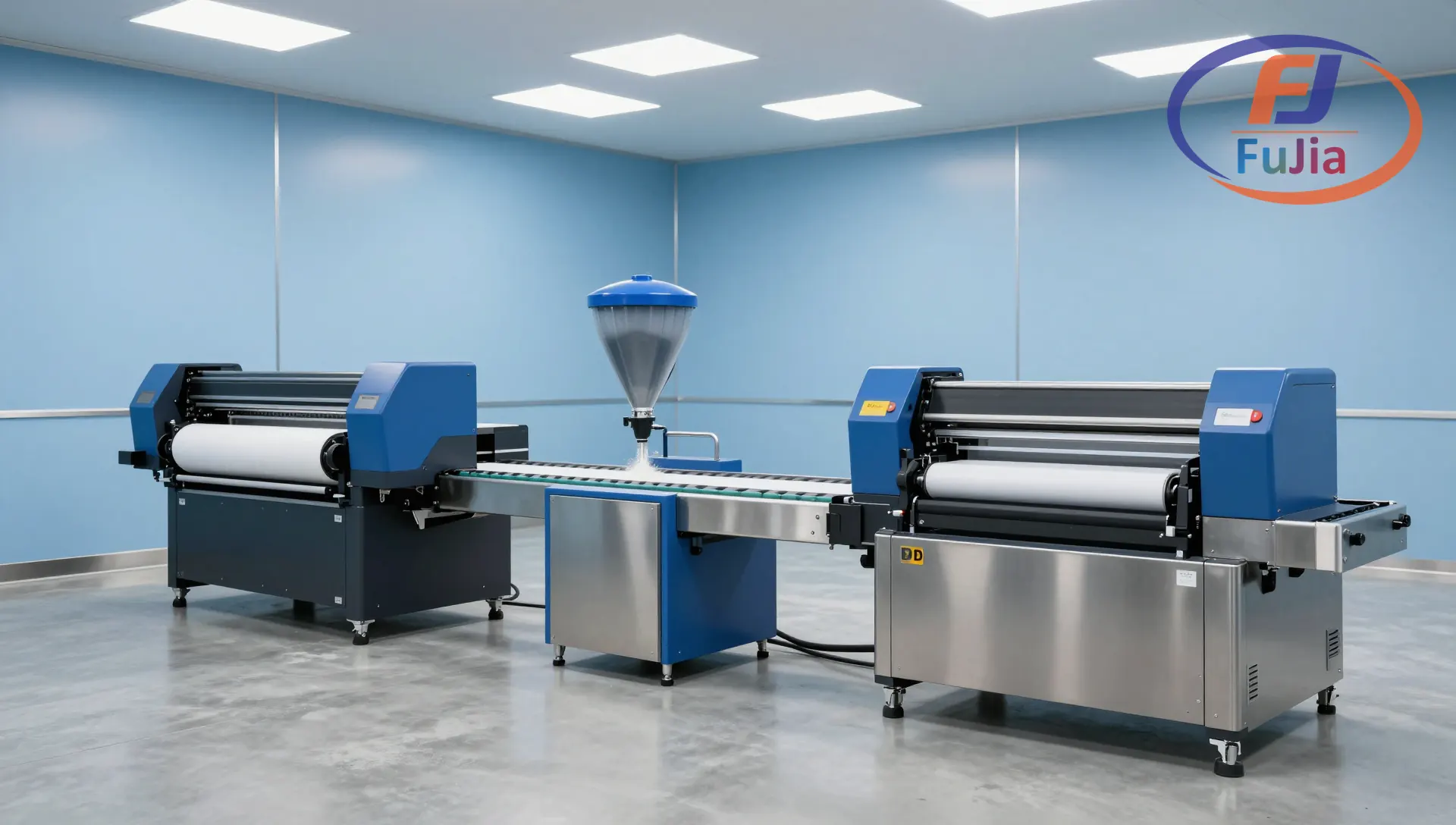
The shaker applies adhesive powder automatically and cures it in a single pass. Integrated shaker-and-oven units process film rolls continuously, while manual setups require separate powder application and a heat gun or oven for curing.
Heat Press
A flat heat press completes the transfer. Clamshell presses ($150-$500) handle single garments, while draw-type presses ($400-$1,500) improve workflow for production environments. Press temperature must reach 160-170 degrees Celsius with even pressure distribution across the platen.
DTF Meaning in Different Contexts
The acronym DTF has distinct meanings across different fields. In printing and apparel decoration, DTF means Direct-to-Film. The table below clarifies the most common interpretations:
| Context | DTF Meaning | Industry |
|---|---|---|
| Printing / Apparel | Direct-to-Film (heat transfer printing) | Textile decoration |
| Slang / Social media | Unrelated colloquial acronym | Internet culture |
| Finance | Discount Treasury Bill rate | Banking |
| Technology | Desktop Transfer Format | Software development |
When someone in a printing, garment decoration, or apparel customization context says “DTF,” they are referring to Direct-to-Film printing. The technology has grown rapidly since 2020, with major equipment manufacturers including Epson, Mimaki, and Kornit introducing dedicated DTF devices, as noted in Wikipedia’s coverage of Direct-to-Film printing history.
DTF Printing Cost Breakdown
The per-square-foot cost of DTF transfers includes three consumable components:
| Component | Cost per sq ft | Purpose |
|---|---|---|
| PET film | $0.15-$0.25 | Carrier for the printed design |
| DTF ink (CMYK + white) | $0.20-$0.45 | Color and white underbase |
| Hot-melt adhesive powder | $0.15-$0.20 | Bonds transfer to fabric |
| Total | $0.50-$0.90 | Per square foot |
A standard 12×12 inch design costs approximately $0.50-$0.90 in materials. Factoring in equipment amortization, labor, and overhead, the all-in cost per transfer averages $1.00-$2.50 depending on production volume and efficiency.
Based on data from our customers across 50+ countries, small print shops producing 20-50 transfers per day recover their equipment investment ($1,500-$3,000 entry-level setup) within 2-4 months. The Fujia Print factory in Guangzhou has produced over 2,000 DTF machines annually since 2019, serving customers in Turkey, Kenya, Brazil, and 47 other countries.
What does DTF mean in printing?
DTF in printing stands for Direct-to-Film, a heat transfer decoration method where designs are printed onto PET film using inkjet technology, coated with hot-melt adhesive powder, and then heat-pressed onto garments. The process was adopted in the early 2020s among small and mid-size apparel decorators, followed by major equipment manufacturers launching dedicated DTF printers. DTF transfers work on cotton, polyester, nylon, fabric blends, and both light and dark-colored garments without requiring fabric pre-treatment. The acronym DTF also exists as unrelated internet slang, but in any printing, garment decoration, or textile context, DTF always refers to Direct-to-Film printing technology.
Is DTF printing the same as heat transfer vinyl (HTV)?
No, DTF printing and HTV are different technologies. DTF printing uses inkjet printheads to deposit full-color CMYK plus white ink directly onto PET film, creating photorealistic transfers with unlimited colors and gradients. HTV (heat transfer vinyl) involves cutting single-color or pre-printed vinyl sheets into shapes using a cutting plotter, then weeding away excess material and heat-pressing the remaining design onto fabric. DTF requires no cutting or weeding and handles fine details, small text, and photographic images that HTV cannot produce. DTF per-transfer cost ($0.50-$0.90 per square foot) is comparable to HTV ($0.25-$0.75 per square foot), but DTF saves significant labor time by eliminating manual weeding.
Can DTF printers print on any fabric?
DTF printers produce transfers that adhere to virtually all common apparel fabrics, including 100% cotton, 100% polyester, cotton-poly blends, nylon, canvas, and denim. This fabric versatility is a primary advantage over dye-sublimation (polyester only) and direct-to-garment printing (cotton-dominant). DTF transfers also bond to dark and black fabrics, since the white ink underbase creates an opaque layer between the fabric color and the CMYK design. The transfer sits on the fabric surface with a slightly rubbery texture, unlike sublimation where dye molecularly penetrates polyester fibers. DTF transfers are rated for 50+ home laundry wash cycles when properly applied at 160-170 degrees Celsius.
How much does a DTF printer cost?
DTF printer prices range from $500 for entry-level A3 desktop models to $6,000 for industrial A1 systems. Entry-level A3 DTF printers with a single Epson XP600 printhead cost $500-$1,500 and handle print widths up to 300mm. Mid-range A1 systems with dual Epson I3200 heads cost $2,000-$4,000 and print at 600-650mm width. Industrial A1 systems with 4 heads, like the Fujia Print A1 DTF 4-Head, cost $4,000-$6,000 and deliver 27 square meters per hour. A complete setup including printer, powder shaker, heat press, and initial consumables (ink, film, powder) adds $500-$1,500 to the printer cost. Per-transfer material costs run $0.50-$0.90 per square foot.
Conclusion
DTF means Direct-to-Film printing, a versatile heat transfer technology that prints full-color designs on PET film and bonds them to virtually any fabric. Explore Fujia Print DTF printer models to find a system matched to your production volume, or read our DTF vs sublimation comparison to decide which technology fits your garment decoration business.
