

A mug printing machine applies custom designs, logos, or photographs onto ceramic, glass, or stainless-steel drinkware using heat press, sublimation, UV printing, or screen printing technology. Choosing the right machine depends on your production volume, the mug material, and whether you print single pieces or bulk orders.
Key Takeaways
- Sublimation mug presses ($70-$300) dominate the entry-level market for personalized ceramic mugs with polyester-coated surfaces
- Commercial UV flatbed printers ($800-$2,000) handle glass, metal, and untreated ceramics without coating requirements
- Mug printing profit margins range from 200% to 500% per piece, with break-even at 50-80 mugs for a basic setup
- DTF transfer technology enables full-color mug designs on any fabric-coated or treated surface without minimum order quantities
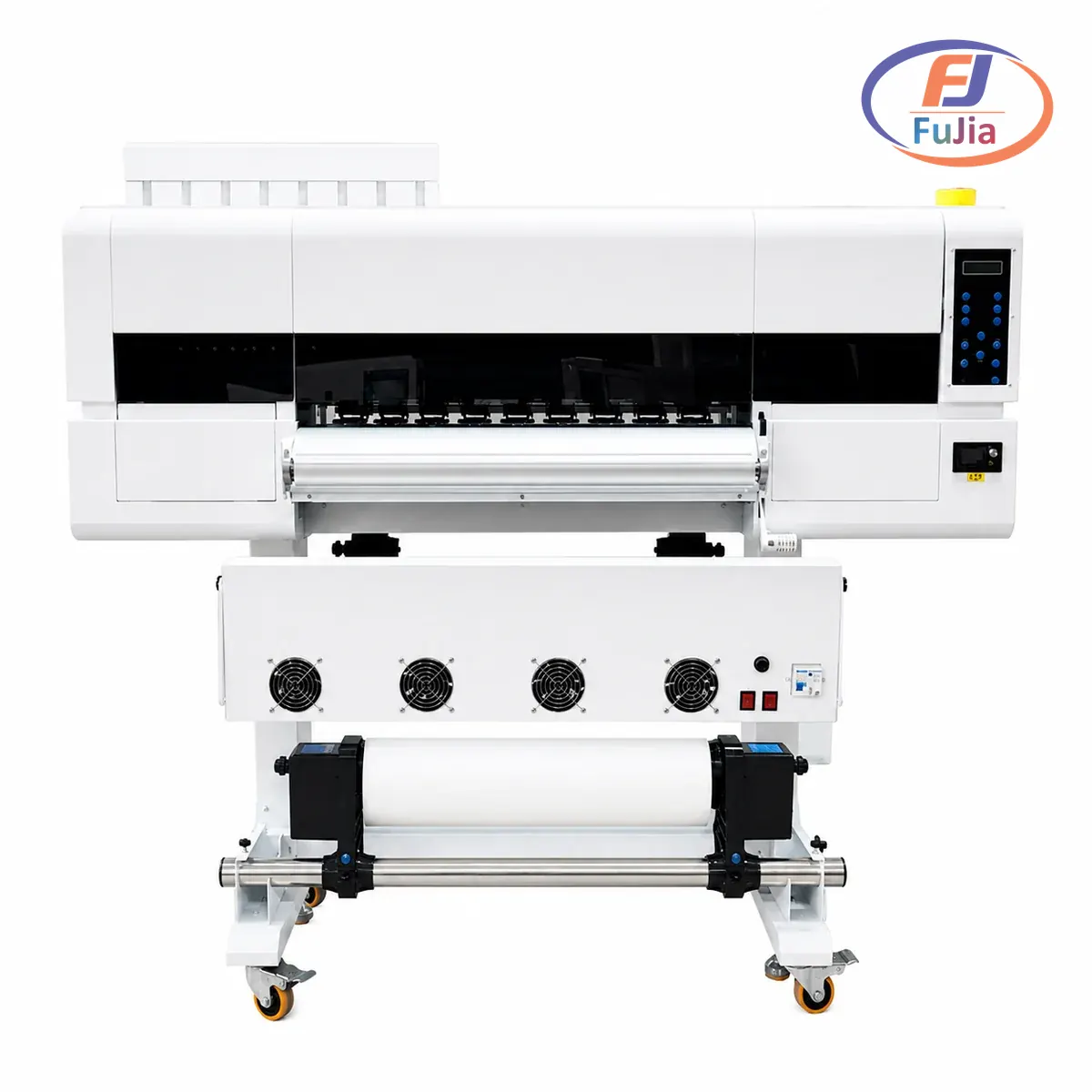
- Fujia Print manufactures both sublimation printers and UV flatbed systems suited for mug and drinkware decoration from its 3,500 m² Guangzhou factory
What Is a Mug Printing Machine?
A mug printing machine is equipment that permanently transfers images, text, or graphics onto cylindrical drinkware. The five dominant technologies are dye-sublimation heat presses, UV flatbed printers, DTF (direct-to-film) transfer systems, screen printing presses, and water-slide decal applicators. Each method differs in cost, durability, minimum order size, and compatible mug materials.
Sublimation remains the most popular method for ceramic mug decoration. The process requires sublimation ink printed onto transfer paper, then a heat press that bonds the dye into a polymer-coated mug surface at 350-400 degrees Fahrenheit (175-205 degrees Celsius). The dye penetrates the coating at a molecular level, producing prints that resist fading, peeling, and dishwasher wear according to technical documentation on dye-sublimation printing from Wikipedia.
UV flatbed printing offers an alternative for materials that sublimation cannot handle. UV-curable ink adheres to glass, metal, wood, and bare ceramic without requiring a polymer coating. The ink cures instantly under UV-LED lamps, making it suitable for high-mix, low-volume production environments.
Types of Mug Printing Machines
Sublimation Mug Presses
Sublimation mug presses are the entry point for most custom mug businesses. A standard mug press wraps a heating element around the mug and applies consistent temperature and pressure for 3-5 minutes per cycle. Prices range from $70 for a basic single-mug press to $300 for a 5-in-1 system that handles different drinkware shapes.
The Cricut Mug Press at $149 and the VEVOR Mug Heat Press at $85 represent the consumer-grade segment, based on current retail data from Home Depot and Target. The Geo Knight DK3 at $750 targets commercial operations with higher duty cycles and precise temperature control.
Whatever method you choose, the mug and drinkware printing solutions hub compares every approach side by side.
Key limitation: sublimation only works on mugs with a polyester-based polymer coating. Standard ceramic mugs from a dollar store will not accept sublimation ink. You must purchase sublimation-ready blank mugs, which cost $1.50-$3.00 each wholesale.
UV Flatbed Printers
UV flatbed printers direct UV-curable ink onto the mug surface in a single pass. The Fujia Print FJ-6090 A1 UV Flatbed fits 6-8 wine glasses or 4-6 standard mugs per 600x900mm print bed cycle. Equipped with Ricoh GEN5 or Epson I3200 printheads, the machine delivers 4-8 square meters per hour at up to 720×1800 dpi resolution.
UV printing eliminates the coating requirement entirely. The ink bonds to bare ceramic, glass, metal, and plastic surfaces through UV-LED curing. A water-cooled UV lamp system provides instant drying, and an optional varnish channel adds spot gloss or matte finishes that increase per-unit pricing by 30-50%. For a deeper comparison of these two approaches, see our guide on UV printing versus DTF for hard surface decoration.
For mug-specific applications, the auto height detection system handles curved surfaces up to 180mm thick. The material database includes 300+ tested substrates, covering ceramic, porcelain, tempered glass, stainless steel, and enamel finishes.
DTF Transfer Systems
DTF (direct-to-film) printing creates heat-transferable film that can be applied to almost any surface, including mug exteriors. The Fujia Print A1 DTF 2-Head printer produces transfer film at 8-13 square meters per hour using dual Epson I3200 printheads. Printed film is then applied to the mug using a standard heat press.
DTF transfers work on surfaces where sublimation fails: dark-colored mugs, untreated ceramics, and materials without polymer coatings. The white ink underbase enables vivid colors on black or dark mug backgrounds. DTF ink uses a 13-color system (CMYK + LC + LM + Orange + Red + Green + Blue) that produces a wider color gamut than standard 4-color sublimation. Learn more about how DTF transfer systems compare to sublimation for drinkware decoration.
Screen Printing Presses
Screen printing presses deposit ink through a mesh stencil onto the mug surface. Manual single-color mug presses start around $200, while automatic multi-color rotary machines exceed $2,000. Commercial screen printing machines like the WM-SM350R handle high-volume paper cup and mug production at $1,980 per unit.
Screen printing delivers the lowest per-unit cost for large runs (500+ pieces) but requires separate screens for each color. Setup time and minimum order quantities make screen printing impractical for custom one-off mugs or small batches.
Mug Printing Machine Price Comparison
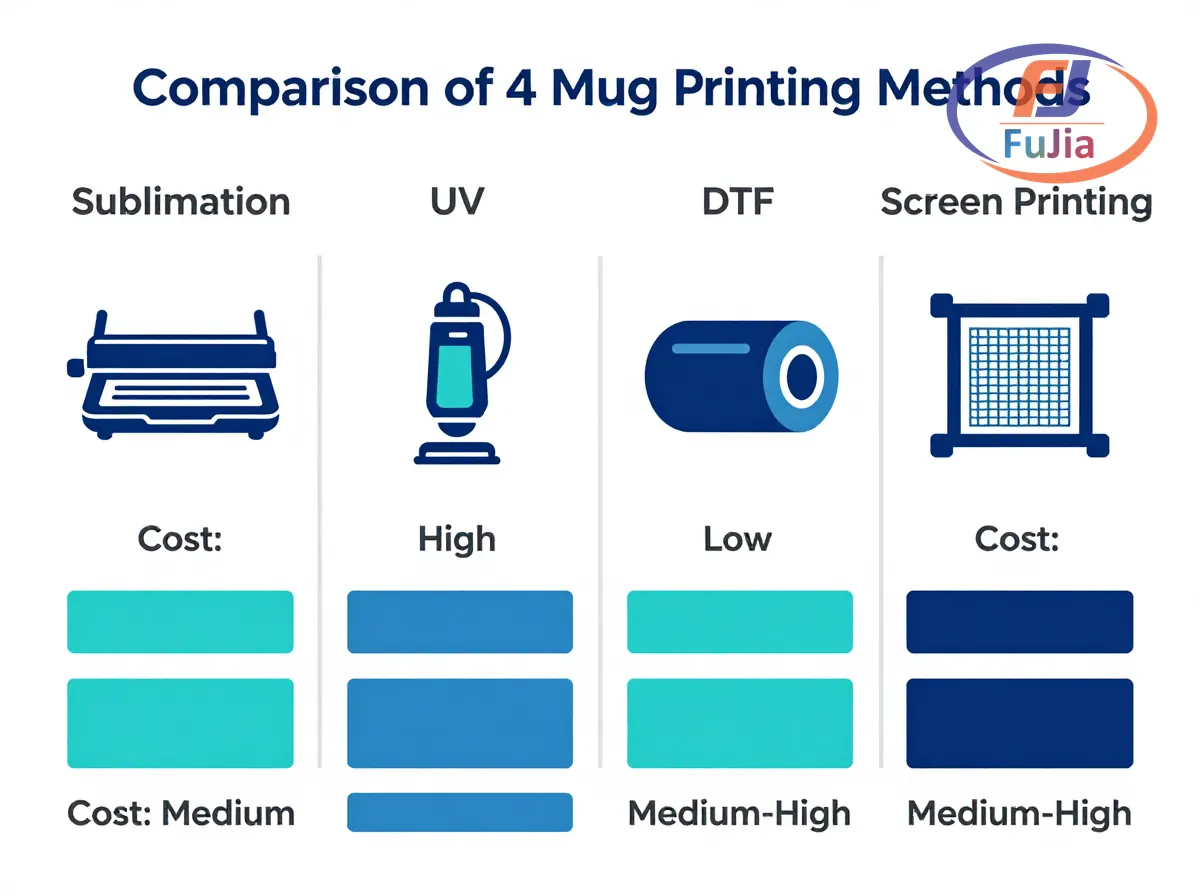
| Machine Type | Entry Price | Commercial Price | Per-Mug Cost | Min Order | Best For |
|---|---|---|---|---|---|
| Sublimation mug press | $70-$150 | $300-$750 | $0.50-$2.00 | 1 piece | Personalized gifts, photo mugs |
| UV flatbed printer | $800-$1,500 | $2,000-$5,000 | $0.30-$1.00 | 1 piece | Glass, metal, untreated ceramic |
| DTF transfer system | $500-$1,200 | $2,500-$6,000 | $0.40-$1.50 | 1 piece | Dark mugs, multi-surface jobs |
| Screen printing press | $200-$500 | $1,980-$5,000 | $0.10-$0.50 | 100+ pieces | Bulk uniform orders |
| Water-slide decal | $50-$100 | $200-$400 | $0.20-$0.80 | 1 piece | Low-budget hobbyists |
Entry-level sublimation presses offer the lowest barrier to entry. A complete starter kit (press + sublimation printer + blank mugs + ink + paper) totals $200-$500. Commercial UV and DTF systems require $2,000-$6,000 upfront but handle a wider range of materials and deliver lower per-unit costs at scale.
How to Choose a Mug Printing Machine
Step 1: Determine your mug material.
Standard ceramic mugs require sublimation with polymer-coated blanks. Glassware, tumblers, and metal drinkware work best with UV flatbed or DTF transfer methods. If you plan to print on dark or black mugs, DTF transfers with white ink underbase are the only viable option for full-color designs.
Step 2: Calculate your production volume.
For under 50 mugs per day, a single sublimation mug press ($70-$150) handles the workload. Each pressing cycle takes 3-5 minutes, meaning one operator produces 8-12 mugs per hour. For 50-200 mugs per day, consider a 5-in-1 multi-station press ($200-$300) or a small UV flatbed system.
Step 3: Evaluate ink and consumable costs.
Sublimation ink costs $0.05-$0.15 per mug. UV ink runs $0.08-$0.20 per mug but works on uncoated surfaces, saving $1.00-$2.00 per blank. DTF transfer film and powder add $0.10-$0.25 per mug. Factor these recurring costs into your pricing model, not just the machine purchase price.
Step 4: Verify print durability requirements.
Sublimation prints last 100+ dishwasher cycles when properly applied, as the dye molecularly bonds with the polymer coating. UV prints resist scratching but may fade after 50-80 outdoor UV exposure hours without a varnish topcoat. DTF transfers provide 80-100 wash cycles on fabric and similar durability on treated mug surfaces.
Is Mug Printing Profitable?
Mug printing profit margins are among the highest in custom decoration. A personalized sublimation mug sells for $12-$25 retail. With a blank coated mug cost of $2.00 and ink/paper costs of $0.20, the gross profit per mug is $9.80-$22.80.
A basic sublimation setup ($200 starter kit) reaches break-even after selling 20-40 mugs at $12 each. Operators who combine mug printing with t-shirt DTF printing (using the same heat press) can recover equipment costs within the first month. The Kenya glassware workshop case study at Fujia Print documented a customer who increased daily output from 200 to 300 pieces (+50%) after upgrading to a UV flatbed system, while reducing waste from 15% to 9%.
Market demand supports this profitability. The personalized gifts market continues growing as consumers seek customized drinkware for corporate events, weddings, and promotional campaigns. Based on data from our customers across 50+ countries, custom mug orders average 30-50 pieces per corporate client, with reorder rates exceeding 60% for successful print shops.
Recommended Setup by Business Type
| Business Type | Recommended Machine | Budget | Daily Capacity |
|---|---|---|---|
| Home-based hobbyist | Sublimation mug press + inkjet printer | $200-$500 | 20-40 mugs |
| Etsy / online shop | 5-in-1 mug press + DTF printer | $500-$1,500 | 50-100 mugs |
| Print shop (walk-in) | UV flatbed + sublimation press | $2,000-$5,000 | 100-300 mugs |
| Industrial / contract | Automatic screen printing + UV flatbed | $5,000-$15,000 | 500+ mugs |
The Fujia Print UV flatbed printer series includes auto height detection for curved drinkware and a 6-color ink system (CMYK + White + Varnish) that eliminates the need for separate coating and finishing steps. Combined with the Fujia sublimation printer line, the setup covers the full spectrum of mug materials from coated ceramics to bare glass and metal.
Is mug printing profitable in 2026?
Yes, mug printing remains profitable in 2026 with gross margins of 200-500% per piece. A single sublimation mug costs $2.00-$3.00 in materials (blank + ink + paper) and retails for $12-$25. Operators selling 50 mugs per week generate $500-$1,100 in monthly gross profit from a $200 initial equipment investment. Adding corporate clients who order 50-200 branded mugs per contract significantly increases revenue. Profitability depends on sourcing quality blank mugs at $1.50-$2.50 each and maintaining consistent print quality to drive repeat orders. Fujia Print customers across 50+ export countries report mug printing as one of the fastest-returning product lines due to low material costs and high perceived value.
What is the best way to print on mugs?
The best method depends on the mug material and order size. For personalized ceramic mugs in small quantities (1-50 pieces), dye-sublimation with a heat press produces the most durable and vibrant results, as the dye bonds molecularly with the polymer coating at 350-400 degrees Fahrenheit. For glass, metal, or untreated ceramic mugs, UV flatbed printing with UV-curable ink is superior because it requires no coating and cures instantly. For dark-colored mugs requiring full-color designs, DTF transfer film applied with a heat press is the only viable option, as sublimation ink does not show on dark backgrounds. Screen printing remains the cheapest per-unit method for bulk orders of 500+ identical mugs.
How much does a mug printing machine cost?
Mug printing machine prices range from $70 to $5,000 depending on the technology. A basic sublimation mug press costs $70-$150 (Cricut Mug Press: $149, VEVOR: $85). A 5-in-1 multi-station press costs $200-$300. Commercial sublimation presses like the Geo Knight DK3 run $750. UV flatbed printers suitable for mug decoration start at $800 and reach $2,000-$5,000 for industrial-grade systems. DTF transfer printer setups cost $500-$1,200 for entry-level A3 desktop models and $2,500-$6,000 for A1 industrial models. Automatic screen printing presses for high-volume mug production run $1,980-$5,000. A complete starter kit including press, printer, ink, paper, and blank mugs totals $200-$500 for sublimation.
How long does a sublimation mug print last?
A properly sublimated mug print lasts 100+ dishwasher cycles and 1,000+ hand washes without significant fading. The sublimation dye penetrates the polymer coating at a molecular level during the heat press cycle (350-400 degrees Fahrenheit for 3-5 minutes), creating a bond that resists peeling, cracking, and UV fading. Prints may show minor fading after 2-3 years of daily dishwasher use with high-temperature cycles and aggressive detergents. Hand washing extends the print life to 5+ years. UV flatbed prints on mugs last 50-80 dishwasher cycles without a varnish topcoat, and 150+ cycles with a UV varnish protective layer applied during printing.
Conclusion
Mug printing machines span from $70 sublimation presses to $5,000 industrial UV flatbed systems, with sublimation dominating entry-level ceramic mug decoration and UV printing excelling on glass and metal drinkware. Browse the Fujia Print UV flatbed printer collection to find a mug-compatible system, or read our sublimation printer guide for ceramic-specific solutions.
