

A printing t shirt machine search returns four different technologies wearing the same name: screen printing presses, direct-to-garment printers, sublimation systems, and direct-to-film setups, none interchangeable. This guide explains how each actually works, what the mechanism decides about quality and cost, and which orders belong to which machine, because once you can read the physics, the marketing stops mattering.
Key Takeaways
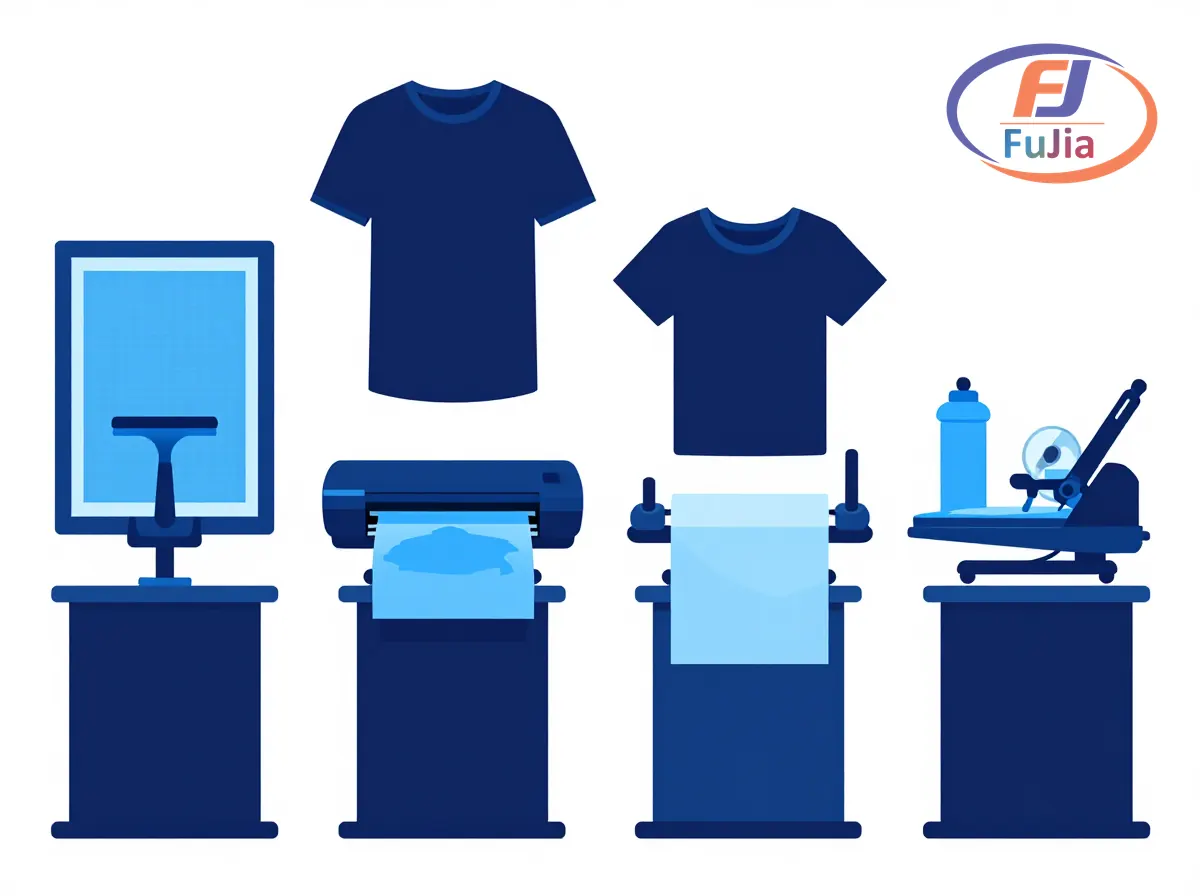
- Four technologies dominate shirt decoration: screen printing (ink pushed through a mesh stencil), DTG (inkjet sprayed into cotton), sublimation (dye gas-bonded into polyester), and DTF (design printed on film, powdered, and heat-pressed).
- The mechanism decides the economics: screen printing amortizes setup across quantity, DTG prices per print regardless of quantity, sublimation requires polyester, and DTF prints any fabric at one flat cost per transfer.
- Dark garments need a white underbase, which screen and DTF handle natively, DTG manages with pretreatment and white channels, and sublimation cannot produce at all.
- Durability ranking on cotton: screen printing and DTF both survive 50-plus washes when applied correctly; sublimation outlasts everything on polyester; DTG typically holds 40-50 washes.
- Volume picks the winner: under 50 pieces favors DTF or DTG, 50-500 daily favors DTF production lines, and 500-plus identical prints per design bring screen printing’s per-unit cost back into play.
How Each Technology Actually Works
Screen printing is the oldest method and mechanically the simplest: a mesh stencil blocks every part of the design except where ink should pass, a squeegee drives plastisol ink through the open mesh onto the shirt, and each color needs its own screen and its own pass. Setup is the expensive part, one screen per color per design, and once screens exist every additional shirt costs pennies, which is why the method owns bulk runs of repeating designs. That said, the economics invert completely below 500 pieces, which is exactly where its rivals feed. The ink sits on top of the fabric as a cured plastic layer, thick enough to feel under a finger, durable enough to outlast the garment itself.
DTG borrows the office inkjet idea and re-engineers it for cloth: a flatbed platen holds the shirt still while piezo heads spray water-based ink directly into the fibers, white ink going down first on dark garments through a pretreated base. There are no screens and no setup, so print one or one hundred, the per-shirt cost barely moves. That flat cost curve is both its superpower and its ceiling, unbeatable for one-off photorealistic cotton prints, uneconomical when a design repeats in the hundreds.
Sublimation skips liquids bonding to surfaces entirely: disperse dye prints onto paper, a heat press turns it to gas at around 200 °C, and the gas bonds with polyester molecules as the fabric cools, becoming part of the material rather than a layer on it. The result is permanently photographic and completely untraceable to the touch, but the chemistry only works on polyester and only on white or light bases, because the process has no white ink. All-over-print shirts, sportswear, and coated hard blanks are its territory.
DTF inverts the sublimation logic: instead of making ink bond with the fabric, it prints the full-color design plus a white underbase onto PET film, dusts the wet image with hot-melt adhesive powder, cures it into a solid decal, and heat-presses the finished film onto the garment at 160 °C for 15 seconds. The fabric never touches a printer, which is why the same transfer works on cotton, polyester, blends, leather, and dark colors without changing anything, and why a single 60 cm machine feeding gang sheets has become the production backbone of the custom apparel boom.
What the Mechanism Decides: Quality, Feel, and Durability
Print quality splits by resolution and by hand feel. DTF and DTG both render photographic detail at 720 dpi-class output, sublimation is flawless within its polyester kingdom, and screen printing degrades as color count rises because each color is a separate physical stencil, halftones and gradients being its weakest ground. Hand feel runs the opposite way: sublimation is untouchable because the dye lives inside the fiber, DTG sits soft because the ink soaks in, DTF sits lightly on the surface with a slight hand from the adhesive layer, and screen printing’s plastisol is the thickest presence of the four.
Durability follows the bond. Sublimation cannot wash out because there is nothing on the surface to wash off. Screen printing and correctly applied DTF both hold grade 4-5 color fastness through 50-plus heavy machine washes, per AATCC-scale testing. DTG typically delivers 40-50 washes before visible fading on cotton. The wash test, 20 cycles on your own design, settles any vendor argument faster than spec sheets. We recommend running one before signing anything, and most small shops will find the results more persuasive than any review.
| Factor | Screen | DTG | Sublimation | DTF |
|---|---|---|---|---|
| Fabrics | cotton best | cotton only | polyester only | any fiber |
| Dark garments | yes, white underbase | yes, pretreat + white | no | yes, white underbase |
| Photorealistic | weak | excellent | excellent | excellent |
| Cost per shirt at qty 1 | high (setup) | flat, mid | flat, low | flat, low-mid |
| Cost per shirt at qty 500+ | lowest | same as qty 1 | lowest on polyester | low |
| Wash durability | 50+ washes | 40-50 washes | outlasts garment | 50+ washes |
Which Orders Belong to Which Machine
Order profile, not brand preference, assigns the work. One-off or small-run photorealistic designs on light cotton belong to DTG, where the flat cost curve and soft hand earn their keep. Full-color designs on dark or mixed-fabric garments, the everyday order of custom apparel, belong to DTF, which is why our DTF printers lineup spans from A3 desktops to 4-head production machines. Bulk runs of a repeating one-to-three-color design above roughly 500 pieces hand the crown back to screen printing, whose setup cost finally amortizes away. Polyester performance wear and all-over prints belong to sublimation without contest, and shops serving mixed demand typically pair two technologies rather than force one to fail at the other’s job.
| Starter checklist | Screen | DTG | Sublimation | DTF |
|---|---|---|---|---|
| Core machine | manual press | DTG printer | sublimation printer | DTF printer |
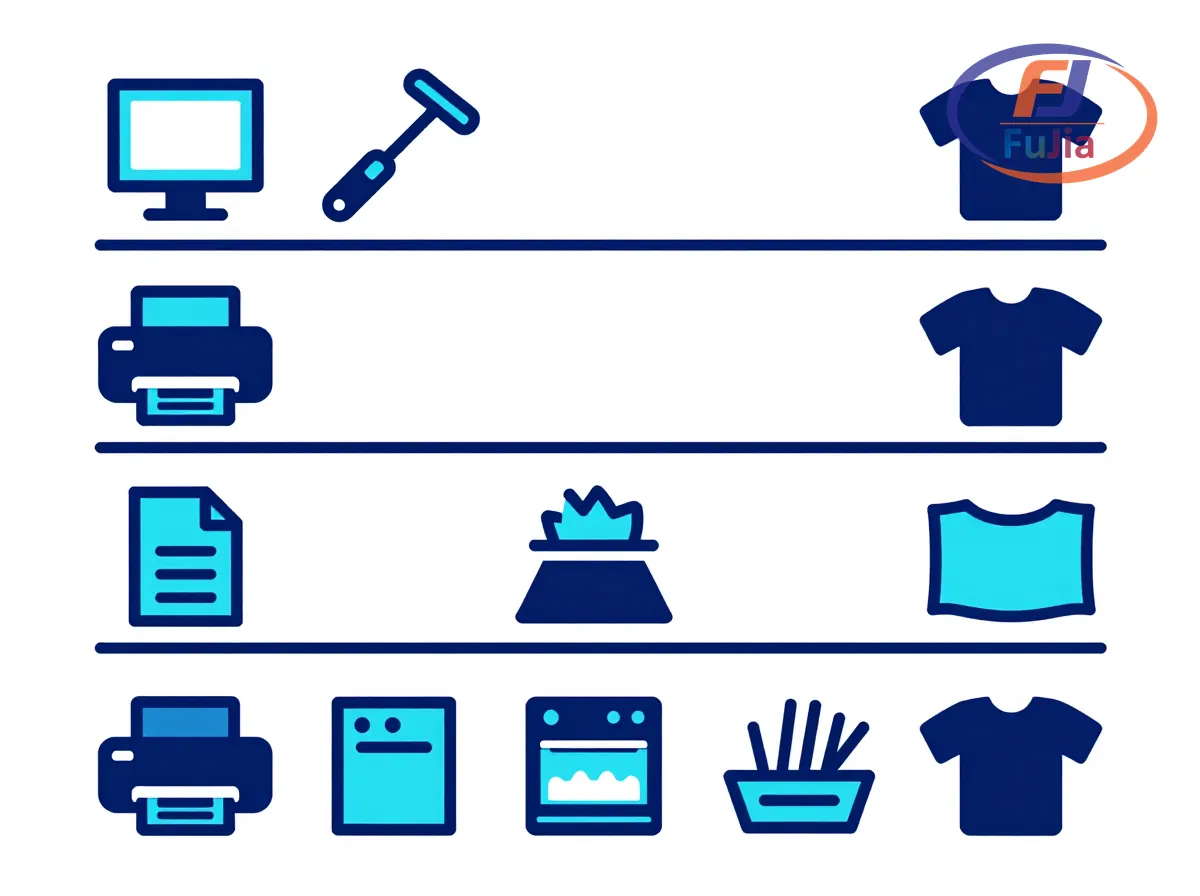
| Finishing | conveyor dryer | pretreat machine + press | heat press | shaker + oven + press |
| Key consumable | plastisol ink + screens | DTG ink + pretreat | sublimation ink + paper | ink + film + powder |
| Entry budget | $500-3,000 | $10,000-15,000 | $2,000-6,000 | $2,000-5,000 |
A corporate gift distributor we supply shows the same logic at order level: the shop ran three suppliers before consolidating, labels moved to UV DTF, small rigid printing to a compact UV flatbed, apparel to DTF, and the result was minimums down from 500 pieces to 50, delivery compressed from 21 days to 7, and average order value doubled, evidence that technology fit, not any single machine, is what compounds.
What machine do you need to print shirts?
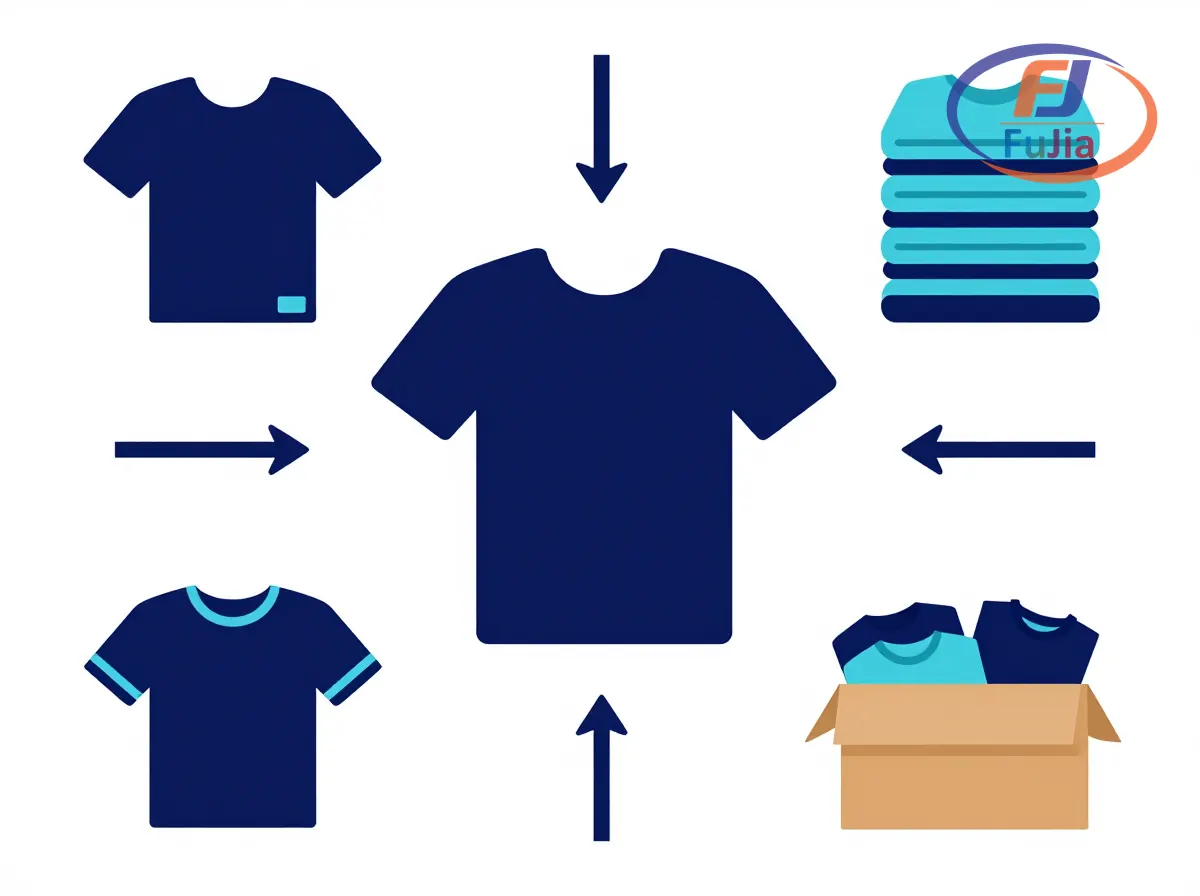
You need the machine whose mechanism matches your fabric, color, and quantity. Cotton shirts with photorealistic one-off designs point to DTG. Dark garments, blends, or mixed fabrics with full-color designs point to a DTF system. Polyester performance wear and all-over prints point to sublimation. Bulk runs of a simple repeating design above roughly 500 pieces point to a screen printing press. Buying the machine before writing down those three answers is the most expensive sequencing mistake in this industry.
How profitable is T-shirt printing?
Profitability tracks the gap between transfer cost and resale price, and the gap is wide at every technology. A DTF transfer consumes roughly $0.40-0.80 in consumables and retails the decorated shirt at $3-8 more than a blank, producing 40-70% margins that recover equipment cost in months at realistic volumes; one Etsy tote brand we supplied moved printing in-house on a 60 cm machine and now ships 1,500-plus pieces monthly at a 65% margin. The honest caveat is demand, not math: the printer pays for itself only when a sales channel feeds it, so line up orders before the crate arrives.
How much does a T-shirt printing machine cost?
By technology: screen printing starts near $500 for a manual press and climbs past $30,000 for automatic carousels; DTG runs $10,000-30,000; sublimation spans $2,000-25,000 by width; and DTF systems run $2,000-5,000 at entry and $13,800-15,200 for a complete 24-inch production station with press. Budget the first month of consumables and any finishing hardware with the machine, because headline prices routinely exclude the pieces that make it produce.
Which T-shirt printing machine is the best?
The best machine is the one whose mechanism fits your orders, and the four divide the market cleanly: DTF for mixed-fabric full-color work, DTG for photorealistic cotton under 50 pieces, sublimation for polyester, screen for bulk repeats. Within DTF, the decision is head count: a single-head A3 proves the model around $3,000, a 60 cm dual-head handles 200-400 pieces daily, and 4-head machines running 27 m²/h at 4-pass serve multi-shift production. Our apparel printing guide maps the full decision tree, and our DTF vs sublimation comparison scores the polyester matchup in detail.
Verdict
The printing t shirt machine market is four technologies answering four different questions, and reading the mechanism tells you which question is yours: screen for bulk simplicity, DTG for cotton one-offs, sublimation for polyester permanence, DTF for everything dark, mixed, or in between. Match the machine to the order profile, verify durability with your own 20-wash test, and the technology choice makes itself. To test your designs on a production DTF line before committing, contact Fujia Print for a same-file comparison print.
Sources
- Wikipedia: Screen printing: mesh stencil process background.
- Wikipedia: Direct-to-garment printing: DTG process reference.
- Wikipedia: Dye-sublimation printing: sublimation chemistry reference.
- Wikipedia: Heat press: transfer pressing background.
- AATCC: test methods behind the color fastness grades cited.
