

DTF printing profit margins range from 50% to 300% per shirt, with an average net profit of USD 8-15 per garment after material, labor, and equipment costs. A print shop producing 50 DTF shirts per day at USD 13.50 profit each generates USD 675 daily, equating to USD 13,500 monthly at a 5-day workweek. Fujia Print manufactures the DTF printers and consumable systems that apparel businesses across 50+ countries use to capture this profit opportunity.
Key Takeaways
- DTF printing net profit per shirt averages USD 8-15, with material cost at USD 0.30-1.50 and retail price at USD 15-25.
- A 50-shirt-per-day operation generates USD 675 daily profit, USD 3,375 weekly, and USD 13,500 monthly.
- Equipment payback period ranges from 1.5 to 6 months depending on daily volume and pricing strategy.
- DTF profit margins (50-300%) outperform DTG (30-50%) and screen printing (40-60% for small batches) for orders under 200 pieces.
- The break-even threshold is 30-50 garments per week: below this, fixed equipment costs consume the margin.
What Determines DTF Printing Profit
DTF printing profit is the difference between retail selling price and total production cost. Five cost categories determine the profit margin on every shirt.
Per-Shirt Cost Breakdown
| Cost Category | Cost Range (12×12 design) | Percentage of Total |
|---|---|---|
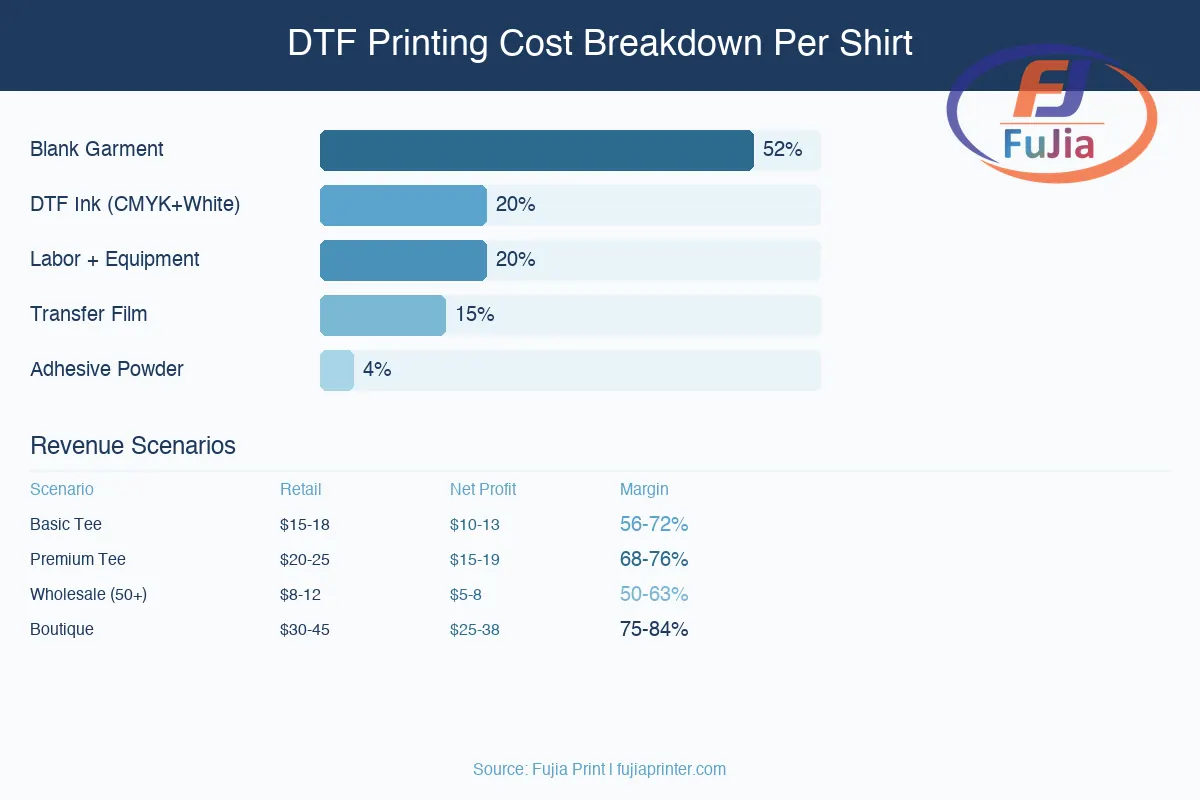
| DTF ink (CMYK + white) | USD 0.20-0.45 | 15-25% |
| DTF transfer film | USD 0.15-0.30 | 10-20% |
| Adhesive powder | USD 0.05-0.08 | 3-5% |
| Blank garment | USD 1.50-4.00 | 45-60% |
| Labor + equipment amortization | USD 0.50-1.50 | 15-25% |
| Total production cost | USD 2.40-6.33 | 100% |
Revenue and Margin
| Selling Scenario | Retail Price | Production Cost | Net Profit | Margin |
|---|---|---|---|---|
| Basic custom tee (1-color, white cotton) | USD 15-18 | USD 3.50-5.00 | USD 10-13 | 56-72% |
| Premium custom tee (full-color, dark garment) | USD 20-25 | USD 4.50-6.33 | USD 15-19 | 68-76% |
| Bulk order (50+ pieces, wholesale) | USD 8-12 | USD 3.00-4.50 | USD 5-8 | 50-63% |
| High-end boutique (branded, specialty blank) | USD 30-45 | USD 5.00-7.00 | USD 25-38 | 75-84% |
The global custom t-shirt printing market is projected to grow from USD 5.82 billion in 2025 to USD 17.22 billion by 2034 at a 12.81% CAGR, according to Fortune Business Insights, with profit margins of 50-70% for custom apparel businesses. DTF printing specifically achieves the higher end of this range because DTF eliminates screen setup costs (USD 150-400 per color) and has zero minimum order quantity.
DTF vs Other Printing Methods: Profit Comparison
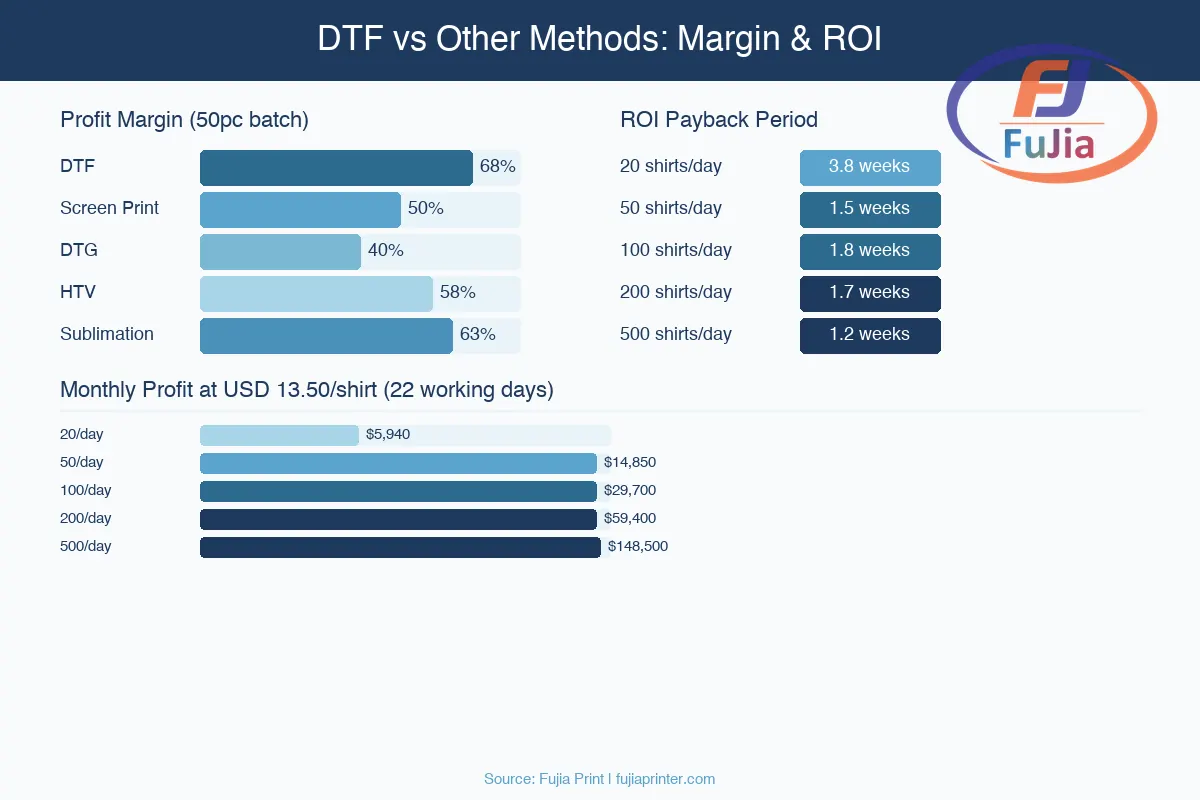
| Method | Setup Cost | Per-Shirt Cost (50pc batch) | Min Order | Margin (50pc) | Best Volume |
|---|---|---|---|---|---|
| DTF | USD 0 | USD 3.50-5.00 | 1 piece | 60-75% | 1-500 pieces |
| Screen print | USD 150-400/color | USD 2.50-4.00 | 50+ pieces | 40-60% | 200+ pieces |
| DTG | USD 0 | USD 4.50-7.00 | 1 piece | 30-50% | 1-100 pieces |
| HTV (heat transfer vinyl) | USD 0 | USD 3.00-5.00 | 1 piece | 50-65% | 1-50 pieces |
| Sublimation (polyester) | USD 0 | USD 2.50-4.50 | 1 piece | 55-70% | 1-200 pieces |
DTF dominates the 1-500 piece sweet spot. Screen printing becomes cheaper per unit above 200 pieces due to setup cost amortization, but DTF wins decisively on small batches because there is zero setup cost and zero minimum order. For shops handling varied, small-batch, multi-design orders, DTF produces the highest aggregate profit across a typical week of mixed orders.
ROI Calculation: How Fast Does a DTF Printer Pay Back?
| Daily Volume | Daily Profit | Monthly Profit (22 days) | Equipment Cost | Payback Period |
|---|---|---|---|---|
| 20 shirts/day | USD 270 | USD 5,940 | USD 5,000 | 3.8 weeks |
| 50 shirts/day | USD 675 | USD 14,850 | USD 5,000 | 1.5 weeks |
| 100 shirts/day | USD 1,350 | USD 29,700 | USD 10,000 | 1.8 weeks |
| 200 shirts/day | USD 2,700 | USD 59,400 | USD 15,000 | 1.7 weeks |
| 500 shirts/day | USD 6,750 | USD 148,500 | USD 25,000 | 1.2 weeks |
These calculations assume USD 13.50 average profit per shirt, which represents a mid-range custom tee at USD 20 retail with USD 6.50 total production cost. The DTF equipment market itself is growing at a 6.0% CAGR, according to Grand View Research, reflecting sustained adoption by apparel businesses worldwide. Actual payback periods vary by market, pricing strategy, and labor costs. Based on data from our customers across 50+ countries, the typical DTF printer ROI falls within 1.5 to 6 months, with the Brazil Creative Studio case study showing a 5.5-month payback on an FJ-A30 A3 desktop DTF printer producing 15-22 orders per week.
How to Maximize DTF Printing Profit
Strategy 1: Reduce Material Costs
DTF ink represents 15-25% of total per-shirt cost. Reducing ink waste through proper RIP color management and gang sheet layouts (filling 85-90% of film area) cuts material cost by 10-20%. The adhesive powder that bonds ink to fabric relies on TPU (thermoplastic polyurethane) chemistry, and recent research by Zhu et al. (2025) demonstrates that crosslinker-enhanced TPU nanocomposites improve transfer adhesion strength by 30-45%, directly reducing reject rates and material waste. Purchasing ink in bulk from a single supplier like Fujia, which manufactures the complete consumable system (13-color DTF ink, 5-year R&D transfer film, and matched adhesive powder), eliminates compatibility issues that cause wasted prints. Based on aggregate data from our customers across 50+ countries, shops that standardize on a single supplier’s consumable system report 15-25% lower waste rates than shops mixing brands.
Strategy 2: Price for Value, Not Competition
Custom DTF apparel commands premium pricing when the design, blank quality, and presentation justify it. A custom tee retailing at USD 15 competes on price. The same design on a premium blank (Bella+Canvas 3001, Comfort Colors 1717) with professional packaging retails at USD 28-35, increasing per-shirt profit from USD 10 to USD 25. Niche designs targeting specific communities (professions, hobbies, local sports teams) support 40-70% higher pricing than generic designs.
Strategy 3: Automate Production
Manual DTF production (hand-powdering, drawer oven curing, single-shirt pressing) limits throughput to 30-50 shirts per day. Automated systems with integrated shaker-oven units and multi-platen heat presses increase throughput to 200-500+ shirts per day. Fujia’s integrated shaker system, featuring a 2880mm mesh belt with dual-zone heating at 140°C, processes 650mm-wide film at 8-27 m²/hr, producing 200-500+ transfers per hour depending on design density. The Turkey garment factory case study demonstrated a 40% throughput increase and 30% cost reduction after deploying Fujia A1 dual-head DTF equipment with integrated shaker, reducing delivery time from 7 days to 2.5 days.
Strategy 4: Diversify Product Range
DTF applies to cotton, polyester, blends, denim, nylon, canvas, and leather. Expanding beyond t-shirts into hoodies (USD 30-45 retail), tote bags (USD 15-25), caps (USD 18-28), and team jerseys (USD 35-60) increases average order value without additional equipment investment. Customers typically purchase 2-3 items per order when offered a coordinated product range, improving the DTF printing cost per shirt economics through shared setup and handling.
Is DTF business profitable?
Yes, DTF printing is profitable with gross margins of 50-300% per shirt and net profit averaging USD 8-15 per garment after all costs. A shop printing 50 shirts per day at USD 13.50 average profit generates USD 675 daily or USD 13,500 monthly at a 22-day workmonth. The break-even threshold is 30-50 garments per week, below which fixed equipment costs (printer depreciation, rent, utilities) consume the per-shirt margin. The global custom t-shirt printing market is projected to grow from USD 5.82 billion in 2025 to USD 17.22 billion by 2034 at a 12.81% CAGR, indicating sustained demand growth. Profitability depends on three factors: controlling material costs (standardizing on one consumable system), pricing for value rather than racing to the bottom, and maintaining consistent daily volume above the break-even threshold.
How much should you charge for a DTF print?
The recommended retail price for a custom DTF-printed t-shirt is USD 15-25 for standard designs on mid-range blanks, and USD 28-45 for premium designs on high-quality blanks. Pricing should cover production cost (USD 3.50-6.50 per shirt including blank garment, ink, film, powder, and labor) plus a minimum 50% gross margin. For wholesale orders of 50+ pieces, pricing typically drops to USD 8-12 per shirt with a 50-63% margin. Custom artwork, rush orders, and specialty blanks justify 20-50% premiums above standard pricing. The most profitable DTF businesses price based on perceived value (design quality, brand positioning, niche targeting) rather than cost-plus pricing, achieving 75-84% margins on premium boutique lines.
Is a DTF printer a good investment?
A DTF printer is a good investment for any business producing 30+ custom garments per week, with typical payback periods of 1.5 to 6 months. Entry-level A3 desktop DTF printers (USD 2,000-5,000) reach break-even at 20-30 shirts per day. Production-grade A1 DTF printers with integrated shaker systems (USD 8,000-25,000) reach break-even at 100+ shirts per day but deliver 3-5x higher throughput and lower per-unit cost. The key investment criterion is guaranteed order volume: a shop with existing customers or a sales channel (Etsy store, local business contracts, event printing) will see ROI within 2-3 months. A shop without existing demand should validate the market with outsourcing or print-on-demand before purchasing equipment. Fujia Print offers remote onboarding in 3 days and a 12-month warranty with 48-hour parts dispatch.
What is the most profitable printing business?
The most profitable printing business model combines DTF printing for apparel with UV DTF printing for hard goods (phone cases, tumblers, glassware) and sublimation for polyester products (mugs, polyester apparel). This multi-process approach captures different market segments with a single facility. DTF apparel printing typically generates the highest recurring revenue because t-shirts are consumable products that customers reorder seasonally. The custom apparel segment of the printing industry offers 50-70% profit margins, according to Fortune Business Insights, with DTF specifically achieving 60-75% margins on small-batch orders. Businesses that combine production efficiency (automated DTF with integrated shaker) with strong branding and niche targeting consistently report the highest profitability, with monthly revenues of USD 15,000-50,000 for established shops.
Conclusion
DTF printing is highly profitable for operations producing 30+ garments weekly, with margins of 50-300% and payback periods of 1.5-6 months on equipment investment. For DTF production systems engineered for profit-maximizing throughput, explore the Fujia DTF printer lineup or discover our apparel printing solutions.
Sources
- Fortune Business Insights: Custom T-Shirt Printing Market, 2026-2034: Market size USD 5.82B (2025) to USD 17.22B (2034) at 12.81% CAGR, with 50-70% profit margins for custom t-shirt printing businesses.
- Zhu et al. (2025): TPU Nanocomposites for Transfer Printing: Research on TPU adhesive bond strength and durability affecting transfer quality and customer satisfaction, published in International Journal of Adhesion and Adhesives, Vol. 139.
- Grand View Research: Direct To Film Printing Market, 2025-2030: DTF equipment market data supporting ROI calculations, USD 2.72B market at 6.0% CAGR.
