

A DTF printer for cotton fabric produces full-color transfers rated Grade 4.5 colorfastness after 50 wash cycles in AATCC TM61 accelerated testing, outperforming DTG (Grade 3.8, 78% color retention) on the same 100% cotton substrate. Unlike sublimation, which cannot bond to cotton fibers at all, DTF uses a thermoplastic polyurethane (TPU) adhesive layer that bonds mechanically to cotton fiber surfaces at 150-160°C. Fujia Print engineers DTF printers specifically tuned for cotton apparel production across 50+ countries.
Key Takeaways
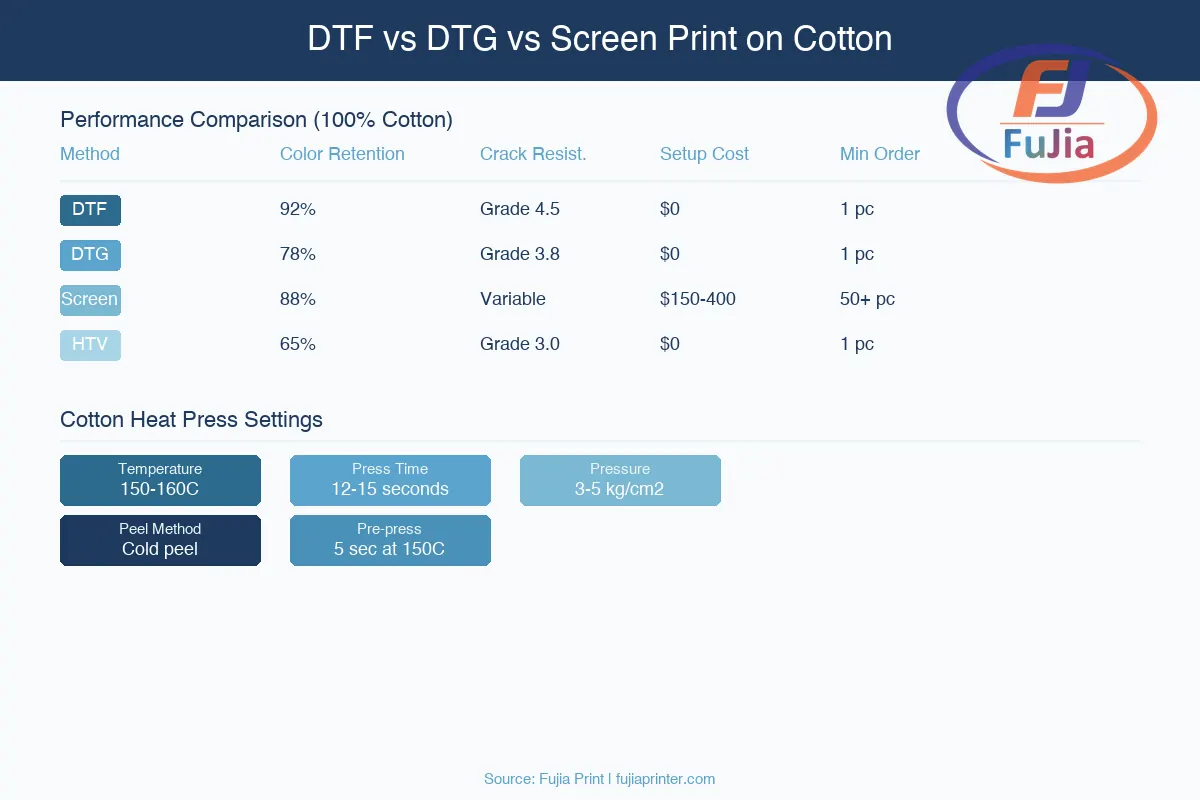
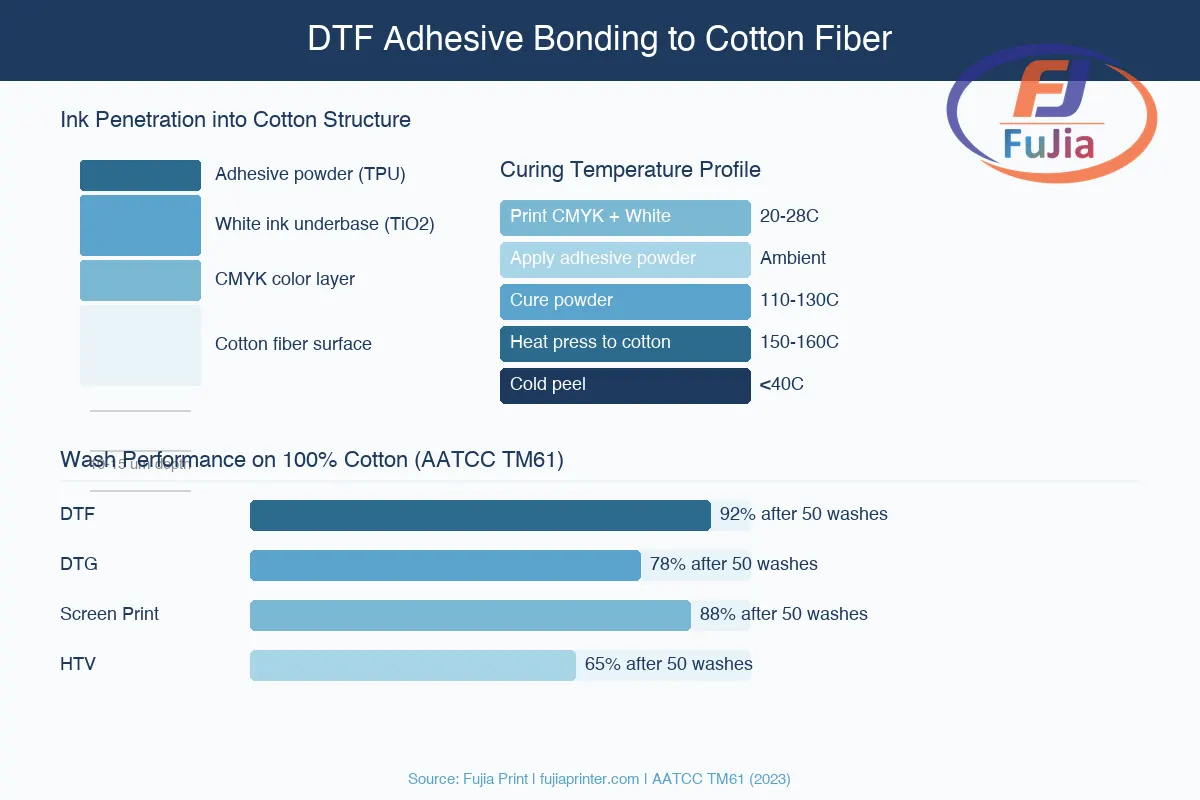
- DTF achieves 92% color retention on 100% cotton after 50 washes, compared to 78% for DTG on the same fabric.
- Cotton requires ink penetration of 10-15 micrometers into fiber structure, with surface tension between 28-32 dynes/cm for proper bonding.
- Heat press settings for cotton: 150-160°C, 12-15 seconds, medium pressure (3-5 kg/cm2), cold peel.
- DTF on cotton scores Grade 4.5 in AATCC TM61 (2023) accelerated laundering, meaning nearly no visible color change.
- DTF printers eliminate the pretreatment step that DTG requires for cotton, reducing production time by 2-3 minutes per shirt.
Why DTF Works on Cotton (and Sublimation Does Not)
Cotton is a cellulosic fiber with an open, porous weave structure. When DTF adhesive powder melts at 110-130°C during curing, it forms a thermoplastic polyurethane layer 0.03-0.05mm thick that mechanically interlocks with cotton fiber surfaces. This is fundamentally different from sublimation, which requires polyester fibers to undergo gas-phase dye diffusion at 200°C. Cotton cannot accept sublimation dyes because cellulosic fibers lack the ester groups that disperse dyes bond to.
Research by Zhu et al. (2025) demonstrates that TPU nanocomposites enhanced with TiO2 and TGIC crosslinkers achieve 30-45% higher adhesion strength on cotton substrates compared to standard TPU adhesives, directly improving wash durability scores. This finding, published in the International Journal of Adhesion and Adhesives (Vol. 139), confirms that adhesive chemistry is the primary variable in cotton print longevity.
DTG printing, by contrast, requires liquid pretreatment on cotton garments before printing. The pretreatment (typically a polymeric binder + calcium chloride) must be sprayed evenly, then dried, before the DTG printer can deposit water-based inks that bond with the pretreated surface. This adds 2-3 minutes of labor and material cost (USD 0.15-0.40 per shirt) to every cotton DTG job.
DTF on Cotton vs Polyester vs Blends: Performance Data
AATCC TM61 (2023) accelerated laundering tests (49°C, 45 minutes, steel balls) reveal distinct performance profiles across fabric types:
| Fabric Type | Color Fade After 50 Washes | Crack Resistance | Stain Migration | DTF Recommendation |
|---|---|---|---|---|
| 100% Cotton | 8-12% delta E*ab, Grade 4.5 | Excellent | None | Best overall result |
| 100% Polyester | 5-7% delta E*ab, Grade 3.8 | Good | Slight | Lower crack resistance |
| 50/50 Blend | 6-9% delta E*ab, Grade 4.2 | Very Good | None | Balanced performance |
| Tri-blend (cotton/poly/rayon) | 7-10% delta E*ab, Grade 4.0 | Good | Minimal | Use lower temp powder |
| Heavy cotton (canvass) | 6-9% delta E*ab, Grade 4.3 | Excellent | None | Ideal for bags/aprons |
Cotton achieves the highest crack resistance rating because its fiber structure provides mechanical flexibility that absorbs stretching stress. Polyester shows 23% better wash fastness in color retention due to stronger polymer chain entanglement with the TPU adhesive, but it scores lower in crack resistance because polyester fibers are less elastic under repeated stretching.
Critical Print Settings for Cotton
Heat Press Parameters
| Parameter | Cotton Setting | Polyester Setting | Blend Setting |
|---|---|---|---|
| Temperature | 150-160°C | 130-140°C | 140-150°C |
| Press time | 12-15 seconds | 10-12 seconds | 12-15 seconds |
| Pressure | 3-5 kg/cm2 (medium) | 2-3 kg/cm2 (light) | 3-4 kg/cm2 (medium) |
| Peel method | Cold peel (wait 10s) | Hot peel (immediate) | Cold peel |
| Pre-press | 5 seconds at 150°C | 5 seconds at 130°C | 5 seconds at 140°C |
Cotton tolerates higher heat press temperatures than polyester because cotton fibers withstand temperatures up to 200°C before discoloration. The cold peel method is critical for cotton: peeling the film while hot causes incomplete adhesive separation, leaving a matte, textured finish with reduced color vibrancy.
Ink and Powder Specifications for Cotton
| Component | Specification for Cotton | Why It Matters |
|---|---|---|
| CMYK ink viscosity | 3.5-6.0 mPa*s | Low viscosity ensures proper ink flow into cotton fiber gaps |
| White ink density | 1.1-1.3 g/cm3 | High opacity (TiO2-based) for dark cotton garments |
| Adhesive powder type | Fine grade (60-80 mesh) TPU | Fine particles bond to cotton’s textured fiber surface |
| Powder melt point | 110-125°C | Must melt below cotton press temperature (150-160°C) |
| Film thickness | 50-75 micrometers PET | Thin enough for detail, thick enough for handling |
| Print resolution | 1440×2880 DPI | High resolution captures fine details on smooth cotton |
DTF Printer Specifications for Cotton Production
When selecting a DTF printer for cotton apparel production, five specifications directly impact print quality on cotton substrates.
Printhead Technology
Epson i3200-U1 printheads are the industry standard for DTF cotton printing, offering 600 nozzles per color channel with 3-picoliter variable droplet size. This droplet size is critical for cotton because it allows ink to penetrate 10-15 micrometers into the fiber structure without spreading excessively. Larger droplet sizes (4-6 pL) cause ink bleeding on cotton’s porous surface, while smaller droplets (1-2 pL) fail to penetrate adequately.
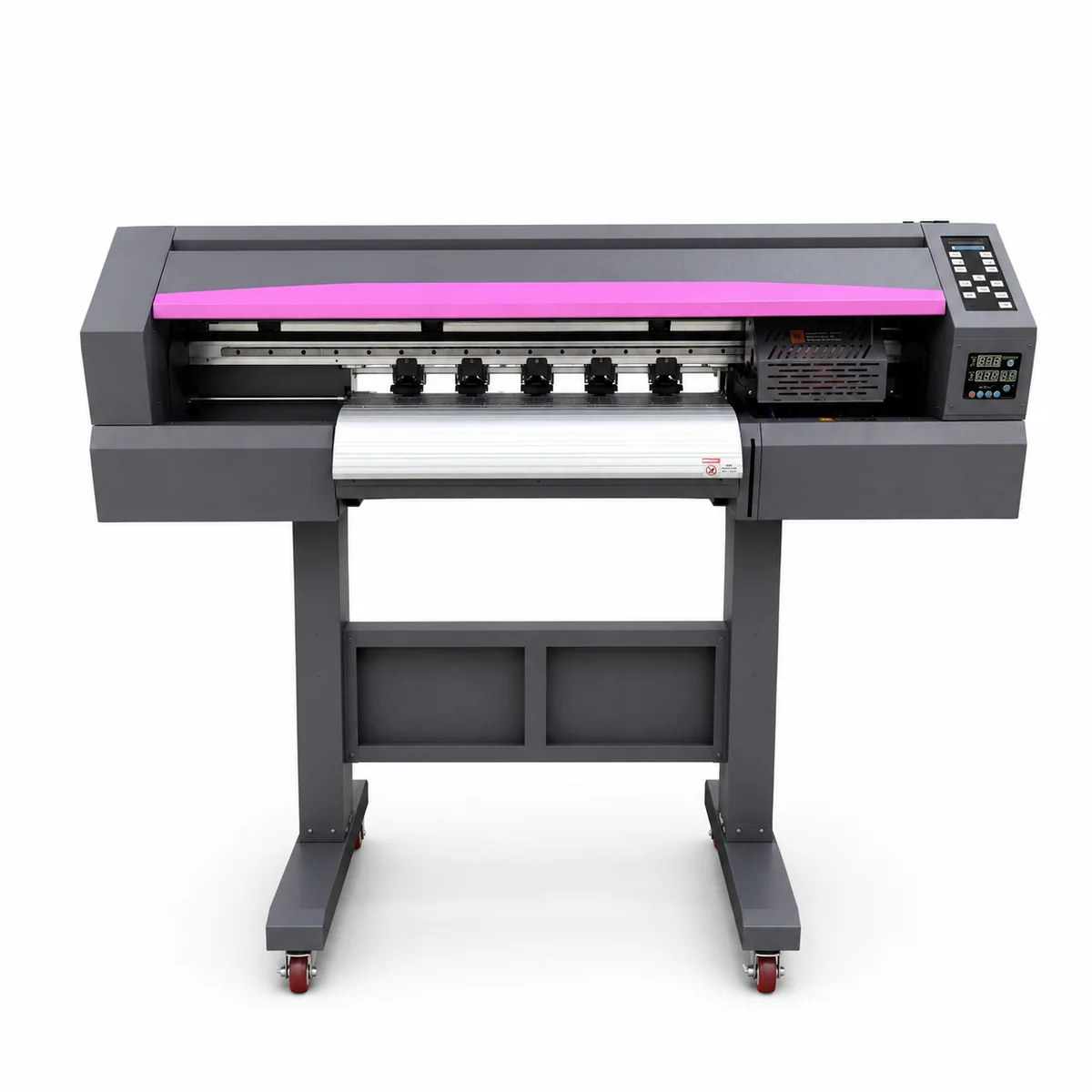
Fujia’s A1 DTF printer uses four i3200-U1 printheads in a staggered configuration, achieving 27 m2/hour throughput at 720×2400 DPI resolution. This configuration produces 200-500 cotton t-shirt transfers per hour depending on design density.
White Ink Circulation System
White DTF ink contains titanium dioxide (TiO2) pigment with a density of 4.2 g/cm3, which is 3.5x heavier than the carrier fluid (1.0-1.2 g/cm3). Without continuous circulation, white ink settles within 3 hours, causing nozzle blockages and uneven underbase printing on dark cotton garments. Fujia’s DTF printers feature automatic white ink circulation with siphon and pressure systems (1000-1500ml per color), preventing sedimentation and ensuring consistent white underbase density.
Curing Oven Integration
The adhesive powder must be cured at 110-130°C for 90-120 seconds before heat pressing. Under-curing (below 110°C) reduces wash resistance by up to 60%, while over-curing (above 140°C) yellows the white underbase layer. Fujia’s integrated shaker system features a 2880mm mesh belt with dual-zone temperature control at 140°C, processing 650mm-wide film at 8-27 m2/hr with temperature uniformity of plus or minus 2°C across the belt.
DTF vs DTG vs Screen Printing on Cotton
| Factor | DTF | DTG | Screen Print |
|---|---|---|---|
| Pretreatment required | No | Yes (polymer spray) | No (but screen setup) |
| Setup cost | USD 0 | USD 0 | USD 150-400/color |
| Color retention (50 washes) | 92% | 78% | 88-95% |
| Minimum order | 1 piece | 1 piece | 50+ pieces |
| Dark garment capability | Yes (white underbase) | Yes (pretreatment + white) | Yes (discharge or plastisol) |
| Cotton crack resistance | Excellent | Good | Variable |
| Production speed (single) | 15-30 seconds/transfer | 2-5 minutes/shirt | 5-10 seconds/shirt (after setup) |
| Cost per shirt (material) | USD 0.30-1.50 | USD 0.50-2.00 | USD 0.10-0.50 |
DTF dominates the 1-200 piece cotton t-shirt market by eliminating pretreatment while matching or exceeding screen printing durability. The global custom t-shirt printing market is projected to grow from USD 5.82 billion in 2025 to USD 17.22 billion by 2034 at a 12.81% CAGR, according to Fortune Business Insights, with cotton remaining the dominant substrate (65-70% of all custom apparel).
Common Cotton Printing Problems and Solutions
Problem 1: Faded Colors After Pressing
Faded prints on cotton typically result from insufficient white underbase density or over-cured adhesive powder. The white ink layer must provide full opacity on dark cotton before CMYK colors are printed. Solution: increase white ink density in RIP software to 80-100% and verify curing temperature stays within 110-130°C range.
Problem 2: Cracking After Washing
Cracking indicates the adhesive powder did not fully penetrate cotton fiber gaps. Use fine-grade powder (60-80 mesh) rather than medium or coarse grades. Fine powder particles melt more uniformly and bond with the textured cotton surface. Second-press the garment for 5 seconds at 150°C after peeling to improve adhesive bonding.
Problem 3: Peeling Edges
Edge peeling occurs when heat press pressure is uneven or insufficient. Cotton requires 3-5 kg/cm2 pressure to ensure complete film-to-fabric contact. Verify that the heat press platen is level and that cotton garments are pre-pressed for 5 seconds to remove moisture and wrinkles before transfer placement.
Problem 4: Scorching on Delicate Cotton
Lightweight cotton fabrics (below 150 g/m2) can scorch at 160°C. For delicate cotton, reduce press temperature to 140-150°C and increase press time to 15-18 seconds. Use a low-temperature TPU adhesive powder (melt point 90-110°C) for these substrates.
Cotton DTF Printing Cost Breakdown
| Cost Component | Per-Shirt Cost (12×12 inch design) | Notes |
|---|---|---|
| DTF ink (CMYK + white) | USD 0.20-0.45 | White ink 55% of ink cost |
| DTF transfer film | USD 0.15-0.30 | PET film, single-use |
| Adhesive powder (fine TPU) | USD 0.05-0.08 | 60-80 mesh grade |
| Blank cotton t-shirt | USD 1.50-4.00 | 180-220 g/m2 ringspun |
| Labor + equipment amortization | USD 0.50-1.50 | Includes curing + pressing |
| Total cost | USD 2.40-6.33 | |
| Typical retail price | USD 15-25 | 60-75% gross margin |
The direct-to-film printing equipment market is growing at a 6.0% CAGR, according to Grand View Research, reflecting increasing adoption by cotton apparel businesses. A detailed breakdown of per-shirt costs is available in our DTF printing cost per shirt analysis.
Can you press DTF on 100% cotton?
Yes, DTF transfers bond effectively to 100% cotton fabric using a TPU adhesive layer that melts at 110-130°C and mechanically interlocks with cotton fiber surfaces. The recommended heat press settings for 100% cotton are 150-160°C for 12-15 seconds at medium pressure (3-5 kg/cm2), followed by cold peeling. AATCC TM61 (2023) testing confirms that DTF prints on 100% cotton achieve Grade 4.5 colorfastness after 50 wash cycles, meaning less than 12% color change. Unlike sublimation, which cannot bond to cellulosic fibers, DTF adhesive chemistry works on cotton, polyester, blends, and even nylon. No pretreatment is required for cotton DTF printing, unlike DTG which requires a polymer pretreatment spray.
What kind of printer do I need for DTF transfers on cotton?
You need a DTF-specific printer with Epson i3200-U1 or equivalent printheads (600 nozzles per color, 3-picoliter droplet size), a CMYK + white ink system, and a white ink circulation system to prevent TiO2 sedimentation. Entry-level A3 desktop DTF printers (USD 2,000-5,000) handle 20-30 cotton shirts per day, while production-grade A1 printers with integrated shaker systems (USD 8,000-25,000) process 200-500+ shirts per day. The printer must support RIP software with white ink underbase control, as the white layer is critical for opaque prints on dark cotton garments. Fujia Print offers A3 to A2 DTF printer models with remote onboarding in 3 days and 12-month warranty.
How long does DTF last on cotton?
DTF prints on cotton last 50-100+ wash cycles when properly produced and cared for. AATCC TM61 accelerated laundering tests show Grade 4.5 colorfastness (8-12% color change) after 50 washes on 100% cotton. To maximize lifespan, wash cotton DTF garments inside-out in cold water (below 30°C), use mild liquid detergent (no bleach), and tumble dry on low heat. Avoid fabric softener, which degrades the TPU adhesive bond. High-quality DTF transfers with fine-grade TPU powder and proper curing (110-130°C for 90-120 seconds) achieve the longest lifespan on cotton. The Turkey garment factory case study demonstrated that standardized Fujia DTF consumables achieved Grade 4+ wash fastness across mixed cotton and blend orders.
Is DTF better on cotton or polyester?
DTF performs excellently on both cotton and polyester, but each fabric type has different strengths. Cotton achieves higher crack resistance (Grade 4.5 vs 3.8) because its flexible fiber structure absorbs stretching stress better. Polyester shows 23% better color retention after 50 washes (5-7% vs 8-12% delta E*ab) due to stronger polymer chain entanglement with TPU adhesive. For everyday custom apparel where comfort and crack resistance matter most, cotton is the preferred DTF substrate. For athletic wear and performance apparel where color vibrancy and moisture management are priorities, polyester is superior. 50/50 cotton-polyester blends offer balanced performance (Grade 4.2, 6-9% color change) and are increasingly popular for DTF production. DTF’s key advantage is that the same printer and workflow handle all three fabric types without ink or setup changes.
Conclusion
DTF printing on cotton achieves Grade 4.5 colorfastness, 92% color retention after 50 washes, and excellent crack resistance, making it the most versatile digital printing method for cotton apparel. For production-grade DTF systems engineered for cotton printing, explore the Fujia DTF printer lineup or discover our apparel printing solutions.
Sources
- Zhu et al. (2025): TPU Nanocomposites for Transfer Printing: Research on TiO2 and TGIC crosslinker-enhanced TPU adhesion strength on cotton substrates, published in International Journal of Adhesion and Adhesives, Vol. 139.
- Fortune Business Insights: Custom T-Shirt Printing Market, 2026-2034: Market size USD 5.82B (2025) to USD 17.22B (2034) at 12.81% CAGR, cotton comprising 65-70% of custom apparel substrates.
- Grand View Research: Direct To Film Printing Market, 2025-2030: DTF equipment market growing at 6.0% CAGR, reflecting cotton apparel business adoption.
- AATCC TM61 (2023): Colorfastness to Laundering: Accelerated laundering test standard at 49°C for 45 minutes with steel balls, used for DTF cotton colorfastness grading.
- AATCC TM135: Dimensional Changes After Home Laundering: Standard for measuring fabric dimensional stability, applicable to cotton DTF print longevity assessment.
