

DTF printing cost per shirt ranges from USD 0.30 to USD 1.50 in materials alone, covering ink, film, and adhesive powder for a standard 12×12 inch design on a cotton t-shirt. The total production cost including blank garment, labor, and equipment amortization reaches USD 3.50-5.00 per shirt. The global DTF printing market was valued at USD 2.93 billion in 2025 and is projected to reach USD 3.92 billion by 2030 at a CAGR of 6.0%, driven by the cost advantages of DTF over screen printing for small and medium batch production. Fujia Print manufactures the complete consumable system, DTF ink, film, and powder, that determines per-shirt material costs across DTF printers deployed in 50+ countries.
Key Takeaways
- DTF material cost per shirt is USD 0.30-1.50 depending on design size, ink coverage, and fabric color (white ink underbase increases cost 40-60% on dark garments).
- A standard 12×12 inch full-color design on a white cotton tee costs approximately USD 0.65 in materials: USD 0.25 film, USD 0.25 ink, USD 0.05 powder, USD 0.10 waste factor.
- Total production cost (materials + blank garment + labor + equipment) reaches USD 3.50-5.00 per shirt for in-house production.
- Retail selling price for custom DTF apparel averages USD 15-25 per shirt, yielding a gross margin of 60-75%.
- DTF becomes more cost-effective than screen printing below 200-300 pieces per design, because screen printing requires USD 150-400 setup cost per color.
What Determines DTF Cost Per Shirt?
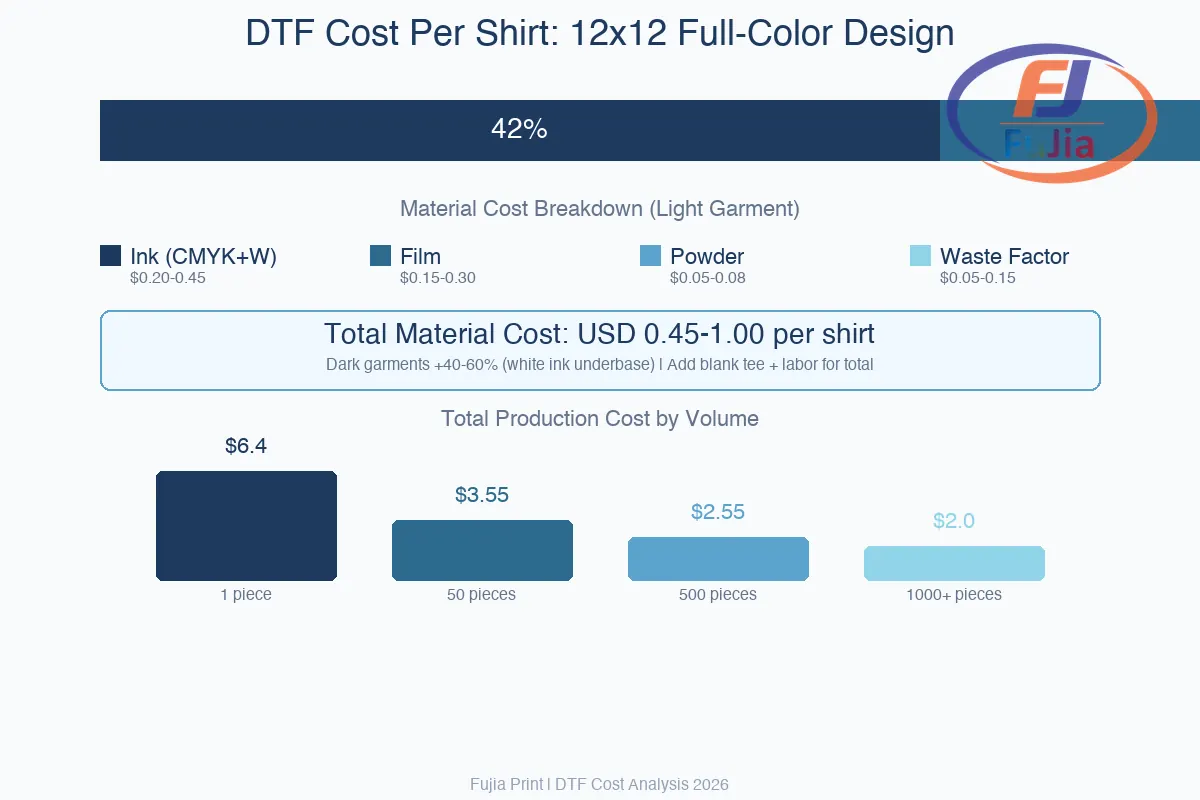
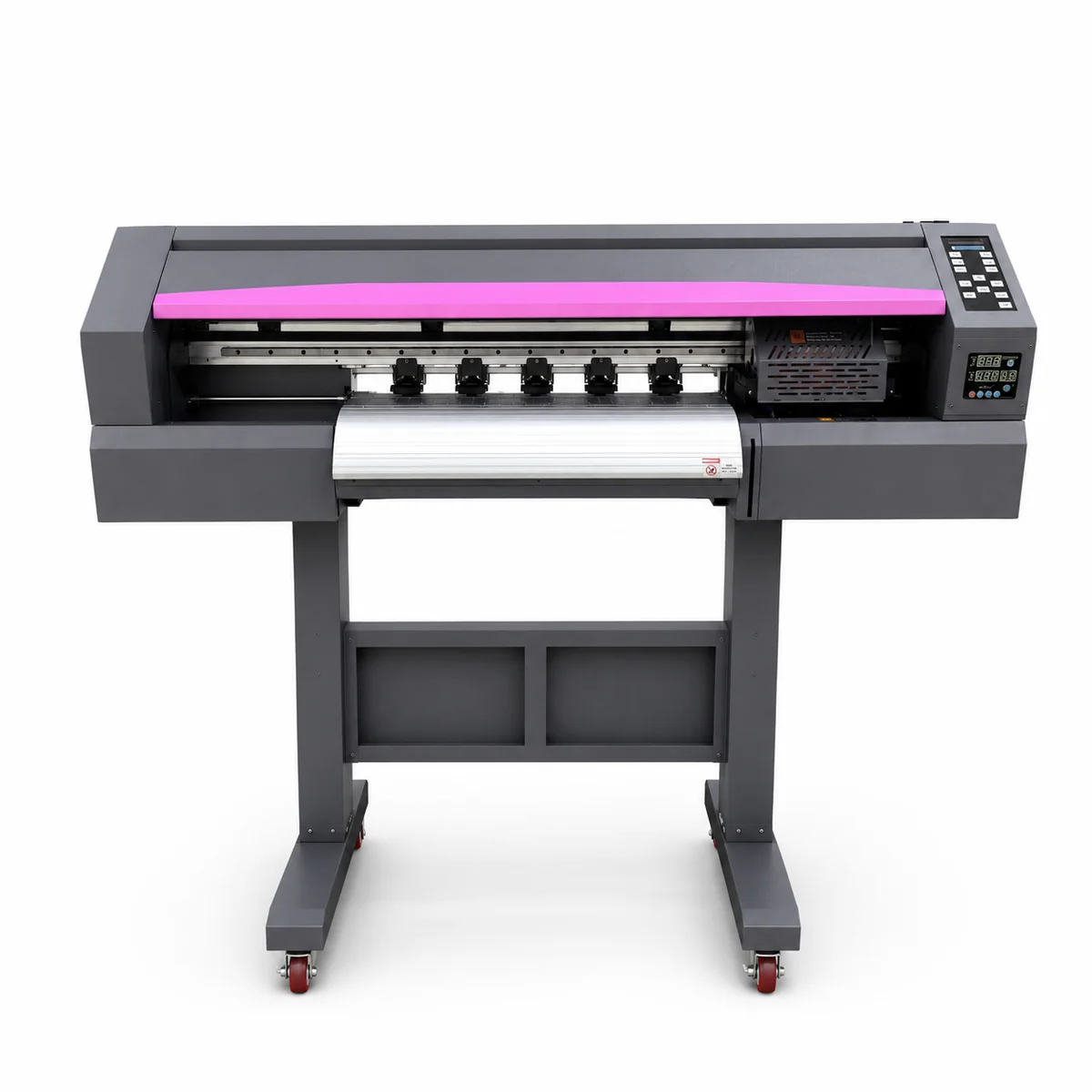
DTF cost per shirt is determined by six cost categories. Understanding each category allows operators to identify cost reduction opportunities and price garments profitably. For a complete overview, see the Fujia DTF printer lineup guide.
Cost Category Breakdown Table
| Cost Category | Per-Shirt Cost (12×12 design) | Percentage of Material Cost | Controllable? |
|---|---|---|---|
| DTF Ink (CMYK + White) | USD 0.20-0.45 | 35-45% | Yes (coverage optimization) |
| DTF Transfer Film | USD 0.15-0.30 | 25-35% | Yes (bulk purchasing) |
| Adhesive Powder | USD 0.05-0.08 | 5-10% | Minimal variance |
| Waste / Reject Factor | USD 0.05-0.15 | 5-10% | Yes (quality control) |
| Blank Garment | USD 1.50-4.00 | N/A (passed to buyer) | Yes (supplier negotiation) |
| Labor + Equipment | USD 0.50-1.50 | N/A (overhead) | Yes (throughput) |
Material cost (ink + film + powder + waste) totals USD 0.45-1.00 for a standard 12×12 inch design on a light-colored garment. Dark-colored garments require a white ink underbase layer that increases ink consumption by 40-60%, raising material cost to USD 0.70-1.50. Large designs (16×20 inches and above) scale proportionally with area, reaching USD 1.20-2.50 in materials alone.
Ink Cost: The Largest Variable Expense
DTF ink is the single largest material cost component, representing 35-45% of total material expense per shirt. Ink consumption depends on three factors: design coverage percentage, print resolution (pass count), and white ink underbase requirement.
Ink Consumption Formula
DTF ink consumption averages 15-25 grams per square meter of printed area for CMYK colors, consistent with the 20g/m2 industry benchmark documented across digital textile printing research. White ink consumption for dark-garment underbases adds 20-35 grams per square meter because the white layer must achieve full opacity to prevent fabric color from showing through.
A 12×12 inch design (0.093 m2) with 60% color coverage consumes approximately: – CMYK ink: 0.093 m2 x 60% x 20 g/m2 = 1.12 grams – White ink (dark garment): 0.093 m2 x 100% x 25 g/m2 = 2.33 grams – Total ink: 3.45 grams
At bulk DTF ink pricing of USD 25-40 per liter (approximately 1.0-1.1 kg per liter), 3.45 grams of ink costs USD 0.08-0.14. However, ink consumption varies significantly with design complexity. A photographic full-bleed design at 100% coverage consumes 3-5x more ink than a line-art logo at 20% coverage.
The Fujia Print DTF ink system uses imported premium resin and pigment raw materials with high concentration and uniform particle size, which reduces ink consumption per print by 10-15% compared to budget alternatives. The siphon and positive pressure supply system (1000-1500ml per color) minimizes ink waste during priming and cleaning cycles.
Film and Powder: Fixed Costs Per Print
DTF transfer film and adhesive powder costs are more predictable than ink costs because they scale directly with design area rather than coverage percentage.
Film Cost Calculation
DTF film is sold by the roll or sheet. A standard A3 sheet (297x420mm) costs USD 0.10-0.15 at bulk pricing. A 12×12 inch design (305x305mm) uses approximately 0.093 m2 of film, costing USD 0.15-0.25 depending on film grade and purchase volume. Cold peel film, the standard for DTF transfers, is priced lower than hot peel film. Fujia manufactures DTF film using Hengli virgin PET base material with a proprietary coating developed over 5 years of R&D iteration, available in A1 (65cm), A2 (42cm), and A3 (30cm) roll widths.
Powder Cost Calculation
TPU adhesive powder costs USD 5.50-6.00 per kilogram at factory-direct bulk pricing. Powder consumption is 8-12 grams per A3-size transfer, translating to USD 0.04-0.07 per shirt. Powder cost is the smallest material component and shows minimal variance across brands when comparing medium-grade (70-170 micrometer) TPU powder.
Total Cost Scenarios: Small vs Large Production
DTF cost per shirt changes dramatically with production volume because fixed costs (labor, equipment amortization) distribute across more units. The following scenarios illustrate cost structures at three production scales.
Cost Per Shirt by Production Volume
| Volume | Materials | Blank Tee | Labor | Equipment | Total Cost | Retail Price | Profit/Shirt |
|---|---|---|---|---|---|---|---|
| 1 piece (custom) | USD 0.90 | USD 2.50 | USD 2.00 | USD 1.00 | USD 6.40 | USD 20-25 | USD 13.60-18.60 |
| 50 pieces (small batch) | USD 0.75 | USD 2.00 | USD 0.50 | USD 0.30 | USD 3.55 | USD 15-18 | USD 11.45-14.45 |
| 500 pieces (production) | USD 0.65 | USD 1.50 | USD 0.25 | USD 0.15 | USD 2.55 | USD 8-12 | USD 5.45-9.45 |
| 1000+ pieces (bulk) | USD 0.55 | USD 1.20 | USD 0.15 | USD 0.10 | USD 2.00 | USD 5-8 | USD 3.00-6.00 |
Based on data from our customers across 50+ countries, full-service DTF printing costs around USD 5-20 per shirt depending on order size and print locations, consistent with SERP competitor data from Ninja Transfers. Shops typically achieve USD 10-20 profit per shirt on standard DTF orders, as documented by ColDesi’s ROI calculator. The break-even point where DTF becomes cheaper than screen printing falls between 200-300 pieces per design. Below that volume, DTF wins because it has zero setup cost. Above that volume, screen printing wins because per-unit ink cost drops below USD 0.10 at scale.
A Brazilian creative studio using the Fujia A3 desktop DTF printer reduced per-order cost from R$18 to R$6.50 (approximately USD 3.50 to USD 1.30) by bringing DTF printing in-house. The studio increased order fulfillment from 15 to 22 orders per week, achieving a 5.5-month payback period on equipment investment. This case demonstrates that the cost advantage of in-house DTF production applies even at low volumes when the alternative is outsourcing transfers at retail pricing.
DTF vs Screen Printing vs DTG: Cost Comparison
DTF occupies a unique cost position between DTG (low volume, high per-unit cost) and screen printing (high volume, low per-unit cost). The comparison below uses standardized cost data for a 12×12 inch single-color design on a white cotton t-shirt.
Per-Shirt Cost by Decoration Method
| Method | 1 piece | 50 pieces | 500 pieces | Setup Cost | Best Volume Range |
|---|---|---|---|---|---|
| DTF | USD 6.40 | USD 3.55 | USD 2.55 | USD 0 | 1-300 pieces |
| Screen Printing | USD 12.00+ | USD 5.00 | USD 1.80 | USD 150-400/color | 200+ pieces |
| DTG | USD 7.50 | USD 4.50 | USD 3.50 | USD 0 | 1-100 pieces |
| HTV (vinyl) | USD 5.00 | USD 3.00 | N/A (too slow) | USD 0 | 1-50 pieces |
DTF wins in the 1-300 piece range because it combines zero setup cost with lower per-unit material cost than DTG. Screen printing requires screen preparation (USD 150-400 per color) that only amortizes at volumes above 200-300 pieces. HTV is competitive for very small runs of simple designs but cannot scale to photographic or multi-color work without exponential labor cost.
How to Reduce DTF Cost Per Shirt
Reducing DTF cost per shirt requires targeting the largest cost categories: ink consumption, film waste, and production throughput. Based on production data from the Fujia Print 3,500 m2 Guangzhou facility, the following strategies reduce per-shirt cost by 15-30%.
Cost Reduction Strategies
Optimize ink coverage in RIP software. Reducing ink limit by 10-15% in the ICC profile reduces ink consumption without visible quality loss on most cotton fabrics. Test each fabric type with a gradient ramp to find the optimal ink limit.
Purchase film in rolls, not sheets. Roll film costs 20-30% less per square meter than pre-cut sheets. A 65cm x 100m roll yields approximately 1,500 A3-equivalent prints at USD 0.08 per print, compared to USD 0.12 per pre-cut sheet.
Batch dark and light garments separately. Dark garments require white ink underbase, which increases ink cost by 40-60%. Scheduling all dark-garment orders together reduces printhead cleaning cycles between ink mode switches, saving 5-10% in ink waste.
Maintain daily printhead cleaning protocol. The 3-5 minute daily maintenance (wiping capping station + nozzle check) prevents nozzle clogs that waste USD 2-5 in ink per unclogging cycle. Fujia’s automatic sealed moisturizing and pumping system reduces this risk further.
Scale to A1 4-head equipment for high volume. The Fujia A1 DTF 4-Head printer produces 27 m2/hour at 4-pass quality, equivalent to approximately 290 A3 prints per hour. At this throughput, labor cost per shirt drops to USD 0.05-0.10, compared to USD 0.50-1.00 on A3 desktop equipment.
How much does a DTF printer cost to print a T-shirt?
A DTF printer costs USD 0.30-1.50 per shirt in materials (ink + film + powder) for a standard 12×12 inch design. The exact cost depends on design coverage, fabric color, and ink pricing. A white cotton t-shirt with a 60% coverage full-color design consumes approximately 3.45 grams of ink (1.12g CMYK + 2.33g white underbase) costing USD 0.08-0.14, plus USD 0.15-0.25 in film and USD 0.05 in powder. Total material cost: USD 0.28-0.44. Adding the blank garment (USD 1.50-4.00) and labor plus equipment amortization (USD 0.50-2.00), the total in-house production cost reaches USD 2.50-6.50 per shirt. Retail selling price averages USD 15-25 for custom one-off orders and USD 8-12 for batch orders above 50 pieces.
How to calculate DTF printing cost?
To calculate DTF printing cost, add four components: material cost, garment cost, labor cost, and equipment amortization. Material cost = (ink grams x ink price per gram) + (film area x film price per m2) + (powder grams x powder price per gram) + waste factor (5-10%). For a 12×12 inch design at 60% coverage: ink = 3.45g x USD 0.035/g = USD 0.12; film = 0.093 m2 x USD 2.50/m2 = USD 0.23; powder = 10g x USD 0.006/g = USD 0.06; waste = 10% x USD 0.41 = USD 0.04. Total material: USD 0.45. Add blank garment, labor, and equipment to reach total cost. Online DTF pricing calculators from Screen Print Direct and ColDesi automate this calculation.
How much does it cost to get 100 shirts printed?
Getting 100 shirts printed via DTF costs approximately USD 355-550 total for in-house production (USD 3.55-5.50 per shirt), or USD 800-1,500 through a DTF printing service (USD 8-15 per shirt with retail markup). In-house cost breakdown for 100 shirts: materials USD 75 (USD 0.75/shirt), blank tees USD 200 (USD 2.00/tee at bulk), labor USD 50 (USD 0.50/shirt), equipment USD 30 (USD 0.30/shirt). Outsourcing to a DTF transfer service costs USD 2.98-6.99 per 12×12 to 16×20 transfer, plus the cost of applying transfers (heat press labor and equipment). The break-even point for investing in in-house DTF equipment (USD 2,000-7,000 for entry-level) typically falls between 200-500 shirts, depending on order frequency and design complexity.
How much should I sell my DTF prints for?
DTF prints should be sold at USD 15-25 per custom shirt (one-off orders), USD 12-18 per shirt for small batches (10-50 pieces), and USD 8-12 per shirt for bulk orders (100+ pieces). Pricing should target a 60-75% gross margin, meaning the retail price is 3-4x the total production cost. A shirt costing USD 3.55 to produce should retail at USD 12-15. Custom and rush orders command USD 20-25 pricing. Shops typically make USD 10-20 profit per shirt on standard DTF orders, consistent with ColDesi ROI calculator data. Pricing strategy should account for local market competition, perceived brand value, and order complexity (photographic designs justify higher pricing than simple text logos).
Conclusion
DTF printing cost per shirt of USD 0.30-1.50 in materials, combined with retail pricing of USD 15-25 per custom garment, creates one of the highest margin opportunities in custom apparel decoration. Controlling ink consumption, optimizing film purchasing, and scaling equipment to match production volume drives per-shirt cost even lower. For factory-direct DTF ink, film, and powder engineered as an integrated consumable system, explore the Fujia Print DTF product line.
Sources
- Grand View Research: Direct To Film Printing Market Report 2025-2030: Global DTF printing market valued at USD 2.93 billion in 2025, projected to reach USD 3.92 billion by 2030 at 6.0% CAGR. Dedicated DTF printers account for 45.0% of market share.
- ScienceDirect / HEASY Digital Textile: Ink Consumption Per Square Meter: Academic and industry research documenting pigment ink consumption benchmarks (20g/m2), ink cost formulas, and the relationship between design coverage and ink usage in digital textile printing.
- AATCC Test Method 135: Dimensional Changes of Fabrics after Home Laundering: Industry standard providing the quality benchmark framework that DTF transfers must meet (Grade 4-5 colorfastness) to justify premium retail pricing.
