

DTF ink is a water-based pigment formula printed onto PET transfer film and heat-pressed onto fabric, using CMYK colors plus a white titanium dioxide underbase layer. The global DTF ink market reached USD 1.05 billion in 2025 and is projected to grow to USD 3.36 billion by 2032 at an 18.05% CAGR, driven by demand for custom apparel and print-on-demand services. Choosing the right DTF ink for your printhead type, and understanding why different ink brands cannot be mixed, determines whether your printhead lasts years or fails within months.
Key Takeaways
- DTF ink uses water-based pigment chemistry with CMYK viscosity of 3.5 to 6.0 mPa seconds and white ink viscosity of 10 to 30 mPa seconds at 22 degrees Celsius, formulated for piezoelectric drop-on-demand printheads.
- Compatible printheads include Epson DX4, DX5, DX7, i3200, I1600, XP600, and L1800, with nozzle apertures of 20 to 50 micrometers requiring pigment particles smaller than 200 to 300 nanometers.
- Mixing DTF ink from different manufacturers causes chemical reactions between incompatible pH levels, resin types, and dispersant packages, leading to immediate nozzle blockage.
- The global DTF ink market grows at 18.05% CAGR through 2032, with white ink accounting for 55.4% of total market share by volume.
- Switching ink brands requires a complete flush procedure using the original manufacturer’s flushing solution, followed by deionized water rinse, damper and filter replacement, then loading the new ink.
What Is DTF Ink Made Of?
DTF ink consists of three primary components: pigment particles, a carrier fluid, and chemical additives that control viscosity, surface tension, and dispersion stability.
The pigment component provides color. CMYK inks use organic pigment particles with densities around 1.5 g/cm3, relatively close to the carrier fluid density of 1.0 to 1.2 g/cm3. White ink uses rutile titanium dioxide (TiO2) with a density of 4.2 g/cm3, making it 3.5 times denser than the carrier fluid and requiring active circulation to prevent sedimentation. Pigment particle sizes range from 200 to 500 nanometers in quality formulations, filtered to ensure compatibility with the 20 to 50 micrometer nozzle apertures found in Epson piezoelectric printheads.
The carrier fluid is a water-based mixture of deionized water and glycol co-solvents. Glycol prevents the ink from drying too quickly inside the printhead nozzles during idle periods. The water-based formulation meets OEKO-TEX ECO PASSPORT and REACH safety standards for textile skin contact, producing low VOC emissions compared to solvent-based alternatives.
Chemical additives include dispersant packages that keep pigment particles suspended, humectants that prevent nozzle drying, biocides that inhibit bacterial growth in the ink lines, and pH adjusters that maintain the ink within the 7.0 to 9.0 pH range. The dispersant system is the most closely guarded formulation secret among ink manufacturers, because it determines whether sediment forms as a soft, remixable precipitate or a hard, permanent blockage.
(TOC triggers here)
DTF Ink Viscosity and Printhead Compatibility
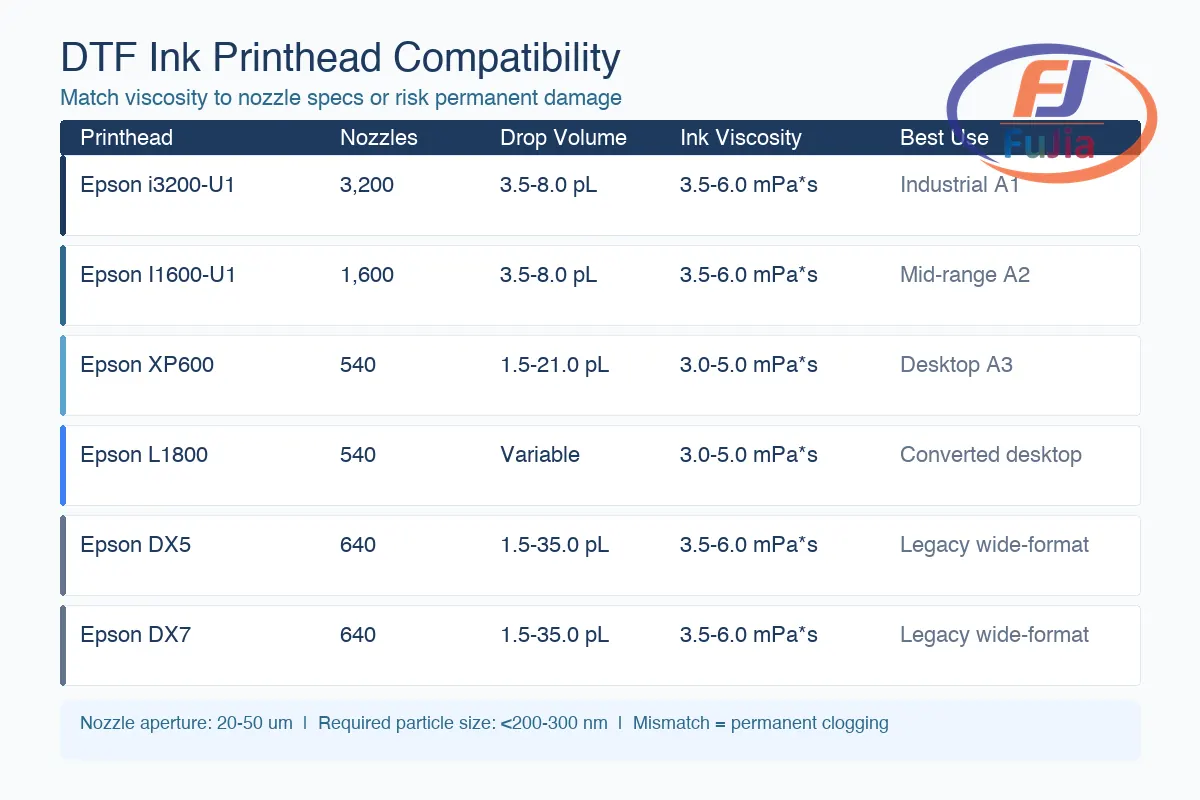
DTF ink viscosity must match the printhead’s jetting requirements. Piezoelectric printheads fire ink by mechanically deforming a piezo element, which pushes a precise droplet through the nozzle. The droplet size, velocity, and flight path depend on ink viscosity being within a specific range.
Printhead Compatibility Matrix
| Printhead | Nozzle Count | Drop Volume | Compatible Ink Viscosity | Common Printers |
|---|---|---|---|---|
| Epson i3200-U1 | 3,200 | 3.5-8.0 pL | 3.5-6.0 mPa*s | Fujia A1, industrial DTF |
| Epson I1600-U1 | 1,600 | 3.5-8.0 pL | 3.5-6.0 mPa*s | Fujia A2, mid-range DTF |
| Epson XP600 | 540 | 1.5-21.0 pL | 3.0-5.0 mPa*s | Fujia A3 desktop, entry DTF |
| Epson L1800 | 540 | Variable | 3.0-5.0 mPa*s | Converted desktop DTF |
| Epson DX5 | 640 | 1.5-35.0 pL | 3.5-6.0 mPa*s | Legacy wide-format |
| Epson DX7 | 640 | 1.5-35.0 pL | 3.5-6.0 mPa*s | Legacy wide-format |
The Fujia A1 DTF 4-Head printer uses four to five Epson i3200 printheads, each with 3,200 nozzles firing droplets between 3.5 and 8.0 picoliters. This configuration achieves 27 m2/hr at 4-pass print speed. The Fujia A3 desktop DTF uses a single Epson XP600 printhead with 540 nozzles, suited for 2 to 3 m2/hr production volumes. Matching ink viscosity to the printhead specification prevents droplet deflection, satellite droplet formation, and inconsistent ink density in the printed transfer.
Why You Cannot Mix DTF Ink Brands
Mixing DTF ink from different manufacturers in the same ink system causes chemical reactions that damage printheads. This is not a theoretical risk. DuPont’s Artistri P1600 application guide explicitly states: “Pigment inks by different manufacturers are not necessarily compatible and should not be considered miscible or interchangeable. Even pigment inks supplied by the same manufacturer may not be compatible.”
The incompatibility arises from three formulation differences between brands:
pH levels. DTF ink pH ranges from 7.0 to 9.0 across manufacturers, but different brands may sit at opposite ends of this range. When inks with different pH values meet in the ink line, the pigment dispersion can destabilize, causing particles to aggregate and form clumps that block nozzles.
Resin types. The polymer resin that binds pigment to fabric after heat pressing varies chemically between manufacturers. One brand may use an acrylic-based resin while another uses a polyurethane-based system. These different resins can coagulate when mixed, creating a gel-like precipitate that clogs dampers and printhead channels.
Dispersant packages. Each manufacturer’s dispersant system is engineered to work with their specific pigment surface treatment. An alumina-coated TiO2 pigment from one brand may not disperse properly in a carrier fluid designed for silica-coated TiO2 from another brand. The result is rapid sedimentation and hard sediment formation that cannot be reversed by shaking or circulation.
The practical rule: never mix ink brands in the same ink system. When switching brands, perform a complete flush using the original ink manufacturer’s flushing solution, replace all dampers and filters, rinse with deionized water, then load the new ink. The full procedure takes 2 to 4 hours but protects printheads that cost USD 200 to USD 800 to replace.
How Much DTF Ink Costs Per Print
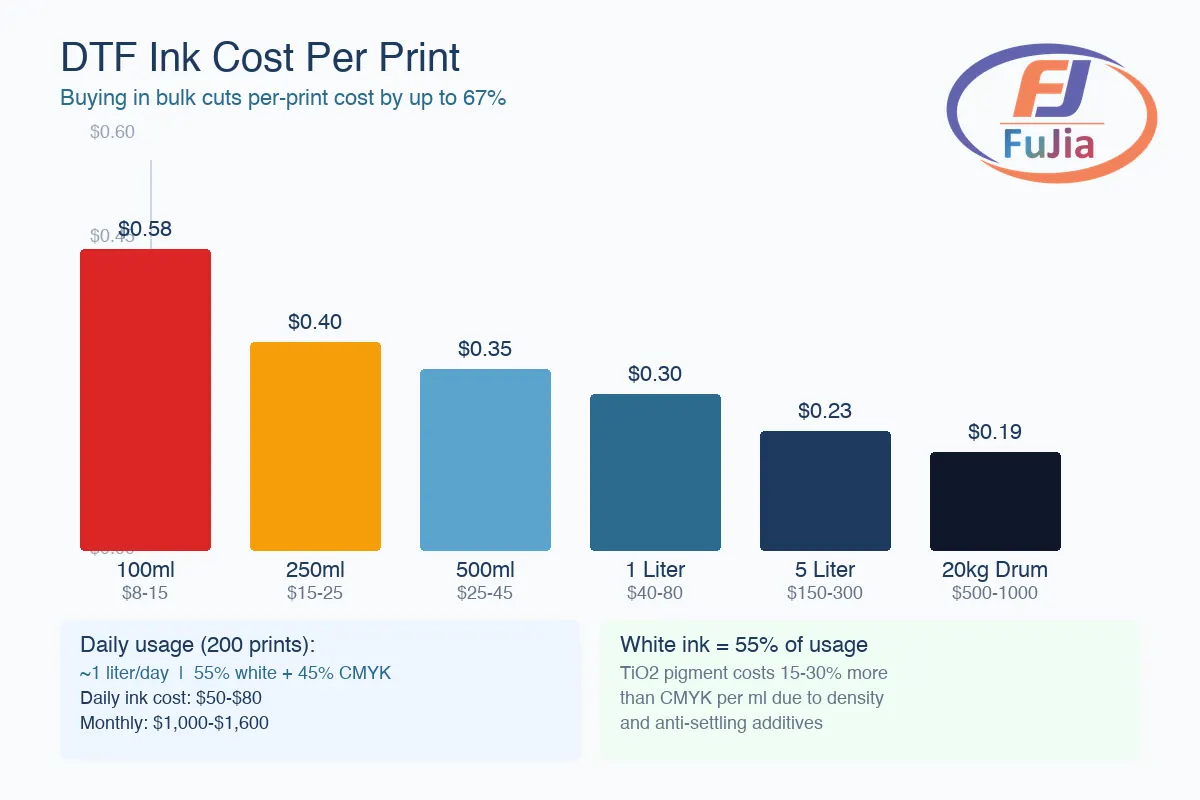
DTF ink consumption varies by design coverage, ink density settings, and whether the print includes a white underbase. Understanding per-print ink costs helps shops price their products accurately and choose ink packaging that matches their volume.
Based on data from our customers across 50+ countries, ink consumption for a standard A3-size transfer (approximately 297 x 420 mm) with 50 percent design coverage runs approximately 3 to 8 ml of total ink per print. White ink accounts for 55 to 65 percent of total consumption because it lays down a dense underbase covering the entire design area. CMYK colors account for the remaining 35 to 45 percent, printing only on top of the white layer.
DTF Ink Cost Breakdown
| Ink Volume | Price Range | Cost Per A3 Print (5ml avg) | Monthly Usage (200 prints/day) | Best For |
|---|---|---|---|---|
| 100 ml bottle | $8-$15 | $0.40-$0.75 | Not suitable | Testing, sampling |
| 250 ml bottle | $15-$25 | $0.30-$0.50 | Not suitable | Hobby, low volume |
| 500 ml bottle | $25-$45 | $0.25-$0.45 | 15-20 bottles | Small commercial |
| 1 liter bottle | $40-$80 | $0.20-$0.40 | 8-10 bottles | Regular production |
| 5 liter jug | $150-$300 | $0.15-$0.30 | 2-3 jugs | High volume |
| 20 kg drum | $500-$1,000 | $0.13-$0.25 | 1 drum | Industrial factory |
The wash fastness of quality DTF ink meets ISO 105-C06 standards at Level 4 to 5 rating, meaning prints survive 50 or more machine wash cycles without significant color fading or cracking. This performance level requires pigment concentrations of 10 to 30 percent by weight and proper heat press settings of 160 degrees Celsius for 15 seconds with a cold peel.
Fujia DTF Ink System: Integrated Chemistry
Fujia Print manufactures DTF ink as part of an integrated consumable system designed to work with Fujia printers, DTF film, and adhesive powder from a single source. The ink system features imported premium resin and pigment raw materials with high concentration, uniform particle size, and smooth viscosity tuned for the Epson i3200 and XP600 printheads used across the Fujia product line.
The standard Fujia DTF ink system covers CMYK plus White, with optional expansion to a 13-color system that adds Light Cyan, Light Magenta, Orange, Red, Green, and Blue for extended color gamut reproduction. This 13-color capability exceeds the standard 5 to 8 channel configurations found in most competitor systems, enabling Pantone-accurate color matching for brand decoration applications.
For shops evaluating DTF ink options, the advantage of a single-supplier ink system is eliminating the cross-brand compatibility risk entirely. When ink, film, and powder come from one manufacturer with matched chemistry, the variables that cause transfer failures shrink to environmental factors and operator settings rather than formulation mismatches.
What ink is used for DTF printing?
DTF printing uses water-based pigment ink containing organic pigments for CMYK colors and rutile titanium dioxide (TiO2) for white ink. The ink is formulated with viscosity between 3.5 and 6.0 mPa seconds for CMYK and 10 to 30 mPa seconds for white ink at 22 degrees Celsius, matching the jetting requirements of Epson piezoelectric printheads (i3200, XP600, DX5, DX7, I1600, L1800). The ink prints onto coated PET film, receives hot-melt adhesive powder, cures in a drying oven, and transfers to fabric at 160 degrees Celsius for 15 seconds. The global DTF ink market reached USD 1.05 billion in 2025 with white ink accounting for 55.4% of total volume, reflecting the mandatory white underbase layer required for printing on dark garments. Quality DTF ink meets OEKO-TEX ECO PASSPORT certification for skin-safe textile contact and achieves ISO 105-C06 wash fastness Level 4 to 5.
Can you put DTF ink in a regular inkjet printer?
You cannot put DTF ink in a standard inkjet printer without converting the printer’s ink delivery system. Standard inkjet printers use dye-based or pigment-based inks formulated for paper, with different viscosity, surface tension, and drying characteristics than DTF ink. The white ink channel is the main technical barrier, because standard inkjet printers do not have a white ink system and cannot produce the opaque underbase required for DTF transfers. Converted DTF printers (typically modified Epson L1800, XP15000, or EcoTank models) replace the standard ink cartridges with refillable DTF ink bottles and install a bulk ink feed system. The conversion also requires RIP software to manage the reversed print order (white ink printed first, then CMYK on top) and to generate the white underbase layer from the design file. Even after conversion, these modified desktop printers lack the automated powder shaker and curing oven needed for the full DTF workflow, requiring manual powder application and a separate heat gun or oven for curing.
How much does DTF ink cost?
DTF ink costs range from USD 0.13 to USD 0.75 per A3-size transfer depending on ink volume purchased and design coverage. A 100 ml bottle costs USD 8 to USD 15 (USD 0.40 to USD 0.75 per print), suitable for testing. A 1 liter bottle costs USD 40 to USD 80 (USD 0.20 to USD 0.40 per print), the standard purchase size for regular production. A 20 kg drum costs USD 500 to USD 1,000 (USD 0.13 to USD 0.25 per print), for industrial factories running multiple shifts. White ink costs 15 to 30 percent more than CMYK colors because of the titanium dioxide pigment loading and anti-settling dispersant packages. A shop producing 200 A3 transfers per day on a Fujia A1 DTF printer consumes approximately 1 liter of ink per day (55 percent white, 45 percent CMYK), translating to roughly USD 50 to USD 80 in daily ink cost. Monthly ink expenditure at this volume runs USD 1,000 to USD 1,600.
Can I turn my printer into a DTF printer?
You can convert certain Epson inkjet printer models into DTF printers, but the conversion requires hardware modification, specialized ink, RIP software, and separate powder handling equipment. The most commonly converted models are Epson L1800, XP15000, EcoTank ET-15000, and Expression Photo HD, because their piezoelectric printheads can jet the viscous DTF pigment ink. The conversion process involves: installing a refillable ink bottle system (CISS) to replace disposable cartridges, loading DTF CMYK plus white ink, installing RIP software (Maintop, Photoprint, or Flexi) to handle reversed print order and white underbase generation, and sourcing a separate powder shaker and curing oven for the adhesive powder step. Total conversion cost runs USD 300 to USD 800 for parts and ink, plus the base printer cost. Converted printers lack the automated white ink circulation systems found in purpose-built DTF printers like the Fujia A1 or A3 models, making white ink clogging a frequent maintenance issue. For production beyond 50 transfers per day, a purpose-built DTF printer provides better reliability and lower total cost of ownership than a converted desktop model.
Conclusion
DTF ink chemistry determines print quality, wash durability, and printhead longevity more than any other variable in the direct-to-film process. Matching ink viscosity to your printhead model and never mixing brands without a full flush procedure are the two rules that separate reliable production from chronic clogging. For factory-direct DTF printers with integrated ink systems, matched consumables, and 13-color capability, explore the Fujia Print product lineup.
Sources
- DuPont Artistri P1600 DTF Ink Application Guide: Printhead compatibility (DX4/DX5/DX7/i3200), cross-brand ink incompatibility warnings, flush procedure, film profiling, and ink loading protocol.
- Grand View Research: Direct to Film Printing Market: Global DTF market context, roll-to-roll segment USD 652M (2024) to USD 987M (2030) at 6.9% CAGR.
- DTF Technology: Industrial Ink Material Data Sheet: Ink viscosity 3.5-6 mPas CMYK / 10-30 mPas white, particle size <200nm, surface tension 28-35 mN/m, pH 7.0-9.0, ISO 105-C06 wash fastness.
