

A DTF gang sheet is a single sheet of PET transfer film containing multiple designs arranged side by side, printed together in one pass through a DTF printer, then cut apart and heat-pressed onto garments individually. Gang sheets reduce per-transfer material cost by 70-80% compared to printing single designs one at a time, because you pay for sheet area rather than per design. Fujia Print supplies the DTF printers, ink, and transfer film used by print businesses across 50+ countries to produce gang sheets at scale.
Key Takeaways
- A DTF gang sheet groups multiple designs onto one PET film sheet for single-pass printing, cutting, and pressing.
- Cost per transfer drops from USD 3.50-5.00 for individual prints to USD 0.90-2.30 on a well-packed 22-inch gang sheet.
- Standard gang sheet widths are 22 inches (56cm) or 24 inches (61cm), with customizable lengths sold in 6-inch increments.
- Designs should be spaced 0.25-0.50 inches apart for clean cutting, with a minimum artwork resolution of 300 DPI.
- Gang sheets work on cotton, polyester, blends, denim, and nylon, applied at 160°C for 15 seconds with cold peel.
How DTF Gang Sheets Work
The DTF gang sheet process follows the standard direct-to-film workflow, with one key difference: multiple designs are arranged on a single canvas before printing. This layout step determines material efficiency before any ink reaches the film.
The process begins with digital file preparation. Each design is saved as a high-resolution PNG with a transparent background at 300 DPI minimum. Designs are then arranged on a canvas matching the sheet width, typically 22 inches (56cm) for most commercial DTF printers. The entire canvas runs through the DTF printer in one pass, applying CMYK ink plus a white ink underbase to the PET film. Hot-melt thermoplastic polyurethane (TPU) adhesive powder is applied across the full sheet, then cured at controlled temperature to lock ink and powder together. The cured gang sheet is then cut into individual transfers and pressed onto garments at 160°C for 15 seconds. The dimensional stability of the host fabric during this pressing step is defined by AATCC TM135, which standardizes the measurement of fabric shrinkage and expansion after heat application and home laundering.
Research published in the International Journal of Adhesion and Adhesives demonstrates that TPU hot-melt adhesives modified with nanocomposite crosslinkers achieve superior water resistance and bond strength on both cotton and polyester substrates, ensuring that gang sheet transfers maintain adhesion through 50+ wash cycles regardless of how many designs share the original sheet.
DTF Gang Sheet Sizes and How Many Designs Fit
The global direct-to-film printing market reached USD 2.72 billion in 2024 and is projected to grow to USD 3.92 billion by 2030 at a 6.0% CAGR, according to Grand View Research. Gang sheet production is a primary efficiency driver in this growth, enabling small-batch apparel decoration at costs competitive with screen printing. T-shirt transfers represent the largest end-product segment, and gang sheets are the standard format for multi-design T-shirt orders.
Gang sheet dimensions are determined by printer width. Most commercial DTF printers handle 22-inch (56cm) or 24-inch (61cm) wide film. Sheet length is customizable, typically sold in 6-inch increments or by the linear foot.
| Sheet Size | Typical Cost | Avg Designs (mixed sizes) | Cost Per Transfer |
|---|---|---|---|
| 22″ x 12″ (56 x 30cm) | USD 8-14 | 6-8 chest prints | USD 1.20-2.30 |
| 22″ x 24″ (56 x 61cm) | USD 14-22 | 12-16 mixed prints | USD 0.90-1.80 |
| 22″ x 36″ (56 x 91cm) | USD 18-28 | 18-24 mixed prints | USD 0.75-1.55 |
| 22″ x 60″ (56 x 152cm) | USD 28-45 | 30-40 mixed prints | USD 0.70-1.50 |
| Single 4″ x 4″ transfer | USD 3.50-5.00 | 1 design | USD 3.50-5.00 |
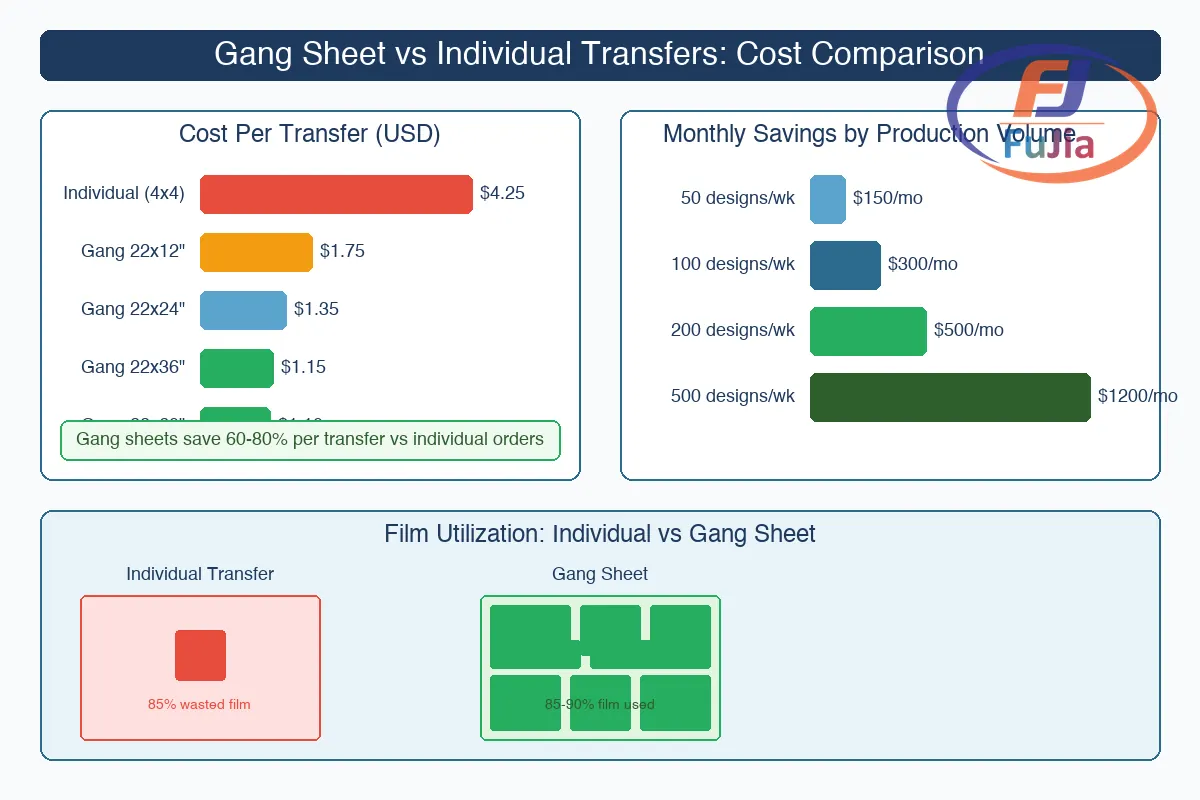
The table illustrates the core economic principle: larger gang sheets with well-packed layouts reduce per-transfer cost by 60-80% versus ordering individual prints. A seller producing 30+ shirts per week can save USD 60-120 monthly by switching from individual transfers to gang sheets.
How to Build a DTF Gang Sheet
Step 1: Prepare Your Design Files
- Save each design as a transparent PNG. Remove all background pixels, including white boxes behind logos. DTF printers automatically generate a white ink underbase for every non-transparent pixel, so any background that is not truly transparent will print as a visible white rectangle.
- Set resolution to 300 DPI at final print size. Lower resolution produces visible pixelation on edges and fine text. Vector files (SVG, AI, EPS) can substitute because they scale without quality loss.
- Use RGB color mode. DTF printer RIP software converts RGB input to CMYK+White output internally. Submitting files in CMYK can cause double conversion and color shifts.
Step 2: Choose Your Canvas Size
- Match canvas width to your supplier’s film width. The most common option is 22 inches (56cm). Some suppliers offer 24-inch (61cm) film.
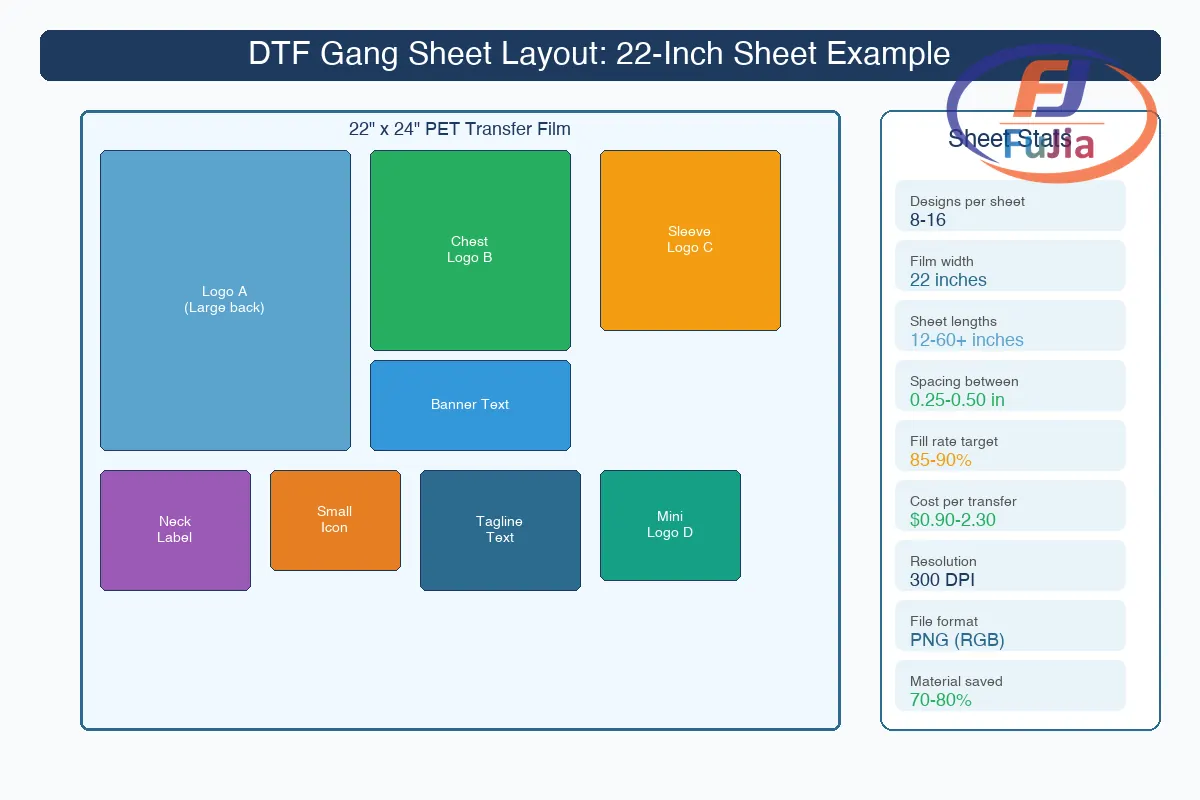
- Select sheet length based on order volume. A 22″ x 12″ sheet fits 6-8 standard chest prints. A 22″ x 36″ sheet fits 18-24 designs. Order only what you will press within 30-90 days, because DTF transfers lose adhesion quality over time when stored improperly.
- Account for cutting margins. Leave 0.25-0.50 inches between every design for clean trimming with scissors or a cutting machine.
Step 3: Arrange Designs for Maximum Density
- Place large designs first. Fill the sheet with full-back or full-chest graphics, then nest smaller logos, sleeve prints, and neck labels in the remaining gaps.
- Rotate designs to save space. A horizontal logo placed at 90 degrees may fit alongside a vertical design, increasing total designs per sheet by 15-25%.
- Prioritize high-volume designs. If one logo sells 10 units weekly and another sells 2 units, fill the sheet with the high-volume design first, then fit lower-volume items around it.
- Group by color similarity. While DTF prints full-color designs, grouping visually similar designs helps with visual quality checking after printing.
Step 4: Export and Print
- Export as a single flattened PNG or TIFF at 300 DPI in RGB color mode. Do not submit layered files unless your supplier specifically requests them.
- Run a visual proof check. Verify that no designs overlap, all spacing is adequate, and the canvas matches the ordered sheet dimensions exactly.
- Submit to your DTF printer or print in-house. Fujia DTF printers using the Honson mainboard and Leadshine servo system handle 22-inch gang sheets at production speeds of 8-27 m²/hr depending on printhead configuration and pass count.
Cost Savings: Gang Sheet vs Individual Transfers
The economic advantage of gang sheets comes from eliminating wasted film area. When you order a single 4″x4″ transfer on a 22″x12″ sheet, you pay for all 264 square inches of film but use only 16 square inches. The remaining 94% is blank film that goes to waste.
| Metric | Individual Transfers | Gang Sheet (22″ x 24″) | Savings |
|---|---|---|---|
| Sheet cost | USD 4.00 x 12 = USD 48 | USD 18 (one sheet) | 63% |
| Transfers produced | 12 designs | 12-16 designs | 0-33% more |
| Film waste | ~85% blank | ~5-15% blank | 70-80% less |
| Print setup time | 12 separate runs | 1 run | 92% less |
| Labor per transfer | USD 0.30 | USD 0.08 | 73% less |
Based on data from our customers across 50+ countries, apparel businesses switching from individual transfers to gang sheets typically reduce their per-print material cost by 60-75% within the first month. The savings compound at higher volumes: a shop printing 200 designs weekly saves USD 400-600 monthly on film and ink alone.
Gang Sheet Layout Best Practices
| Rule | Specification | Why It Matters |
|---|---|---|
| Minimum spacing | 0.25-0.50 inches (6-13mm) | Allows clean scissor or cutter separation without damaging designs |
| Edge margin | 0.5 inches (13mm) minimum | Prevents ink from rolling off the film edge during printing |
| Design rotation | Up to 90 degrees acceptable | Maximizes design count per sheet by 15-25% |
| Maximum density | 85-90% fill rate | Leaves room for cutting without overcrowding |
| File format | PNG (transparent) or TIFF | Preserves quality at 300 DPI without compression artifacts |
| Color mode | RGB | DTF RIP software handles CMYK+White conversion internally |
| White underbase | Automatic (from transparency) | No manual separation needed; printer reads alpha channel |
What Kind of Printer Prints Gang Sheets?
Any DTF printer can produce gang sheets, provided the printer width matches or exceeds the gang sheet width. The printer treats the entire gang sheet as a single large image, so no special gang-sheet mode is required. The key factor is printhead width and ink system capacity.
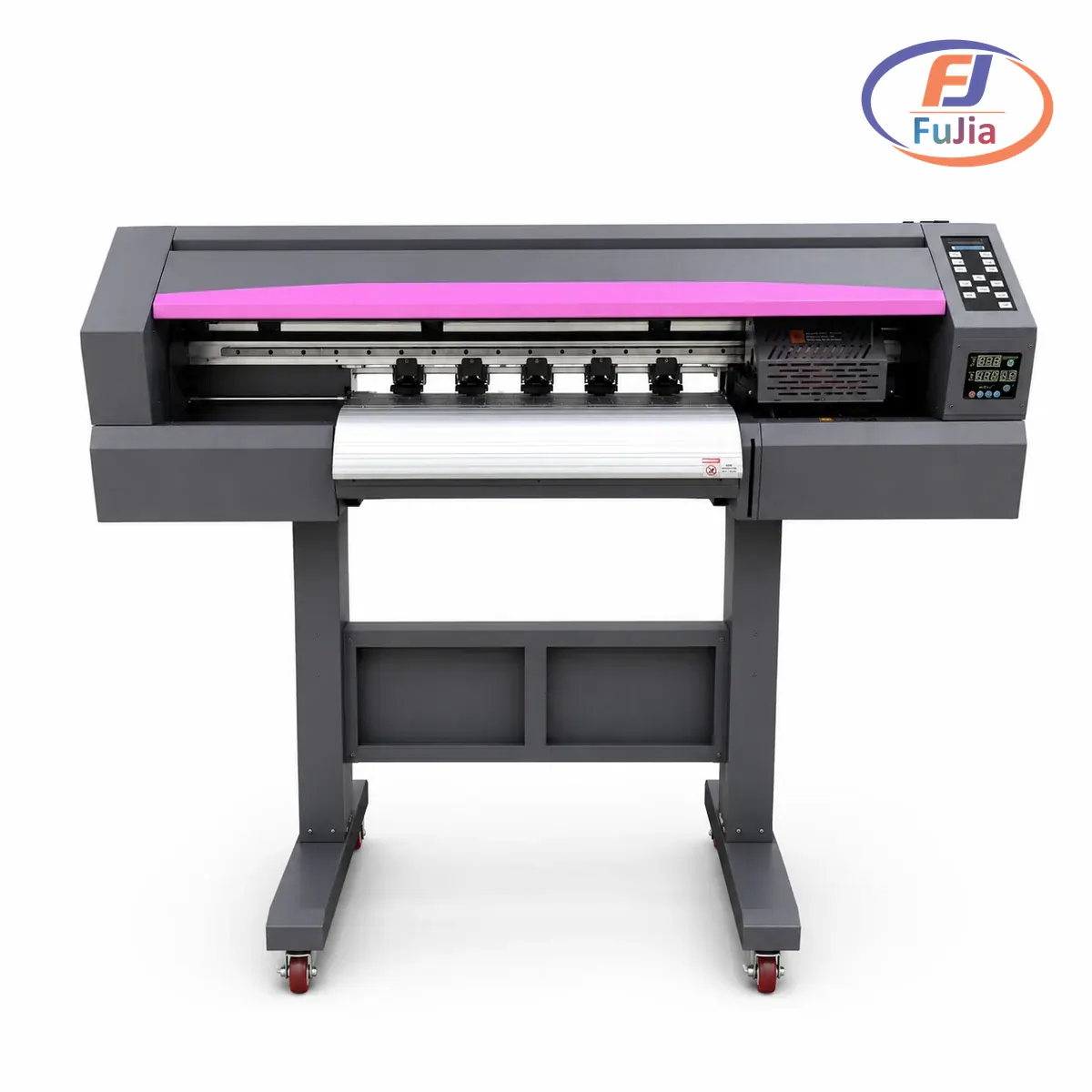
Fujia’s A1 DTF 4-Head printer, equipped with four Epson I3200 printheads, prints gang sheets at 650mm (25.5-inch) width with speeds of 27 m²/hr at 4-pass quality. The dual-section front-and-rear heating system and real-time temperature monitoring ensure consistent ink curing across the full gang sheet, preventing color drift between designs at the sheet edges and center. The A1 DTF 2-Head configuration, using two Epson I3200 printheads, produces gang sheets at 8-13 m²/hr, suitable for medium-volume operations processing 500-1,000 gang sheets monthly.
The Turkey garment factory case study illustrates the production advantage: after deploying Fujia A1 dual-head DTF equipment, the factory increased throughput by 40% and reduced per-order cost by 30%, with file-to-finished-print turnaround under 30 minutes. Small-batch orders (previously requiring 200+ piece minimums for screen printing) now ship with zero minimum quantity, and small-batch production accounts for 60% of total revenue.
What is a DTF gang sheet?
A DTF gang sheet is a single sheet of PET transfer film loaded with multiple designs arranged side by side, printed together in one pass through a DTF printer, then cut apart and pressed onto garments individually. The term “gang” comes from traditional printing, where it means grouping multiple jobs on one sheet to save material and time. In DTF printing, gang sheets are the most cost-effective way to order transfers when you need more than a few designs, because you pay for sheet area rather than per individual design. A standard 22-inch by 24-inch gang sheet typically holds 12-16 mixed-size designs at a cost of USD 0.90-1.80 per transfer, compared to USD 3.50-5.00 for the same designs printed individually. Gang sheets work on cotton, polyester, cotton-poly blends, denim, and nylon.
How long does it take to print a DTF gang sheet?
Printing a DTF gang sheet takes 2-15 minutes depending on sheet size, printhead configuration, and print quality settings. A standard 22″ x 12″ sheet on a dual-Epson I3200 DTF printer at 6-pass quality takes approximately 3-5 minutes to print, plus 60-90 seconds for adhesive powder application and curing. A larger 22″ x 36″ sheet at the same quality takes 8-12 minutes. The entire production cycle, including RIP processing, printing, powder application, curing, and cutting, typically takes 15-25 minutes per gang sheet. Same-day gang sheet printing services offered by transfer suppliers usually ship within 24-36 hours of file upload, including quality checking and packaging. In-house production with a Fujia DTF printer reduces this to under 30 minutes from file submission to ready-to-press transfers.
Which is better, DTG or DTF?
DTF is better than DTG for most custom apparel applications because DTF works on a wider range of fabrics (cotton, polyester, blends, denim, nylon) while DTG works best only on 100% cotton. DTF transfers last 50-100+ wash cycles versus 30-50 for DTG, because DTF ink sits on the fabric surface bonded by TPU adhesive while DTG ink absorbs into the fiber and fades faster. DTF also produces more vibrant colors on dark garments because the white ink underbase is a separate opaque layer, whereas DTG struggles with white ink coverage on dark fabrics. DTG has an advantage for all-over prints on white cotton tees where a softer hand-feel is prioritized. For gang sheet production specifically, DTF is the only viable option because DTG prints directly onto garments, not onto transfer film, making gang sheet consolidation impossible.
What kind of printer prints gang sheets?
Any DTF printer with sufficient print width can produce gang sheets, because the printer treats the entire gang sheet as a single image file. The minimum requirement is a printer width that matches the gang sheet width, typically 22 inches (56cm) for commercial applications. Printhead type affects speed and quality: Epson I3200 printheads (used in Fujia A1 printers) deliver 720×2400 DPI resolution at 8-pass with production speeds of 17-27 m²/hr. Entry-level XP600 printheads produce gang sheets at 2-3 m²/hr with 720×1200 DPI resolution. UV DTF printers can also produce gang sheets for hard-surface applications (phone cases, tumblers, glassware) but use a different ink and adhesive system. For apparel gang sheets, a dedicated DTF printer with CMYK plus white ink channels and a powder shaking/curing unit is the standard configuration.
Conclusion
DTF gang sheets multiply production efficiency by printing multiple designs on one PET film in a single pass, cutting per-transfer cost by 60-80% versus individual orders. For DTF printers engineered for gang sheet production at speeds up to 27 m²/hr, explore the Fujia DTF printer lineup or discover our apparel printing solutions.
Sources
- Grand View Research: Direct To Film Printing Market, 2025-2030: Market size USD 2.72B (2024) projected to USD 3.92B by 2030 at 6.0% CAGR, with gang sheet production driving small-batch efficiency.
- Zhu et al. (2025): TPU Nanocomposites for Transfer Printing: Research on TPU hot-melt adhesive water resistance and bond strength with TiO2 nanocomposite and TGIC crosslinker, published in International Journal of Adhesion and Adhesives, Vol. 139.
- AATCC TM135: Dimensional Changes of Fabrics After Home Laundering: Standard test method defining four washing temperatures and three agitation cycles for evaluating fabric dimensional stability relevant to gang sheet transfer pressing.
