

DTF in printing means Direct-to-Film, a garment decoration process that prints a design onto PET film, dusts the wet ink with hot-melt adhesive powder, cures the powder, and heat-presses the film onto fabric at 160 °C for 15 seconds. The acronym carries a second, unrelated slang meaning that dominates bare “DTF meaning” searches, so this page stays locked on the garment-printing sense; if you came for the slang, that is a different DTF.
\n\n\n\n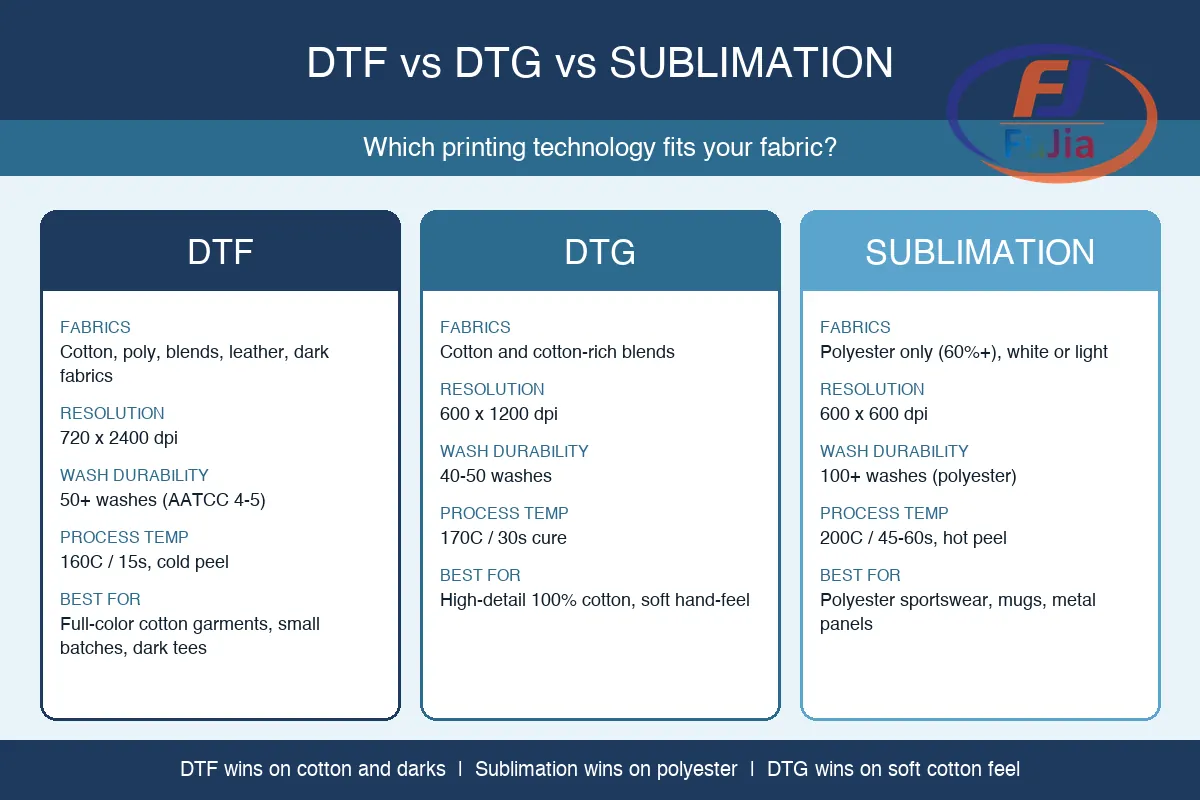
Key Takeaways
\n\n\n\n- \n\n\n
- DTF expands to Direct-to-Film: print onto PET film, powder the wet ink, cure, then press at 160 °C for 15 seconds with a cold peel. \n\n\n
- One film covers cotton, poly blends, leather, and dark garments, the exact fabrics where sublimation fails. \n\n\n
- Industrial A1 machines print at 720 x 2400 dpi and up to 27 m²/h; A3 desktop units run 2-3 m²/h at $1,500-4,000. \n\n\n
- Correctly pressed transfers grade AATCC 4-5 for color fastness and survive 50+ machine washes. \n\n\n
- Most small shops should validate demand on an A3 desktop unit before stepping up to A1 hardware. \n\n\n
Two DTF Meanings: Which One You Searched For
\n\n\n\nA bare search for “DTF meaning” mostly serves the Gen Z slang sense, and the front page for that query belongs to UrbanDictionary and social profiles. Searchers who want the printing process add a context word such as printing, shirts, or transfers, and those longer queries are the ones this page answers.
\n\n\n\nThe printing acronym expands to Direct-to-Film and nothing else in garment decoration. A companion article covers the full acronym breakdown, including the neighboring DTG and DTS terms, at what DTF stands for in printing. This page goes one level deeper on the process itself: what happens inside the machine, what it costs to run, and where it beats the neighboring technologies.
\n\n\n\nWhat the Direct-to-Film Process Actually Does
\n\n\n\n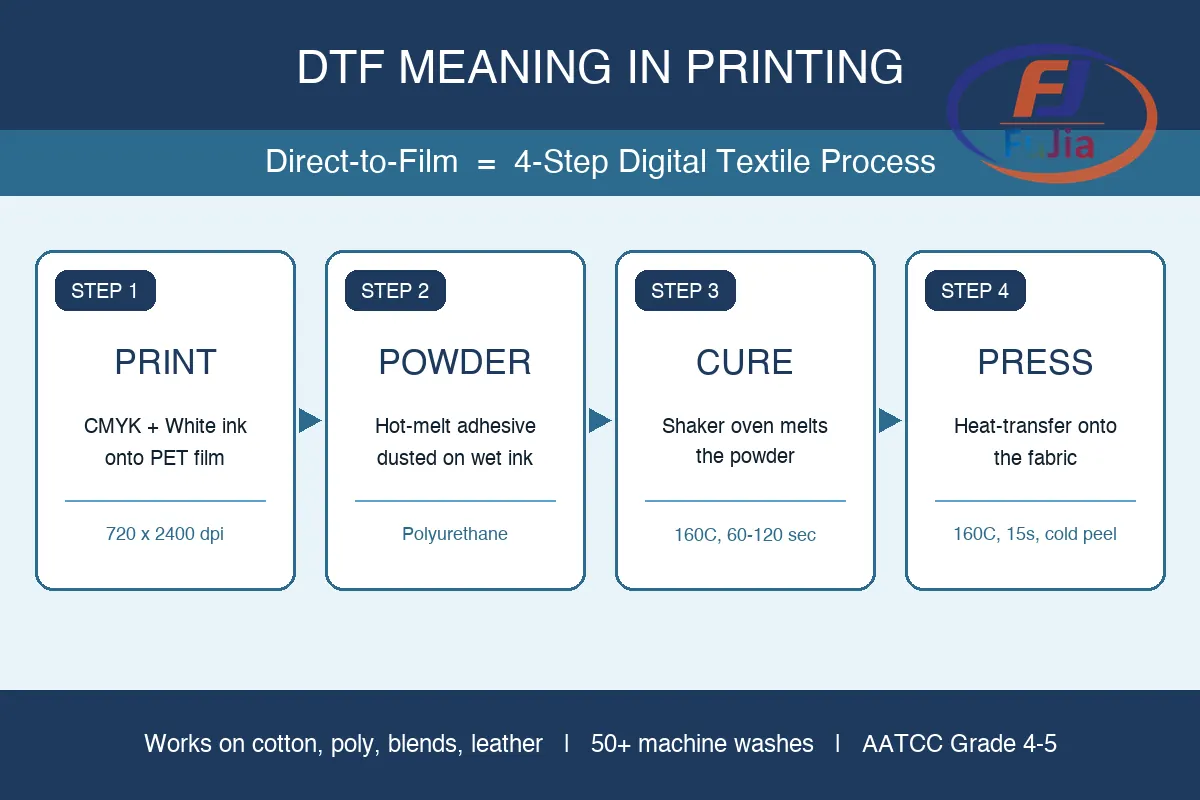
Direct-to-Film describes the path the ink travels. A printhead lays CMYK plus white ink onto coated PET film, the film gets dusted with polyurethane powder while the ink is still wet, and a short cure melts that powder into an adhesive glaze. A heat press then transfers the finished layer onto the garment. The film is a carrier, and the adhesive does the joining.
\n\n\n\nThe workflow runs in four steps on every machine class, from A3 desktop units to the A1 four-head line:
\n\n\n\n- \n\n\n
- Print. RIP software sends the design plus a white underbase to the printhead. Epson I3200 industrial heads lay ink at 720 x 2400 dpi on A1 machines, and XP600 heads power most A3 desktop units. \n\n\n
- Powder. An automated shaker or a manual sieve dusts polyurethane adhesive across the wet ink, and excess powder shakes off before curing. \n\n\n
- Cure. The film passes through a heated tunnel at roughly 160 °C for 60-120 seconds, melting the powder into a smooth glaze. \n\n\n
- Press. The cured film goes face-down onto the garment under a 160 °C press for 15 seconds, then peels cold. \n\n\n
The cold peel is the step beginners rush, and rushing it lifts half the ink away with the film. A transfer that survives 50+ washes versus one that cracks in five often differs only at the peel. Patience decides it.
\n\n\n\nDTF vs DTG vs Sublimation: Where Each One Wins
\n\n\n\nThe three technologies all put ink on textiles, and buyers weigh them in every first-machine decision. Numbers first, then the verdicts.
\n\n\n\n| Feature | \nDTF | \nDTG | \nSublimation | \n
|---|---|---|---|
| Printable fabrics | \nCotton, blends, leather, darks | \nCotton and cotton-rich blends | \nPolyester only, 60%+ content | \n
| Dark garments | \nWhite underbase, full color | \nWhite underbase, full color | \nNot possible, transparent ink | \n
| Print resolution | \n720 x 2400 dpi (industrial A1) | \n600 x 1200 dpi | \n600 x 600 dpi | \n
| Wash durability | \n50+ washes, AATCC Grade 4-5 | \n40-50 washes | \n100+ washes on polyester | \n
| Press recipe | \n160 °C, 15 s, cold peel | \n170 °C, 30 s cure | \n200 °C, 45-60 s, hot peel | \n
| Best use | \nFull-color cotton, small batches | \nSoft-hand 100% cotton | \nPolyester sportswear, mugs, panels | \n
DTF wins on cotton and on any dark fabric, the two places sublimation cannot go and where DTG fights white-ink circulation. Sublimation wins on pure polyester sportswear, where its dye bonds inside the fiber and outlasts everything else in this table. DTG wins when the buyer wants ink sitting in the fabric, not on it. Match the technology to the fabric first, and everything else follows.
\n\n\n\nDeeper comparisons live in our DTF vs DTG analysis and the DTF vs sublimation breakdown.
\n\n\n\nWhat DTF Printing Costs to Start and Run
\n\n\n\nHardware sorts into three width classes, and the class sets the price band:
\n\n\n\n| Class | \nPrint width | \nSpeed at 4-pass | \nEntry price band | \nTypical buyer | \n
|---|---|---|---|---|
| A3 desktop | \n300 mm | \n2-3 m²/h | \n$1,500-4,000 | \nEtsy sellers, startup studios | \n
| A2 mid-volume | \n420 mm | \n6-10 m²/h | \n$4,000-9,000 | \nSmall print shops | \n
| A1 industrial | \n600-650 mm | \n8-27 m²/h | \n$9,000-25,000+ | \nGarment factories | \n
Consumables run $0.50-1.00 per letter-size transfer once ink, film, and powder are amortized. The A1 four-head machine behind those top speeds carries four Epson I3200 heads across a 650 mm width, weighs 155 kg, and holds registration through 12-hour shifts. Full specifications sit on the DTF printer lineup page.
\n\n\n\nThe 500+ print businesses running our hardware cluster around a 3-8 month payback at 200 or more transfers a day. If you’re just starting out, the A3 tier answers the volume question before it exists, and the payback math still lands inside a year at 50 orders a week. Exact payback shifts with your local labor and power costs. If your weekly volume doesn’t justify in-house printing yet, we’ll say so. A short chat with our engineers costs nothing and might save you a four-figure mistake. A Turkish garment factory that replaced its screen line with an A1 dual-head unit cut its minimum order from 200+ pieces to one, lifted throughput 40%, and compressed delivery from 7 days to 2.5 days. Small-batch orders now drive 60% of that factory’s revenue. Volume like that is why the apparel printing workflow anchors on DTF.
\n\n\nWhat does DTF mean in printing?
\u003cp\u003eIn printing, DTF means Direct-to-Film, a four-step garment decoration process. A printhead prints CMYK plus white ink onto coated PET film, and the wet ink then takes a dusting of hot-melt polyurethane powder. The powder cures at roughly 160 °C, and a heat press transfers the finished layer onto fabric at 160 °C for 15 seconds with a cold peel. The process handles cotton, polyester blends, leather, and dark garments in one workflow, which is the main reason it displaced small-batch screen printing and vinyl transfer in custom apparel. Industrial A1 machines print at 720 x 2400 dpi and up to 27 m²/h, while A3 desktop units produce 2-3 m²/h. The defining trait versus DTG is the film carrier, meaning ink never travels straight from head to shirt.\u003c/p\u003e
What do DTF and DTG mean?
\u003cp\u003eDTF and DTG are neighboring acronyms in garment decoration. DTF means Direct-to-Film, where ink prints onto a PET film and transfers to fabric under a 160 °C press. DTG means Direct-to-Garment, where water-based ink sprays straight into the cotton fiber with no film stage. DTF covers more fabrics, including darks and blends, and its transfers survive 50+ washes against the typical 40-50 for DTG. DTG produces a softer hand on 100% cotton because the ink sits in the fiber rather than on the surface. Buyers choosing between them should weigh fabric mix first and volume second.\u003c/p\u003e
What does DTF mean on shirts?
\u003cp\u003eOn shirts, DTF means a transfer printed by the Direct-to-Film process, and sellers use the term in listings for custom tees, hoodies, and tote bags. The design prints onto PET film with a white underbase, takes an adhesive powder layer, then presses onto the shirt at 160 °C for 15 seconds. A correctly applied DTF print survives 50+ machine washes and keeps AATCC Grade 4-5 color. Shoppers seeing \u0022DTF print\u0022 in a product description can expect full-color artwork that stretches with the fabric and works on black garments as well as white. Print shops treat the same term as shorthand for the whole film-to-press workflow.\u003c/p\u003e
Is DTF printing good quality?
\u003cp\u003eDTF printing produces commercial-grade quality when parameters are respected. Transfers reach AATCC Grade 4-5 for color fastness, hold 50+ heavy-duty wash cycles, and print photographic detail at 720 x 2400 dpi on industrial heads. The UV DTF branch of the process adds a varnish topcoat and reaches 3H+ pencil hardness, which is why crystal labels survive abrasion on bottles and phone cases. Quality failures trace to four causes: pressing below 150 °C, peeling hot instead of cold, under-curing the powder, or running cheap film with an inconsistent coating. Each cause is operator-fixable, which is why DTF quality varies more between shops than between machine brands. A shop that controls press temperature and peel discipline gets output that matches screen printing below 3,000 pieces per design.\u003c/p\u003e
Conclusion
\n\n\n\nDTF in printing means Direct-to-Film, the film-carried process that puts full-color, 50-wash artwork onto cotton, blends, and dark garments, from a $1,500 desktop line to a 27 m²/h A1 four-head machine. Fabric range is its edge over sublimation, and the film carrier is its difference from DTG. To match a machine class to your order volume, contact Fujia Print or compare models on the DTF printer lineup page.
\n\n\n\nSources
\n\n\n\n- \n\n\n
- Wikipedia: Direct-to-film printing: baseline definition of the process. \n\n\n
- AATCC test methods: color fastness grading behind the Grade 4-5 wash figures. \n\n\n
- Grand View Research: direct-to-film printing market: market growth context for DTF adoption. \n\n\n
