

UV DTF prints are full-color, UV-cured transfers bonded to a clear film that you peel and press onto hard surfaces like tumblers, phone cases, and glass without a heat press. The process prints CMYK plus white plus varnish onto A/B film, cures instantly under a UV LED lamp, and ships as ready-to-apply decals that survive 100+ dishwasher cycles. This guide covers what UV DTF prints are, how they work, what they cost, and where to source them.
Key Takeaways
- UV DTF prints are peel-and-stick UV-cured transfers for rigid surfaces, applied with hand pressure in 10-15 seconds, no heat press required
- Wholesale UV DTF prints cost $0.10-$8.99 per piece depending on size and quantity, with gang sheets at $10.99-$15.00 per 22×10 inch sheet
- UV DTF prints adhere to glass, metal, ceramic, plastic, wood, and acrylic, surviving 100+ dishwasher cycles and 3H pencil hardness with varnish
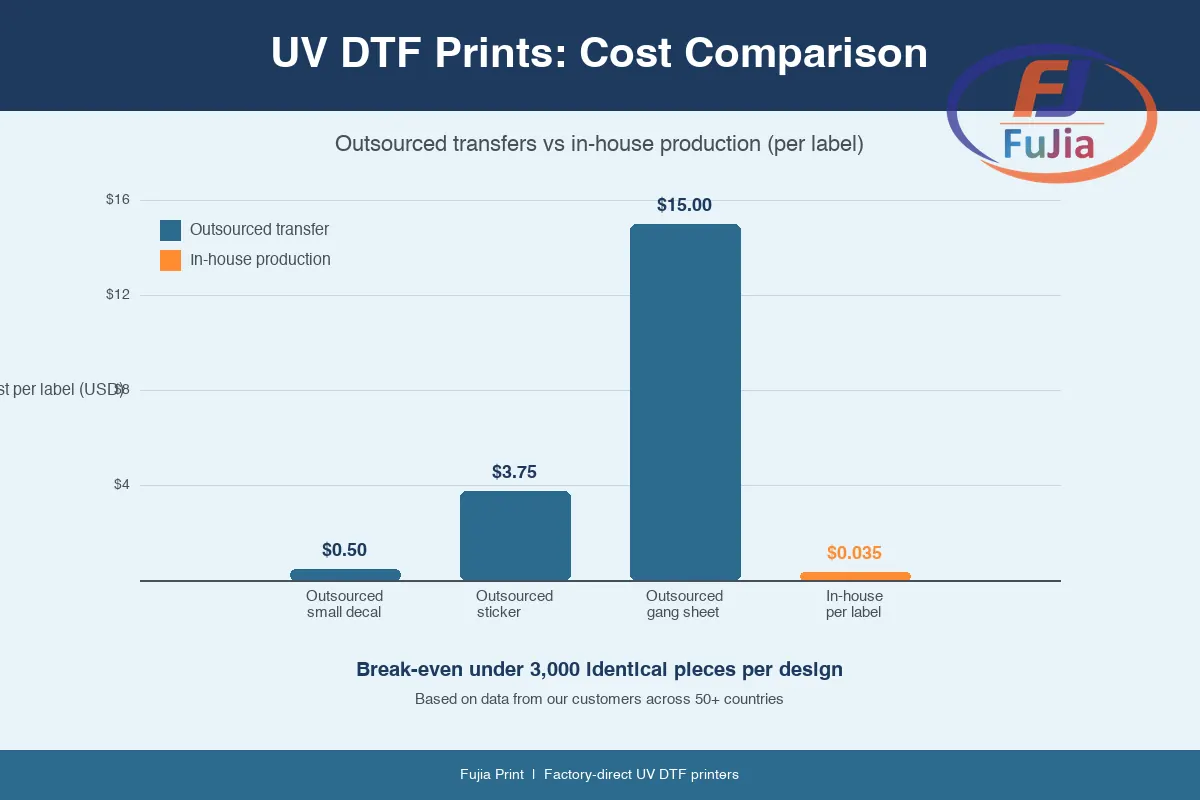
- In-house UV DTF printing beats outsourced transfers below 3,000 identical pieces per design, based on aggregate data from our customers across 50+ countries
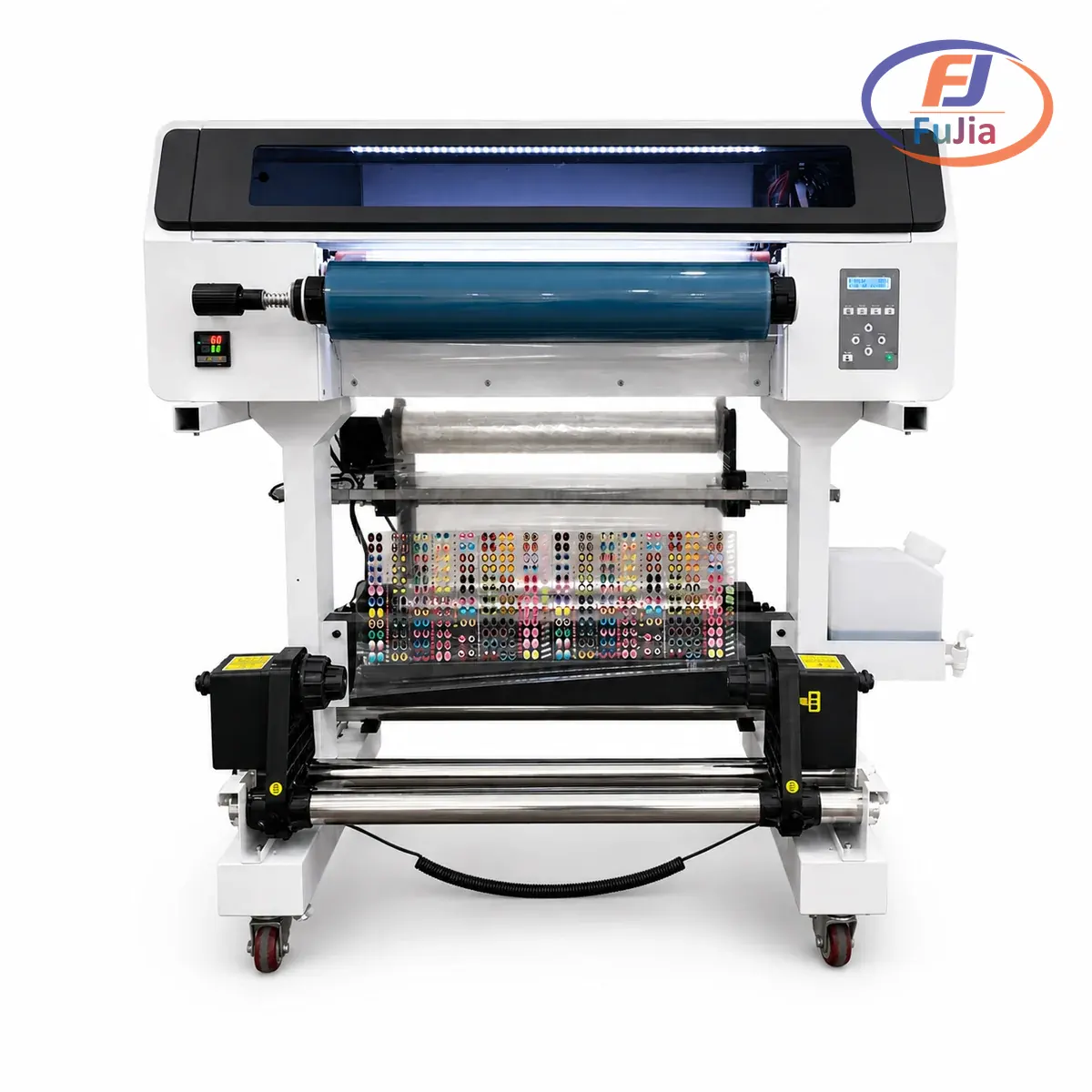
- Fujia Print manufactures UV DTF printers in A1, A2, and A3 widths, including the A1 UV DTF 3/4-Head model rated for 5,000+ labels per hour
What Are UV DTF Prints?
UV DTF prints are transfer decals produced by printing UV-curable ink directly onto a special A/B film using a UV DTF printer, then applying the cured design to rigid surfaces by hand. “DTF” stands for Direct-to-Film, meaning the image prints onto a carrier film rather than directly onto the final product. “UV” refers to the ultraviolet LED light that cures each ink layer instantly as it exits the printhead.
A finished UV DTF print is a thin, flexible decal with full CMYK color plus a white ink underbase for opacity on dark or clear substrates. A clear varnish top layer adds scratch resistance and can create gloss, matte, or textured effects. The full ink stack, typically 6 channels (CMYK + White + Varnish), measures roughly 50-150 microns thick once cured.
UV DTF differs from standard UV flatbed printing in one fundamental way. UV flatbed printers jet ink directly onto the final object, which limits the print area to the machine bed size. UV DTF printing separates the print step from the application step: the design prints onto film at high speed on a roll-to-roll machine, then an operator applies the film decal to any shape or surface by hand. This separation lets one UV DTF printer feed thousands of small decals per hour that would take a flatbed machine far longer to produce one at a time.
How UV DTF Prints Are Made
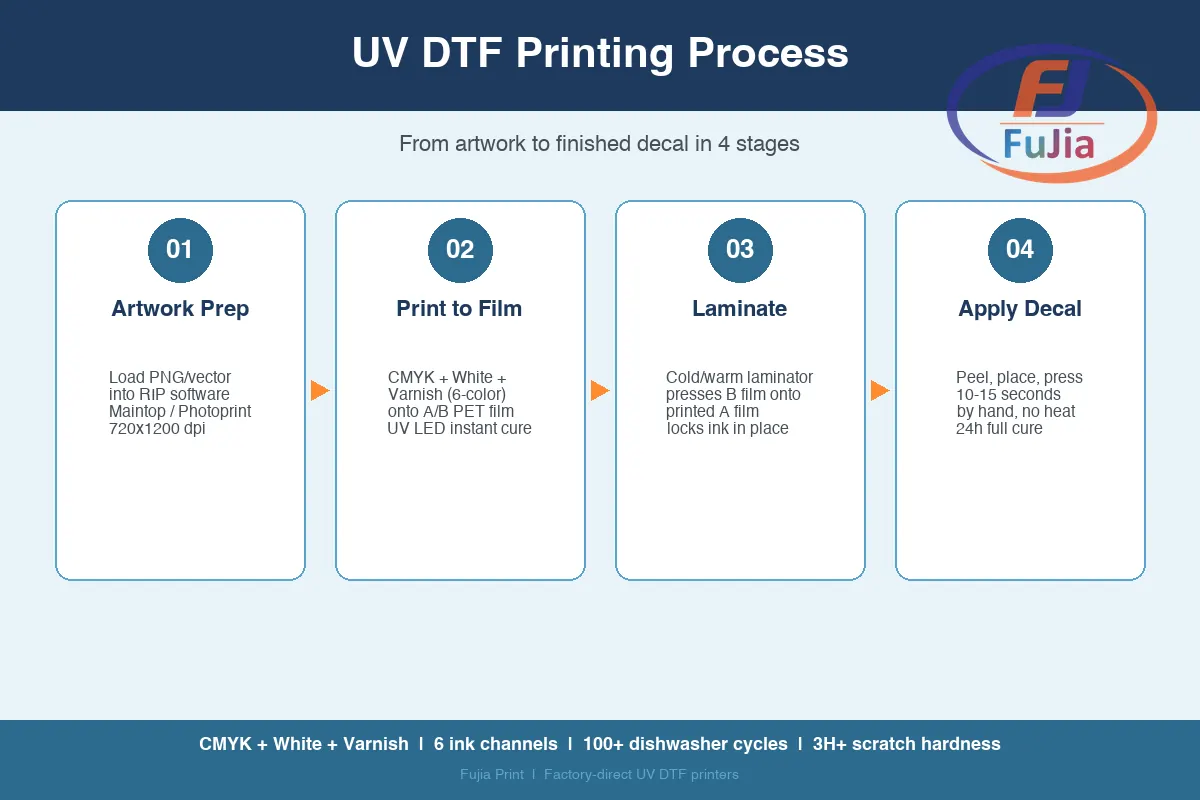
The UV DTF printing process has four main stages, from digital file to finished decal applied on a product.
Prepare the artwork. The design file, typically a PNG or vector with transparent background, is loaded into RIP software such as Maintop, Photoprint, or RIIN. The RIP separates colors into CMYK channels, generates a white underbase layer, and optionally adds a varnish channel for gloss or texture effects. Resolution ranges from 720×1200 dpi for production speed up to 1440×1440 dpi for fine detail work.
Print onto A/B film. The UV DTF printer loads A/B film, a two-layer material where the A film carries the ink and the B film acts as a protective laminate. The printheads jet CMYK ink, then white ink for opacity, then varnish, onto the A film surface. A water-cooled UV LED lamp mounted on the carriage cures each layer instantly as it prints, so the film exits the machine fully dry and tack-free.
Laminate the A and B films. A cold or warm laminator presses the B film onto the printed A film, bonding the two layers. This step locks the ink between the films and creates the peel-and-stick structure. Some integrated UV DTF printers perform lamination inline, while desktop models require a separate laminator pass.
Apply the decal to the product. The operator peels the B film backing, places the decal on the target surface (tumbler, phone case, bottle, tile), presses firmly by hand or with a squeegee for 10-15 seconds, then removes the A film carrier. The ink layer adheres permanently. Full chemical cure takes about 24 hours at room temperature.
UV DTF Printing Process Parameters
| Stage | Parameter | Typical Value |
|---|---|---|
| Print resolution | Production / fine | 720×1200 dpi / 1440×1440 dpi |
| Ink channels | Standard | CMYK + White + Varnish (6-color) |
| UV cure | Lamp type | Water-cooled UV LED, instant |
| Film type | A/B structure | PET, 75-100 microns thick |
| Hand transfer | Time | 10-15 seconds with pressure |
| Full cure | Room temp | 24 hours |
| Dishwasher durability | Cycles | 100+ with varnish |
| Scratch hardness | Pencil grade | 3H+ with varnish |
What UV DTF Prints Cost
UV DTF prints are priced by size, quantity, and finish. The market splits into two segments: ready-to-buy transfers from print-on-demand services, and in-house production for businesses running their own UV DTF printer.
Wholesale UV DTF Print Prices (Outsourced)
| Product | Size | Price Range | Source |
|---|---|---|---|
| Small cut decal | 1.75×2.25 in | $0.10-$0.69 | DTF Transfers Now, Eagle DTF |
| Medium sticker | 2×2 in to 5×5 in | $0.50-$3.75 | Apex Transfers, DTF Dallas |
| Single full-size print | 3.5 in | $2.10-$8.99 | Krafters Kingdom, BES Prints |
| Gang sheet | 22×10 in | $10.99-$15.00 | DTF Dallas, Ninja Transfers |
Small wholesale UV DTF prints in bulk run $0.10-$0.19 per piece when ordered in volume from suppliers like SEPS Graphics and DTF Transfers Now. Retail single stickers from brands like DTF Dallas and Apex Transfers sit at $0.50-$3.75 each. Gang sheets, which let buyers fill a 22×10 inch sheet with multiple designs, cost $10.99-$15.00 and are the most economical format for small-batch custom work.
In-House UV DTF Printing Cost (Per Label)
Based on aggregate data from our customers across 50+ countries, in-house UV DTF production costs $0.02-$0.05 per label at typical production volumes of 1,000-5,000 prints per day. This figure covers UV ink, A/B film, and machine depreciation, excluding labor and facility overhead. The break-even point against outsourced transfers falls below 3,000 identical pieces per design, which is why promotional product businesses, tumbler brands, and label shops increasingly bring production in-house.
UV ink consumption drives the largest variable cost. Fujia UV ink ships in bulk bottles sized for continuous ink supply systems, which keeps per-print ink cost low. A/B film, sourced in 30 cm or 60 cm roll widths, accounts for the second largest consumable expense. Varnish adds a marginal cost per print while commanding 30-50% higher per-unit pricing on the finished product due to the premium gloss or textured finish.
What UV DTF Prints Stick To
UV DTF prints adhere to nearly any rigid or semi-rigid surface that is clean, dry, and smooth. The UV-cured ink forms a mechanical and chemical bond with substrates including glass, metal, ceramic, plastic, acrylic, wood, leather, and painted finishes. Unlike sublimation, which requires polyester-coated substrates, UV DTF works on uncoated materials.
Common applications for UV DTF prints include:
- Tumblers and drinkware – stainless steel, glass, and acrylic cups; 30-40 bottles per hour with hand transfer
- Phone cases – plastic, TPU, and leather cases; industrial dual-head setups print one case in under 15 seconds
- Product labels – bottles, jars, and packaging; replaces screen printing for runs under 3,000 pieces
- Promotional products – pens, keychains, USB drives, corporate gifts; MOQ drops from 500 to 50
- Glassware and tiles – wine glasses, coasters, decorative glass; 6-8 wine glasses or 12 phone cases per cycle on a 60×90 cm flatbed
- Hard signage – acrylic signs, metal plates, wooden plaques for indoor and outdoor use
Surfaces to avoid include soft fabrics, silicone with oil residue, and heavily textured materials where the film cannot make full contact. Heat-sensitive plastics that warp below 60 degrees Celsius are fine for UV DTF application because the process requires no heat press, only hand pressure.
UV DTF Prints vs Traditional DTF Transfers
UV DTF prints and traditional DTF transfers both print onto film, but the ink chemistry, application method, and target substrates differ completely. UV DTF uses UV-curable liquid ink that cures with UV light and applies to hard surfaces by hand. Traditional DTF uses water-based ink that requires a heat press to melt adhesive powder onto fabric.
UV DTF vs DTF Comparison
| Feature | UV DTF Prints | Traditional DTF Transfers |
|---|---|---|
| Ink type | UV-curable liquid | Water-based pigment |
| Cure method | UV LED lamp, instant | Heat press, 160 Celsius |
| Application | Hand press, 10-15 seconds | Heat press, 160 Celsius, 15 seconds |
| Target surface | Hard (glass, metal, plastic) | Fabric (cotton, polyester blends) |
| Heat press required | No | Yes |
| Wash durability | 100+ dishwasher cycles | 50+ machine washes |
| Scratch hardness | 3H+ with varnish | N/A (textile) |
| White ink | Yes (opacity on dark surfaces) | Yes (opacity on dark fabric) |
| Varnish effect | Yes (gloss, matte, texture) | No |
The core distinction: traditional DTF serves apparel and textiles, while UV DTF serves hard goods. A tumbler decorating business running UV DTF printers does not compete with a t-shirt shop running standard DTF equipment. Some print businesses run both lines side by side, using DTF for garments and UV DTF for the drinkware and accessory categories, which is a combination we see frequently among promotional product distributors serving corporate clients.
UV DTF Print Durability and Quality
UV DTF prints deliver outdoor and indoor durability that rivals or exceeds screen printing. The UV-cured ink layer resists fading under sunlight, withstands temperature swings from minus 20 to 60 degrees Celsius, and holds up to chemical exposure including mild solvents and cleaning agents.
Durability Specifications
| Test | Result | Standard |
|---|---|---|
| Dishwasher cycles | 100+ with varnish | Home dishwasher, normal cycle |
| Scratch hardness | 3H+ pencil grade | ASTM D3363 |
| Outdoor weathering | 2+ years without lamination | UV ink on rigid substrate |
| Temperature range | -20 to 60 Celsius | No cracking, no peeling |
| Chemical resistance | Mild solvents, cleaning agents | Isopropyl alcohol, glass cleaner |
The varnish top layer is what pushes UV DTF prints past standard decal durability. A print without varnish scratches more easily and loses gloss over time. Adding varnish, which most production UV DTF printers support as a dedicated ink channel, raises per-unit pricing 30-50% while extending service life significantly. For products that see frequent handling, such as tumblers and phone cases, varnish is standard practice rather than an upgrade.
Color quality on UV DTF prints comes from the white ink underbase. The white layer sits between the substrate and the CMYK layer, providing opacity so colors appear vivid on dark or transparent surfaces. Without white ink, CMYK colors on a dark tumbler would look muddy. The CMYK plus white plus varnish stack, six ink channels total, is the production standard for UV DTF printing and matches the configuration on Fujia UV DTF printer models.
Who Should Buy UV DTF Prints and Printers
UV DTF prints and the printers that produce them serve businesses that need full-color decoration on hard surfaces in small to medium quantities. The technology fills a gap between screen printing (high setup cost, low per-unit cost, high volume) and pad printing (single or two colors, limited design complexity).
Buyer Profile by Use Case
| Buyer Type | Typical Volume | Best Fit | Why |
|---|---|---|---|
| Custom tumbler brand | 200-500/day | A3 UV DTF 1/2-Head desktop | Compact, low capex, fits 20 m2 space |
| Promotional product distributor | 500-5,000 labels/day | A1 UV DTF 3/4-Head | High-volume crystal label output |
| Corporate gift supplier | 50-500 pieces/design | A3 or A1 UV DTF | MOQ drops from 500 to 50 |
| Phone case brand | 1,000-8,000/month | A1 UV DTF with rotation jig | 12-40+ SKU expansion in 60 days |
| Glassware and drinkware workshop | 200-300 pieces/day | A2 or A1 UV DTF | +50% output, -40% waste vs pad printing |
| Product label manufacturer | 800+ pieces/day | A1 UV DTF | Break-even under 3,000 pieces vs screen print |
Businesses that benefit most from bringing UV DTF printing in-house share three traits: they decorate hard surfaces, they need frequent design changes or low MOQ per design, and they currently outsource transfers at $0.50-$3.75 per piece. At 500 pieces per day, outsourcing at $1.50 average per piece costs $750 per day or roughly $15,000 per month. An in-house UV DTF printer at the same volume costs $0.02-$0.05 per piece in consumables, or $25 per day, which recovers the machine investment in well under a year.
For businesses exploring product labeling solutions, UV DTF printing offers a direct path to same-day shipping, 60% lower per-label cost, and zero screen setup fees. A small appliance brand using UV printing increased daily output from 200 to 800 pieces, a 4x improvement, by eliminating screen changeover time.
What are UV DTF prints made of?
UV DTF prints are made of UV-curable ink printed onto a two-layer A/B film. The ink stack typically includes CMYK color ink, a white ink underbase for opacity, and a clear varnish top layer for protection and gloss. The A film carries the printed design, while the B film acts as a protective laminate that bonds to the A film during lamination. Once applied to a surface, the decal consists of the cured ink layer (50-150 microns thick) bonded directly to the substrate, with the carrier films removed. The ink itself is a liquid photopolymer that cures solid under UV LED light at wavelengths typically around 395 nanometers. Unlike solvent or water-based inks, UV inks contain no volatile organic compounds and cure to a hard, durable finish that resists scratching, fading, and chemical exposure. The A/B film is a PET (polyethylene terephthalate) material, chosen for its dimensional stability, smooth surface, and clean release properties during application.
How long do UV DTF prints last?
UV DTF prints last 100+ dishwasher cycles when produced with a varnish top layer, and they withstand 2+ years of outdoor weathering without lamination. Scratch hardness reaches 3H+ on the pencil hardness scale (ASTM D3363), which means the print resists fingernail scratches, key scuffs, and normal handling wear. Temperature tolerance spans minus 20 to 60 degrees Celsius with no cracking or peeling. On drinkware subjected to daily use and washing, a varnished UV DTF print typically shows minor edge wear after 6-12 months but remains largely intact and legible. On static indoor surfaces like signage, plaques, and decorative glass, UV DTF prints maintain full color and gloss for 3-5 years or longer. The main factor limiting lifespan is not the ink itself but the substrate preparation: dust, oil, or moisture on the application surface causes adhesion failure. Cleaning the surface with isopropyl alcohol before application extends durability significantly.
Can you put UV DTF prints on fabric?
UV DTF prints are not designed for fabric. The UV-cured ink forms a rigid layer that does not flex with textile fibers, which causes cracking and peeling after a few wash cycles. UV DTF prints work best on rigid or semi-rigid surfaces such as glass, metal, ceramic, plastic, acrylic, wood, and painted finishes. For fabric decoration, standard DTF (Direct-to-Film) printing is the correct technology: DTF uses water-based ink with hot-melt adhesive powder that bonds to cotton, polyester, and blends through a heat press at 160 degrees Celsius for 15 seconds. DTF transfers survive 50+ machine washes and remain flexible with the fabric. Some businesses that decorate both hard goods and apparel run a UV DTF printer for tumblers, phone cases, and labels alongside a standard DTF printer for t-shirts and bags. Running both technologies from one supplier simplifies consumable sourcing, technical support, and warranty coverage.
How much does it cost to start UV DTF printing?
Starting in-house UV DTF printing requires a UV DTF printer, RIP software, A/B film, UV ink, and a laminator (if not integrated). Entry-level A3 desktop UV DTF printers, suitable for 200-500 prints per day, carry a lower capital cost than A1 industrial models. Consumable cost per finished label runs $0.02-$0.05 based on aggregate data from our customers across 50+ countries, covering UV ink and A/B film. A typical small business investing in an A3 UV DTF setup recovers the equipment cost within 3-8 months depending on daily volume and the price gap between in-house production and outsourced transfers. For comparison, outsourcing UV DTF prints at $0.50-$3.75 per piece adds up fast: 500 pieces per day at $1.50 average equals $15,000 per month in transfer costs. In-house production at the same volume costs roughly $25 per day in consumables, making the financial case straightforward for businesses with steady hard-surface decoration volume.
Do UV DTF prints need a heat press?
UV DTF prints do not need a heat press. The application process uses hand pressure only: peel the B film backing, position the decal on the clean target surface, press firmly by hand or with a squeegee for 10-15 seconds, then peel away the A film carrier. No heat, no machine, no power source required. This is one of the main advantages of UV DTF over traditional DTF transfers and sublimation, both of which require a heat press at 160-200 degrees Celsius. The no-heat application makes UV DTF prints viable for heat-sensitive substrates like certain plastics, wax-coated surfaces, and filled containers that cannot go through a heat press. Full chemical cure of the ink takes about 24 hours at room temperature, during which the print reaches maximum adhesion and chemical resistance. Applying the print is instant; full bond strength develops over the first day.
Conclusion
UV DTF prints give hard-surface decorators a full-color, no-heat, low-MOQ alternative to screen printing and pad printing, with per-label costs that drop to $0.02-$0.05 when produced in-house. For factory-direct UV DTF printer pricing and free sample inquiries, contact Fujia Print.
Sources
- UV curing – Wikipedia: technical reference on UV LED photopolymerization and cure mechanisms
- ASTM D3363 – Standard Test Method for Film Hardness by Pencil Test: standard test method for film hardness, cited for scratch resistance values
- UV Cured Printing Inks Market – Mordor Intelligence: market size and growth data for UV-curable ink adoption, valued at USD 1.88 billion in 2026
- Polyethylene terephthalate – Wikipedia: technical reference on PET film used as A/B carrier material in UV DTF printing
