

A 24 inch DTF printer is a wide-format Direct-to-Film machine that prints transfers up to 60cm (about 24 inches) wide for garments, hats, bags and home textiles. It uses CMYK plus white ink on PET film, then a heat press at 160°C for 15 seconds transfers the design onto the product. Fujia Print builds factory-direct 24 inch (A1, 650mm) DTF printers with Epson i3200 printheads for print shops that need commercial throughput without reseller markup.

Key Takeaways
- A 24 inch DTF printer prints transfers up to 60cm wide, bridging desktop A3 (30cm) and roll-to-roll industrial models.
- Production speed runs 8-13 m²/h on a 2-head unit and up to 27 m²/h on a 4-head unit at 4-pass.
- Market price for a 24 inch DTF printer ranges from about $6,600 for a dual-head unit to $35,000 for a 9-color system, before adding a powder shaker dryer.
- Fujia Print’s A1 24 inch DTF printer pairs Epson i3200 printheads with a Honson mainboard, Leadshine servo motor and THK guide rail for 12-hour continuous runs.
- A 24 inch DTF printer suits shops doing 3,000+ pieces per month, where ROI typically lands within 1.5 to 8 months.
What Is a 24 Inch DTF Printer?
A 24 inch DTF printer is a digital printing machine built around a 600-650mm (24-25.5 inch) print bed that lays CMYK and white ink onto PET transfer film. The “24 inch” label refers to the maximum media width, which in practice lets you nest several adult-size shirt designs or one oversized panel on a single 60cm film pass. Fujia Print’s A1 model uses a 650mm (25.5 inch) width, the same class most US sellers market as “24 inch.” See the full DTF printer lineup for width options across the A1 range. DTF is a form of inkjet printing tuned for pigment ink on film.
DTF differs from sublimation and DTG because the design is printed on a film, not directly on fabric. That film is then covered with hot-melt adhesive powder, cured, and pressed onto the product at 160°C for 15 seconds with a cold peel. The result bonds to cotton, polyester blends, denim, leather and canvas without pre-treatment, which is why a 24 inch DTF printer fits mixed-material shops better than a DTG machine limited to cotton. For background on the core process, see what is a DTF printer.
How a 24 Inch DTF Printer Works
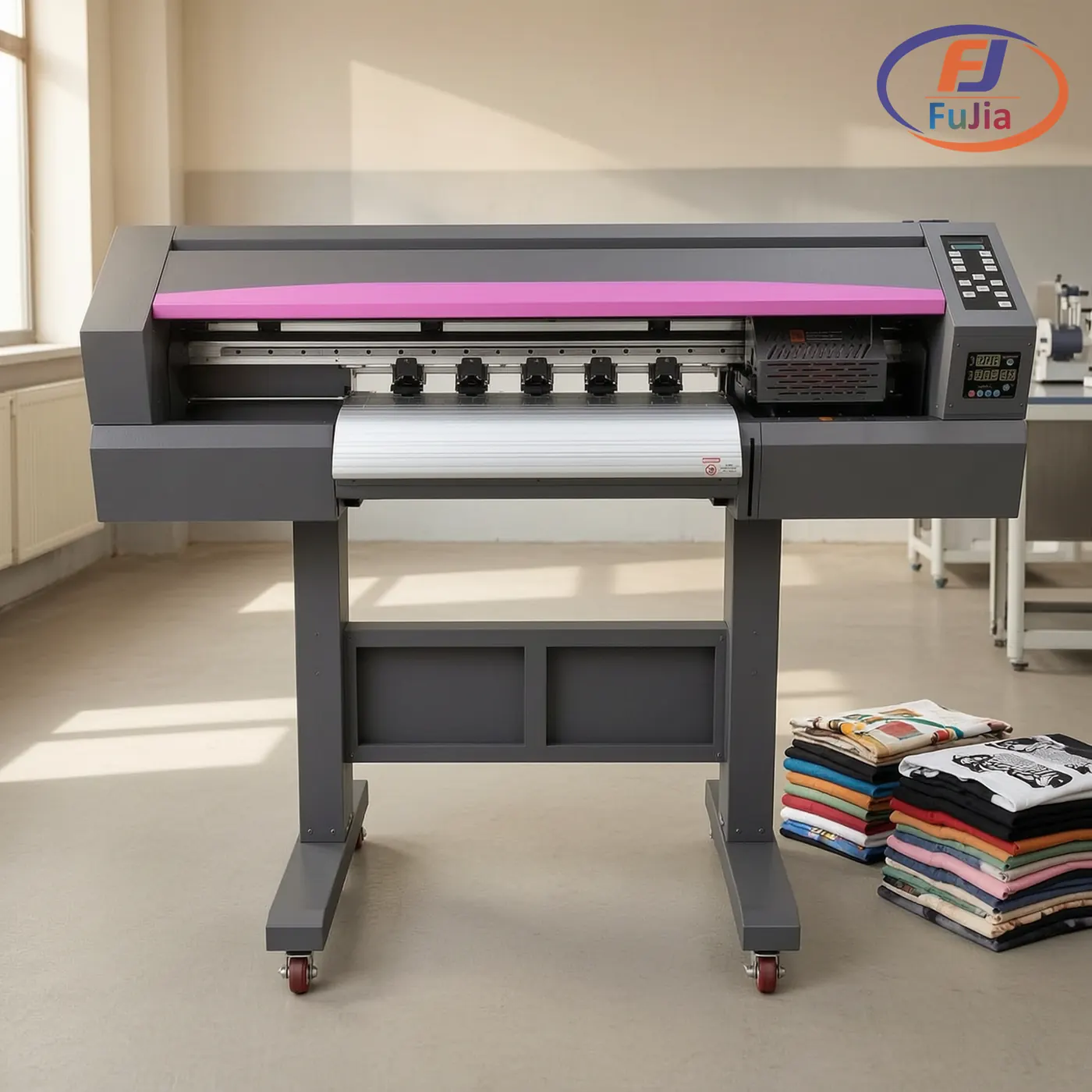
The DTF workflow has five steps from file to finished product.
- Prepare the artwork. Rip the design in Maintop or Photoprint, set CMYK plus white layers, and load PET film on the 60cm roll.
- Print the film. The printer lays color first, then white ink, at up to 720×2400 dpi in 8-pass mode. Fujia Print’s auto white-ink circulation keeps TiO2 pigment from settling during idle or power loss.
- Apply adhesive powder. A shaker spreads hot-melt powder across the wet ink, then a dryer cures it at about 100-110°C.
- Heat press the transfer. Press the film onto the garment at 160°C for 15 seconds, then peel cold.
- Finish and ship. The print survives 50+ heavy machine washes at AATCC Grade 4-5 color fastness.
Printheads and Production Speed
The printhead count decides both speed and price. Most 24 inch DTF printers use Epson i3200-A1 heads, with 2-head and 4-head being the common layouts.
| Configuration | Printheads | Speed at 4-pass | Speed at 6-pass | Speed at 8-pass | Resolution |
|---|---|---|---|---|---|
| Entry 2-head | 2x Epson i3200/XP600 | 8-13 m²/h | 6-10 m²/h | 4-6 m²/h | 720×1800 dpi |
| Fujia A1 4-head | 4-5x Epson i3200 | 27 m²/h | 22 m²/h | 17 m²/h | 720×2400 dpi |
| CALCA Ultra IV | 4x Epson i3200-A1 | 22 m²/h | 18 m²/h | 12 m²/h | 720×2400 dpi |
| DTF Printer USA D-24-4 | 4x Epson i3200-A1 | 26.9 m²/h | 18.1 m²/h | 13 m²/h | 1440 dpi |
Fujia Print’s 4-head A1 unit reaches 27 m²/h at 4-pass because it pairs the Epson i3200 heads with a Honson mainboard, Leadshine servo motor and THK silent guide rail. That transmission stack holds alignment through 12-hour continuous runs, which matters more than peak speed when a shop prints daily.
How Much Does a 24 Inch DTF Printer Cost?

A 24 inch DTF printer is rarely sold alone. The printer body, a powder shaker dryer, and a heat press are three separate purchases, and the shaker alone adds $6,955 to $8,555 at US resellers.
| Model | Heads | Print width | Body price | Notes |
|---|---|---|---|---|
| CALCA Plus 24 inch | 2x i3200 | 600mm | $6,597-$7,250 | Budget dual-head |
| DTF Printer USA D-24-4 | 4x i3200-A1 | 24″ (60cm) | $16,995.95 | Was $19,900 |
| CALCA Ultra IV | 4x i3200-A1 | 620mm | $18,999 | LA warehouse stock |
| Sublistar STAR IV 6003 | 3x i3200 | 24″ (600mm) | $21,064 | 9-color, was $35,000 |
| Prestige XL4 bundle (USCutter) | 4x i3200 | 24″ | $29,418.29 | With Seismo L24R shaker |
Fujia Print sells the 24 inch (A1) DTF printer factory-direct, which removes the importer and reseller markup baked into the US list prices above. Across the 500+ print businesses we serve, a complete 24 inch DTF setup including shaker typically runs well below the US bundle prices once you buy at factory terms, with a 12-month warranty, 48-hour parts dispatch and 3-day remote onboarding included.
24 Inch vs 13 Inch (A3) DTF Printer
Size is the main fork in the road. A 13 inch (A3, 30-33cm) DTF printer fits a desk and costs far less, while a 24 inch (A1, 60-65cm) unit doubles your printable width and throughput.
| If you print… | Choose | Why |
|---|---|---|
| Under 500 pieces per month, home or stall | 13 inch A3 | Fits a 120cm bench, lower ink and film cost |
| 3,000+ pieces per month, mixed sizes | 24 inch A1 | Nests 2-4 adult designs per 60cm pass |
| Oversized panels, bags, home textiles | 24 inch A1 | 650mm width handles one-piece large transfers |
Fujia Print’s A3 unit prints 2-3 m²/h on a single XP600 head, while the A1 4-head reaches 27 m²/h. The A1 costs more upfront but cuts per-print labor by roughly 4-8x at volume, which is why most shops outgrow the A3 size within a year. The A1 DTF printer buying guide covers head-count tradeoffs in more depth.
Is a 24 Inch DTF Printer Worth It for Your Business?
For a shop already shipping 3,000+ transfers per month, a 24 inch DTF printer pays for itself fast. One Fujia apparel customer running a 60cm dual-head unit reported 3,000+ pieces per month at 60% margin with a 1.5-month payback. A Turkish garment factory using the A1 dual-head DTF printer lifted throughput by 40%, cut cost by 30%, and shortened delivery from 7 days to 2.5 days.
Based on data from our customers across 50+ countries, in-house DTF ROI typically falls within 3-8 months once monthly volume passes 2,000 pieces. The break-even point shifts by region. Developed markets with higher labor costs see faster payback, while shops in humid tropical climates may adjust dwell times and still hold margin. If your volume is below 500 pieces per month, an A3 desktop unit is the smarter first buy.
What to Look for in a 24 Inch DTF Printer
Use this checklist before you request a quote.
- Printhead brand and count. Epson i3200-A1 is the industry standard. Pick 4 heads if you print daily, 2 heads for ramp-up.
- Transmission stack. Look for a named mainboard, servo motor and guide rail. Fujia Print uses Honson, Leadshine and THK for alignment stability.
- White ink system. Auto circulation prevents clogging. Fujia Print’s system runs even during power outages.
- Ink width. A 13-color ink system (CMYK+LC+LM+Orange+Red+Green+Blue) beats standard 6-color for brand-matched color.
- Warranty and support. Favor a 12-month warranty with 48-hour parts dispatch and remote onboarding over a 12-month mail-in plan.
- Certifications. ISO 9001 and CE mark signal consistent build quality. Fujia Print holds both plus ROHS and REACH.
What is a 24 inch DTF printer and how does it work?
A 24 inch DTF printer is a wide-format Direct-to-Film machine with a 600-650mm print bed that prints CMYK and white ink onto PET transfer film. The process starts in RIP software such as Maintop or Photoprint, where you set the color and white layers. The printer then lays color first and white on top at up to 720×2400 dpi. A shaker spreads hot-melt adhesive powder over the wet ink, a dryer cures it near 100-110°C, and a heat press transfers the design to the garment at 160°C for 15 seconds with a cold peel. Unlike DTG, no fabric pre-treatment is needed, so the same 24 inch DTF printer handles cotton, polyester, denim, leather and canvas. Finished prints survive 50+ heavy machine washes at AATCC Grade 4-5 color fastness, which is why print shops choose DTF for mixed-material orders.
How much does a 24 inch DTF printer cost?
A 24 inch DTF printer body alone ranges from about $6,600 for a budget dual-head unit such as the CALCA Plus to $18,999 for a 4-head model like the CALCA Ultra IV, with 9-color systems such as the Sublistar STAR IV listed at $21,064 after discount from $35,000. The printer is only part of the setup. A powder shaker dryer adds $6,955 to $8,555 at US resellers, and a heat press is separate. Bundle pricing reflects this: the Prestige XL4 24 inch printer with Seismo L24R shaker sells for $29,418.29. Fujia Print sells the A1 24 inch DTF printer factory-direct, which removes importer and reseller markup and typically lands a complete setup below US bundle prices while including a 12-month warranty, 48-hour parts dispatch and 3-day remote onboarding. Always price the printer, shaker and press as one package before comparing quotes.
Is a 24 inch DTF printer worth it for a small business?
A 24 inch DTF printer is worth it once your shop ships roughly 2,000-3,000 transfers per month. Real results back this up: a Fujia apparel customer on a 60cm dual-head unit reported 3,000+ pieces per month at 60% margin with a 1.5-month payback, and a Turkish garment factory using the A1 dual-head model lifted throughput by 40% and cut cost by 30%. Based on data from our customers across 50+ countries, in-house DTF ROI typically lands within 3-8 months past the 2,000-piece monthly threshold. Below 500 pieces per month, an A3 desktop DTF printer is the better first buy because its lower ink and film cost protects margin at low volume. The 24 inch unit earns its keep through labor savings of roughly 4-8x per print at scale, not through a lower sticker price.
What printheads do 24 inch DTF printers use?
Most 24 inch DTF printers use Epson i3200-A1 printheads, the de facto industry standard, in either 2-head or 4-head layouts. The 2-head configuration prints 8-13 m²/h at 4-pass, while the 4-head reaches 27 m²/h at 4-pass, as seen on Fujia Print’s A1 model and the CALCA Ultra IV. Some budget units use Epson XP600 heads, which cost less but print slower. The printhead is only half the story. Fujia Print pairs the Epson i3200 heads with a Honson mainboard, Leadshine servo motor and THK silent guide rail, a named transmission stack that holds alignment through 12-hour continuous runs and keeps white ink coverage stable on long PET film passes. When comparing quotes, ask for the exact head model and the supporting electronics, not just the head count.
24 inch vs 13 inch DTF printer: which size should I choose?
Choose a 13 inch (A3, 30-33cm) DTF printer if you print under 500 pieces per month from a home or market stall, because it fits a 120cm bench and keeps ink and film cost low. Choose a 24 inch (A1, 60-65cm) DTF printer when volume passes 3,000 pieces per month or you need oversized panels for bags and home textiles. The width difference is decisive: a 60cm pass nests 2-4 adult shirt designs at once, while a 30cm pass fits one. Fujia Print’s A3 unit prints 2-3 m²/h on a single XP600 head, and the A1 4-head reaches 27 m²/h, so the A1 cuts per-print labor by roughly 4-8x at volume. Most shops outgrow the A3 size within a year, so buy the A1 if you expect quick growth.
Conclusion
A 24 inch DTF printer bridges desktop and industrial printing with a 60cm width that fits most apparel, bag and home-textile work at commercial speed. For factory-direct 24 inch DTF printer pricing and a free sample print, contact Fujia Print.
