

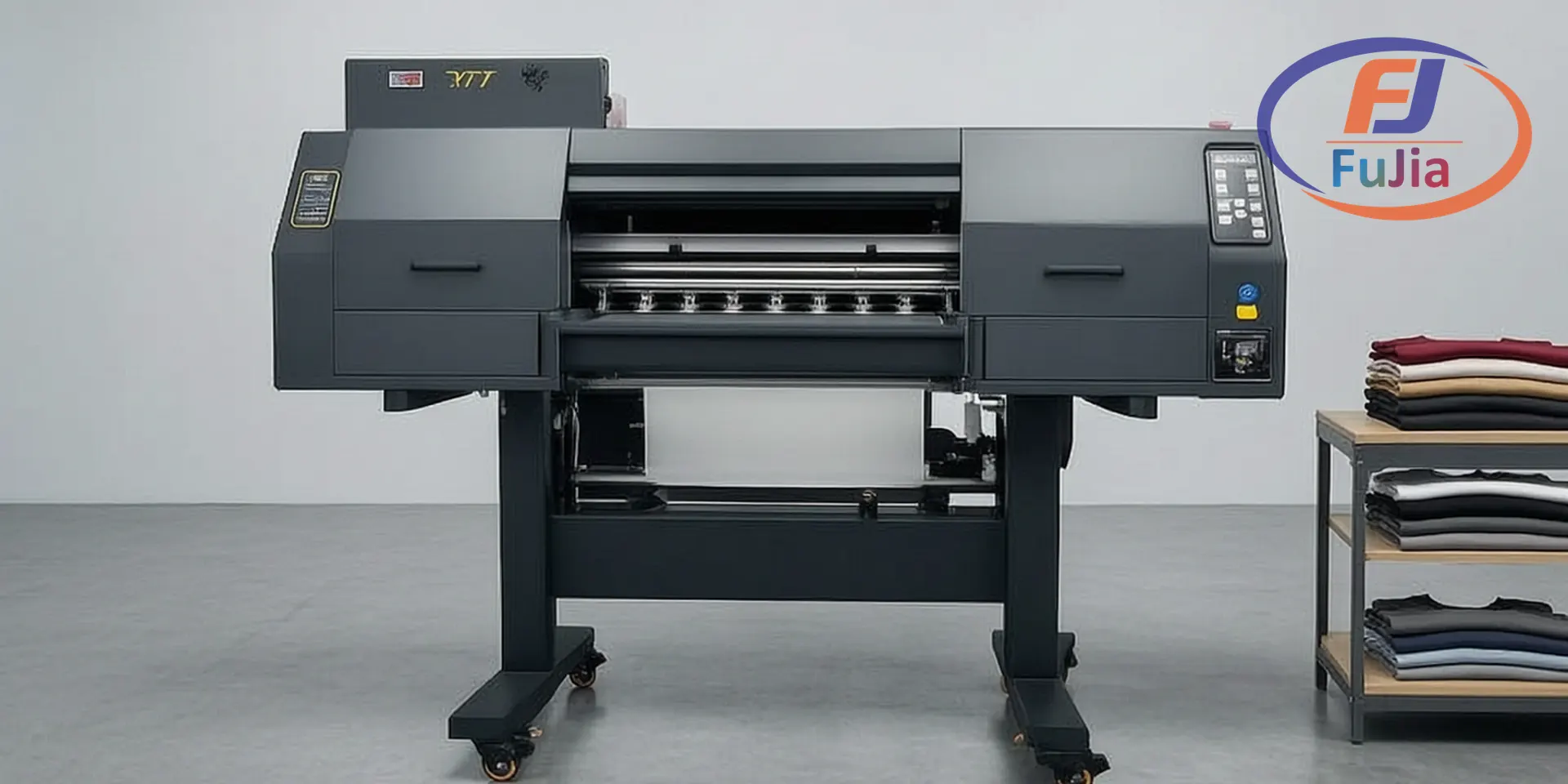
A DTF printer for shirts prints a full-color design onto PET film, then presses it onto cotton, polyester, or blends with a heat press. For most shirt businesses, an Epson i3200 printhead model from a factory-direct maker beats a reseller’s L800 or XP600 unit on speed, durability, and cost per print.
Key Takeaways
- DTF prints on cotton, polyester, and blends, including dark shirts, with no fabric pre-treatment.
- The Epson i3200 printhead outlasts the L800 and XP600 heads found in most sub-$3,000 reseller bundles.
- Real 2026 prices span $300 for an A4 L800 starter to $7,899 for an apparel system, with A3 i3200 units around $3,000 to $4,000.
- Print width decides output: A4 (8 inch) suits samples, A3 (13 inch) fits most shirt fronts and backs, A1 (24 inch) handles production.
- Fujia Print builds i3200 DTF printers in Guangzhou, tests every unit in a 3,500 m² facility, and ships 2,000 machines a year to 50+ countries.
What Is a DTF Printer for Shirts?
A DTF printer for shirts is a desktop or wide-format inkjet printer that lays colored and white ink onto a PET film instead of directly onto fabric. The printed film is covered with hot-melt powder, cured, and then a heat press transfers the design onto the shirt. The shirt itself never enters the printer, which is why DTF works across fabric types that defeat other methods.
The process separates the printing from the garment. That single design choice removes the biggest headaches of direct-to-garment printing, where the shirt must be flat, pretreated, and compatible with the ink. With DTF, the printer cares about the film, not the cotton.
DTF sits between two older methods. Sublimation only bonds to polyester and light colors. Screen printing needs a minimum order and a new screen per design. DTF handles one-offs and runs alike, on dark or light fabric, which is why shirt sellers adopt it as their first in-house method.
Can You Use a DTF Printer for T-Shirts?
Yes. A DTF printer for t-shirts is one of the most common setups in custom apparel, because DTF adheres to the three fabrics shirts are made from. Cotton takes the transfer cleanly. Polyester takes it cleanly. A 50/50 blend takes it cleanly. Dark shirts work because the printer lays a white ink base under the color.
| Shirt fabric | DTF result | Why it matters |
|---|---|---|
| 100% cotton | Excellent | No pretreatment, full opacity on dark |
| 100% polyester | Excellent | Works where DTG struggles |
| 50/50 blend | Excellent | Common promo-shirt fabric |
| Dark colors | Excellent | White underbase solves it |
| Performance wear | Good | Use low-temp film to protect stretch |
The one watch-out is stretch fabric. Performance and athletic shirts need a low-temperature film and a gentle press so the transfer flexes instead of cracking. Standard cotton and poly tees have no such limit.
What Makes the Best DTF Printer for Shirts
The “best” unit depends on volume, but four parts decide print quality and uptime. The printhead leads the list, because it governs resolution, speed, and how long the machine runs before a clog forces a service call.
| Printhead | Typical use | Lifespan | Notes |
|---|---|---|---|
| Epson i3200 | A3 to A1 production | Longest of the three | Industrial piezo, up to 4 heads per unit |
| XP600 | A3 desktop | Moderate | Common in $3,000 to $6,000 bundles |
| L1800 | A4 entry | Shortest | Consumer EcoTank head in $300 starters |
Print width is the second decision. An A4 (8 inch) printer handles chest logos and samples. An A3 (13 inch) covers full-front and full-back shirt designs, which is where most shops land. An A1 (24 inch) unit prints multiple shirts per pass for production runs.
Ink circulation matters more than buyers expect. White ink settles, and a printer without active white-ink stirring clogs within days of idle time. Fujia’s units run continuous white-ink circulation and pass a testing center before shipment, so the first print after a weekend is still clean.
DTF Printer for Shirts Price Tiers (2026)
Real listing prices from retailers and marketplaces show the full range. These figures come from current product pages and shopping results, not estimates.
| Tier | Width | Head | Real price | Example |
|---|---|---|---|---|
| Starter | A4 (8 in) | L1800 | from $300 | Procolored F8 A4 L800 |
| Mid desktop | A3 (13 in) | L1800 | $3,159 to $3,950 | Procolored F13 A3 |
| Mid i3200 | A3 (13 in) | i3200 | ~$3,000 to $4,000 | Fujia A3 i3200 line |
| Pro bundle | A3 (13 in) | XP600 dual | $4,739 to $7,505 | Procolored P13 / F13 Pro |
| Apparel system | A3+ | mixed | $7,899 | xTool Apparel Printer |
| Production | A1 (24 in) | i3200 x2 to x4 | quote-based | Fujia A1 line |
The spread is wide because resellers bundle ovens, powder shakers, and software into the price. A factory-direct i3200 A3 unit lands near the middle of the range yet skips the reseller margin, which is where the cost-per-shirt advantage comes from.
Epson’s own DTFilm G-Series targets shirt decorators through its dealer network, but pricing runs through quote-based commercial channels rather than open retail. For a buyer comparing open prices, the i3200 factory-direct route is the measurable alternative.
How to Print Your Own DTF Transfers for Shirts
Printing your own transfers turns the printer into a finish line, not a starting point. The steps are fixed, and small mistakes in curing show up as peeling later.
- Build the artwork. Size the design to the shirt panel and mirror it, because the transfer flips during pressing.
- Print the film. The printer lays white ink first, then color, onto PET film. Active white-ink circulation keeps the head clean.
- Apply powder. A shaker coats the wet print with hot-melt adhesive powder while it is still tacky.
- Cure the film. The powder melts and binds in an oven or on a curing station at a set temperature.
- Press the shirt. A heat press at the film’s rated temperature transfers the design in seconds.
- Peel and finish. Cold or warm peel depends on the film, then a short post-press locks the ink.
A controlled environment beats a fast one. Stable temperature and a clean powder shaker keep transfers consistent across a 200-shirt order, which is where in-house printing pays back the machine.
Fujia Print’s Approach to Shirt Printers
Fujia Print builds DTF printers in Guangzhou rather than trading other brands. The difference shows in the parts that affect a shirt business: the printhead, the test before shipping, and the support after.
The company was founded in 2011 and now runs a 3,500 m² facility with 80 people, shipping 2,000 machines a year to 50+ countries. Every printer passes a testing center before it leaves, and common replacement parts ship within 48 hours. The warranty covers the mainboard, headboard, and motors for one year.
Real results back the equipment. A Brazilian creative studio scaled with a Fujia A3 desktop DTF printer and grew 45% after bringing printing in-house. A Turkish garment factory lifted efficiency 40% with a Fujia A1 DTF printer on production runs. Those cases show the i3200 line handling both entry and volume shirt work.
Buying factory-direct means one supplier for printer, film, ink, and powder, with no dealer markup between the build and the box. For a shirt business watching cost per transfer, that structure matters as much as the spec sheet.
What is the best DTF printer for shirts?
The best DTF printer for shirts pairs an Epson i3200 printhead with the width your orders need. An A3 (13 inch) i3200 unit covers full-front and full-back designs and prints faster than the L800 or XP600 heads found in most sub-$3,000 reseller bundles. Fujia’s A3 i3200 line prints at production speed, ships with continuous white-ink circulation, and passes a testing center before delivery. A starter A4 L800 printer costs from $300 but caps out at chest logos, while an A1 i3200 unit handles multiple shirts per pass for volume. Match the head and width to your weekly shirt count, not to the lowest sticker price, because clog downtime costs more than the saved purchase price.
Can I use a DTF printer for t-shirts?
Yes, a DTF printer works on t-shirts made from cotton, polyester, or a 50/50 blend, and it prints on dark shirts through a white ink underbase. This flexibility is the main reason shirt sellers choose DTF over direct-to-garment printing, which prefers cotton, or sublimation, which only bonds to polyester and light colors. The shirt never enters the printer, so fabric flatness and pretreatment are not issues. The one exception is high-stretch performance wear, where a low-temperature film and a gentle press keep the transfer from cracking. For standard cotton and poly tees, DTF handles one-off and bulk orders with the same setup.
How much does a DTF printer cost?
A DTF printer for shirts costs from $300 for an A4 L800 starter to $7,899 for a complete apparel system, with A3 i3200 units around $3,000 to $4,000. Reseller bundles such as the Procolored F13 A3 L1800 list at $3,159 to $3,950, and dual-XP600 Procolored units reach $4,739 to $7,505. The xTool Apparel Printer sits at $7,899, and DTG systems like the DTG PRO FUSION V2 start near $5,499. Factory-direct i3200 models land in the middle of that range while removing the reseller margin, which lowers the real cost per shirt. Budget for the powder shaker and oven as part of the total, since those are required to finish transfers.
How can I print my own DTF transfers?
Print your own DTF transfers by building mirrored artwork, printing white then color onto PET film, shaking hot-melt powder over the wet print, curing the powder in an oven, and pressing the film onto the shirt with a heat press. The printer only handles steps two and three, so the powder shaker, oven, and press are required companions. Keep the workspace temperature stable and the white-ink system circulating, because inconsistent curing causes peeling on later shirts in a batch. Once the workflow is set, a 200-shirt order becomes a repeatable routine rather than a custom job, which is where in-house printing beats outsourcing on both cost and turnaround.
Conclusion
A DTF printer for shirts earns its place by printing on any fabric, including dark cotton and polyester blends, without pretreatment. Choose an i3200 printhead and the right width for your order volume, weigh real prices from $300 to $7,899 against the cost per transfer, and prefer a maker that tests before shipping and supports after. For factory-direct i3200 DTF printers and a free sample inquiry, contact Fujia Print.
