

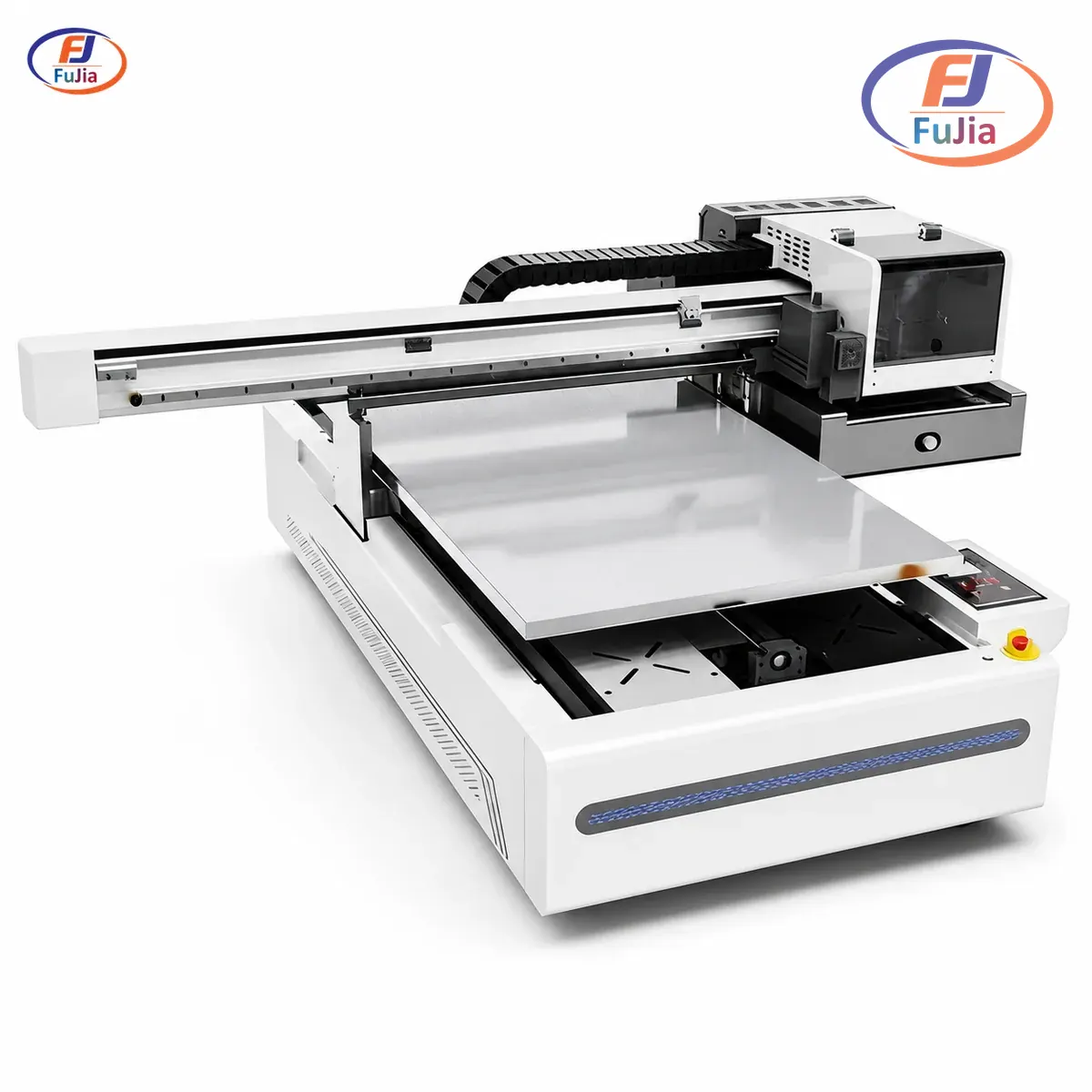
A UV printer for wood prints full-color, instantly cured graphics straight onto wooden surfaces such as MDF, plywood, bamboo, and solid wood, with no film, plate, or transfer step. Fujia Print builds UV flatbed printers in Guangzhou that handle this job for sign shops, gift makers, and furniture workshops across 50+ countries.
Key Takeaways
- A UV printer for wood prints directly on MDF, plywood, bamboo, and solid wood with ink that cures in seconds under a UV-LED lamp.
- Pick a UV flatbed for flat panels and bulk runs; pick UV DTF when the wood is curved, textured, or pre-finished.
- Keep wood moisture under 10 percent and sand with 180-grit then 220-grit paper for sharp, bonded prints.
- Expect roughly $0.10-0.40 of ink and power per A4 wood panel in-house, below the per-piece cost of outsourced screen or pad printing.
- See Fujia’s UV printers for flatbed models sized A3 to A1.
Does UV Ink Bond to Wood?
UV-curable ink jets onto the wood surface and a UV-LED lamp in the 365-405 nm band cures it in milliseconds, so the ink forms a thin solid film on top of the wood rather than soaking in. The 365-405 nm UV-LED band sits in a measured optical range documented by the National Institute of Standards and Technology. That surface cure is what keeps fine lines crisp instead of bleeding into the grain.
Porous or rough wood can pull uncured ink into the grain, which dulls color and softens edges. A white ink base layer blocks the natural wood tone and keeps colors bright on dark or uneven boards. Fujia UV flatbed ink runs as a 6-color set: CMYK plus White plus Varnish. The varnish layer adds spot gloss or matte and supports 30-50 percent higher per-unit pricing on finished goods.
Fujia’s material database already covers 300+ tested substrates, including the common wood types listed below. The bond holds through normal handling, but adhesion depends on surface prep. Clean, dry, sealed wood gives the strongest result, and curing must be tuned because under-cured ink stays tacky while over-cured ink turns brittle.
UV-LED curing draws far less power than a heated drying tunnel, a point the U.S. Department of Energy makes about LED efficiency. Cured UV ink also releases minimal volatile organic compounds versus solvent systems, which the U.S. Environmental Protection Agency tracks as an air-quality concern. Fujia UV flatbeds run Ricoh GEN5 or Epson I3200 printheads for that droplet precision.
UV Flatbed vs UV DTF for Printing on Wood
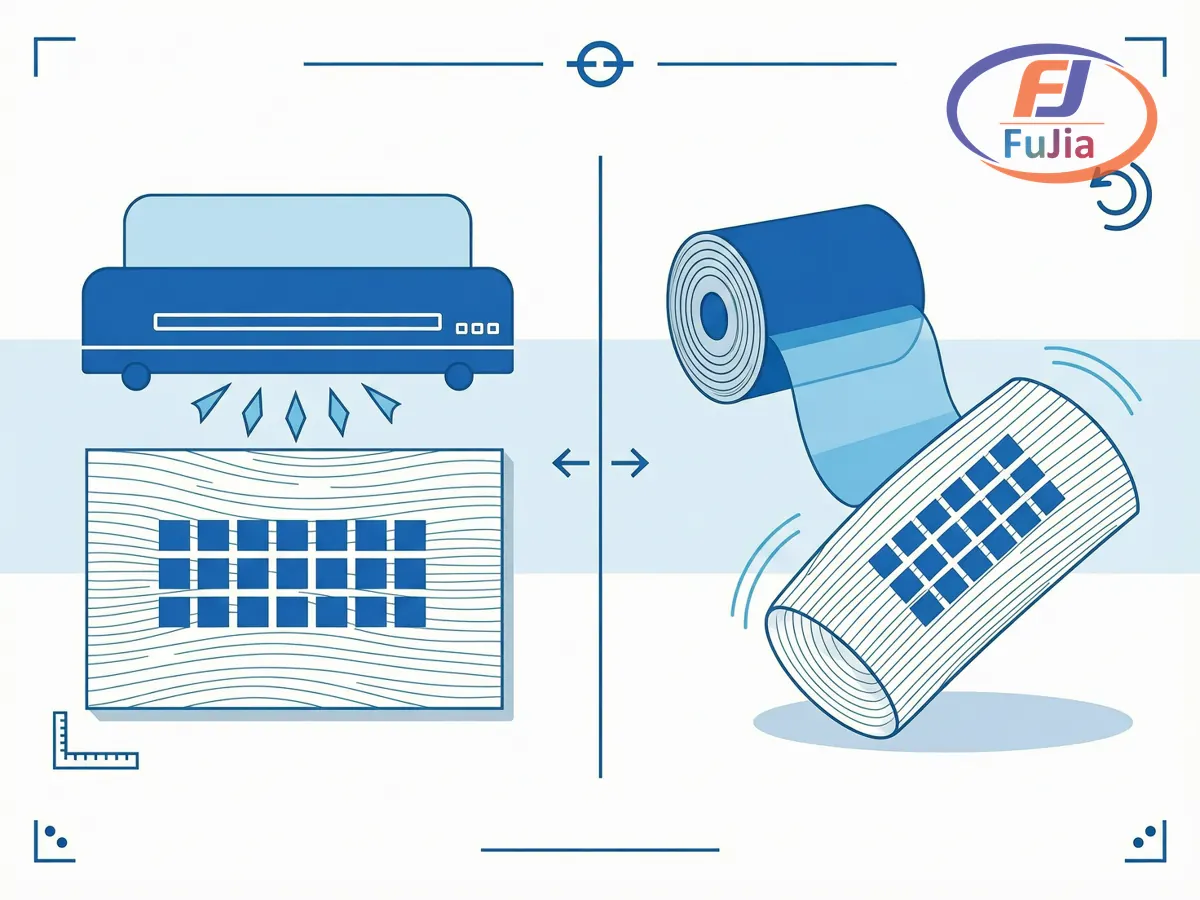
A UV flatbed printer prints the design straight onto the wood placed on its bed. A UV DTF printer prints the design onto AB film first, then transfers it onto the wood by pressure. The choice comes down to the shape of the wood and how you plan to run production.
| Factor | UV flatbed | UV DTF |
|---|---|---|
| Printing method | Direct on wood bed | Print on film, transfer by pressure |
| Best wood shape | Flat panels, boards | Curved, textured, pre-finished |
| Per-piece ink cost | ~$0.10-0.40 A4 panel | Higher (film + adhesive) |
| Max thickness | Up to 180 mm | Any shape, no bed limit |
| Throughput | 4-8 m²/hr on A1 6090 | Slower per transfer |
| Durability | Direct, strong bond | Good for decorative |
The flatbed wins on flat, repeatable work such as signs, coasters, and cabinet doors, where ink cost per piece stays low. UV DTF wins on curved or textured wood, pre-finished boards, and small mixed batches where a film transfer avoids the need for a perfectly flat bed. Both appear side by side in our UV flatbed vs UV DTF breakdown.
Which Wood Types and Products Work Best

Hardwoods and engineered panels give the smoothest, most uniform results. Maple, birch, MDF, plywood, bamboo, and oak all print well. Softwoods like pine carry resins that can seep and interfere with adhesion, so they need more prep and a test print.
| Wood type | Print quality | Prep needed |
|---|---|---|
| Maple / Birch | Excellent, smooth | Light sand |
| MDF | Uniform, no grain | Seal the edges |
| Plywood | Good, layered grain | Sand + seal |
| Bamboo | Good, fine grain | Light sand |
| Oak / hardwood | Good, visible grain | Sand |
| Pine / softwood | Variable, resin risk | Seal + test |
A UV printing machine opens up a long list of wood products: cutting boards, coasters, name plaques, signs, gift boxes, photo frames, cabinet doors, and decorative wall panels. A 600×900 mm bed holds several coasters or a full sign panel per cycle, so short runs and one-off gifts are both practical.
How to Prep Wood Before UV Printing
Good prep decides whether the print looks sharp and stays bonded. Follow these steps before the first drop of ink hits the wood.
- Sand the surface. Start with 180-grit paper, then move to 220-grit to remove tool marks and open a uniform face.
- Clean off dust and oils. Wipe with a lint-free cloth because any dust trapped under ink shows as specks.
- Check moisture content. Use a pin moisture meter and keep the reading under 10 percent to stop warping and ink cracking.
- Seal porous or raw wood. Spray a thin, even primer so ink sits on a non-porous base, and test on a scrap first because primer can change grain show-through.
- Print a white base on dark wood. Lay white ink first so colors stay accurate on dark or uneven tones.
An optional clear varnish after curing adds scratch and moisture resistance. The whole prep takes minutes per board, and a clean, dry, flat surface is what the vacuum bed needs to hold the wood steady during the pass.
Real Production Numbers from a Fujia UV Workshop
The Fujia FJ-6090 UV flatbed runs a 600×900 mm bed with 3-4 Ricoh GEN5 or Epson I3200 printheads at 4-8 m²/hr and up to 720×1800 dpi. A Kenya glassware workshop using this model lifted daily output 50 percent (200 to 300 pieces/day), cut material waste from 15 to 9 percent, and shortened turnaround from 5-7 days to 1-2 days.
Varnish effects on finished goods command 30-50 percent higher per-unit pricing, which is why many shops add the sixth color. Fujia backs every printer with a 12-month warranty and ships common parts within 48 hours, plus a 3-day remote onboarding plan that takes a new operator from setup to first perfect print.
Based on data from our customers across 50+ countries, in-house UV printing on wood beats outsourced screen or pad printing on cost below about 3,000 identical pieces, and wood decor runs are typically profitable from the first batch. For deeper cost modeling, see our UV printing costs guide.
Can you UV print directly on wood?
Yes. A UV printer for wood prints full-color graphics straight onto wooden surfaces with no film, plate, or transfer step. The printer jets UV-curable ink onto the board and a UV-LED lamp in the 365-405 nm band cures it in milliseconds, so the ink forms a hard film on the surface instead of soaking into the grain. This works on MDF, plywood, bamboo, maple, birch, oak, and most solid woods. The print stays sharp because the ink does not bleed, and it is ready to handle the moment the lamp passes. The main limit is shape: a flatbed needs the wood to sit flat on the bed, so very curved or rough pieces print better after sanding or with a UV DTF film transfer. Adhesion is strong on clean, dry, sealed wood, and a white ink base keeps colors accurate on dark tones.
Do you need primer or white ink when UV printing on wood?
It depends on the wood. Raw or porous wood such as MDF and open-grain boards should get a thin, even primer so the ink sits on a sealed, non-porous base instead of being absorbed. Pre-finished or coated wood may print fine with no primer, but always test a scrap first because some coatings resist UV ink. White ink is a different tool: it acts as an opaque undercoat on dark or uneven wood so the colors on top stay bright and accurate. Without a white base, dark grain can muddy a light design. Most shops sand with 180-grit then 220-grit paper, keep moisture under 10 percent, and add primer only where the surface is thirsty. White ink is then printed first, followed by the color layers and an optional varnish. This combination gives the most durable, vibrant result on natural wood.
What wood products can you make with a UV printer?
A UV printer for wood supports a wide range of custom goods. The most common are cutting boards, coasters, name plaques, signs, gift boxes, photo frames, cabinet doors, and decorative wall panels. Sign shops use it for indoor and point-of-purchase displays, while gift makers print wedding favors, company gifts, and souvenirs. Furniture workshops decorate tabletops and cabinet fronts with full-color or photographic images while keeping the natural grain visible. A 600×900 mm flatbed bed holds several coasters or a full sign panel per cycle, which makes both one-off pieces and short batches practical. Because the ink cures instantly, pieces move to finishing or shipping right away with no drying racks. Wooden packaging such as wine and tea boxes also print well with brand art and product text in a single pass.
Should you choose a UV flatbed or UV DTF printer for wood?
Choose a UV flatbed if your wood is flat and you run panels, signs, coasters, or cabinet doors in medium to large volume. The flatbed prints directly, keeps ink cost per piece low at roughly $0.10-0.40 for an A4 panel, and reaches 4-8 m²/hr on an A1 6090 bed. Choose UV DTF if the wood is curved, textured, pre-finished, or part of a high-mix, low-volume gift run. UV DTF prints the design on AB film and transfers it by pressure, so bed flatness and thickness stop being a limit. Many shops buy both: the flatbed for bread-and-butter flat jobs, the UV DTF for odd shapes and quick custom requests. The decision rests on three things: the shape of the wood, how often you repeat the same design, and whether you need the strongest direct bond or the widest material range.
Conclusion
Wood is one of the most profitable UV printing applications because the natural grain adds value that flat media cannot. For factory-direct UV flatbed printer pricing and a free wood sample print, contact Fujia Print.
