

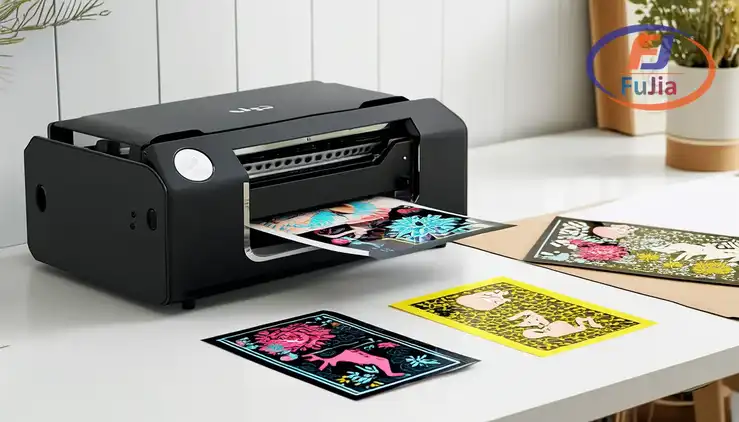
A UV DTF sticker machine is the print-and-laminate station that turns digital designs into peel-and-press crystal stickers, priced $1,500-6,000 across desktop and wide-format configurations, and it is the hardware behind the sticker businesses visible at every craft market. The machine pairs a UV printer with an AB-film laminator, and the pair prints weather-resistant, hand-applied stickers that bond to glass, metal, plastic, and finished wood without heat. This guide prices the stations, runs the sticker economics, and times the purchase against the wrap-service alternative.
Key Takeaways
- Stations run $1,500-2,950 at desk width with separate laminators, $1,600-2,550 for 2-in-1 bodies, and $4,000-6,000 wide-format.
- Stickers cost $0.15-0.45 each in film and ink against $2-10 retail, and stations repay inside 6-10 weeks at craft velocity.
- The workflow is print, laminate, cut, weed, apply, with lamination quality as the stage that decides sellability.
- White plus varnish channels are the non-negotiable spec, because opacity and depth are the product.
- We recommend wrap services for demand testing and the station once weekly sticker orders steady at 20-30 pieces.
The Station Configurations and Prices
| Configuration | Components | Price | Stickers/hour |
|---|---|---|---|
| A4 desk + hand roller | printer, manual laminate | $1,300-1,800 | 10-20 |
| A3 desk + roll laminator | printer + $200-400 unit | $1,800-2,950 | 25-50 |
| 2-in-1 integrated | print and laminate one body | $1,600-2,550 | 20-40 |
| wide-format 60 cm | production station | $4,000-6,000 | 60-100 |
The configuration table is the buying menu, and the lamination column is where the rows truly differ: hand rollers serve craft volumes, roll laminators add bubble-free speed at $200-400, 2-in-1 bodies trade redundancy for desk space, and wide-format serves production houses. White plus varnish channels appear across every serious row, and they are the spec to verify first, because the white underlay is what makes stickers pop on glass and dark objects, per the channel requirements our UV printers guides set across the category.
The 2-in-1 decision carries the same trade our transfer-machine guide documents: integration removes the second device and the alignment step where hand lamination traps bubbles, but it couples both functions to one machine’s uptime. Businesses whose sticker output is revenue should weigh the fallback a separate laminator provides, and desks where space binds should weigh the integration’s footprint, because the right configuration is the one whose failure mode the business can absorb.
The Sticker Economics
| Line | Station route | Wrap service route |
|---|---|---|
| hardware | $1,500-6,000 | $0 |
| per-sticker cost | $0.15-0.45 | $0.50-2.00 |
| design change | a file | an order |
| break-even | 6-10 weeks at 20-30 weekly | immediate |
The economics table frames the two routes, and the wrap service is the station’s test-phase competitor: identical stickers without hardware, at per-design premiums that volume escapes. A seller testing 10 designs buys wraps, proves the sellers, and escapes the premium when weekly orders steady, at which point the $1,500-2,950 desk station repays inside 6-10 weeks. The design-change line is the creative argument that outlives the spreadsheet, because a new design at the station costs a file, and the same crossover logic our sticker guides apply to every wrap category closes this one.
Consumables discipline keeps the economics honest after purchase: film and ink at $0.15-0.45 per sticker, varnish adding its fraction to both cost and retail, and the RIP’s ink limits as the margin control. Sticker retail spans $2-10 from craft fairs to corporate branding, and the station’s hourly capacity prices comfortably against either. Here’s the thing about sticker businesses generally: the machine is the cheapest durable asset in the stack, and the design pipeline is the compounding one. We recommend budgeting for designs, not just for hardware.
The Workflow That Produces Sellable Stickers
The workflow is fixed at four steps, and lamination is the step that decides sellability: the B adhesive film rolls over the fresh LED-cured print, and trapped bubbles are permanent, so steady roller pressure is the skill the station rewards. Cutting follows plotter or scissors conventions, weeding clears the excess, and application presses the decal onto an alcohol-wiped surface with fingertip force, no heat anywhere. The two-second wipe is the application step’s whole quality contribution, because the adhesive grips by surface contact, per the process standards our UV DTF process guide documents in full. Surface prep is free, and it is the entire adhesion budget.
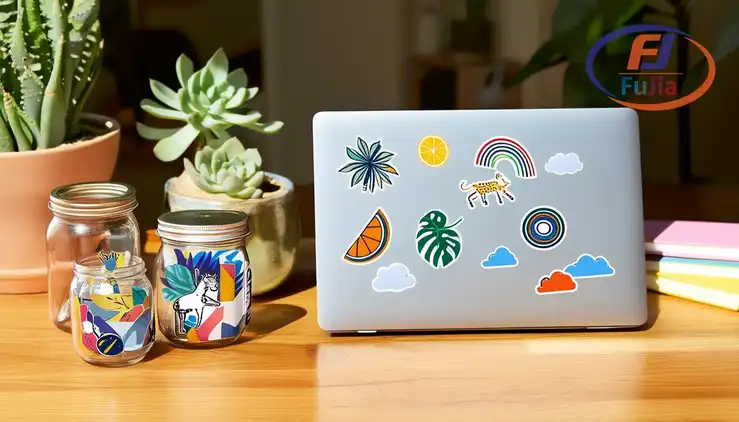
Storage is the workflow’s quiet advantage: finished stickers wait on their backing for 6-12 months and apply on demand, so the station prints bestsellers in batch before seasonal peaks and fulfills custom orders same-day from the same desk. That warehousing property lets a desktop station serve seasonal curves that would demand production hardware in any direct-print method, per the storage economics our labeling guides document for decal programs. The backing paper is inventory, and the desk is the warehouse.
We recommend shipping application cards with every order, because the customer’s surface is the one variable the station cannot control, and the card converts complaint tickets into clean results. The station prints the sticker, and the card protects it after it leaves.
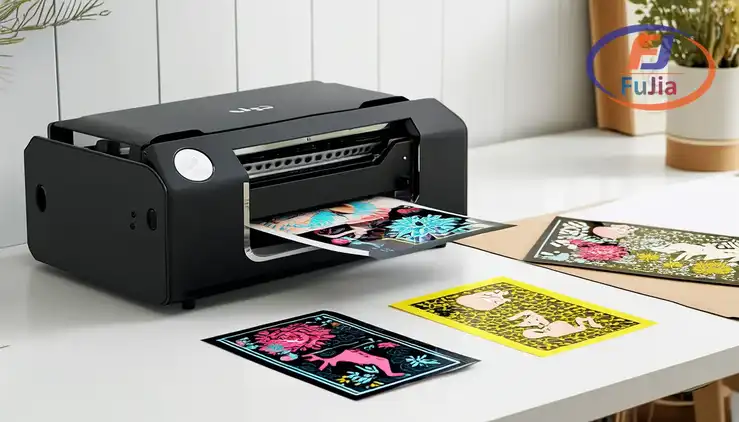
The station desk in one view:
A seller case we supply anchors the economics: a stationery brand testing custom stickers through wraps for one season, buying an A3 desk station with a roll laminator when reorders passed 25 stickers weekly, and recovering the hardware inside two months while cutting per-unit cost by two thirds. The test-then-own path is the category’s standard success pattern, and the same two-phase logic our guides document across wrap categories is the recommendation this page exists to make.
What machine do I need for UV DTF stickers?
UV DTF stickers need a UV printer with LED curing and white ink capability paired with a laminator for the B adhesive layer, available as separate components at $1,800-2,950 or integrated 2-in-1 bodies at $1,600-2,550, with white plus varnish channels as the non-negotiable spec. Standard garment DTF printers cannot substitute, because the ink chemistry, curing, and film systems differ entirely despite the shared name. The laminator is not optional, and buyers who price only the printer meet the workflow’s second half at the worst time. Verify the circulation pump and the channel list before price, per the spec priorities our ink guide documents.
How much does a UV DTF sticker machine cost?
A UV DTF sticker machine costs $1,500-2,950 at desk width with a separate laminator, $1,600-2,550 for integrated 2-in-1 bodies, and $4,000-6,000 for wide-format production stations, with consumables at $0.15-0.45 per sticker against $2-10 retail. Complete stations repay inside 6-10 weeks at 20-30 stickers weekly, and wrap services price the same product without hardware for buyers below that volume. The price ladder including printer-only tiers sits in our flatbed pricing guide, and the station price is the honest one because lamination is the workflow’s second half.
Is a UV DTF sticker business profitable?
A UV DTF sticker business is profitable at craft-market and online velocity, because consumables of $0.15-0.45 against $2-10 retail carry 90%+ gross margins once the $1,500-2,950 station repays inside 6-10 weeks of 20-30 weekly orders. The margin structure survives marketplace fees and card processing with room to spare, and the design pipeline is the compounding asset that seasonal collections and custom orders keep feeding. Profitability fails only below the volume floor, where wraps serve the demand without hardware, and in our experience the wrap-first test answers the question for the price of an order. Margins this wide forgive a lot of learning.
How long do UV DTF stickers last?
UV DTF stickers last 1-2 years of hand-wash use on drinkware and years of indoor display, with 6-12 months of direct outdoor sun before noticeable fade, and the variables are surface preparation and the care the object receives. Alcohol-wiped smooth surfaces hold the full range, textured or dusty surfaces fail within weeks, and abrasive washing shortens any film’s life. The care card shipping with every order, hand wash, no abrasives, is part of the lifespan, and stickers that survive their first month on the object reach their full range, per the durability data our labeling guides document for the film class.
Verdict
The UV DTF sticker machine is a print-and-laminate pair at $1,500-6,000, running a four-step workflow whose sellability lives in bubble-free lamination, earning 90%+ gross margins at $0.15-0.45 per sticker, and timing its purchase against wrap-service testing that answers demand for the price of an order. Verify white and varnish channels, choose the lamination configuration your fallback tolerance accepts, and ship application cards with every order. The station converts design files into a product line, and the product line walks out of craft fairs wearing itself. To see your designs as finished stickers before the hardware decision, contact Fujia Print for a sample pack.
Sources
- Wikipedia: UV curing: LED ink chemistry.
- Wikipedia: Pressure-sensitive adhesive: B layer chemistry.
- AATCC: durability testing standards.
- Fujia Print labeling cases: sticker program examples.
