

Yes, UV DTF transfers bond to a stainless steel tumbler and survive roughly 100 dishwasher cycles, but curved walls are the failure point because the adhesive fights constant peeling stress. This article covers where UV DTF beats sublimation on drinkware, where it does not, and when both methods belong on the same production floor.
Key Takeaways
- UV DTF transfers bond to stainless steel tumblers without any coating or pre-treatment, and the transfer takes 15 seconds by hand.
- Expect roughly 100 dishwasher cycles from UV DTF on drinkware, against 500+ cycles from dye sublimation on a polymer-coated tumbler.
- Curved surfaces are the failure point, because adhesive on a cylinder fights continuous peeling stress near the edges.
- UV DTF wins on small batches, multi-SKU runs, and blank types sublimation cannot coat, not on maximum wash durability.
- Full adhesive cure takes 24 hours, and washing before that point is the most common cause of early edge lift.
Can You Put UV DTF on a Tumbler?
UV DTF transfers stick to stainless steel, glass, ceramic, and powder-coated tumblers with no pre-treatment and no heat press. The transfer is a UV-cured ink layer printed onto a PET carrier film, laminated with an adhesive backing, then burnished onto the surface by hand and peeled away.
The mechanism differs from sublimation in one important way. Sublimation dye diffuses into a polymer coating at 180°C over 60 seconds, becoming part of the surface. UV DTF sits on top of the surface as a bonded film, which is why the two methods fail differently.
A UV DTF transfer is a sticker with very good glue, not a chemical bond. That distinction explains every durability number that follows.
The workflow suits mug and drinkware printing operations running many designs in small quantities, because one operator applies UV DTF to 30 to 40 bottles per hour by hand. Larger shops buying bulk coated blanks usually stay on sublimation, where the per-piece economics favour long press runs. The split is rarely either-or in a busy drinkware shop, which is why most end up running both.
What Actually Happens to UV DTF on Curved Surfaces
A flat surface lets adhesive relax. A cylinder does not, because the outer edge of a wrapped transfer sits under continuous tension trying to straighten the film back out.
The honest truth is that UV DTF on a curved tumbler is a compromise, not a permanent bond. Edge lift on cylinders is a real and documented failure mode, and sellers who claim otherwise are selling something.
| Surface type | Expected dishwasher cycles | Main failure mode | Mitigation |
|---|---|---|---|
| Flat stainless panel | 100+ cycles | Abrasion on print face | Varnish topcoat, 3H+ pencil hardness |
| Straight-wall tumbler | 80 to 120 cycles | Edge lift at top rim | Round the transfer corners, burnish hard |
| Tapered tumbler | 50 to 80 cycles | Wrinkling on the taper | Cut the design into vertical panels |
| Ceramic mug (curved) | 60 to 100 cycles | Edge lift plus thermal shock | Hand wash, avoid thermal cycling |
| Powder-coated bottle | 70 to 110 cycles | Coating delamination | Test the coating, not the transfer |
Based on data from our customers across 50+ countries, the shops with the fewest complaints cut their tumbler artwork into two or three vertical panels instead of one full wrap. Panel gaps give the adhesive somewhere to relieve stress. The visible seam is generally an acceptable trade for a print that survives two years in a busy shop.
UV DTF vs Sublimation for Drinkware
The two methods are not interchangeable, and the choice depends on what the blank is made of.
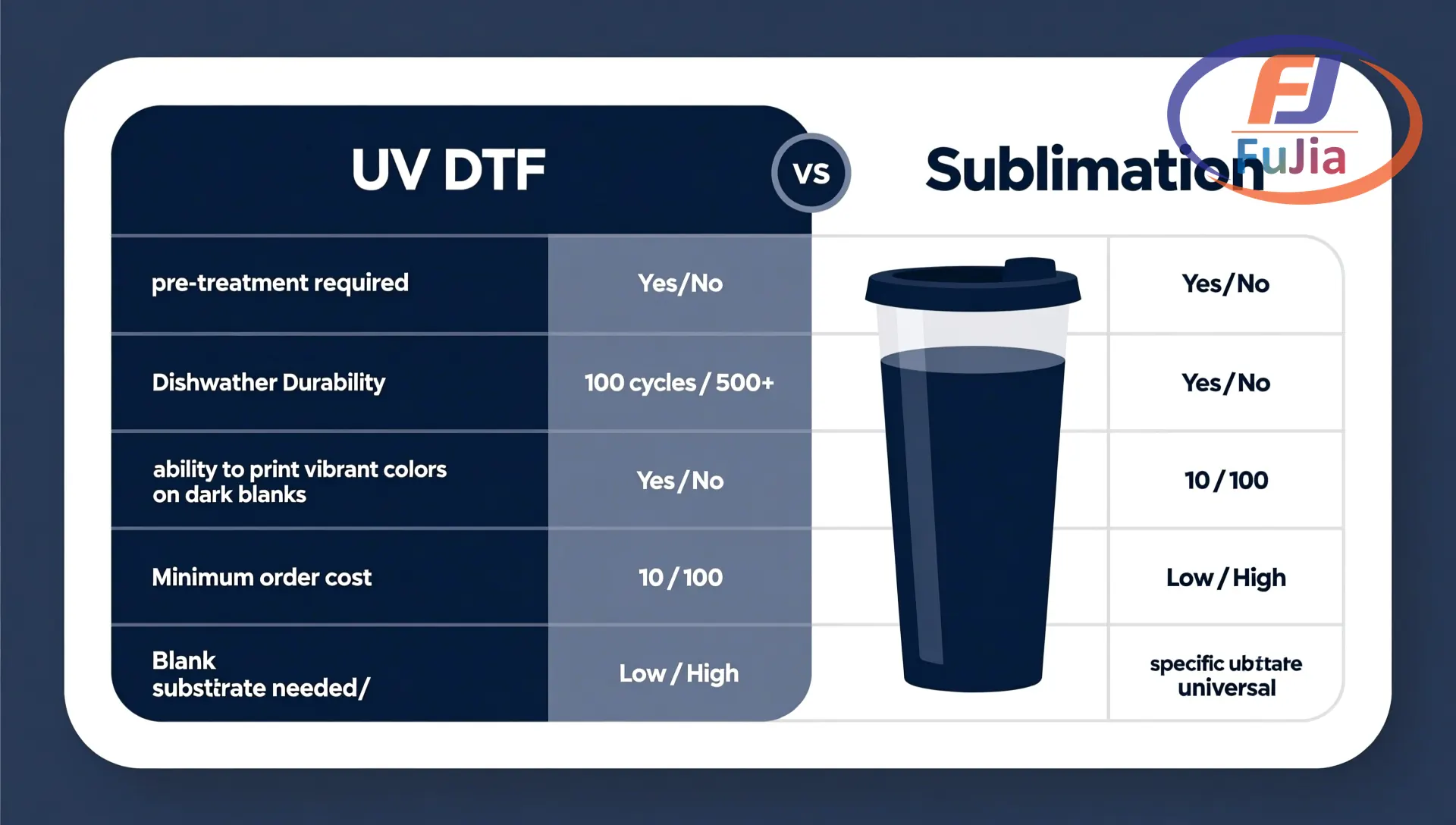
| Factor | UV DTF | Dye sublimation |
|---|---|---|
| Blank requirement | Any clean hard surface | Polymer-coated, white or light only |
| Pre-treatment | None | Coating mandatory |
| Equipment | UV DTF printer, laminator | Sublimation printer, 180°C mug press |
| Press time | 15 seconds by hand | 60 seconds per 11oz mug |
| Dishwasher cycles | ~100 cycles | 500+ cycles |
| Colour on dark blanks | Full colour with white ink underlay | Not possible |
| Minimum order | 1 piece | 1 piece, but coating cost favours batches |
| Outdoor durability | 5+ years | 2 to 3 years before noticeable fade |
| Scratch hardness | 3H+ with varnish | Coating dependent |
Sublimation wins outright on wash durability and on any blank that already carries a polymer coating. UV DTF wins on dark blanks, on uncoated metal, and on designs that need to survive outdoors.
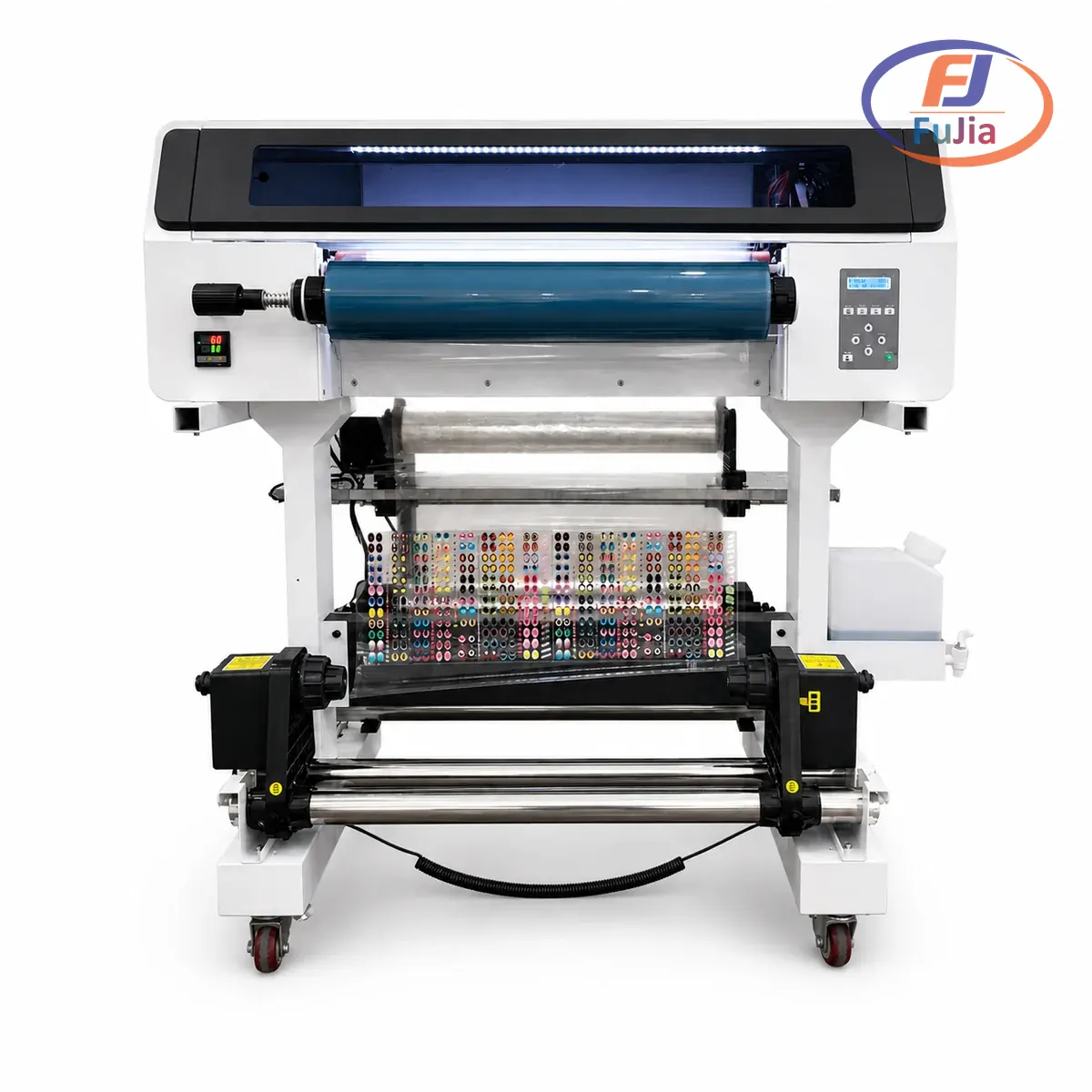
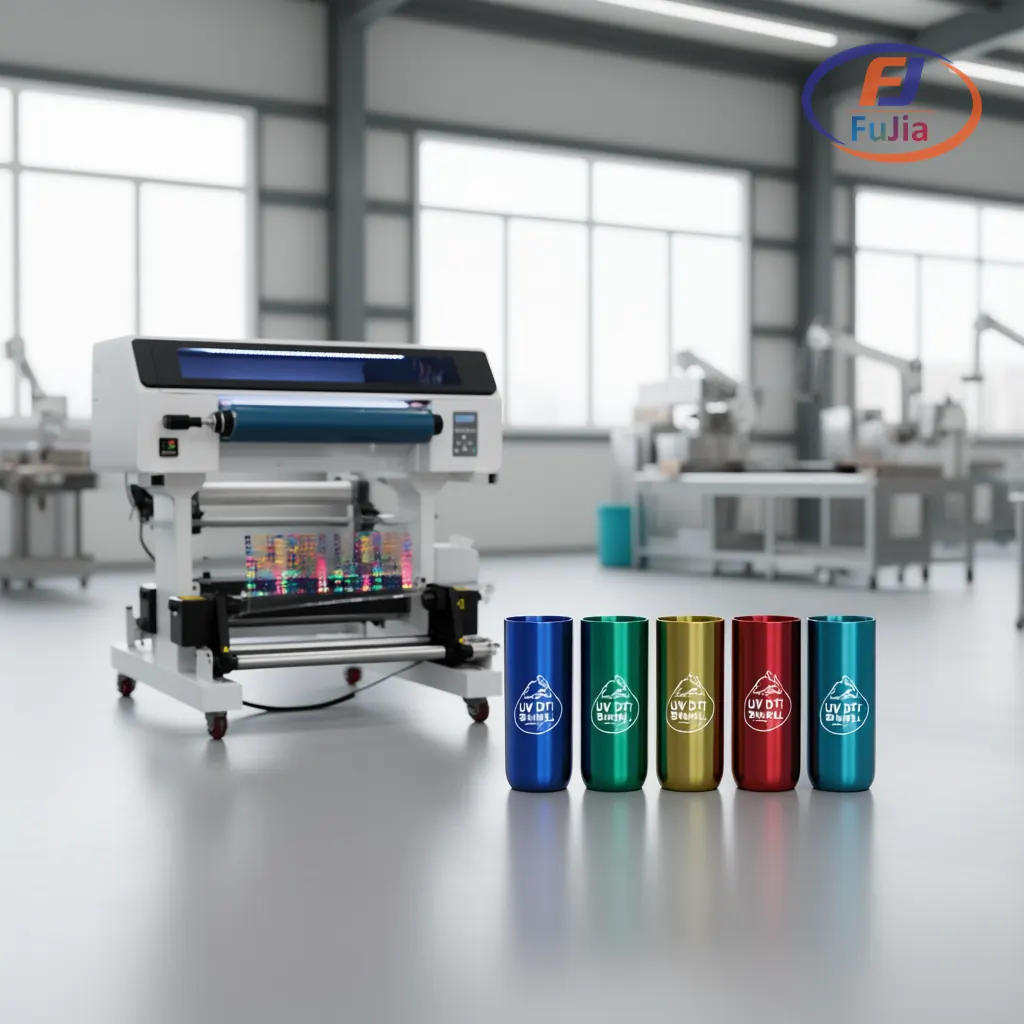
The UV DTF printer range starts at a 30cm A3 desktop unit and runs to a 65cm A1 machine with an I3200HD printhead. Fujia’s AB transfer film is 75 to 100μm PET at 60cm width, which matters because thin film conforms to a curve far better than thick film and resists the edge peel that kills drinkware transfers early. Both widths are held in stock for sample testing and short delivery runs.
How to Apply UV DTF to a Tumbler
Application technique decides most of the durability outcome. A well-applied transfer outlives a rushed one by a wide margin.
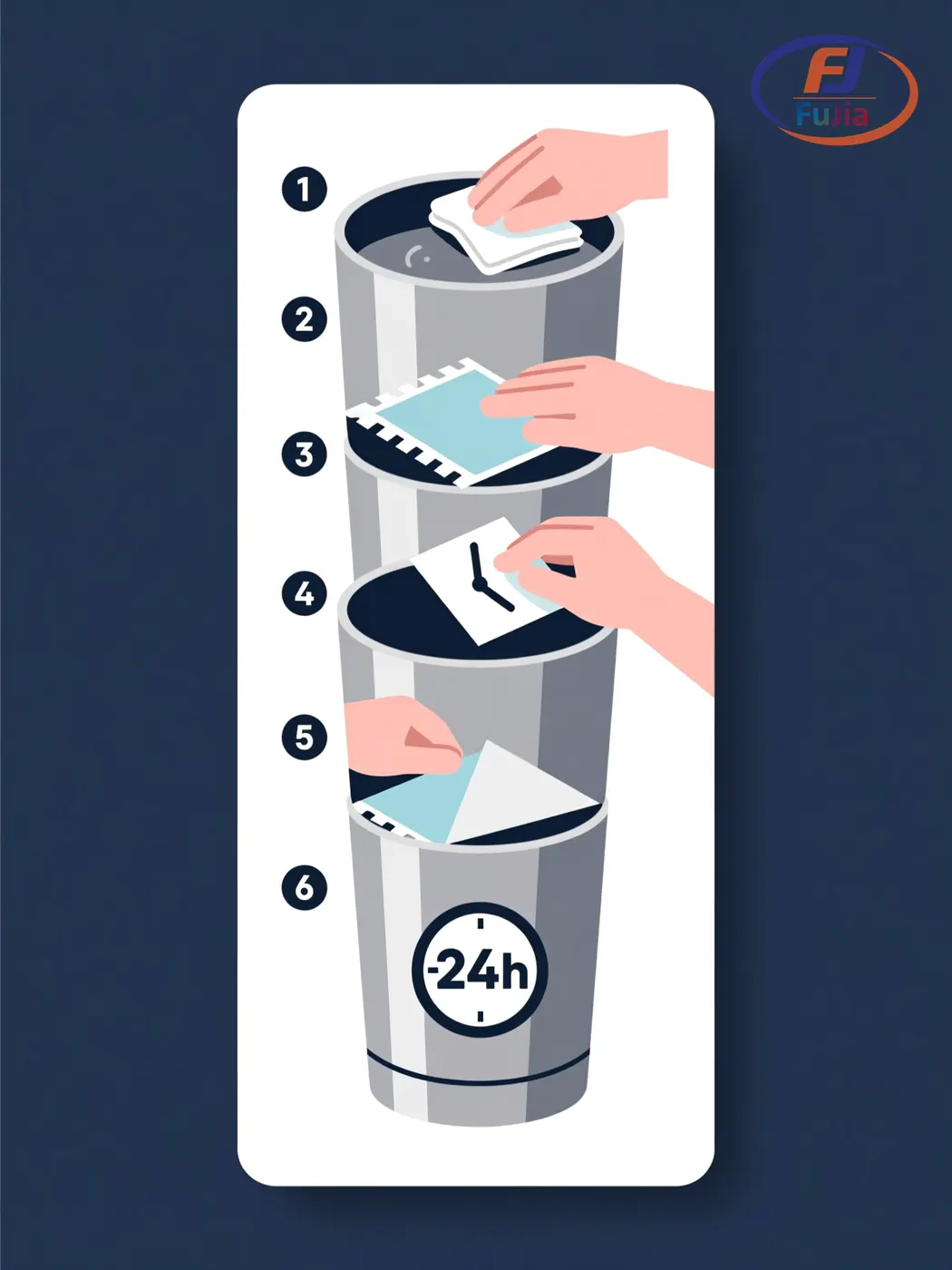
- Clean the surface. Wipe the tumbler with isopropyl alcohol and let it dry completely. Skin oils and mould release agents are the top cause of early lift.
- Position the transfer dry. Place the transfer without peeling the backing, and check alignment. The adhesive grabs instantly on contact.
- Burnish from the centre outward. Press with a squeegee or firm thumb pressure, working from the middle toward the edges to push air out.
- Peel the carrier at a low angle. Pull the film back flat against the surface rather than lifting straight up, which keeps the ink layer down.
- Burnish the edges again. Go over every edge with firm pressure after the carrier comes off.
- Wait 24 hours before washing. The adhesive reaches full strength after a day, and washing earlier is the most common cause of premature failure.
For tapered cups, warm the transfer with a heat gun on low for a few seconds before burnishing. Warm adhesive flows into the curve, and that single step adds measurable life on difficult shapes.
When a UV DTF Printer Beats Sublimation for Drinkware
UV DTF wins in four specific situations, and loses in one.
Dark or uncoated blanks. Sublimation cannot print white, and it cannot bond to bare stainless steel. UV DTF prints a white ink underlayer and sticks to metal directly.
High SKU counts. A hand bottle labeler we work with moved from paper labels to UV DTF crystal labels and cut minimum order quantity from 500 to 12 units per design. Delivery went from 3 weeks to 4 days, and order value rose 60%.
Outdoor and industrial use. UV DTF holds colour outdoors for 5+ years, roughly double what sublimation manages on drinkware.
Same-day turnaround. No coating, no press, no jig inventory.
Serving drinkware decorators across 50+ countries, most shops run both methods rather than choosing one. Sublimation takes the high-volume polymer-coated tumbler work, and UV DTF takes everything else.
Can I use UV DTF on my tumbler?
UV DTF works on stainless steel, glass, ceramic, and powder-coated tumblers with no coating or heat press required. The practical limits come from geometry and washing habits rather than material. On a straight-wall stainless tumbler, expect roughly 80 to 120 dishwasher cycles before edge lift becomes visible, and apply the transfer in vertical panels rather than one full wrap so the adhesive has somewhere to relieve stress. Clean the surface with isopropyl alcohol first, burnish from centre outward, peel the carrier film at a low angle, and wait the full 24 hours before the first wash. Skipping the 24-hour cure is the single most common cause of early failure. For drinkware that goes through a commercial dishwasher daily, sublimation on a polymer-coated blank lasts considerably longer at 500+ cycles.
What is the best UV printer for printing on tumblers?
A UV DTF printer is the right machine for tumbler work, not a UV flatbed printer, because the transfer film conforms to curves while a flatbed requires the object to sit flat under the gantry. Look for three specifications. A 60cm to 65cm A1 width handles gang sheets with 20 or more tumbler designs per run, which is what makes per-unit economics work. Check that the machine prints a white ink underlayer plus varnish, since the varnish layer raises scratch hardness to 3H+ and noticeably extends wash life. Third, confirm the AB film specification, because 75 to 100μm PET film wraps a curve far better than thicker stock. Fujia Print builds UV DTF machines from a 30cm A3 desktop unit up to a 65cm A1 machine fitted with an I3200HD printhead, all factory-direct.
What kind of printer do I need for UV DTF?
UV DTF requires a dedicated UV DTF printer, which is a UV-curable machine printing onto PET transfer film with an integrated laminator that applies the adhesive backing layer. A standard UV flatbed cannot do this job, because it prints directly onto objects with no transfer step, and a conventional DTF printer cannot do it either, since DTF uses water-based pigment ink with heat-melt powder and requires a heat press at 160°C. The UV DTF workflow prints CMYK plus white plus varnish, cures each layer instantly under a UV-LED lamp, laminates the adhesive, then transfers to the object by hand in 10 to 15 seconds. Anyone comparing the two transfer technologies should read the UV DTF and UV flatbed comparison before buying, because the machines serve genuinely different production models.
Can I use a DTF printer for tumblers?
A standard DTF printer is the wrong tool for tumblers, because DTF transfers need a heat press at 160°C for 15 seconds and the adhesive is designed for textile fibres rather than hard surfaces. DTF ink sits in a powder adhesive layer that bonds to fabric weave, and on stainless steel or glass the bond fails quickly under washing and temperature change. Sublimation is the established method for polymer-coated tumblers at 180°C for 60 seconds per 11oz mug, reaching 500+ dishwasher cycles. UV DTF is the option for tumblers that cannot be coated or pressed, delivering roughly 100 cycles with no heat at all. Shops already running a DTF printer for garments should add a UV DTF unit rather than trying to adapt the existing machine, and the UV DTF sticker guide covers the consumable side in more detail.
Conclusion
UV DTF works on tumblers and suits short runs, dark blanks, and outdoor use, while sublimation remains the stronger choice at roughly 500 dishwasher cycles for high-volume coated drinkware. The curved wall is the limiting factor, and panel-cut artwork plus a full 24-hour cure will do more for durability than any machine specification. Match the method to the blank before you match it to the budget. For factory-direct UV DTF printer pricing and free sample transfers on your own tumblers, contact Fujia Print.
Sources
- AATCC test methods: backs the wash durability and colour fastness testing framework cited above.
- ASTM standards: backs the adhesion and abrasion testing standards referenced for transfer durability.
- Wikipedia, dye-sublimation printing: backs the sublimation process description and coating requirement.
- Wikipedia, inkjet printing: backs the printhead and ink deposition mechanism described for UV-curable systems.
