

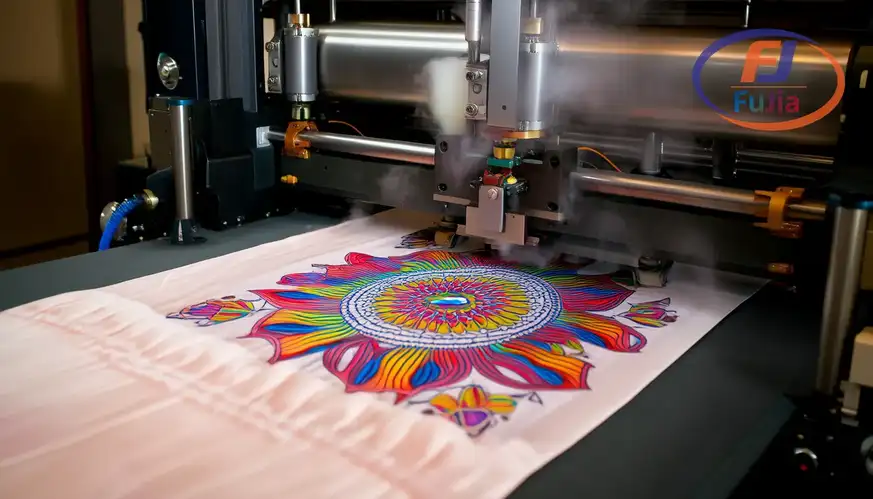
A heat transfer printing machine for fabric is really a pairing: a printer that produces the transfer and a heat press that bonds it to the garment, with complete systems running $300-1,000 for vinyl-and-press, $1,500-4,000 for sublimation, and $3,000-8,000 for DTF, each serving different fabrics and run lengths. Heat transfer remains the most accessible garment-decoration economy because the press is the constant and the transfer method is the choice, and the methods differ by fabric, durability, and per-piece economics. This guide maps the four transfer systems, matches them to fabrics, and prices the setups that go live in a week.
Key Takeaways
- The four systems are DTF ($3,000-8,000), sublimation ($1,500-4,000), heat transfer vinyl with plotter ($300-1,000), and plotted transfers via service.
- DTF prints any fabric with one white-ink workflow, sublimation needs light polyester, vinyl cuts solid colors, and each prices runs differently.
- The heat press is non-negotiable at every tier: 38×38 cm clamshells start at $200-400, and swing-away models serve thicker goods.
- Per-piece economics split by run length: vinyl wins single-color one-offs, DTF wins full-color mixed runs, sublimation wins polyester volume.
- We recommend DTF as the default full-color system and sublimation where the product list is poly-based.
The Four Transfer Systems and What Each Costs
| System | Hardware cost | Fabrics | Per-piece economics |
|---|---|---|---|
| DTF | $3,000-8,000 | any fabric, any color | $0.50-1.50, full color |
| sublimation | $1,500-4,000 | light polyester | $0.30-1.00, all-over |
| HTV vinyl + plotter | $300-1,000 | cotton, blends | $1-3, solid colors |
| plotted service transfers | press only, $200-400 | any fabric | $1-4 per transfer |
The system table is the market’s shape, and each row is a different answer to the same question: how does color get onto fabric under heat. DTF prints full color with white underlay onto film that presses onto any fabric, which is why it has become the default full-color system. Sublimation dyes polyester itself for the softest hand and all-over coverage, at the cost of its light-poly substrate requirement. HTV vinyl cuts solid-color shapes that press one at a time, remaining the single-color one-off champion, and plotted service transfers outsource the printing while keeping the press, per the system-split logic our DTF printers guides document across garment work.
The pairing rule is the guide’s first lesson: the printer without the press prints nothing wearable, and the press without a transfer source sits idle, so every budget below is a pairing budget rather than a machine price. Buyers who already own a serviceable press subtract it from every row, which is why vinyl-plus-press remains the true $300 entry into garment decoration.
Matching the System to the Fabric and Run
| Job profile | Best system | Why |
|---|---|---|
| full-color tees, mixed designs | DTF | one workflow, any color shirt |
| polyester sportswear, all-over | sublimation | dyes the fabric itself |
| names and numbers, single color | HTV vinyl | no printing, pure cutting |
| occasional full-color one-offs | service transfers | no hardware beyond press |
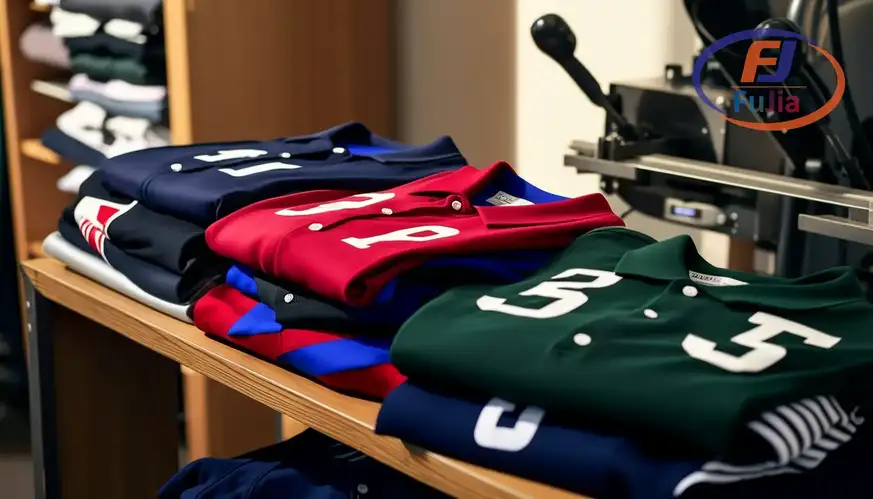
The matching table routes jobs by fabric and run, and the rows coexist inside one working shop: a decorator pressing DTF tees at noon, sublimating team jerseys at two, and cutting HTV names at four is running the standard mixed shop, not an exception. DTF’s fabric freedom earns the default slot because dark cotton, poly blends, and performance fabrics all press identically, while sublimation’s substrate limit is also its quality ceiling, dyeing rather than layering for the hand feel athletics demand. Vinyl’s economics invert the printing logic, costing a cut rather than a print, so single-color names remain its unchallenged territory, and the same run-length partition our printing price guides document across processes governs the routing here.
Fabric content is the routing variable that surprises digital-native buyers: cotton accepts DTF and HTV but starves sublimation, polyester starves under DTG’s water-based inks but sings under sublimation and DTF, and blends follow the binder. We recommend keeping one test garment of every fabric the shop sells and pressing each new transfer system onto it before quoting, because the fabric’s answer is the quote’s foundation, per the substrate-first logic our apparel guides apply across every process.
The Heat Press: The Constant at Every Tier
| Press spec | Entry level | Production level |
|---|---|---|
| platen | 38×38 cm clamshell | 40×60 cm swing-away |
| price | $200-400 | $600-1,500 |
| pressure control | basic knob | digital, repeatable |
| extras | none | drawer, double station |
The press table prices the constant, and the spec that matters is pressure repeatability, because every transfer system’s wash durability depends on pressing at spec, and a knob that drifts between shirts produces wash results that drift with it. Clamshell presses serve flat garments at entry budgets, swing-away models clear the platen for thicker goods like hoodies and Victoriana-style seams, and production shops graduate to double-station presses where one operator loads while the other station presses. The press is also the cheapest insurance in the chain, and a $20 surface thermometer verifying platen temperature settles curing arguments the way it does in every heat process our guides document.
Here’s the thing about curing specs: they differ by system and belong on the wall rather than in memory, DTF presses at roughly 160 °C for 15 seconds, sublimation at 190-200 °C for 40-60 seconds, and HTV at 150 °C for 10-15 seconds, and the mixed shop that labels its settings per system avoids the cross-contamination that ruins a batch. We recommend writing the settings at the press, because the operator changing systems mid-run is the standard failure mode, and the same settings-discipline our press guides apply to every heat process applies here.
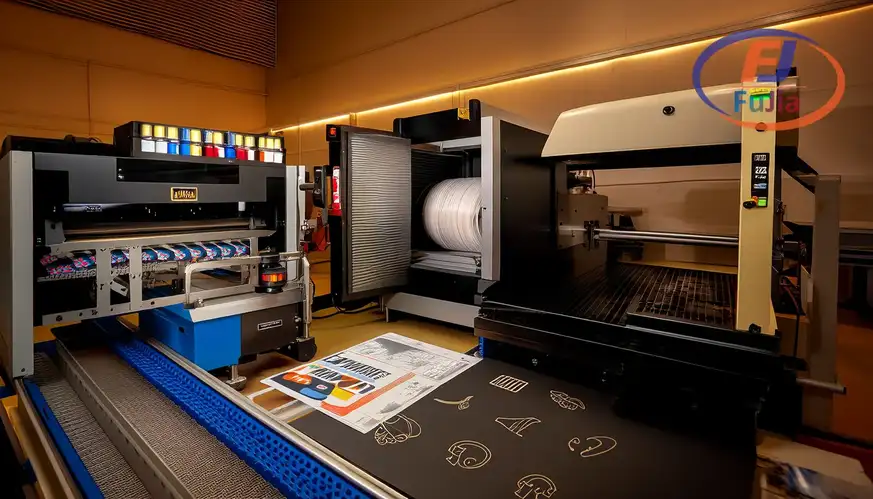
The three systems running side by side in one mixed shop:
The Shop Math From Setup to Steady
| Line | vinyl start | DTF shop | mixed shop |
|---|---|---|---|
| hardware | $300-1,000 | $3,000-8,000 | $6,000-12,000 |
| per-piece cost | $1-3 | $0.50-1.50 | by route |
| retail per piece | $15-25 | $20-30 | $18-30 |
| monthly break-even | 20-50 pieces | 150-400 pieces | 100-300 pieces |
The economics table prices three entry strategies, and the vinyl column is the proof that garment decoration has a genuine $300 door: names, numbers, and single-color logos on a plotter-and-press setup break even inside 20-50 pieces, which is why school-sport and workwear niches launch there. The DTF column buys the full-color market at a $3,000-8,000 entry and repays inside 150-400 pieces, and the mixed shop runs both plus sublimation against the widest order book. Per-piece margins of $12-25 carry every configuration, and the binding constraint is always orders rather than capacity, which is the same demand-first arithmetic our printer guides apply at every tier.
Financing at the entry tiers is often unnecessary, which is the category’s quiet advantage: the vinyl setup is a cash purchase, and the DTF shop clears $3,000-8,000 inside a season of steady orders. Growth compounds from retained margin rather than from borrowed capacity, and the shops that reinvest that margin into a second press or a shaker-and-dryer line scale without debt, per the bootstrap patterns our startup cases document.
What kind of printer do you need to print heat transfers?
Heat transfers print on three machine types by system: DTF printers at $3,000-8,000 print full-color transfers with white underlay onto PET film for any fabric, sublimation printers at $1,500-4,000 print onto transfer paper for light polyester, and vinyl cutters at $300-500 cut solid-color HTV with no printing at all. Every system pairs with a heat press at $200-400 entry that bonds the transfer to the garment. The fabric and design decide the system: full color on any fabric routes to DTF, polyester all-over routes to sublimation, and single-color names route to vinyl. The pairing, printer plus press, is the actual machine.
How much does a heat transfer printer cost?
A heat transfer printer costs $3,000-8,000 as a DTF system, $1,500-4,000 as a sublimation setup, and $300-1,000 as an HTV vinyl cutter with plotter, with heat presses adding $200-400 at entry and $600-1,500 at production spec. Per-piece transfer costs run $0.30-1.50 by system, and complete setups break even inside 20-400 pieces depending on tier. The vinyl route is the genuine $300 entry into garment decoration, DTF is the default full-color system, and sublimation serves the polyester market its substrate requires. Price the pairing, never the printer alone.
What are the downsides of heat transfer printing?
Heat transfer printing’s downsides concentrate in four areas: the transfer sits on the fabric rather than in it, so hand feel is firmer than dye-based processes and washing requires care; DTF and vinyl layers can crack at high heat over years; sublimation is locked to light polyester substrates; and production speed is one press cycle per piece, which caps throughput below screen printing at volume. Durability of 30-50 washes across the systems is honest rather than weak, and the process’s fabric freedom and per-piece economics outweigh the limits for short and medium runs. The downsides are real, and screen printing’s setup costs are realer below 50 pieces, per the run-length partition our apparel guides document.
Is a heat transfer printing business profitable?
The profitable niche in one view:
A heat transfer printing business is profitable at small scale because its entry price is genuinely small: a $300 vinyl setup breaks even inside 20-50 pieces, and a $3,000-8,000 DTF shop clears hardware inside 150-400 pieces at $12-25 per-piece margins. Profitability concentrates in niches with repeat demand, school sports, workwear, event merch, where orders recur and the shop’s design library compounds. Capacity caps at press cycles, which is the ceiling that volume eventually hits, and the growth path adds presses or graduates to DTF production lines. In our experience the business fails from absent orders rather than from economics, and the niche-first launch is the honest path.
Verdict
The heat transfer printing machine market for fabric is a pairing economy: DTF at $3,000-8,000 for full color on any fabric, sublimation at $1,500-4,000 for polyester, HTV vinyl at $300-1,000 for single-color one-offs, and the heat press that every system shares at $200-1,500 by spec. Match the system to fabric and run length, press at spec with a verified thermometer, and let per-piece margins of $12-25 carry a setup that breaks even inside a season. Heat transfer remains the most accessible door into garment decoration, and the pairing math is why. To test DTF transfers against your own fabrics before choosing a system, contact Fujia Print with your garment list.
Sources
- Wikipedia: Heat transfer printing: process overview.
- Wikipedia: Dye-sublimation printing: polyester chemistry.
- AATCC: wash durability standards.
- Fujia Print apparel cases: transfer production examples.
