

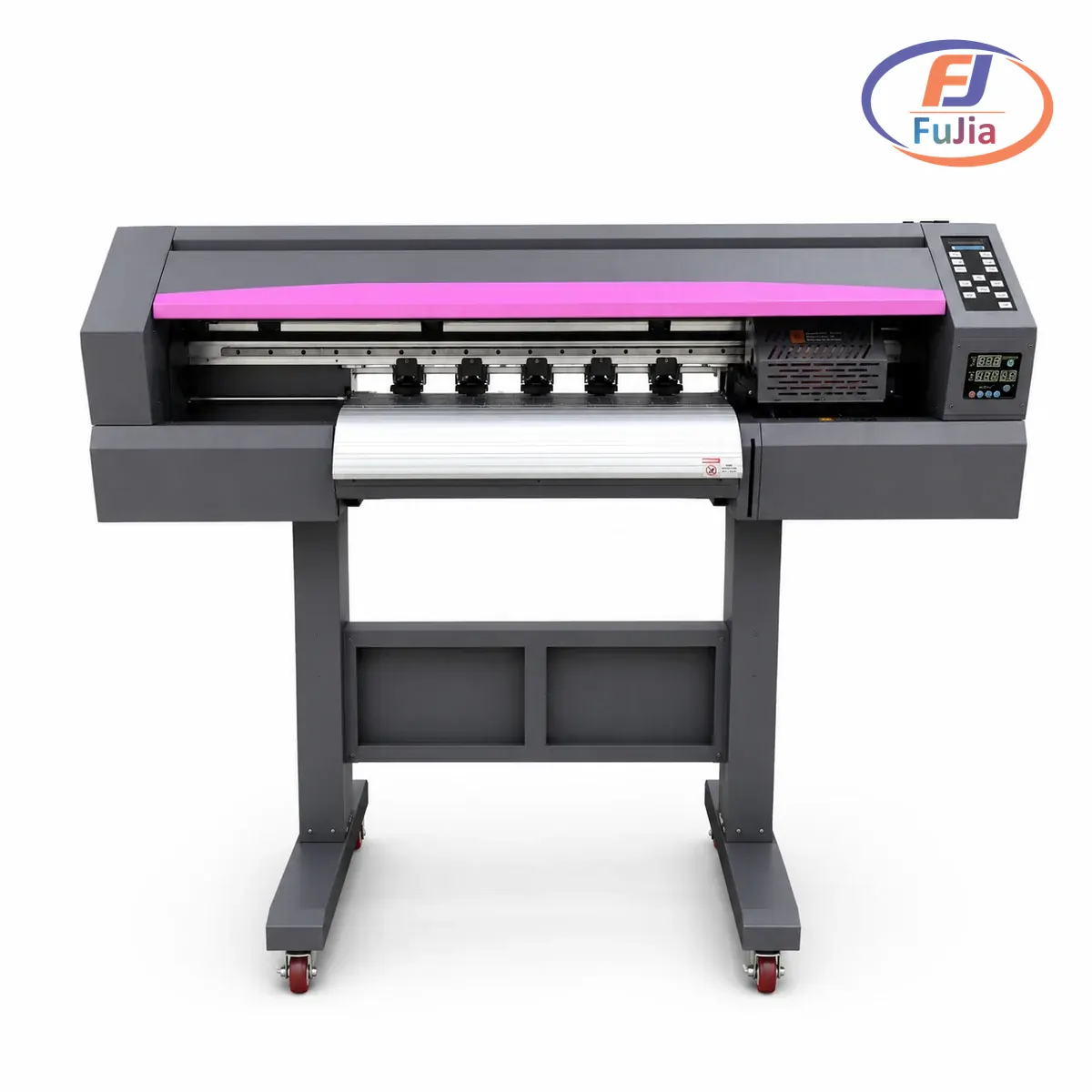
The Epson SureColor G6070 is Epson’s first purpose-built wide-format DTF printer, listed at $14,995 MSRP and selling at $13,495 street after a $1,500 instant rebate at major US dealers. This review covers what the 35.4-inch platform engineers into that price, the ink cost math no dealer page publishes, and how it stacks against factory-direct machines, because Epson selling the whole machine, not just the heads inside it, changes the buying conversation.
Key Takeaways
- The G6070 lists at $14,995 MSRP with a $13,495 street price at USCutter and Lawson after a $1,500 instant rebate, and it is the first Epson DTF printer engineered as one, not converted from an office platform.
- Print width is 35.4 inches on a single roll, roughly 50% more design area per linear foot than the 24-inch class, with output up to 2,000 left-chest logos per hour by dealer math.
- Six ink channels run CMYK plus White plus Mild Lavender in 1.6-liter sealed UltraChrome DF packs, and the ML channel exists to hold photo-gray gradients, not to sell more ink.
- Reliability engineering is the real product: Nozzle Verification Technology detects and cleans clogs without media, a fabric wiper cleans the head, and white ink circulation prevents sedimentation, which is why Epson backs it with a 1-year next-business-day on-site warranty.
- Buyers comparing a $13,495 one-head machine against factory-direct multi-head platforms should price ink per liter and heads per dollar before signing, because both numbers change the math faster than brand preference.
What the G6070 Actually Is
Epson occupies a strange position in DTF: it sells the PrecisionCore printheads inside most competing machines, and the G6070 is its answer to the category those heads created. The platform is a single PrecisionCore Micro TFP head with Nozzle Verification Technology, front-loading roll media from 10 to 35.4 inches wide, and a sealed ink-pack system rather than bottles or tanks. That architecture places it against the converted-Epson fleet, Mimaki’s TxF series, and Chinese multi-head production machines all at once, which is why dealer pages compare it to everything and clarify nothing.
The honest truth about this positioning: Epson is competing against its own component business. A factory-direct machine running two or four i3200 heads prints wider and faster for less money, but it does so on Epson silicon anyway, so the real comparison is integration versus assembly, and both sides of that trade deserve scrutiny rather than marketing.
Specifications That Matter
| Spec | G6070 | Why it matters |
|---|---|---|
| Print width | 35.4 in (35.2 printable) | 47% more area per linear foot than 24-inch class |
| Head | PrecisionCore Micro TFP, single | One head = one replacement cost, but one point of failure |
| Resolution | 1,200 x 600 dpi | Standard for the class, matches i3200-based machines |
| Ink | UltraChrome DF, 6Ch (CMYK + Wh + ML) | ML channel holds grayscale gradients in photo work |
| Ink supply | 1.6 L sealed packs per color | No refill mess; higher price per liter than bottles |
| Maintenance | Automated, NVT, fabric wiper, white circulation | Minutes per week, not daily nozzle checks |
| Weight | 295 lb (133 kg) | Needs real floor space and a stand, included |
| Warranty | 1-year, next-business-day on-site (US/CA) | Best-in-class response for the tier |
| Software | Fiery Digital Factory Epson Edition + Edge Print Pro | Included, not a $695 add-on |
The ML channel is the spec everyone lists and nobody explains. Mild Lavender adds a light gray ramp that reduces grain in black-and-white and desaturated photo prints, where CMYK-only builds show texture in skin tones and shadows; on DTF film it matters for photorealistic portraits and photographic merchandise, and it does nothing for spot-color logos. Shops printing left-chest text and simple graphics will never miss it, while photo-heavy sellers get measurably smoother gradients, so the channel is a segment signal rather than a universal upgrade.
Nozzle Verification Technology is the second under-explained spec. Conventional converted machines detect a clog when you print a nozzle check and see the gap, which costs media and operator time; NVT scans nozzle health continuously and fires cleaning cycles without printing anything, and the fabric wiper strips ink residue and lint from the head face on a schedule. Combined with white ink circulation, this is why Epson rates upkeep in minutes per week while converted platforms assume daily discipline, and it is engineering you are paying for whether you value it or not.
Real 2026 Pricing and What Is Included
| Cost item | Figure | Source |
|---|---|---|
| MSRP | $14,995 | Epson list |
| Street price | $13,495 after $1,500 instant rebate | USCutter, Lawson (thru Mar 2026) |
| Included software | Fiery Digital Factory + Epson Edge Print Pro | In box, not licensed separately |
| Stand | Included | USCutter bundle list |
| Shaker/oven | Not included; EP36 or Miro 36 bundles extra | Dealer options |
| Ink | T57S UltraChrome DF packs, 1.6 L per color | Sold separately |
| Gray-market import | ~$8,397 | worldprinthead (non-authorized) |
The bundle logic differs from Mimaki and Crio because Epson separates the printer from the finishing line: $13,495 buys the printer, stand, RIP, and warranty, while powder shaker and oven run extra through DTF Station or HPN bundles, so budget the complete station at roughly $16,000-18,000 rather than the headline figure. The gray-market number deserves a warning rather than a wink: imports at $8,397 carry no US warranty, and Epson’s next-business-day on-site service is the single strongest argument for paying the authorized price, so a buyer who skips it is buying hardware while deleting the support that differentiates the platform.
Ink Cost Math Dealers Do Not Publish
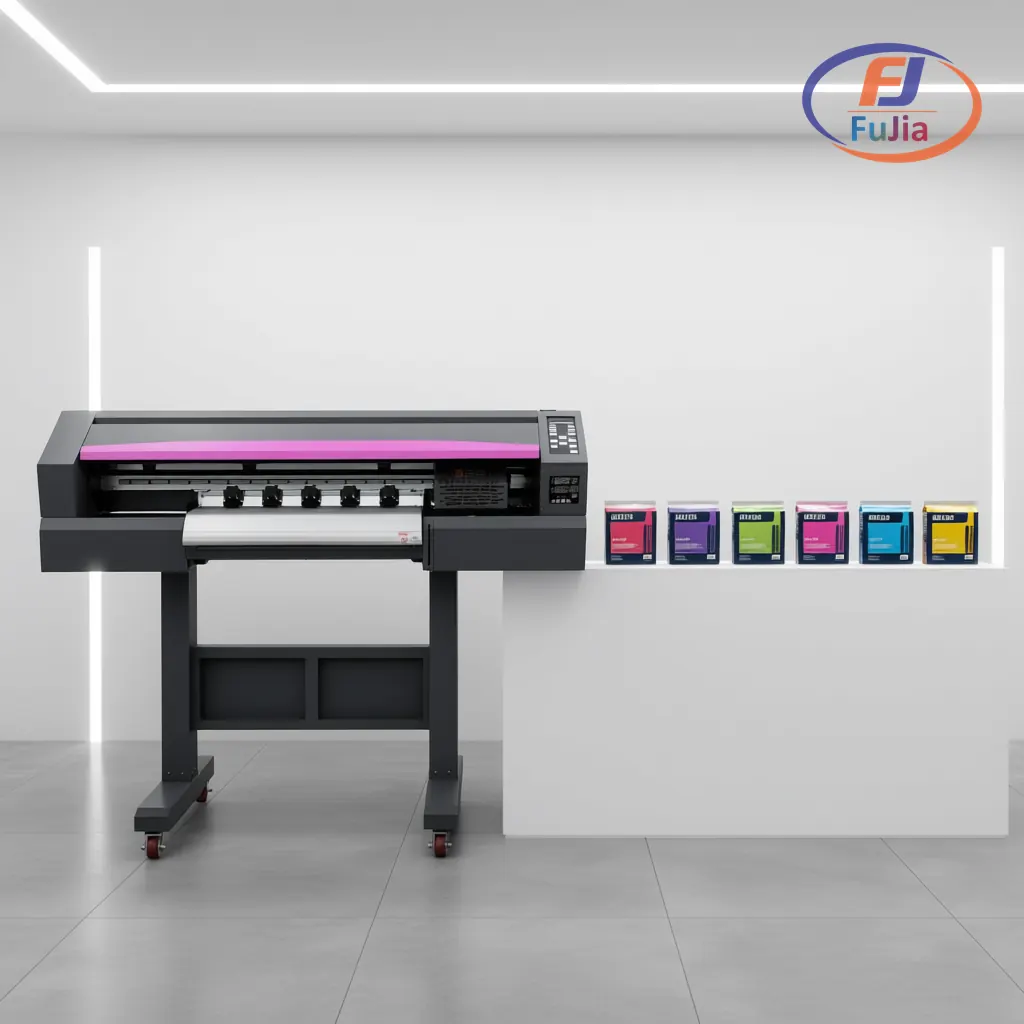
Sealed packs trade convenience for price per liter, and the trade is measurable. At typical UltraChrome DF street pricing around $95-110 per 1.6-liter pack for colors and more for white, ink runs roughly $0.06-0.08 per milliliter, versus $30-45 per liter for bottled CMYK on converted platforms; on a dense full-coverage 35-inch-wide print consuming about 12 ml per square foot, that is roughly $0.75-0.95 in ink per square foot against $0.35-0.50 bottled, a premium of $0.30-0.50 per square foot that compounds quickly at production volume. A shop printing 200 square feet of film daily pays roughly $60-100 more per day for sealed-pack ink, which is $1,300-2,100 monthly, real money that should be set against maintenance hours saved and warranty coverage when comparing total cost of ownership.
The white ink story is where the sealed system earns back part of the premium: white pigment settles fastest and ruins the most hardware, and Epson’s sealed packs with automated circulation eliminate the daily agitation routine that converted machines demand, while the 1.6-liter pack size limits the exposure window of opened white ink that bottle systems suffer. Based on data from our customers across 50+ countries, white ink mismanagement is the single largest cause of first-year printhead deaths on converted machines, and the sealed system is a credible answer to exactly that failure mode.
Who Should Buy the G6070
Volume first: the G6070’s single head and 35-inch width serve a specific band of demand, roughly 200-500 finished pieces daily on gang sheets, where a 24-inch dual-head machine feels tight and a 4-head platform would idle. Photo-heavy work second: the ML channel and 1,200 dpi output reward portrait sellers and photographic merchandise more than text-and-logo shops. Service third: next-business-day on-site coverage is worth real money to solo operators whose downtime is unbilled, and worth little to shops with in-house technical staff. The financing conversation is straightforward at this tier because dealers routinely structure the complete station across 24-48 months; our DTF printer financing guide covers how those numbers work.
Our XP600 vs i3200 printhead comparison explains the component-level trade-offs inside the machines Epson sells heads to, and our HTVRont DTF printer review covers the entry tier below this bracket.
G6070 vs Factory-Direct 35-Inch Class
| Factor | Epson G6070 | Factory-direct 2-4 head (600-800 mm) |
|---|---|---|
| Heads | 1x Micro TFP | 2-4x i3200/XD class |
| Width | 35.4 in | 24-31.5 in typical |
| Rated output | 2,000 left-chest/hr (dealer math) | 8-27 m²/h depending on head count |
| Ink system | 1.6 L sealed packs, 6Ch with ML | Bottles 1-1.5 L, 6Ch CMYK+Wh (+2nd Wh on some) |
| Ink cost per ml | ~$0.06-0.08 | ~$0.03-0.045 |
| Maintenance | Automated, minutes/week | Daily routine, operator discipline |
| Warranty | 1-yr NBD on-site (US/CA) | 2-yr factory with remote video diagnosis, 48-hr parts |
| Complete station | ~$16,000-18,000 | ~$14,000-18,000 with shaker and oven |
The comparison is honest in both directions: Epson sells integration, automation, and a service network that answers the phone with a truck, while factory-direct platforms sell heads per dollar, cheaper ink per milliliter, and dual white channels for shops that print heavy underbase. Most small shops will never need the on-site truck and will feel the ink premium every single day, which is why the G6070’s natural buyer has contract service obligations, photographic work, or a single-operator structure, while volume shops with technical staff should price the factory tier seriously; the factory-direct DTF printers lineup shows what that tier looks like configuration by configuration.
That said, one customer outcome anchors the enterprise angle: a corporate gift distributor we supplied consolidated three suppliers into one after adding in-house transfer capacity, cut minimums from 500 pieces to 50 per design, and doubled order value once short-run personalization shipped in days, and that profile, contract-driven, deadline-bound, brand-accountable, is exactly where paying for integration beats assembling capacity.
Which Epson printer is best for DTF?
For purpose-built DTF, the G6070 is Epson’s only true answer: 35.4 inches, NVT, sealed UltraChrome DF, and on-site warranty. Epson’s desktop EcoTank line converts into budget DTF machines and dominates the sub-$1,000 conversion market, but converted units carry Epson neither officially nor in warranty terms, and print quality depends on the conversion quality rather than Epson’s engineering. Between those poles, Epson’s F-series sublimation printers serve polyester, not DTF film, so the G6070 stands alone in the lineup for serious direct-to-film production. A practical test before deciding: run your top three designs as nozzle-check-heavy photorealistic files and compare output against your current machine, because the NVT and ML channel advantages only show on exactly that kind of work.
What are the disadvantages of using an Epson DTF printer?
Three real ones: sealed-pack ink costs roughly 60-100% more per milliliter than bottled supply, the single head is both simpler and a single point of failure where a two-head factory machine keeps printing degraded after one head fails, and the 35-inch width, while wider than 24-inch platforms, trails the 800-millimeter Chinese production machines for all-over prints. Add the finishing gap: shaker and oven are extra, so the complete station lands near $16,000-18,000, and the 1-year warranty, though excellent, is shorter than the 2-year factory warranties common on imported machines. None of these are hidden costs, and none disqualify the machine, but a buyer who writes them into the comparison spreadsheet before purchase will never feel surprised by ownership.
Can an Epson printer be used for DTF printing?
Yes in two senses. Converted EcoTank desktops print DTF film at hobby-to-entry volume, which is how the conversion market exists, and the G6070 is Epson’s official purpose-built entry that carries warranty, support, and certified ink. The middle ground, converting professional Epson machines like the F-series, is technically possible and practically a dead end, because those platforms’ warranties void on non-OEM ink and their heads cost more than entry DTF printers; buyers should choose the conversion route for learning cheaply or the G6070 for production, and skip converting expensive intermediate hardware.
What is the best DTF printer brand?
No single brand wins because the category divides by volume and support needs: Epson leads on integration and service infrastructure, Mimaki on industrial build and certified ink heritage, and factory-direct manufacturers on capacity per dollar with 4-head 27 m²/h platforms under $10,000. The honest ranking question is not brand but duty cycle: under 50 prints weekly favors entry platforms, 200-500 daily favors single-head integrated machines like the G6070, and multi-shift production favors multi-head factory platforms, so buyers should map their last 30 days of orders to a volume band first and only then compare badges within it.
Verdict
The G6070 is the most credible purpose-built DTF machine from a major brand, and its price is rational for what it integrates: NVT reliability engineering, sealed six-channel ink with a genuinely useful photo channel, and the only next-business-day on-site network in the category. The costs are equally rational: a 60-100% ink premium per milliliter, a single-head architecture that trades redundancy for simplicity, and finishing hardware sold separately. Buyers should price 12 months of ink, their true weekly volume, and the value of a service truck before choosing between integration and capacity per dollar, because at this tier both are legitimate answers to different businesses; to run those numbers against factory-direct configurations, contact Fujia Print for a same-file comparison print and a line-by-line quote.
Sources
- Epson SureColor G6070 official product page: specifications, ink configuration, warranty terms.
- USCutter G6070 listing: $13,495 street price with $1,500 instant rebate, bundle contents.
- Lawson Screen & Digital G6070 page: throughput claims, NVT and maintenance system details.
- OEKO-TEX ECO PASSPORT: certification standard behind UltraChrome DF ink safety claims.
- Wikipedia: Epson: company background and PrecisionCore heritage.
