

DTF printing works on cotton, polyester, blends, nylon, and dark garments with 50-100 wash cycle durability, while sublimation bonds dye permanently into polyester fibers for 100+ wash cycles but cannot work on cotton or dark fabrics. DTF uses a TPU adhesive layer on the fabric surface; sublimation converts solid dye to gas that infuses into polyester at 190-200°C. Fujia Print manufactures both DTF printers and sublimation printers for apparel businesses across 50+ countries.
Key Takeaways
- DTF works on all fabrics (cotton, polyester, blends, nylon, dark colors); sublimation works only on polyester (100% or 85%+) and light colors.
- Sublimation achieves 100+ wash cycles with zero fading because dye is embedded in the fiber; DTF achieves 50-100 washes (Grade 4.5) with surface adhesive.
- DTF per-print cost: USD 0.60-1.00; sublimation per-print cost: USD 0.20-0.40 (cheaper consumables but requires polyester blanks).
- DTF requires 150-160°C for 12-15 seconds; sublimation requires 190-200°C for 45-60 seconds.
- DTF startup cost: USD 2,000-5,000; sublimation startup cost: USD 500-1,500.
How Each Method Works
DTF: Surface Adhesive Transfer
DTF printing deposits CMYK ink plus a white underbase onto PET film, applies thermoplastic polyurethane (TPU) adhesive powder to the wet ink, cures at 110-130°C, and transfers to fabric using a heat press at 150-160°C. The result is a thin, flexible adhesive layer (0.03-0.05mm) that bonds to fabric surfaces through mechanical adhesion. Because the white ink underbase provides opacity, DTF produces vivid prints on dark garments of any fabric type.
Research by Zhu et al. (2025) in the International Journal of Adhesion and Adhesives (Vol. 139) demonstrates that TPU nanocomposites enhanced with TiO2 and TGIC crosslinkers achieve 30-45% higher adhesion strength, extending DTF wash durability from 50 washes toward 80-100 washes when using enhanced adhesive formulations.
Sublimation: Gas-Phase Dye Infusion
Sublimation printing uses disperse dyes that undergo solid-to-gas phase transition at 190-200°C. The gas-phase dye molecules penetrate polyester fiber surfaces and diffuse 5-10 micrometers into the polymer matrix, becoming permanently locked within the fiber structure as the fabric cools. No physical layer exists on the surface, which is why sublimation prints have zero hand feel and cannot crack, peel, or fade regardless of wash count.
Direct Comparison Table
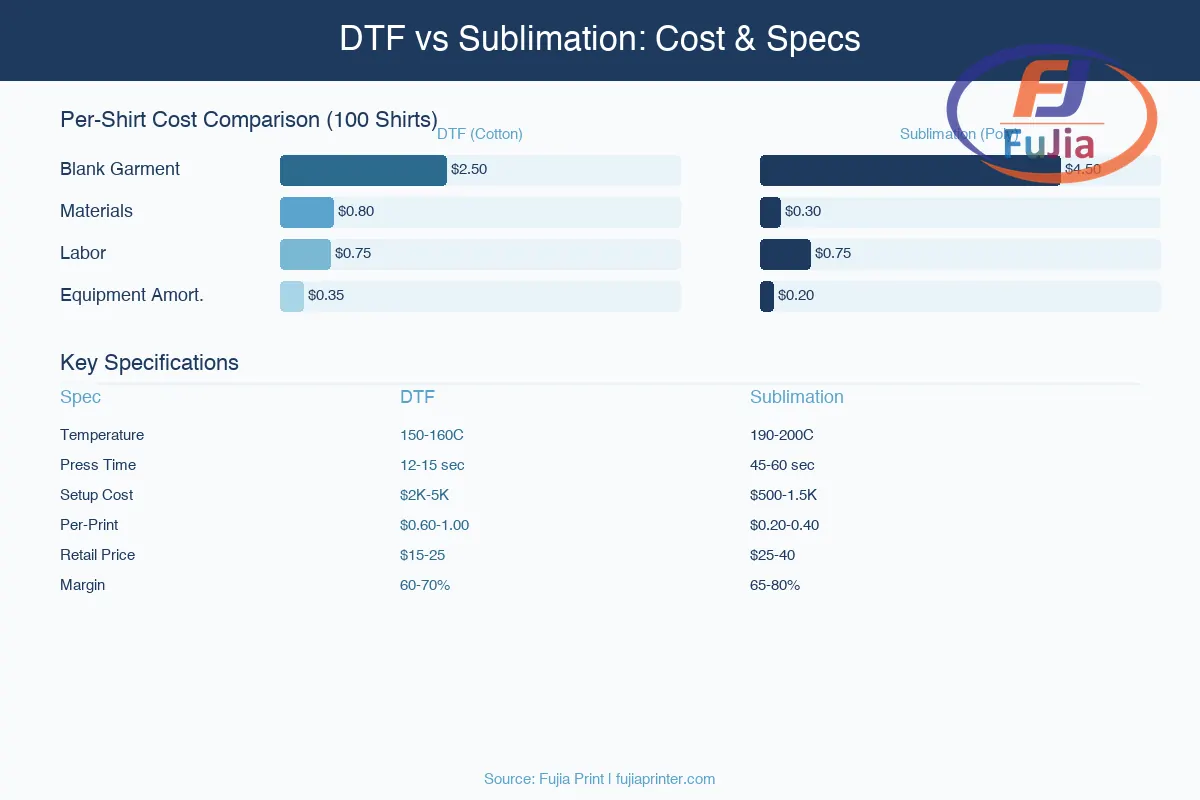
| Feature | DTF | Sublimation |
|---|---|---|
| Fabric compatibility | All fabrics (cotton, poly, blends, nylon) | Polyester only (100% or 85%+) |
| Dark garment printing | Yes (white underbase) | No (transparent ink) |
| Bonding mechanism | TPU adhesive on surface | Gas-phase dye inside fiber |
| Wash durability | 50-100 cycles (Grade 4.5) | 100+ cycles (no degradation) |
| Hand feel | Soft, thin film (noticeable) | Zero (dye inside fiber) |
| Breathability | Slightly reduced | Unaffected |
| Temperature | 150-160°C | 190-200°C |
| Press time | 12-15 seconds | 45-60 seconds |
| Per-print cost (materials) | USD 0.60-1.00 | USD 0.20-0.40 |
| Blank garment cost | USD 1.50-4.00 (cotton) | USD 3.00-6.00 (polyester) |
| Color vibrancy | Very good on all fabrics | Excellent on polyester, invisible on cotton |
| Setup cost | USD 2,000-5,000 | USD 500-1,500 |
| Best for | Cotton apparel, mixed fabrics, dark garments | Performance wear, all-over prints, hard goods |
Wash Durability: AATCC TM61 Test Results
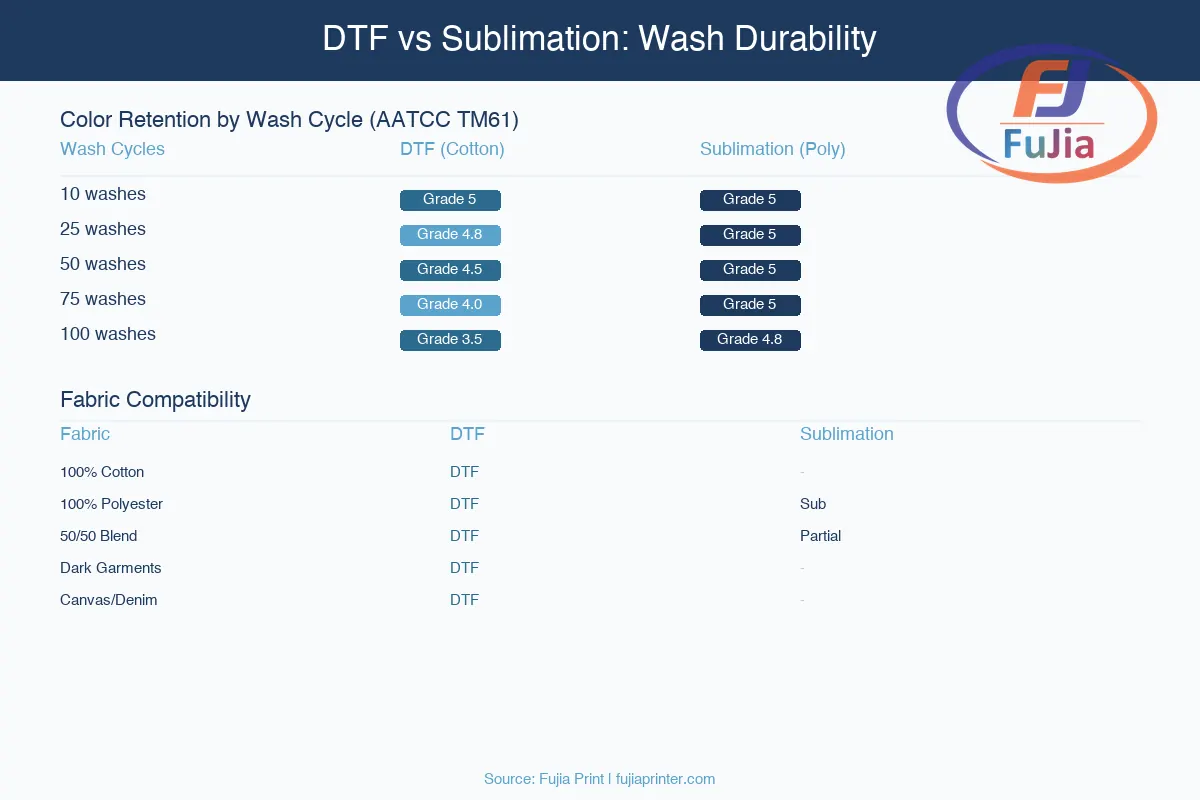
Accelerated wash testing per AATCC TM61 (2023) at 49°C for 45 minutes with steel balls produces measurable differences:
| Wash Cycles | DTF (Cotton) | Sublimation (Polyester) |
|---|---|---|
| 10 washes | Grade 5, no change | Grade 5, no change |
| 25 washes | Grade 4.8, minimal fading | Grade 5, no change |
| 50 washes | Grade 4.5, 8-12% color change | Grade 5, no change |
| 75 washes | Grade 4.0, 12-18% color change | Grade 5, no change |
| 100 washes | Grade 3.5, visible fading | Grade 4.8, minimal change |
Sublimation’s permanence comes from the dye being physically trapped inside the polyester fiber matrix. DTF adhesive degrades gradually because repeated washing flexes the adhesive film, causing micro-fractures that slowly reduce bond strength. The DTF market, growing at a 6.0% CAGR according to Grand View Research, is driven by adhesive chemistry improvements that narrow this durability gap.
Fabric Compatibility: The Deciding Factor
Fabric type is often the single factor that determines which method to use. Sublimation requires polyester because disperse dyes can only bond with synthetic polymer chains that have ester groups. Cotton, being cellulosic, lacks these ester groups and cannot accept sublimation dye.
| Fabric Type | DTF | Sublimation | Recommended |
|---|---|---|---|
| 100% Cotton | Yes (Grade 4.5) | No | DTF |
| 100% Polyester | Yes (Grade 4.0) | Yes (Grade 5, permanent) | Sublimation |
| 50/50 Cotton-Poly Blend | Yes (Grade 4.2) | Partial (faded, 60-70% intensity) | DTF |
| Nylon | Yes (Grade 4.0) | Yes (light colors only) | DTF or Sublimation |
| Dark garments | Yes (white underbase) | No (transparent ink) | DTF |
| Canvas/denim | Yes (Grade 4.3) | No | DTF |
| Leather | Yes (Grade 3.8) | No | DTF |
Cost Analysis: 100 Custom Shirts
The global custom t-shirt market is projected to grow from USD 5.82 billion in 2025 to USD 17.22 billion by 2034 at a 12.81% CAGR, according to Fortune Business Insights. Within this market, DTF and sublimation serve different cost structures.
| Cost Component | DTF (Cotton) | Sublimation (Polyester) |
|---|---|---|
| Blank garment | USD 1.50-3.50 | USD 3.00-6.00 |
| Transfer materials per shirt | USD 0.60-1.00 | USD 0.20-0.40 |
| Labor per shirt | USD 0.50-1.00 | USD 0.50-1.00 |
| Equipment amortization | USD 0.20-0.50 | USD 0.10-0.30 |
| Total per shirt | USD 2.80-6.00 | USD 3.80-7.70 |
| Retail price | USD 15-25 | USD 25-40 |
| Margin | 60-70% | 65-80% |
Sublimation has lower material costs per print but requires more expensive polyester blanks. DTF has higher material costs but cheaper cotton blanks. The total per-shirt cost is comparable, but sublimation commands higher retail prices on performance wear.
When DTF Is the Better Choice
You Print on Cotton
If your primary product is cotton t-shirts, hoodies, or canvas items, DTF is the only viable digital transfer method. Sublimation simply does not work on cotton. For detailed DTF per-shirt cost analysis, see our DTF printing cost breakdown.
You Print on Dark Garments
DTF’s white ink underbase provides full opacity on black, navy, and other dark fabrics. Sublimation ink is transparent and invisible on dark colors. For dark apparel decoration, DTF and HTV are the only digital options.
You Need Fabric Versatility
A single DTF printer handles cotton, polyester, blends, nylon, and leather without changing inks or setup. Sublimation locks you into polyester-only production. For print shops serving diverse customer needs, DTF eliminates the need for multiple printing systems.
You Produce Mixed-Fabric Orders
Sports teams, corporate clients, and schools often order mixed products: cotton t-shirts for staff, polyester jerseys for players, canvas tote bags for events. DTF handles all of these with one workflow.
When Sublimation Is the Better Choice
You Specialize in Polyester Performance Wear
For soccer jerseys, running shirts, swimwear, and compression gear, sublimation is the industry standard. The zero-hand-feel print does not interfere with moisture wicking or breathability, and the permanent dye ensures team logos and sponsor graphics last the entire garment lifespan.
You Need All-Over Prints
Sublimation enables edge-to-edge, full-coverage designs on polyester garments because the fabric is printed before cutting and sewing. This is impossible with DTF or HTV, which apply designs to finished garments in the size of the heat press.
You Make Hard Goods
Sublimation works on ceramic mugs, metal tumblers, phone cases, coasters, and any item with a polyester coating. The dye bonds permanently with the coating at 190-200°C, creating a scratch-resistant finish that outlasts any adhesive-based transfer. DTF cannot match this on hard surfaces.
Can You Use Both Methods?
Many successful print shops operate both DTF and sublimation systems, using each for its strengths: DTF for cotton and dark garments, sublimation for polyester and hard goods. This dual-system approach requires higher initial investment but expands the product catalog to cover virtually any custom apparel or promotional item request.
The key consideration is volume: if cotton orders represent more than 60% of your business, invest in DTF first. If polyester performance wear represents more than 60%, invest in sublimation first. Add the second system when demand justifies the investment.
Which is better: DTF or sublimation?
Neither DTF nor sublimation is universally better; the choice depends on your fabric type and product mix. DTF is better for cotton garments, dark fabrics, mixed-fabric orders, and shops needing maximum versatility from a single printer. Sublimation is better for polyester performance wear, all-over prints, ceramic mugs, and applications requiring permanent prints with zero hand feel. For wash durability on polyester, sublimation is superior (100+ washes, no degradation). For fabric versatility and dark garment printing, DTF is the clear choice (Grade 4.5 on cotton, works on any color). Many businesses use both methods to cover their entire product range. The global DTF market growing at 6.0% CAGR and the custom apparel market growing at 12.81% CAGR indicate strong demand for both technologies.
Can you use sublimation ink in a DTF printer?
No, you cannot use sublimation ink in a DTF printer or DTF ink in a sublimation printer. The two systems use fundamentally different ink chemistries designed for different transfer mechanisms. DTF ink is water-based pigment ink that bonds with TPU adhesive powder at 110-130°C curing temperature. Sublimation ink contains disperse dyes that sublimate into gas at 190-200°C and bond with polyester fibers. Mixing these inks will clog printheads, produce unusable prints, and potentially damage the printer permanently. Each system requires its own dedicated printer, ink, and transfer media (PET film for DTF, sublimation paper for sublimation). Fujia Print offers dedicated DTF and sublimation printer models, each engineered for its specific ink chemistry and transfer process.
Is DTF cheaper than sublimation?
DTF has higher per-print material costs (USD 0.60-1.00 for film, powder, and ink) compared to sublimation (USD 0.20-0.40 for paper and ink). However, DTF works on cheaper cotton blanks (USD 1.50-3.50) while sublimation requires more expensive polyester blanks (USD 3.00-6.00). The total per-shirt cost is comparable: DTF at USD 2.80-6.00 vs sublimation at USD 3.80-7.70. DTF startup cost (USD 2,000-5,000 for printer plus shaker) is higher than sublimation startup (USD 500-1,500 for converted printer plus heat press). For profitability, sublimation commands higher retail prices (USD 25-40 for performance wear vs USD 15-25 for cotton tees) with margins of 65-80% vs DTF’s 60-70%. The most cost-effective choice depends on your product mix and target market pricing.
Does DTF last as long as sublimation?
No, DTF does not last as long as sublimation on polyester, but both methods are considered highly durable. Sublimation prints on polyester show no degradation after 100+ wash cycles because the dye is permanently embedded in the fiber. DTF prints achieve Grade 4.5 in AATCC TM61 testing after 50 washes (8-12% color change) and typically last 50-100 wash cycles before visible fading becomes significant. On cotton, DTF is the most durable digital transfer method available, as sublimation cannot bond to cotton at all. For applications where maximum longevity is critical (team uniforms, premium athletic wear), sublimation on polyester is the gold standard. For cotton apparel where versatility matters more than 100+ wash permanence, DTF provides excellent durability that meets or exceeds customer expectations.
Conclusion
DTF and sublimation are complementary technologies that serve different segments of custom apparel production. For integrated DTF and sublimation printing systems, explore the Fujia printer lineup or discover our apparel printing solutions.
Sources
- Zhu et al. (2025): TPU Nanocomposites for Transfer Printing: Research on TiO2 and TGIC crosslinker-enhanced TPU adhesive improving DTF wash durability, published in International Journal of Adhesion and Adhesives, Vol. 139.
- Fortune Business Insights: Custom T-Shirt Printing Market, 2026-2034: Market size USD 5.82B (2025) to USD 17.22B (2034) at 12.81% CAGR, with DTF and sublimation serving different segments.
- Grand View Research: Direct To Film Printing Market, 2025-2030: DTF market at 6.0% CAGR, driven by adhesive chemistry improvements expanding durability.
- AATCC TM61 (2023): Colorfastness to Laundering: Accelerated laundering standard for comparative wash durability testing.
- AATCC TM135: Dimensional Changes After Home Laundering: Fabric dimensional stability standard relevant to print quality assessment.
