

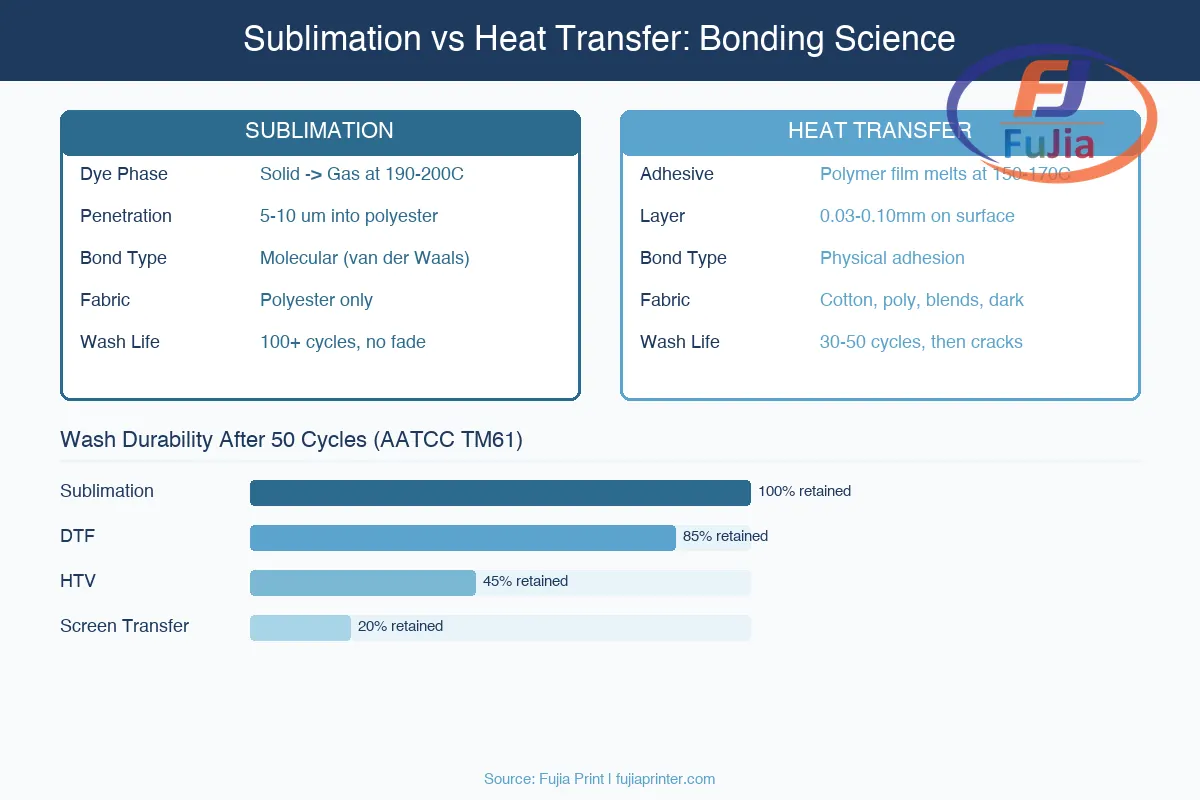
Sublimation printing chemically bonds disperse dyes into polyester fibers at 190-200°C, producing prints that withstand 100+ wash cycles with zero cracking or fading. Heat transfer printing applies an adhesive polymer film to fabric surfaces at 150-170°C, working on cotton, polyester, blends, and dark garments but degrading after 30-50 washes. Fujia Print manufactures both DTF printers and sublimation printers for apparel businesses across 50+ countries.
Key Takeaways
- Sublimation produces permanent prints rated for 100+ wash cycles on polyester; heat transfer lasts 30-50 washes before visible cracking.
- Sublimation requires 100% polyester or poly-coated substrates; heat transfer works on cotton, polyester, blends, nylon, and dark fabrics.
- Sublimation ink is transparent and cannot print on dark garments; heat transfer creates an opaque layer visible on any color.
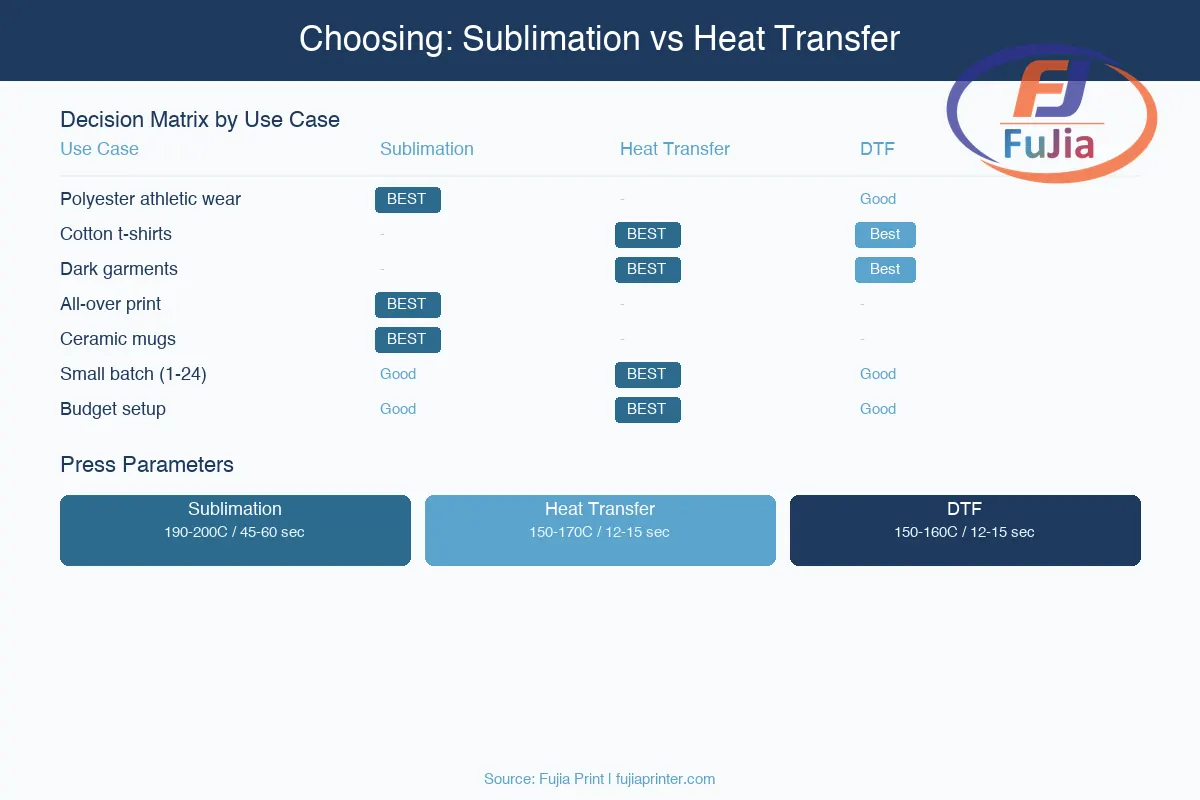
- Sublimation temperature: 190-200°C for 45-60 seconds; heat transfer temperature: 150-170°C for 12-15 seconds.
- Heat transfer wins on versatility (any fabric, any color); sublimation wins on durability, breathability, and color vibrancy on polyester.
The Science: How Each Method Bonds to Fabric
Sublimation: Gas-Phase Dye Infusion
Sublimation printing uses disperse dyes that undergo solid-to-gas phase transition at 190-200°C. When heat and pressure are applied, the dye molecules vaporize and penetrate polyester fiber surfaces, diffusing 5-10 micrometers into the polymer matrix. As the fabric cools, the gas molecules solidify within the fiber structure, becoming a permanent part of the material. No physical layer exists on the fabric surface, which is why sublimation prints have zero hand feel and cannot crack, peel, or fade.
This molecular integration means the print breathes with the fabric, making sublimation the standard for performance athletic wear where moisture wicking and air permeability are critical. The dye bonds with polyester polymer chains through van der Waals forces and diffusion entrapment within the fiber’s amorphous regions.
Heat Transfer: Adhesive Film Bonding
Heat transfer printing (including HTV vinyl and transfer paper) uses an adhesive polymer layer that melts at 150-170°C and bonds to the fabric surface through physical adhesion. The transfer creates a thin film layer (0.03-0.10mm thick) that sits on top of the fabric, held in place by the adhesive’s grip on fiber surfaces. This surface-layer approach means the print can eventually crack, peel, or separate from the fabric under repeated washing and stretching.
Research on thermoplastic polyurethane (TPU) adhesive chemistry by Zhu et al. (2025), published in the International Journal of Adhesion and Adhesives (Vol. 139), demonstrates that TPU nanocomposites enhanced with TiO2 and TGIC crosslinkers achieve 30-45% higher adhesion strength on fabric surfaces. This advancement directly extends the wash durability of heat transfer prints from 30-50 washes toward 50-80 washes when using enhanced adhesive formulations.
Side-by-Side Comparison
| Feature | Sublimation | Heat Transfer (HTV/Paper) | DTF |
|---|---|---|---|
| Bonding mechanism | Gas-phase dye infusion into fiber | Adhesive film on surface | TPU adhesive on surface |
| Fabric compatibility | Polyester only (100% or 85%+) | Cotton, poly, blends, nylon | Cotton, poly, blends, nylon |
| Dark garment printing | No (ink is transparent) | Yes (opaque layer) | Yes (white underbase) |
| Wash durability | 100+ cycles, no degradation | 30-50 cycles, then cracking | 50-100 cycles, Grade 4.5 |
| Hand feel | Zero (dye inside fiber) | Noticeable film layer | Soft, thin film |
| Breathability | Unaffected | Reduced by film layer | Slightly reduced |
| Temperature | 190-200°C | 150-170°C | 150-160°C |
| Press time | 45-60 seconds | 12-15 seconds | 12-15 seconds |
| Color vibrancy | Excellent on polyester | Good | Very good |
| Setup cost | USD 0 | USD 0 (HTV) / USD 0 (paper) | USD 0 |
| Per-print cost | USD 0.50-1.50 | USD 0.30-1.00 | USD 0.30-1.50 |
| Best volume | 25+ pieces | 1-200 pieces | 1-500 pieces |
Durability Testing: What Happens After 50 Washes
Accelerated wash testing according to AATCC TM61 (2023) reveals dramatic differences after 50 wash cycles at 49°C:
| Method | Visual Condition | Hand Feel | Structural Integrity |
|---|---|---|---|
| Sublimation (polyester) | No change, colors identical | Unchanged | Zero degradation |
| DTF | Slight fading (8-12% delta E) | Slightly stiff | Good, Grade 4.5 |
| HTV (heat transfer vinyl) | Visible cracking at stress points | Rubber texture more pronounced | Functional but degraded |
| Screen print transfer | Flaking and peeling | Thick, plastic layer separating | Failed, unusable |
Sublimation samples show no detectable difference after 50 aggressive wash cycles because the dye is locked inside the polyester fiber matrix. Heat transfer methods degrade because the adhesive film is repeatedly flexed during washing and wearing, causing micro-fractures that propagate into visible cracking.
When to Choose Sublimation
Performance Athletic Wear
Sublimation is the gold standard for sportswear because the print adds zero weight, zero texture, and zero breathability restriction. Soccer jerseys, running shirts, compression wear, and swim suits use sublimation exclusively because the print does not interfere with moisture wicking or thermal regulation. The global custom apparel market, projected to reach USD 17.22 billion by 2034 at a 12.81% CAGR according to Fortune Business Insights, is driven largely by polyester athletic wear where sublimation dominates.
All-Over Print Apparel
Sublimation enables edge-to-edge, seam-to-seam full coverage prints on polyester garments. Because the dye infuses into the fabric before cutting and sewing, designs can wrap completely around the garment with no gaps or alignment issues. This is impossible with heat transfer, which can only apply designs to finished garments in the size of the heat press platen.
Hard Goods with Polymer Coating
Sublimation works on ceramic mugs, metal tumblers, phone cases, and polyester-coated hard goods. The dye bonds with the polymer coating at 190-200°C, creating a permanent, scratch-resistant finish. Heat transfer cannot achieve this level of permanence on hard surfaces.
When to Choose Heat Transfer
100% Cotton Apparel
Sublimation cannot bond to cellulosic cotton fibers because they lack the ester groups that disperse dyes require. For cotton t-shirts, hoodies, and canvas products, heat transfer (HTV or transfer paper) is the primary option. The global direct-to-film printing market, growing at a 6.0% CAGR according to Grand View Research, reflects the demand for cotton-compatible digital transfer methods.
Dark Garments
Sublimation ink is transparent and cannot produce visible prints on dark fabrics. Heat transfer creates an opaque white or colored layer that shows clearly on black, navy, and other dark garments. For dark apparel decoration, heat transfer and DTF are the only viable digital printing options.
Small-Batch and One-Off Orders
Heat transfer has zero setup cost and no minimum order quantity. For orders of 1-24 pieces, heat transfer is more cost-effective than sublimation, which requires dedicated sublimation ink, sublimation paper, and polyester substrates. A basic HTV setup (cutter + heat press) costs USD 300-500, while a sublimation setup costs USD 500-1,500.
Specialty Finishes
HTV is available in glitter, metallic, holographic, reflective, and glow-in-the-dark finishes that cannot be replicated by sublimation. For novelty apparel and specialty decoration, heat transfer offers creative options unavailable through other methods.
Cost Comparison: 100 Custom Shirts
| Cost Factor | Sublimation (Polyester) | Heat Transfer (Cotton) |
|---|---|---|
| Blank garment | USD 3.00-5.00 (poly tee) | USD 1.50-3.50 (cotton tee) |
| Ink/paper per shirt | USD 0.50-1.00 | USD 0.30-0.80 |
| Labor per shirt | USD 0.50-1.00 | USD 0.50-1.00 |
| Equipment amortization | USD 0.20-0.50 | USD 0.10-0.30 |
| Total per shirt | USD 4.20-7.50 | USD 2.40-5.60 |
| Retail price | USD 25-40 | USD 15-25 |
| Margin | 65-80% | 55-70% |
Sublimation commands higher retail prices on polyester performance wear but has higher per-unit costs. Heat transfer has lower costs but also lower retail pricing on cotton apparel. For detailed per-shirt cost analysis including DTF, see our DTF printing cost per shirt breakdown.
DTF: The Hybrid Alternative
DTF printing bridges the gap between sublimation and heat transfer by offering sublimation-level color vibrancy with heat-transfer-level fabric versatility. DTF works on cotton, polyester, blends, and dark garments, achieving Grade 4.5 wash durability (50-100 washes) through TPU adhesive bonding. For shops that need to print on mixed fabric types without maintaining separate sublimation and heat transfer equipment, DTF provides a single-system solution. DTF does not match sublimation’s 100+ wash permanence on polyester, but it exceeds HTV’s 30-50 wash lifespan by 50-100%.
Is sublimation better than heat transfer?
Sublimation is better than heat transfer for polyester apparel, achieving 100+ wash cycle durability with zero cracking or fading because the dye becomes part of the fabric. Heat transfer is better than sublimation for cotton garments, dark fabrics, and small-batch orders because it works on any material and has no setup cost. The choice depends on your substrate: for 100% polyester athletic wear, sublimation produces superior results. For 100% cotton casual apparel, heat transfer is the only viable option since sublimation cannot bond to cellulosic fibers. For shops handling both fabric types, DTF printing offers a versatile middle ground with 50-100 wash durability on all fabrics.
Can you use a regular printer for sublimation?
No, you cannot use a standard inkjet printer for sublimation. Sublimation requires a printer filled with dedicated sublimation ink containing disperse dyes that vaporize at 190-200°C. Standard inkjet ink (dye or pigment) does not undergo sublimation and will wash out immediately. Some Epson EcoTank models can be converted to sublimation by flushing the original ink and filling with sublimation ink before first use. Once converted, the printer cannot be used for regular printing. You also need sublimation-specific paper with a coating that releases dye efficiently during heat pressing. Fujia Print offers dedicated sublimation printers designed specifically for this process.
How long does heat transfer last on shirts?
Heat transfer prints on shirts last 30-50 wash cycles before showing visible cracking, peeling, or fading. The adhesive polymer film that bonds the transfer to the fabric degrades gradually with each wash cycle due to mechanical stress from machine washing and chemical exposure from detergents. Washing inside-out in cold water (below 30°C) with mild detergent extends heat transfer lifespan to the upper end of this range. Fabric softener and bleach accelerate degradation, reducing lifespan to 15-25 washes. High-quality HTV with premium TPU adhesive can reach 50-80 washes. By comparison, sublimation prints on polyester show no degradation after 100+ washes because the dye is embedded within the fiber structure. DTF transfers achieve 50-100 washes (Grade 4.5 in AATCC TM61 testing), positioned between heat transfer and sublimation.
What temperature do you press sublimation vs heat transfer?
Sublimation requires 190-200°C (375-400°F) for 45-60 seconds at medium pressure (3-4 kg/cm2). The higher temperature is necessary to convert the solid disperse dye into gas that can penetrate polyester fibers. Heat transfer (HTV and transfer paper) requires 150-170°C (300-340°F) for 12-15 seconds at medium to firm pressure (3-5 kg/cm2). The lower temperature is sufficient to melt the adhesive polymer layer. DTF transfers use similar settings to heat transfer: 150-160°C for 12-15 seconds. The temperature difference reflects the fundamental mechanism: sublimation needs enough heat for a phase change (solid to gas), while heat transfer only needs enough heat to melt adhesive. Using sublimation temperature on heat transfer vinyl will scorch and ruin the material.
Conclusion
Sublimation and heat transfer serve different segments of the custom apparel market: sublimation for permanent, breathable polyester prints, heat transfer for versatile cotton and dark-fabric decoration. For production systems that handle both, explore the Fujia printer lineup or discover our apparel printing solutions.
Sources
- Zhu et al. (2025): TPU Nanocomposites for Transfer Printing: Research on TiO2 and TGIC crosslinker-enhanced TPU adhesive for heat transfer applications, published in International Journal of Adhesion and Adhesives, Vol. 139.
- Fortune Business Insights: Custom T-Shirt Printing Market, 2026-2034: Market size USD 5.82B (2025) to USD 17.22B (2034) at 12.81% CAGR, with polyester athletic wear driving sublimation demand.
- Grand View Research: Direct To Film Printing Market, 2025-2030: DTF market at 6.0% CAGR, reflecting cotton-compatible digital transfer adoption.
- AATCC TM61 (2023): Colorfastness to Laundering: Accelerated laundering standard used for comparative wash durability testing of sublimation, heat transfer, and DTF prints.
- AATCC TM135: Dimensional Changes After Home Laundering: Standard for fabric dimensional stability assessment relevant to print deformation analysis.
