

Sublimation blanks are products coated with polyester polymer or made from polyester fabric that accept sublimation dye at 190-200°C, producing permanent prints rated for 100+ wash cycles with zero cracking or fading. The global sublimation blanks market spans seven major categories: apparel, drinkware, hard goods, home decor, accessories, metal panels, and specialty items. Fujia Print manufactures sublimation printers and provides DTF printers for apparel businesses that need both sublimation and cotton-compatible printing across 50+ countries.
Key Takeaways
- Sublimation blanks require polyester content (minimum 65% for apparel, polymer coating for hard goods) to accept disperse dye at 190-200°C.
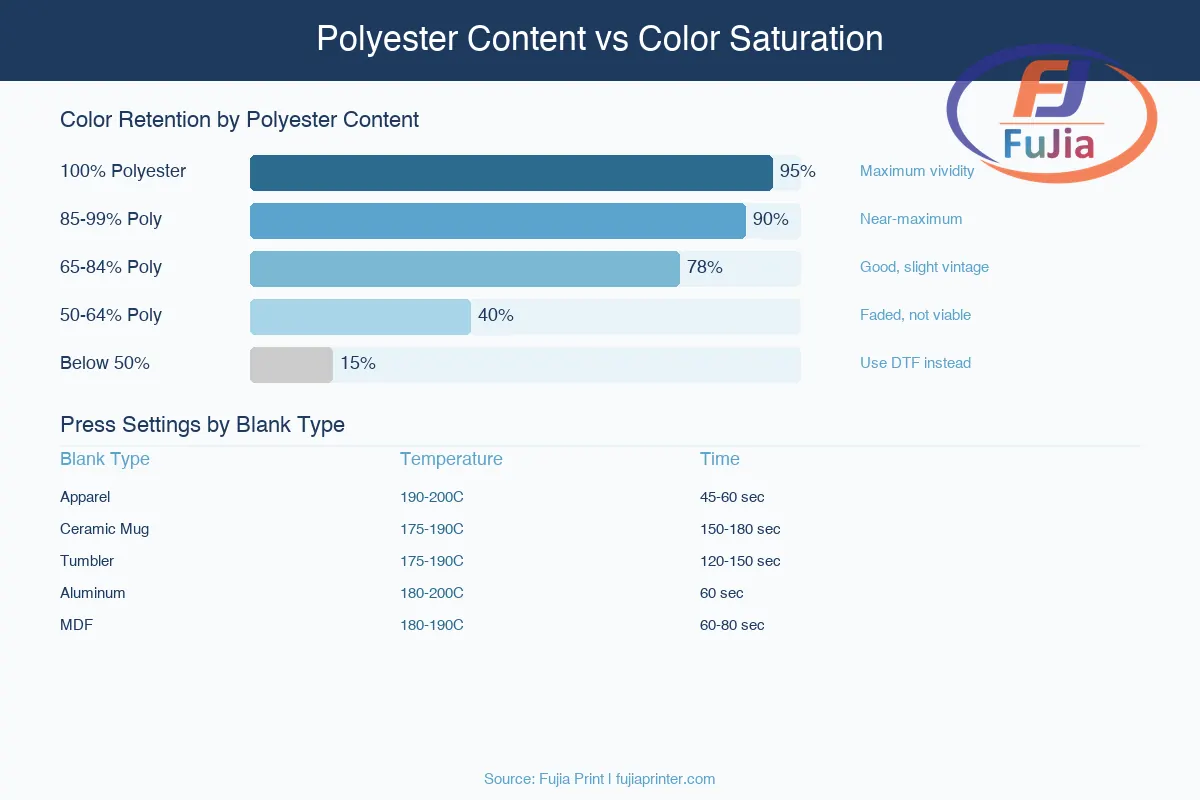
- 100% polyester blanks retain 95% color vibrancy after 50 industrial washes; 65-75% polyester blends lose 20-30% saturation.
- AAA-grade polymer coatings on hard goods produce brighter colors and sharper details than standard or economy-grade coatings.
- The 11oz ceramic mug is the highest-volume sublimation blank globally, followed by 20oz stainless steel tumblers and 100% polyester t-shirts.
- Sublimation temperature: 180-200°C for 45-60 seconds; aluminum blanks require 180-200°C for 60 seconds at medium pressure.
What Makes a Sublimation Blank Work
Sublimation printing converts solid disperse dye into gas at 190-200°C. The gas-phase dye molecules penetrate polyester fiber surfaces or polymer coatings and solidify within the material structure as it cools. This molecular bonding mechanism means the blank material must contain polyester or a compatible polymer coating.
Research on thermoplastic polyurethane adhesive chemistry by Zhu et al. (2025), published in the International Journal of Adhesion and Adhesives (Vol. 139), demonstrates that polymer surface energy and coating uniformity directly determine dye uptake efficiency. This finding applies to both sublimation blank coatings and DTF adhesive bonding, confirming that surface preparation is the primary variable in transfer print quality across all heat transfer methods.
Polyester Content and Color Saturation
| Polyester Content | Color Result | Wash Durability | Best Application |
|---|---|---|---|
| 100% | Maximum vibrancy, photo-quality | 95% retention after 50 washes | Performance wear, all-over prints |
| 85-99% | Near-maximum vibrancy | 90% retention | Fashion sublimation, retail apparel |
| 65-84% | Good saturation, slight vintage look | 75-80% retention | Casual wear, heathered designs |
| 50-64% | Faded, washed-out appearance | Below commercial viability | Not recommended |
| Below 50% | Dull, uneven color transfer | Fails after first wash | Use DTF instead |
Seven Categories of Sublimation Blanks
1. Sublimation Apparel
Polyester apparel is the largest sublimation blank category by revenue. The global custom t-shirt printing market is projected to grow from USD 5.82 billion in 2025 to USD 17.22 billion by 2034 at a 12.81% CAGR, according to Fortune Business Insights, with polyester performance wear driving sublimation demand.
| Blank Type | Material | Weight | Wholesale Price | Retail Price |
|---|---|---|---|---|
| 100% polyester t-shirt | Polyester interlock | 4.0 oz | USD 3.50-5.00 | USD 20-35 |
| Polyester hoodie | Polyester fleece | 7.0 oz | USD 8.00-12.00 | USD 35-55 |
| Sports jersey | Polyester mesh | 4.5 oz | USD 5.00-8.00 | USD 30-50 |
| Baby onesie | Polyester blend | 5.0 oz | USD 3.00-4.50 | USD 18-28 |
| Polyester socks | Polyester knit | 3.0 oz | USD 1.50-2.50 | USD 12-20 |
2. Sublimation Drinkware
Drinkware represents the highest-volume category by unit count. Ceramic mugs and stainless steel tumblers dominate the personalized gift market.
| Blank Type | Material | Size | Wholesale Price | Coating Grade |
|---|---|---|---|---|
| Ceramic mug | AAA-grade coated ceramic | 11oz | USD 1.20-2.00 | AAA |
| Ceramic mug (large) | Coated ceramic | 15oz | USD 1.50-2.50 | AAA |
| Stainless steel tumbler | Powder-coated steel | 20oz | USD 3.50-6.00 | Polymer |
| Water bottle | Coated aluminum | 600ml | USD 2.50-4.00 | Polymer |
| Wine tumbler | Powder-coated steel | 12oz | USD 3.00-5.00 | Polymer |
3. Hard Goods
Hard goods offer the highest profit margins in the sublimation blanks market, with typical markups of 200-400%.
| Blank Type | Material | Size | Wholesale Price | Notes |
|---|---|---|---|---|
| MDF keychain | Coated MDF | 2×3 inch | USD 0.20-0.50 | Top seller by volume |
| MDF ornament | Coated MDF | 3×3 inch | USD 0.30-0.60 | Seasonal demand |
| Ceramic tile | Glazed ceramic | 4.25×4.25 inch | USD 0.80-1.50 | Home decor |
| Phone case | Polymer-coated plastic | Model-specific | USD 1.50-3.00 | High turnover |
| Mouse pad | Polyester fabric + rubber | 9.4×7.9 inch | USD 0.50-1.20 | Corporate gifts |
| Puzzle | Coated cardboard | 120 pieces | USD 1.00-2.00 | Personalized gifts |
4. Aluminum Metal Panels
Aluminum sublimation blanks produce premium photo panels with exceptional color depth and durability. The polyester coating on aluminum enables dye penetration for scratch-resistant, UV-stable prints.
| Blank Type | Alloy | Thickness | Temperature | Time |
|---|---|---|---|---|
| Photo panel | 1050/1100 | 0.55-0.8mm | 180-200°C | 60 seconds |
| License plate | 1100 | 0.8mm | 190°C | 60 seconds |
| Sign panel | 3003 | 1.0mm | 190°C | 60 seconds |
Aluminum blanks are available in glossy white, matte white, silver brushed, and gold brushed finishes. The 0.55-0.8mm thickness range is most popular for photo and panel printing applications.
5. Home Decor
Home decor sublimation blanks target the personalized gift and interior design markets.
| Blank Type | Material | Size | Price Range |
|---|---|---|---|
| Pillow cover | Polyester | 16×16 inch | USD 2.00-4.00 |
| Garden flag | Polyester | 12×18 inch | USD 2.50-4.50 |
| Wall plaque | Coated MDF | 8×10 inch | USD 1.50-3.00 |
| Photo panel | Coated MDF | Various | USD 1.00-3.50 |
| Coaster set | Ceramic | 4×4 inch | USD 0.50-1.00 each |
6. Accessories
| Blank Type | Material | Price Range | Best Seller |
|---|---|---|---|
| Keychain (MDF) | Coated MDF | USD 0.20-0.50 | Yes |
| Keychain (acrylic) | Polymer-coated | USD 0.30-0.60 | Seasonal |
| Bookmark | Coated MDF | USD 0.15-0.35 | Schools |
| Fridge magnet | Coated | USD 0.10-0.25 | Tourist |
| Luggage tag | Coated MDF | USD 0.40-0.80 | Travel |
7. Specialty Items
Specialty blanks include seasonal ornaments, pet tags, clipboards, serving trays, cutting boards (with sublimation insert), and neoprene products. These items command premium pricing during holiday seasons and for corporate gifting programs.
Coating Quality: The Hidden Variable
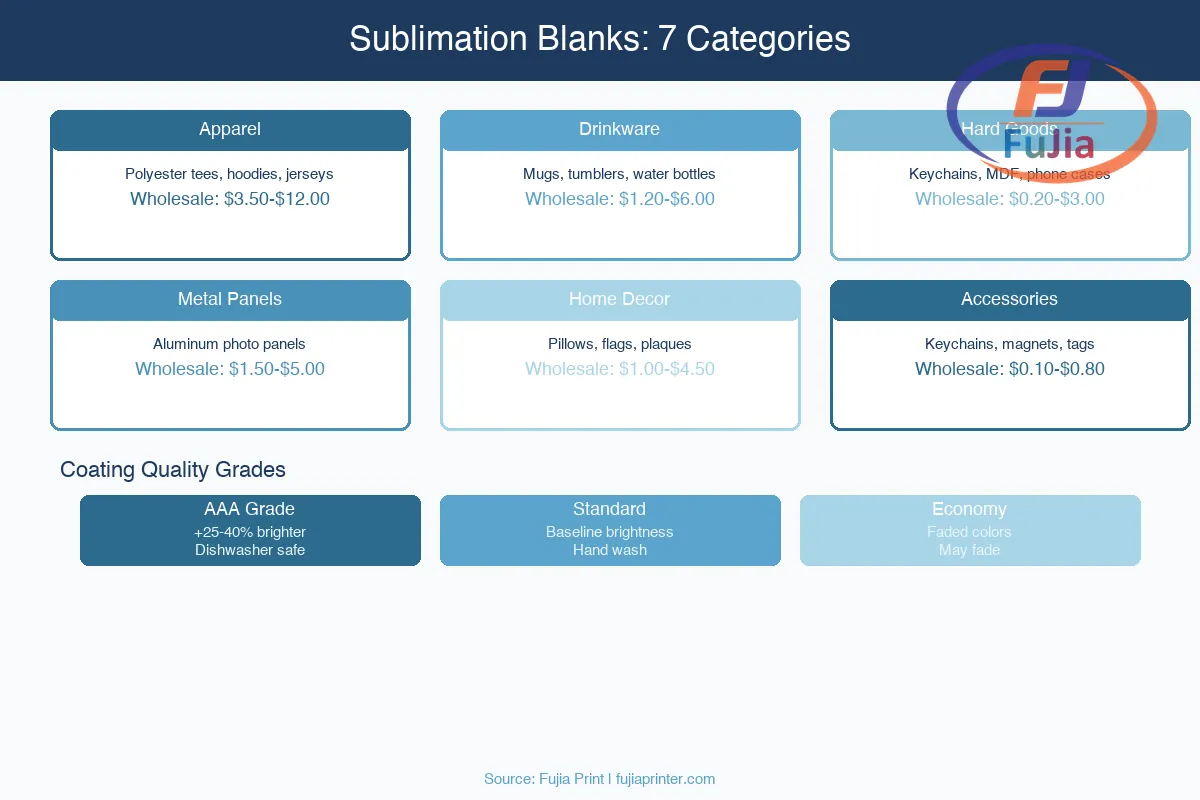
The quality of the polymer coating on hard-surface blanks is the single most important factor in print quality. Three coating grades exist in the market:
| Grade | Color Output | Detail Sharpness | Durability | Price Premium |
|---|---|---|---|---|
| AAA | Maximum brightness | Razor-sharp edges | Dishwasher safe | +20-30% |
| Standard | Good brightness | Acceptable detail | Hand wash recommended | Baseline |
| Economy | Faded colors | Soft edges | May fade after washing | -20-30% |
AAA-grade coatings produce 25-40% brighter colors than standard coatings and resist fading through 50+ dishwasher cycles. The difference is most visible on photographic designs with gradients and fine detail. For commercial production, always specify AAA-grade coatings when sourcing from suppliers.
Testing according to AATCC TM61 (2023) confirms that polyester fabric blanks retain Grade 5 colorfastness (no visible change) after 50 accelerated wash cycles at 49°C, while cotton-polyester blends below 65% polyester degrade to Grade 2-3 (significant fading).
Sublimation Temperature and Press Settings
| Blank Type | Temperature | Time | Pressure | Peel |
|---|---|---|---|---|
| Polyester apparel | 190-200°C | 45-60 sec | Medium (3-4 kg/cm2) | Warm |
| Ceramic mug | 175-190°C | 150-180 sec | Mug press | Cool |
| Stainless steel tumbler | 175-190°C | 120-150 sec | Tumbler press | Cool |
| Aluminum panel | 180-200°C | 60 sec | Medium | Cool |
| MDF products | 180-190°C | 60-80 sec | Medium | Cool |
| Phone case | 175-185°C | 60 sec | Light | Cool |
Temperature precision within plus or minus 5°C is critical. The global sublimation printing market growth is tracked by Grand View Research analysis of the broader digital textile printing segment, showing 6.0% CAGR in related transfer printing equipment.
How to Source Quality Sublimation Blanks
Step 1: Request Samples
Always order 5-10 sample blanks before committing to bulk purchases. Test each sample with a standardized design that includes solid colors, gradients, fine text, and photographic elements. Compare results side by side under consistent lighting.
Step 2: Verify Coating Specifications
Ask suppliers to specify: coating grade (AAA/standard/economy), coating thickness (micrometers), heat resistance range, and whether the coating is dishwasher-safe. Reputable suppliers provide this data without hesitation.
Step 3: Check Consistency Across Batches
Order from two different production batches and compare. Inconsistent coating thickness across batches indicates poor quality control and will produce variable print results that frustrate customers.
Step 4: Evaluate Packaging
Hard-surface blanks (ceramic, aluminum, MDF) require protective packaging to prevent coating damage during shipping. Broken or scratched coatings produce unusable prints.
DTF as an Alternative for Cotton Products
Sublimation cannot work on cotton fabrics. For cotton apparel and dark garments, DTF printing is the recommended alternative, achieving Grade 4.5 wash durability (50-100 washes) on 100% cotton. Many successful print shops operate both sublimation (for polyester and hard goods) and DTF (for cotton and dark garments) to cover their entire product range. For detailed cost comparison, see our DTF printing cost per shirt analysis.
What are sublimation blanks?
Sublimation blanks are products made from polyester fabric or coated with a polyester polymer layer that accepts sublimation dye at 190-200°C. The dye converts from solid to gas under heat and pressure, penetrating the polyester fibers or coating to create a permanent, full-color print that will not crack, peel, or fade. Common sublimation blanks include 100% polyester t-shirts, ceramic mugs with AAA-grade coatings, stainless steel tumblers with polymer coatings, MDF keychains and ornaments, aluminum photo panels, and polyester home decor items. The key requirement is that the blank surface must contain polyester or a compatible polymer coating. Cotton fabrics, untreated wood, and uncoated metals cannot accept sublimation dye and require DTF or HTV printing instead.
Can you sublimate on cotton?
No, sublimation cannot work on 100% cotton fabric. Sublimation dye bonds with polyester polymer chains through a gas-phase diffusion process at 190-200°C, and cotton (cellulosic fibers) lacks the ester groups required for this bond. If you attempt to sublimate on cotton, the dye will sit on the surface and wash out completely after the first laundry cycle. For cotton-polyester blends, sublimation works proportionally to polyester content: 50/50 blends produce faded, washed-out prints unsuitable for commercial use. For cotton apparel decoration, use DTF printing (which bonds to any fabric via TPU adhesive) or heat transfer vinyl instead. Fujia Print offers DTF printers specifically for cotton apparel production.
What temperature do you press sublimation blanks?
Sublimation blanks require 175-200°C (350-400°F) depending on the blank type. Polyester apparel presses at 190-200°C for 45-60 seconds at medium pressure (3-4 kg/cm2). Ceramic mugs press at 175-190°C for 150-180 seconds in a dedicated mug press. Stainless steel tumblers press at 175-190°C for 120-150 seconds in a tumbler press or convection oven. Aluminum panels press at 180-200°C for 60 seconds. MDF products press at 180-190°C for 60-80 seconds. The temperature must stay within plus or minus 5°C of the target to ensure complete dye sublimation without scorching the coating. Always consult the blank manufacturer’s specifications for exact temperature and time, as coating formulations vary by supplier.
Where to buy sublimation blanks wholesale?
Sublimation blanks are available from specialized sublimation suppliers, general craft distributors, and direct from manufacturers in China. When sourcing wholesale, request samples to verify coating quality, check minimum order quantities (many suppliers offer no-minimum ordering), verify shipping times and costs, and compare AAA-grade coating pricing across at least three suppliers. For hard-surface blanks (mugs, tumblers, MDF), specify AAA-grade coating for maximum color vibrancy and dishwasher-safe durability. For apparel, verify polyester content is 100% or minimum 85% for acceptable sublimation results. The global sublimation blanks market is served by hundreds of suppliers across North America, Europe, and Asia, with competitive pricing available at wholesale volumes of 50+ units per SKU.
Conclusion
Sublimation blanks enable permanent, full-color decoration on polyester fabrics and polymer-coated hard goods with 100+ wash cycle durability. For integrated sublimation and DTF printing systems, explore the Fujia sublimation printer lineup or discover our apparel printing solutions.
Sources
- Zhu et al. (2025): TPU Nanocomposites for Transfer Printing: Research on polymer surface energy and coating uniformity effects on dye uptake, published in International Journal of Adhesion and Adhesives, Vol. 139.
- Fortune Business Insights: Custom T-Shirt Printing Market, 2026-2034: Market size USD 5.82B (2025) to USD 17.22B (2034) at 12.81% CAGR, with polyester performance wear driving sublimation demand.
- Grand View Research: Direct To Film Printing Market, 2025-2030: Digital transfer printing market analysis at 6.0% CAGR, including sublimation and DTF segments.
- AATCC TM61 (2023): Colorfastness to Laundering: Accelerated laundering standard confirming polyester sublimation colorfastness at Grade 5 after 50 cycles.
- AATCC TM135: Dimensional Changes After Home Laundering: Fabric stability standard relevant to sublimation blank quality assessment.
