
A DTF printer for small business pays back its equipment investment in 2-6 months when producing 30+ custom garments per week, with net profit averaging USD 8-15 per shirt after all material and labor costs. Entry-level A3 desktop DTF systems start at USD 2,000-5,000 and handle 20-50 shirts per day, while production-grade A1 systems with integrated shakers process 200-500+ shirts daily. Fujia Print manufactures DTF printers for small businesses across 50+ countries, offering remote onboarding in 3 days and 12-month warranty.
Key Takeaways
- Break-even threshold for DTF small business profitability is 30-50 garments per week; below this, fixed costs consume the margin.
- Entry-level A3 DTF printers (USD 2,000-5,000) suit startups producing 20-50 shirts per day with 60-70% gross margins.
- Production-grade A1 DTF printers with integrated shaker (USD 8,000-25,000) handle 200-500+ shirts daily with 70-80% margins.
- ROI timeline: 1.5-6 months depending on daily volume, pricing strategy, and equipment tier.
- The global custom t-shirt market is projected to reach USD 17.22 billion by 2034 at a 12.81% CAGR, indicating sustained demand for DTF-printed apparel.
Why DTF Is Ideal for Small Business
DTF printing offers three structural advantages that make it the preferred digital printing method for small and growing apparel businesses.
Zero Setup Cost Per Order
Unlike screen printing (which requires USD 150-400 per color in screen setup), DTF has zero setup cost. Every order starts profitable from piece one, making DTF ideal for custom, one-off, and small-batch orders that dominate small business revenue.
Universal Fabric Compatibility
A single DTF printer handles cotton, polyester, blends, nylon, and dark garments. This eliminates the need for multiple printing systems and allows small businesses to serve diverse customer needs from sports teams (polyester jerseys) to corporate clients (cotton polo shirts) to craft markets (canvas tote bags).
No Pretreatment Required
DTG printing requires liquid pretreatment on cotton garments before printing, adding 2-3 minutes of labor and USD 0.15-0.40 material cost per shirt. DTF eliminates this step entirely through its TPU adhesive powder system, reducing per-shirt production time and cost.
Research by Zhu et al. (2025) in the International Journal of Adhesion and Adhesives (Vol. 139) confirms that TPU nanocomposites enhanced with TiO2 and TGIC crosslinkers achieve 30-45% higher adhesion strength, directly improving the wash durability that underpins customer satisfaction and repeat business for small DTF operations.
Selecting by Business Stage
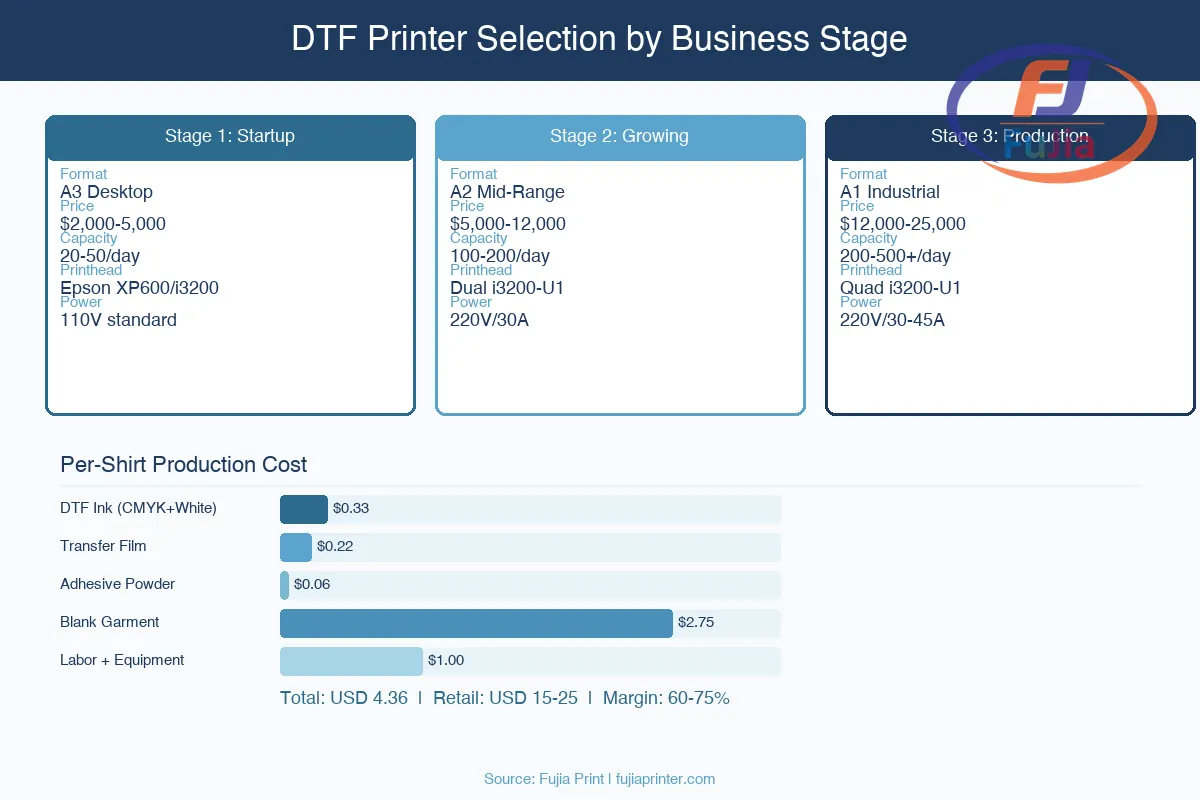
Stage 1: Startup (0-50 shirts/day)
| Specification | Requirement |
|---|---|
| Printer format | A3 (300mm width) |
| Price range | USD 2,000-5,000 |
| Throughput | 8-12 m2/hour |
| Daily capacity | 20-50 transfers |
| Printhead | Epson XP600 or i3200-U1 |
| Resolution | 1440×2880 DPI |
| Shaker | Manual or desktop all-in-one |
| Space needed | 2-3 m2 |
| Power | 110V standard outlet |
At this stage, the priority is learning the DTF workflow and building a customer base. A desktop A3 system keeps investment low while producing commercial-quality prints. The break-even point is 20-30 shirts per day at USD 15-20 retail pricing.
Stage 2: Growing Business (50-200 shirts/day)
| Specification | Requirement |
|---|---|
| Printer format | A2 (450mm width) |
| Price range | USD 5,000-12,000 |
| Throughput | 12-18 m2/hour |
| Daily capacity | 100-200 transfers |
| Printhead | Dual Epson i3200-U1 |
| Resolution | 1440×2880 DPI |
| Shaker | Integrated all-in-one |
| Space needed | 4-6 m2 |
| Power | 220V/30A dedicated circuit |
Growing businesses need automated powder application and curing to maintain consistent quality at higher volume. An integrated shaker system with 85-95% powder recycling reduces material waste and labor.
Stage 3: Production Business (200-500+ shirts/day)
| Specification | Requirement |
|---|---|
| Printer format | A1 (600-650mm width) |
| Price range | USD 12,000-25,000 |
| Throughput | 18-27 m2/hour |
| Daily capacity | 200-500+ transfers |
| Printhead | Quad Epson i3200-U1 |
| Resolution | 720×2400 DPI |
| Shaker | Integrated with HEPA filtration |
| Space needed | 8-12 m2 |
| Power | 220V/30-45A |
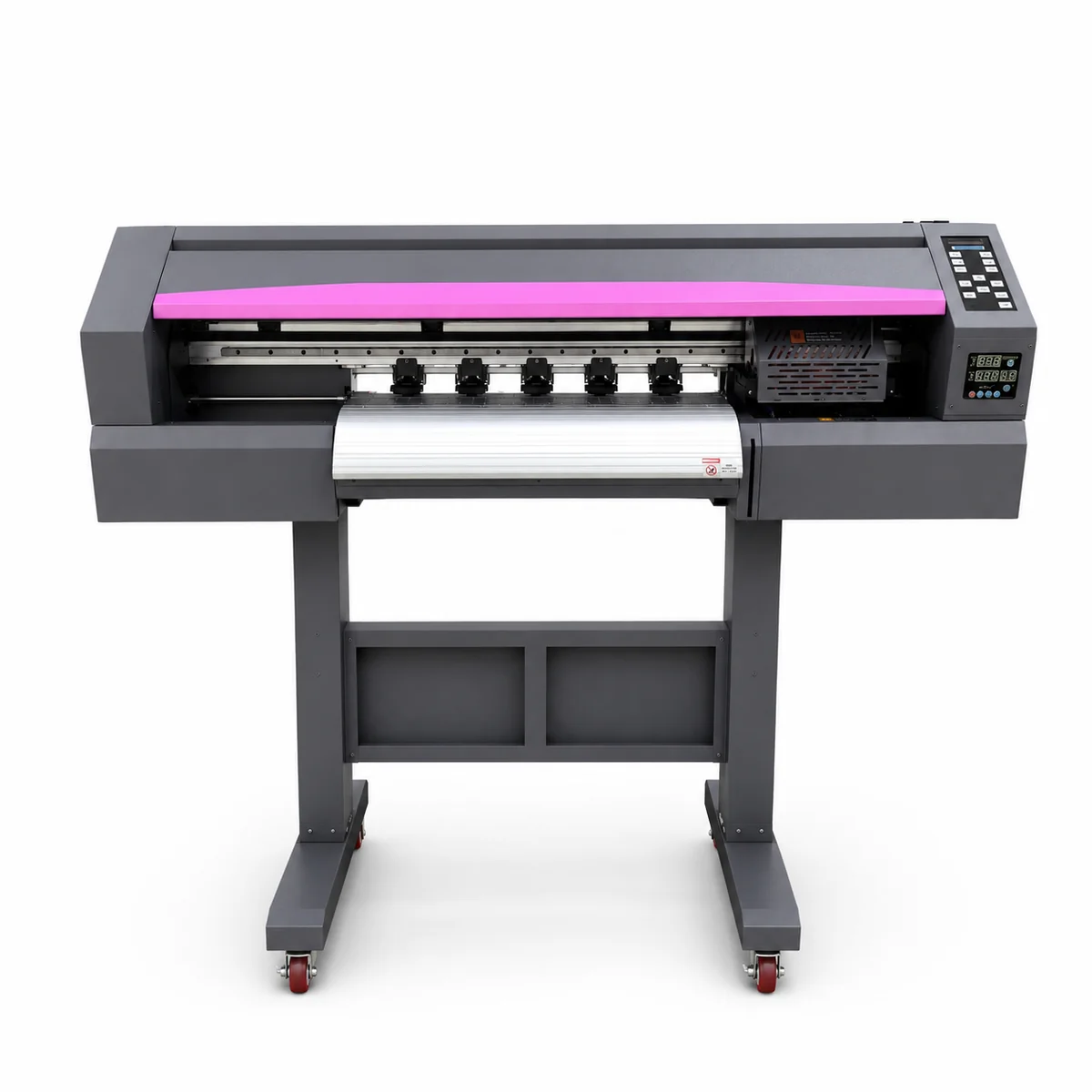
Fujia’s A1 DTF system features four i3200-U1 printheads achieving 27 m2/hour throughput, with a 2880mm mesh belt shaker providing dual-zone temperature control at 140°C and 99% fume capture through HEPA filtration.
ROI Calculation by Daily Volume
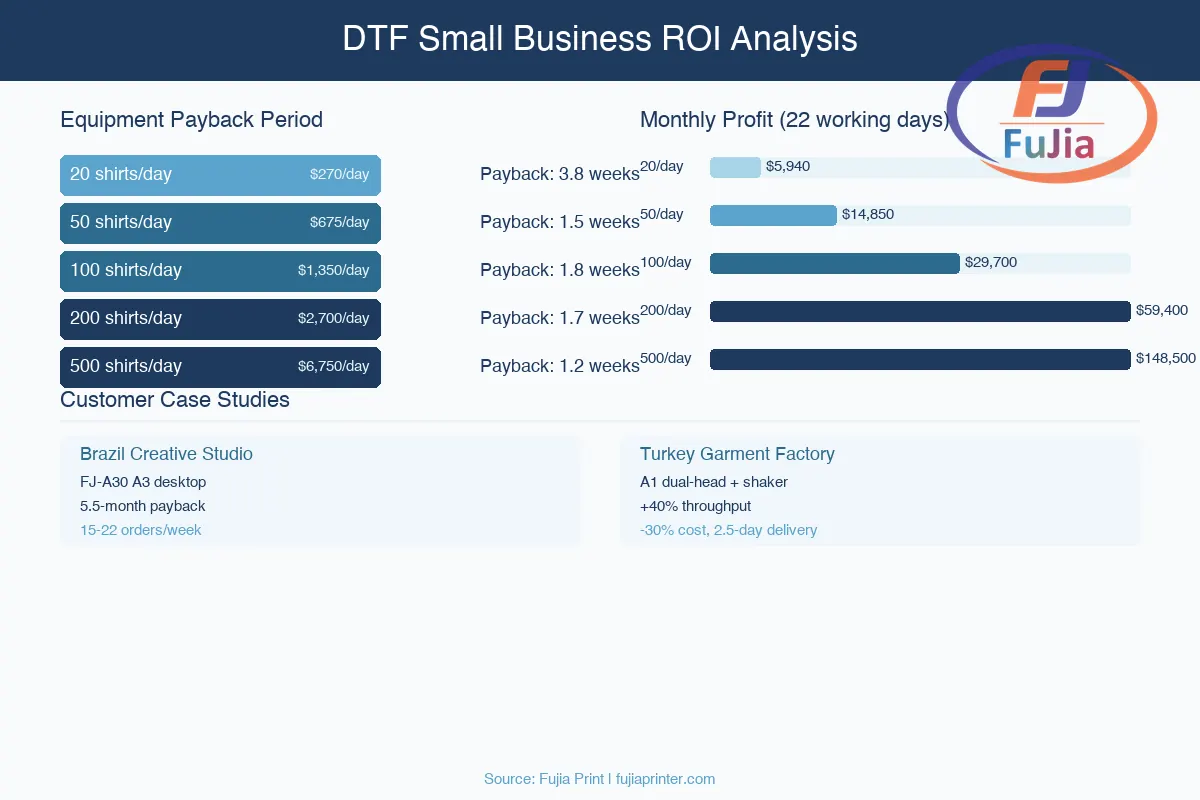
| Daily Volume | Daily Profit | Monthly Profit (22 days) | Equipment Tier | Payback Period |
|---|---|---|---|---|
| 20 shirts/day | USD 270 | USD 5,940 | USD 3,000 (A3) | 3.8 weeks |
| 50 shirts/day | USD 675 | USD 14,850 | USD 5,000 (A3+) | 1.5 weeks |
| 100 shirts/day | USD 1,350 | USD 29,700 | USD 10,000 (A2) | 1.8 weeks |
| 200 shirts/day | USD 2,700 | USD 59,400 | USD 15,000 (A1) | 1.7 weeks |
| 500 shirts/day | USD 6,750 | USD 148,500 | USD 25,000 (A1+) | 1.2 weeks |
These calculations assume USD 13.50 average net profit per shirt. The global custom t-shirt printing market, projected to grow from USD 5.82 billion in 2025 to USD 17.22 billion by 2034 at a 12.81% CAGR according to Fortune Business Insights, provides sustained demand for DTF-printed apparel.
The DTF equipment market itself is growing at a 6.0% CAGR, according to Grand View Research, reflecting strong adoption by small businesses worldwide.
Per-Shirt Cost Breakdown
| Cost Component | Per-Shirt Cost | Notes |
|---|---|---|
| DTF ink (CMYK + white) | USD 0.20-0.45 | White ink 55% of ink cost |
| DTF transfer film | USD 0.15-0.30 | PET film, single-use |
| Adhesive powder (TPU) | USD 0.05-0.08 | Fine grade 60-80 mesh |
| Blank garment | USD 1.50-4.00 | Cotton 180-220 g/m2 |
| Labor + equipment | USD 0.50-1.50 | Includes curing + pressing |
| Total cost | USD 2.40-6.33 | |
| Retail price | USD 15-25 | 60-75% gross margin |
For a detailed breakdown of cost factors and pricing strategies, see our DTF printing cost per shirt analysis.
Real Customer Case Studies
Brazil Creative Studio
A creative studio in Brazil invested in a Fujia FJ-A30 A3 desktop DTF printer for their custom apparel startup. Within 5.5 months, they achieved full payback on the equipment investment, producing 15-22 custom orders per week. The studio’s success was built on niche targeting (local sports teams and community events) and standardized Fujia consumables that maintained consistent Grade 4+ wash fastness.
Turkey Garment Factory
A garment factory in Turkey upgraded to Fujia A1 dual-head DTF equipment with an integrated shaker system to handle growing wholesale order volume. The deployment resulted in a 40% throughput increase and 30% cost reduction, with delivery time shortened from 7 days to 2.5 days. The factory now processes mixed cotton and blend orders with Grade 4+ wash fastness across all product lines.
Common Mistakes to Avoid
Mistake 1: Underestimating White Ink Maintenance
White DTF ink contains titanium dioxide (TiO2) with a density of 4.2 g/cm3, which settles within 3 hours without circulation. Printhead clogs from settled white ink are the number one cause of production downtime. Always choose a printer with automatic white ink circulation, or commit to daily manual agitation.
Mistake 2: Buying Too Much Printer Too Early
A USD 25,000 A1 production system is overkill for a startup producing 10 shirts per day. The fixed costs (depreciation, power, space) of oversized equipment extend payback periods unnecessarily. Match equipment tier to current volume, not aspirational volume. Upgrade when daily orders consistently exceed 80% of current capacity.
Mistake 3: Ignoring Curing Temperature Precision
Adhesive powder must cure at 110-130°C. Below 110°C, wash resistance drops 60%. Above 140°C, the white underbase yellows. Always verify that your curing oven or heat press maintains temperature within plus or minus 2°C. Fujia’s integrated shaker system provides PID-controlled dual-zone heating at 140°C with plus or minus 2°C uniformity.
Mistake 4: Pricing Too Low
Competing on price (USD 12-15 per shirt) in a market with 50-300% margins leaves significant profit on the table. Value-based pricing (USD 20-35 per shirt for premium designs on quality blanks) achieves 70-84% margins. Niche designs targeting specific communities support 40-70% higher pricing than generic designs.
How much does a DTF printer for small business cost?
A DTF printer for small business costs USD 2,000-5,000 for an entry-level A3 desktop model, USD 5,000-12,000 for a mid-range A2 system, and USD 12,000-25,000 for a production-grade A1 system with integrated shaker. The total cost includes the printer, RIP software, and initial consumable supplies (ink, film, powder). Entry-level A3 systems operate on standard 110V outlets and require 2-3 m2 of space. Production A1 systems require 220V/30-45A dedicated circuits and 8-12 m2 of space. The key consideration is matching equipment cost to your daily volume: a USD 3,000 A3 printer reaches break-even at 20-30 shirts per day, while a USD 15,000 A1 system needs 100+ shirts daily for optimal ROI. Fujia Print offers A3 to A1 models with remote onboarding in 3 days.
Is a DTF printer profitable for a small business?
Yes, a DTF printer is profitable for small businesses producing 30+ custom garments per week, with typical payback periods of 1.5-6 months. Net profit averages USD 8-15 per shirt after material, labor, and equipment costs. A shop printing 50 shirts per day at USD 13.50 profit each generates USD 675 daily or USD 14,850 monthly at a 22-day workmonth. The break-even threshold is 30-50 garments per week, below which fixed equipment costs consume the per-shirt margin. Profitability depends on three factors: controlling material costs (standardize on one consumable system), pricing for value rather than competing on price, and maintaining consistent daily volume above break-even. The Brazil Creative Studio case study achieved 5.5-month payback on a Fujia FJ-A30 A3 desktop printer.
What is the best DTF printer for beginners?
The best DTF printer for beginners is an A3-format desktop model with automatic white ink circulation, priced between USD 2,000-5,000. Key features to look for include Epson i3200-U1 or XP600 printheads (600 nozzles per color, 3-picoliter droplet size), 1440×2880 DPI resolution, automatic white ink circulation to prevent TiO2 settling, and included RIP software with white ink underbase control. A3 desktop printers handle 20-50 shirts per day, which is sufficient for most startup operations. Avoid the temptation to start with a large A1 production system before you have consistent order volume. Fujia Print offers A3 entry-level models with remote onboarding in 3 days and 12-month warranty with 48-hour parts dispatch, specifically designed for first-time DTF operators.
Can I run a DTF business from home?
Yes, you can run a DTF business from home with an A3 desktop DTF printer, which operates on standard 110V power and fits in a 2-3 m2 space. Home-based DTF businesses typically start with Etsy stores, local craft fairs, and social media sales, producing 20-50 custom garments per day. Key considerations for home operation include: adequate ventilation for adhesive powder curing fumes (look for printers with integrated HEPA filtration), temperature and humidity control (20-28°C, 45-65% humidity), and noise management (DTF printers operate below 65 dB). The total home setup cost including printer, heat press, initial consumables, and basic workspace preparation ranges from USD 3,000-6,000. Many successful DTF businesses start from home and scale to a commercial space once daily volume exceeds 50 shirts.
Conclusion
A DTF printer enables small business profitability with 60-80% gross margins and 2-6 month payback periods at 30+ shirts weekly. For DTF production systems scaled to your business stage, explore the Fujia DTF printer lineup or discover our apparel printing solutions.
Sources
- Zhu et al. (2025): TPU Nanocomposites for Transfer Printing: Research on TPU crosslinker-enhanced adhesive improving wash durability for small business DTF production, published in International Journal of Adhesion and Adhesives, Vol. 139.
- Fortune Business Insights: Custom T-Shirt Printing Market, 2026-2034: Market size USD 5.82B (2025) to USD 17.22B (2034) at 12.81% CAGR, indicating sustained demand for DTF small businesses.
- Grand View Research: Direct To Film Printing Market, 2025-2030: DTF equipment market at 6.0% CAGR, reflecting small business adoption.
- AATCC TM61 (2023): Colorfastness to Laundering: Wash durability standard confirming Grade 4+ DTF print quality for commercial production.
- AATCC TM135: Dimensional Changes After Home Laundering: Fabric stability standard relevant to DTF transfer quality for small business apparel.
