

The Audley DTF printer line is a legitimate industrial option built by a 29-year-old Chinese factory, with real 2026 market prices running from $3,997 for a 12-inch dual-head unit to $22,895 for a 24-inch printer-and-shaker system. This review pulls every published price, spec, and buyer complaint into one place, then compares the line against buying the same print-width class factory-direct, so you know where the dealer premium goes before you wire money.
Key Takeaways
- Audley is made by Zhengzhou Audley Digital Control Equipment Co., Ltd, a Henan factory founded in 1997 with an 80,000 m² plant and about 380 employees: an established manufacturer, not a reseller brand.
- Street prices in 2026 run from $3,997 (12-inch dual-head) through $6,894 (24-inch S7070-3) to $22,895 (Magic DTF-24″ with shaker), per listed dealer and Google Shopping prices.
- Core models use dual or quad Epson i3200-A1 heads with CMYK + White pigment ink and white ink circulation, the industry-standard configuration for this class.
- US buyers typically purchase through dealers such as Alder Color Solutions and DTFonestop, which adds a support layer but also a markup.
- Comparing quotes above $10,000 for a dual-head 60 cm machine? Factory-direct alternatives with the same i3200 configuration and a Honson mainboard, Leadshine servo motor, and THK guide rail belong on your shortlist.
Who Is Audley? Company Background
Audley is the DTF printer brand of Zhengzhou Audley Digital Control Equipment Co., Ltd, a manufacturer founded in 1997 and headquartered in the Xinxiang Printing Industrial Park in Henan Province, China. The company states its facility covers 80,000 square meters with about 380 employees, and it claims 150 patents across its digital printing equipment lines. Those numbers put Audley in the same general size class as other large Henan- and Guangdong-based printer factories, well above the threshold of a trading company slapping its logo on imported hardware. Based on data from our customers across 50+ countries, that scale matters less for print quality than for parts continuity, because a factory that molds its own frames and boards will still ship consumable spares in year five.
The portfolio extends beyond DTF into UV flatbed, UV DTF, DTG, and sublimation printers, with ISO certification plus SGS and CE marks referenced across the line. The practical meaning for a buyer: Audley shipped digital printers before DTF existed as a category, and the DTF line inherits a distribution network already spanning the US and South Asia. One thing the company does not publish is independent performance data, so every quality claim traces back to Audley’s own channels or its dealers, which is exactly why a third-party teardown like this one matters.
Audley DTF Printer Models & Real 2026 Prices
Audley does not sell direct to end users through a public web store, so the prices below are actual listed prices from authorized US dealers and Google Shopping listings in 2026. Treat them as the realistic budget range rather than wishful “starting from” figures.
| Model configuration | Width | Printheads | Listed price (2026) | Source |
|---|---|---|---|---|
| 12″ dual-head DTF printer | 12 in (30 cm) | 2 heads | $3,997 | Alder Color Solutions |
| A3 DTF printer + powder shaker starter bundle | A3 (33 cm) | 2 heads | $5,599 | DTFonestop |
| S7070-3 premium dual-head | 24 in (60 cm) | 2× Epson i3200-A1 | $6,894 | Alder Color Solutions |
| 4-head premium | 24 in (60 cm) | 4× Epson i3200-A1 | $11,186 | Alder Color Solutions |
| S7070-3 + DF-800(A) powder shaker | 24 in (60 cm) | 2× Epson i3200-A1 | $11,499 | Alder Color Solutions |
| Magic DTF-24″ printer + shaker system | 24 in (70 cm frame) | dual-head | $22,895 | Copyfaxes via Google Shopping |
Two pricing patterns deserve attention. First, the jump from the dual-head S7070-3 at $6,894 to the 4-head at $11,186 is roughly $4,300 for doubled head count, which tracks the industry norm of paying roughly 60-80% more to double throughput. Second, the spread between the highest and lowest quote for what appears to be similar 24-inch dual-head hardware, $11,499 at one dealer versus the same-class system listed at $22,895 elsewhere, shows how much dealer markup and bundling can move the final number. Audley’s strongest search demand actually comes from South Asia, with Google autocomplete suggesting “price in Bangladesh”, “price in India”, and “price in Pakistan” as common refinements; in those markets, local dealer quotes typically add import duties on top of the ex-works price, so the US dealer prices above are a useful ceiling reference rather than a local quote.
Build Quality & Print Performance
The flagship S7070-3 prints up to 24 inches (60 cm) wide using two Epson i3200-A1 printheads with CMYK + White pigment ink, and the listed configuration includes white ink circulation and stirring to keep titanium dioxide pigment from settling. Automated powder application and curing come as part of the turnkey package on shaker bundles. Audley also markets a “precise dot alignment system” for color accuracy, a software-level claim that is hard to verify without printing the same test file on competing machines.
Speed is where head count matters most. The Audley Magic DTF-24″ dual-head system is listed at 15 m² per hour, a workable production rate for a two-person shop, but it sits below what a well-tuned 4-head machine can sustain. The honest truth about comparing machines in this class: throughput numbers published by factories tend to be 4-pass laboratory figures, and real shops running 6-pass or 8-pass workflows should discount them by 30-45% before planning production schedules.
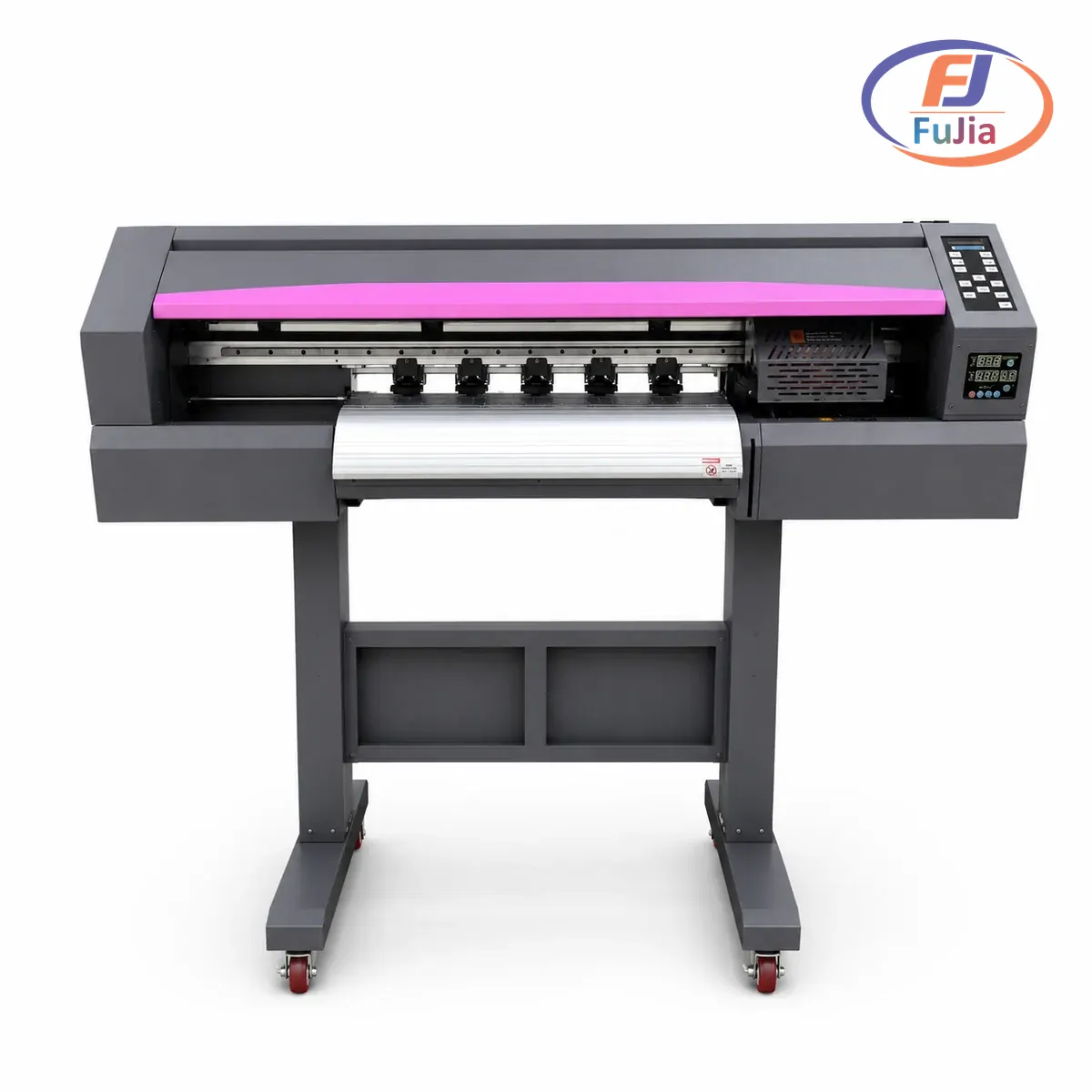
For reference on the 4-head class, Fujia’s A1 4-head DTF printer uses 4 to 5 Epson i3200 heads across the same 650 mm width and is rated at 27 m²/h at 4-pass, holding 720×2400 dpi at 8-pass, nearly double the dual-head throughput at a listed price ($11,186 for Audley’s 4-head) that lands in the same bracket. The short version on this bracket: pay for the extra heads only when your orders already queue, because unused head count is the most expensive idle capacity in this industry.
The component level is where factory-direct machines separate themselves from what spec sheets tell you. Fujia’s A1 line runs a Honson mainboard, a Leadshine servo motor, and a THK silent guide rail, a combination the factory credits for 12-hour continuous runs without quality drift, plus an auto power-off white ink circulation system that keeps pigment moving even during outages. The same transmission platform carries the factory-direct A1 lineup from the 2-head 650 mm machine up to the 4-head production unit. Audley’s public materials do not name its transmission components, which is not proof of inferior parts, but it does mean you should ask the dealer directly before buying and get the answer in writing.
Throughput claims only matter if the machine survives daily use. One of our customers, an Etsy tote bag brand, moved from a 2-week turnaround to same-day delivery after installing a 60 cm dual-head DTF printer, now shipping 1,500+ pieces per month at a 65% margin, and wholesale orders tripled once the faster turnaround became part of their pitch. That outcome came from the dual-head class, not a 4-head machine, which is the short version of an uncomfortable fact: most small brands do not need to spend $11,000 to hit professional capacity.
| Spec | Audley S7070-3 (dual) | Audley 4-head premium | Fujia A1 4-head (comparison) |
|---|---|---|---|
| Print width | 24 in (60 cm) | 24 in (60 cm) | 650 mm (25.6 in) |
| Printheads | 2× Epson i3200-A1 | 4× Epson i3200-A1 | 4-5× Epson i3200 |
| Rated speed | 15 m²/h (Magic 24″ class) | not published | 27 m²/h @4-pass |
| Resolution | not published | not published | 720×2400 dpi @8-pass |
| Transmission | not published | not published | Honson board + Leadshine servo + THK rail |
| Listed price | $6,894 | $11,186 | factory quote, typically under $10,000 |
What Buyers Praise and Complain About
The consistent praise in dealer copy and buyer discussion centers on color accuracy and print sharpness, both tied to the dot alignment system, plus the practical benefit of white ink circulation keeping print quality stable across long runs. Buyers in the 12-inch and A3 bracket also flag the starter bundles, printer plus powder shaker at $5,599, as a low-friction way into production DTF without assembling a system from separate components.
The complaint signals are quieter but real. A 2026 YouTube video titled around an Audley “design flaw” and a one-change fix has drawn five-figure views, and while one video is not a verdict, it points at the broader issue: US buyers depend on dealers like Alder, which advertises 18-hour US support, or on importing direct without a service network. Replacement parts are a searchable concern too, with “Audley DTF printer parts” appearing in Google autocomplete ahead of most other refinements. When a parts lookup outranks a setup query, that tells you what owners are worried about.
Regional pricing is the last friction point. Because Audley reaches most markets through distributors, the same 24-inch dual-head machine that lists at $6,894 in the US can carry a substantially higher tag in Bangladesh, India, or Pakistan once distributor margin and import duties stack up. Buyers in those markets should quote the ex-works China price and the landed price separately, because comparing only local quotes hides the size of the middle layer. Based on data from our customers across 50+ countries, the distributor layer adds 15-40% between ex-works and landed cost in South Asia, so it pays to ask for both numbers in the same email.
Audley vs Buying Direct From a Factory
Dealer purchases and factory-direct purchases solve different problems, and the right answer depends on how much hand-holding you need. A dealer gives you a local returns address, business-hours phone support, and usually an installed machine; the premium for that convenience is visible above, where a dual-head 24-inch system with shaker reaches $11,499 at a US dealer. Factory-direct pricing removes that layer, and in Fujia’s case the support model replaces the dealer’s function: 12-month warranty on every printer, common parts shipped within 48 hours, and a 3-day remote onboarding program covering hardware (day one), RIP and ICC (day two), and your first production-grade print (day three).
Testing before paying settles the trust question. Fujia’s free sampling service works like this: send your design file and your actual fabric or film, the factory prints the sample, records video of the process, and ships the physical sample back, which removes the “will it work on my material” question from the sales conversation entirely. DDP shipping with duties prepaid runs 15-25 days to the EU or US by sea, so order-to-first-print lands in the same 3-week window a US dealer typically needs just to schedule delivery and install.
Nothing here argues Audley is a bad machine; the i3200 configuration is the industry standard and the factory is verifiably large. The argument is simpler: at $6,894 to $11,499 for the same print class, the dealer premium is large enough to fund a serious support program of its own, so buyers comfortable with remote onboarding should price factory-direct before committing.
What is the best DTF printer on the market?
There is no single “best” machine, because the right choice tracks your weekly volume and your tolerance for remote support. The 2026 industrial benchmark is the 60 cm dual-head or 4-head Epson i3200 class: dual-head units list between $3,997 and $11,499 depending on width and bundling, and 4-head machines reach 27 m²/h at 4-pass, enough to supply multiple apparel decorators. Audley’s S7070-3 at $6,894 sits mid-bracket with a verifiable factory behind it. What separates the top machines is less the printhead, which nearly everyone shares, and more transmission quality, white ink management, and the support response when a head clogs at 9pm. Fujia’s A1 line, built on a Honson mainboard, Leadshine servo motor, and THK guide rail with auto-circulating white ink, competes on exactly those three quieter factors.
Is owning a DTF printer worth it?
For most shops printing more than about 50 transfers per day, yes, and the math is visible in real customer outcomes. One Etsy tote bag brand moved printing in-house on a 60 cm dual-head machine, went from a 2-week turnaround to same-day, and now ships 1,500+ pieces per month at a 65% margin. Break-even typically arrives within months once outsourced transfer costs of $1.50-3.00 per print are replaced by in-house consumable costs of roughly $0.30-0.60 per A3 transfer at 2026 market prices. Ownership also removes the MOQ and queue constraints of outsourcing, which unlocks same-day delivery promises. That said, worth it assumes daily maintenance, because white ink systems need circulation and capping-station wipes of 3-5 minutes to stay reliable.
Who has the best quality DTF prints?
Print quality in DTF is decided by four factors in this order: the RIP profile, powder application uniformity, curing temperature accuracy, and only then the printhead, which is why two shops running identical Epson i3200 hardware produce noticeably different output. Audley markets a precise dot alignment system for color accuracy, and its white ink circulation targets the most common quality killer, pigment settlement. Fujia attacks the same problem at component level with dual-section front and rear heating, real-time temperature and humidity monitoring, and siphon plus positive-pressure ink supply holding 1,000-1,500 ml per color. Grade 4-5 color fastness (AATCC) across 50+ wash cycles is the realistic benchmark for a tuned machine of either brand, so ask any vendor for a same-file, same-film comparison print rather than trusting marketing claims.
What is the best DTF printer for a home business?
Start a home business in the A3 to 12-inch dual-head bracket, where 2026 prices run from $3,997 (12-inch dual-head) to $5,599 (A3 printer-plus-shaker starter bundle), and machines fit on a standard workbench in about 20 m². Single-head A3 machines print 2-3 m² per hour, roughly 40-60 A3 transfers in an 8-hour day, enough for an Etsy or team-jersey side business until orders pass about 50 per day; our DTF printer for small business guide walks through that sizing decision in detail. The upgrade trigger: two straight weeks of turned-away orders means moving to the 60 cm dual-head class, where a verified workflow produces 1,500+ pieces per month as the tote bag case shows. We recommend against the $22,895 systems until monthly revenue clears five figures, because head count you cannot feed with orders is depreciating metal.
Verdict
Audley DTF printers are built by a real 29-year-old factory with an 80,000 m² plant, the i3200-based configurations are current, and the dealer prices from $3,997 to $11,499 are within the normal 2026 band. The two honest reservations are the unpublished spec details, transmission components and per-model speeds are not public, and the dealer-dependent support layer, which adds cost in exchange for local service. If you are comfortable comparing quotes, request component-level specs in writing, get a comparison sample printed on your own film, and price a factory-direct A1 machine with a 12-month warranty and 48-hour parts dispatch before you sign anything; you can see the full factory-direct lineup on our DTF printers page.
Sources
- Epson PrecisionCore printhead technology: Epson’s official page on the printhead platform behind the i3200 heads referenced in the configuration tables.
- Wikipedia: Direct-to-film printing: process definition and transfer workflow background.
- Wikipedia: Digital textile printing: market context for digitally printed apparel production.
