

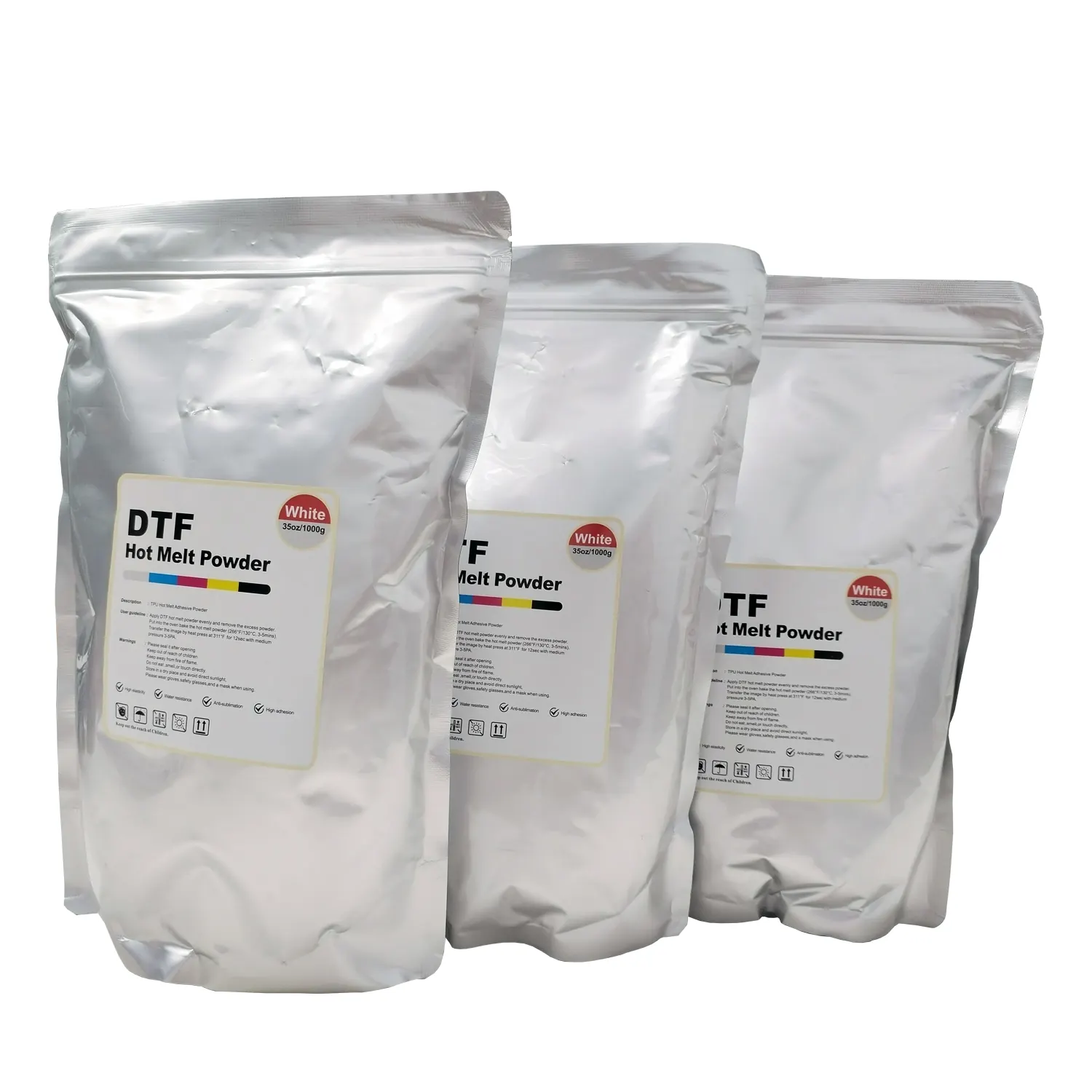
DTF powder adhesive is a thermoplastic polyurethane (TPU) hot-melt adhesive that melts under heat press conditions to permanently bond DTF ink layers to textile fibers. The global heat transfer printing textile market reached USD 4,511.1 million in 2025 and is projected to grow to USD 8,566.5 million by 2033 at a CAGR of 8.5%, driven largely by the expansion of direct-to-film and custom apparel decoration. Fujia Print manufactures the DTP-PWD heat melt adhesive powder in both black and white formulations, engineered specifically for the DTF workflow at 160 degrees C and 15 seconds.
Key Takeaways
- DTF powder adhesive is a TPU-based hot-melt compound that melts at 110-160 degrees C and solidifies into a flexible, wash-resistant bond between ink and fabric.
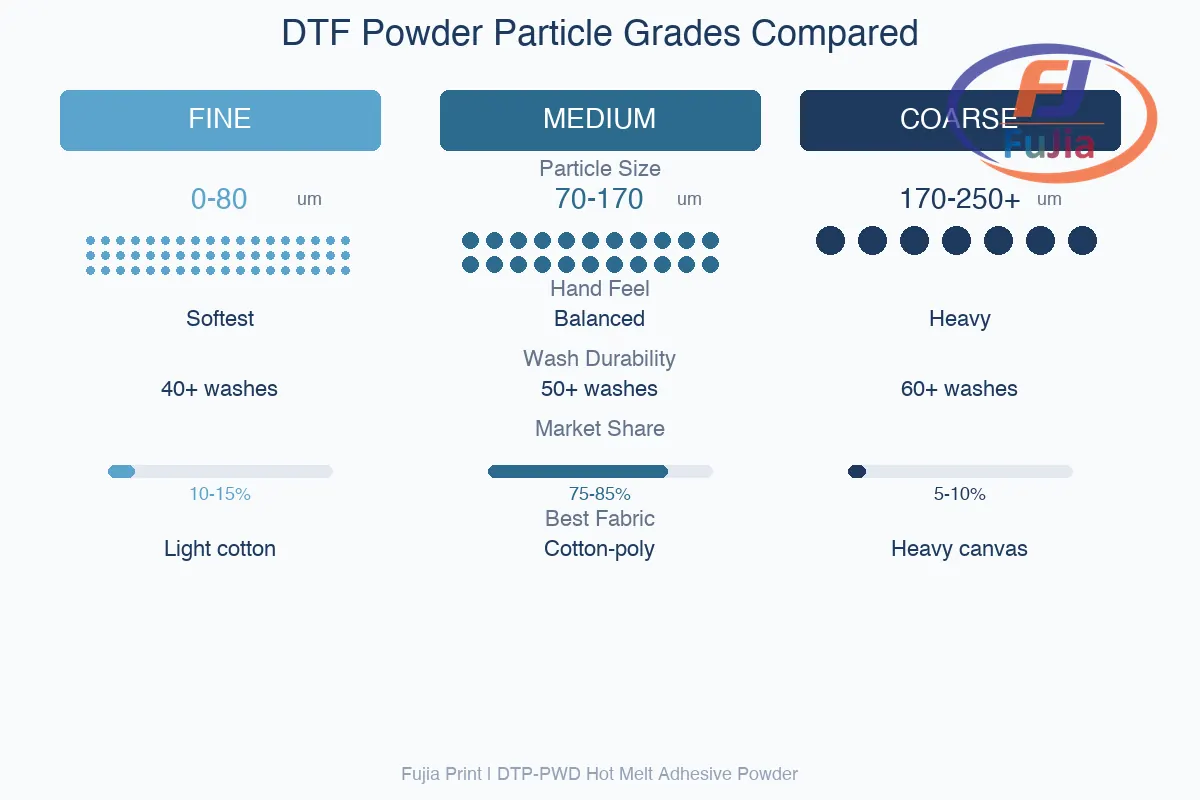
- Three particle grades control the application: Fine (0-80 micrometers) for soft hand feel, Medium (70-170 micrometers) for general purpose, and Coarse (170-250 micrometers and above) for heavy fabrics.
- Standard bonding parameters are 160 degrees C, 15 seconds, 1.5-2.5 kg/cm2 pressure, and cold peel, producing transfers that withstand 50+ machine washes at Grade 4-5 AATCC color fastness.
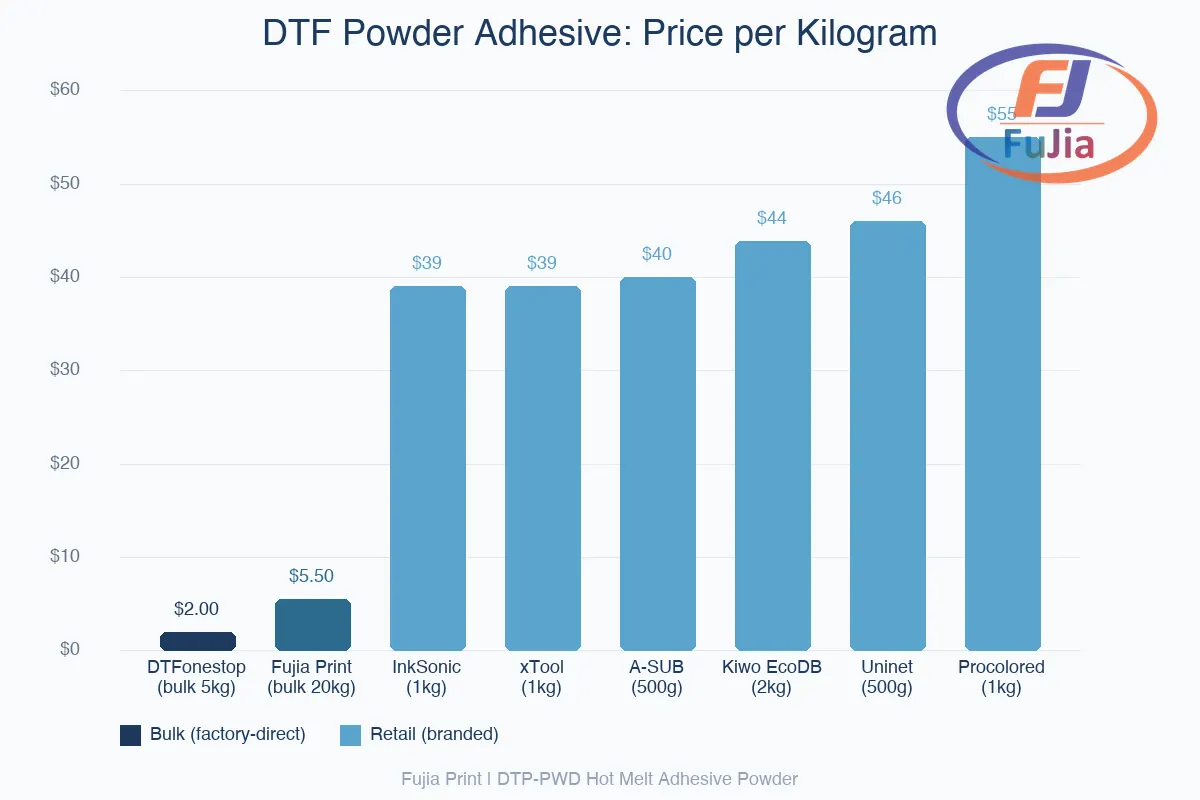
- Retail prices range from USD 19.99 for a 500g jar (A-SUB) to USD 55.00 for a premium 1kg bag (Procolored), with bulk 20kg bags at USD 5.50-6.00 per kg for production shops.
- DTF powder adhesive applies to cotton, polyester, blends, nylon, and leather, making it the most fabric-versatile bonding agent in digital textile decoration.
What Is DTF Powder Adhesive?
DTF powder adhesive is the bonding layer in the direct-to-film printing process. When a DTF printer ejects CMYK and white ink onto PET film, the wet ink has no mechanism to stick to fabric. The adhesive powder is applied to the wet ink surface, where it adheres to the ink layer. During heat pressing, the powder melts and penetrates fabric fibers, creating a permanent mechanical and chemical bond.
The active ingredient in most DTF powders is thermoplastic polyurethane (TPU), a class of hot-melt adhesive with a density of 1.18-1.20 g/cm3 and a melting range of 110-125 degrees C measured by differential scanning calorimetry (DSC). TPU offers elasticity, wash resistance, and a soft hand feel, which makes it the dominant chemistry for garment decoration. Alternative chemistries include polyester (PES) adhesive for rigid substrates and polyamide (PA) for balanced performance, though TPU captures the majority of the DTF market because of its flexibility and stretch recovery.
Academic research published on ScienceDirect has demonstrated that TPU nanocomposites achieve excellent adhesion strength and water resistance when nano titanium dioxide (TiO2) is incorporated at 10% content, with TGIC crosslinking further enhancing bonding performance for dark fabric applications. This research explains why properly bonded DTF transfers resist peeling even after 50+ home laundering cycles tested under AATCC TM135, the industry standard for dimensional changes of fabrics after repeated home washing.
TPU Chemistry: Why Thermoplastic Polyurethane Dominates DTF
Thermoplastic polyurethane belongs to the family of segmented block copolymers. Hard segments formed from diisocyanate and chain extender provide mechanical strength and heat resistance. Soft segments formed from long-chain polyols provide elasticity and low-temperature flexibility. This dual-phase structure gives TPU adhesive powder its unique combination of stretch, recovery, and bond strength.
Key TPU Properties for DTF Applications
| Property | Value | Significance |
|---|---|---|
| Density | 1.18-1.20 g/cm3 | Lighter than PES (1.33), similar to PA (1.13) |
| Melting point (DSC) | 110-125 degrees C | Matches standard heat press temperatures |
| Hardness | 80 +/- 3 Shore A | Flexible enough for apparel, firm enough for detail |
| Tensile strength | 20-40 MPa | Resists tearing during stretching |
| Elongation at break | 300-600% | Stretches with knit fabrics without cracking |
| Wash resistance | 50+ cycles (cold), 40 degrees C excellent | Exceeds consumer laundering expectations |
The low melting point of TPU powder adhesive is critical for the DTF workflow. Standard DTF transfer occurs at 160 degrees C for 15 seconds with cold peel, parameters that align perfectly with the 110-125 degrees C melting range of TPU. If the melting point were significantly higher, the heat press would scorch synthetic fabrics like polyester. If lower, the adhesive would activate prematurely during storage or shipping in warm climates.
Research on TPU/TiO2 nanocomposites published on ScienceDirect has shown that incorporating titanium dioxide (TiO2, refractive index 2.75) into TPU adhesive powder improves opacity for dark-garment transfers. The TiO2 particles scatter light within the adhesive layer, preventing the fabric color from showing through the white ink underbase. This is why premium DTF powders appear bright white: the TiO2 content provides both chemical whiteness and optical opacity.
Particle Size Grades: Fine, Medium, and Coarse
DTF powder adhesive is manufactured in three particle size grades, each engineered for specific applications. The grade selection affects hand feel, wash durability, and the type of fabric the transfer suits best.
Particle Grade Comparison Table
| Grade | Particle Size | Hand Feel | Wash Durability | Best Fabric | Market Share |
|---|---|---|---|---|---|
| Fine | 0-80 micrometers | Softest, most flexible | Good (40+ washes) | Lightweight cotton, polyester tees, baby apparel | 10-15% |
| Medium | 70-170 micrometers | Balanced, slight texture | Excellent (50+ washes) | Cotton-poly blends, hoodies, caps, tote bags | 75-85% |
| Coarse | 170-250 micrometers and above | Heavy, rubber-like | Maximum (60+ washes) | Heavy canvas, denim, workwear, jackets | 5-10% |
Medium grade captures the largest share of the DTF powder market because it delivers the best balance of soft feel and wash durability. Most retail DTF powders, including xTool DTF Powder at USD 39.00 (4.8-star rating) and Procolored DTF Powder at USD 55.00 (4.8-star rating), are medium grade. Fine grade commands a price premium because producing uniform 0-80 micrometer particles requires additional milling and classification steps. Coarse grade is the least expensive per kilogram but limited to heavy fabric applications where hand feel is less critical.
The Fujia Print DTP-PWD hot melt adhesive powder is available in medium grade for the standard DTF workflow, with particle distribution optimized for even coverage on 30cm to 65cm print widths. The powder disperses uniformly across wet ink without clumping, a quality controlled by the 5-stage classification process in the Guangzhou production facility. The powder releases cleanly from the DTF transfer film during cold peel, leaving no adhesive residue on the PET surface.
Application Process: How DTF Powder Bonds to Fabric
The DTF powder application process involves four stages that transform dry powder into a permanent fabric bond. Each stage has specific parameters that determine transfer quality.
Stage 1: Powder Application
After the DTF printer deposits CMYK and white ink onto PET film, adhesive powder is applied to the wet ink surface. Automatic powder shakers distribute powder evenly across the printed film at a rate of 10-15 grams per A3 sheet. Manual application uses a powder sifter or salt shaker for smaller operations. The powder adheres to wet ink but falls off dry areas, creating a clean adhesive layer only where ink exists.
Stage 2: Curing (Gelling)
The powdered film passes through a curing oven or heat tunnel at 130-160 degrees C for 60-120 seconds. During curing, the TPU powder melts into a continuous gel layer that encapsulates the ink. The gel transforms from white powder to a translucent film, signaling complete melting. Incomplete curing leaves unmelted powder particles that create a gritty texture and reduce wash resistance.
Stage 3: Heat Press Transfer
The cured film is placed face-down on fabric and pressed at 160 degrees C for 15 seconds with 1.5-2.5 kg/cm2 pressure. The TPU adhesive re-melts and flows into fabric fibers. Pressure forces the molten adhesive into the interstitial spaces between yarns, creating a mechanical interlock in addition to the chemical bond. Cold peel is standard for DTF: the film is removed after the transfer cools to room temperature, which prevents ink smearing and maximizes bond strength.
Stage 4: Post-Press (Optional Second Press)
A second 5-second press with a cover sheet (Teflon or silicone paper) smooths the transfer surface and improves wash resistance by 15-20%. This step is optional for production but recommended for premium garments.
DTF Powder Adhesive Pricing and Sourcing
DTF powder adhesive is sold in retail quantities (500g to 5kg) and bulk quantities (20kg bags and larger). Retail pricing reflects packaging, branding, and domestic distribution, while bulk pricing approaches the commodity cost of raw TPU resin.
DTF Powder Price Comparison
| Brand | Quantity | Price | Price per kg | Rating | Source |
|---|---|---|---|---|---|
| A-SUB | 500g | USD 19.99 | USD 39.98 | 4.2 star | Walmart |
| Uninet Select | 500g | USD 23.00 | USD 46.00 | N/A | USCutter |
| InkSonic | 1kg | USD 39.00 | USD 39.00 | 5.0 star | InkSonic |
| xTool | 1kg | USD 39.00 | USD 39.00 | 4.8 star | xTool |
| Procolored | 1kg | USD 55.00 | USD 55.00 | 4.8 star | Procolored |
| Kiwo EcoDB | 2kg | USD 87.82 | USD 43.91 | N/A | Photo Chemical Systems |
| DTFonestop (bulk) | 5kg | USD 10.00 (listed) | USD 2.00 | N/A | DTFonestop |
Bulk buyers purchasing 20kg bags or larger typically pay USD 5.50-6.00 per kilogram from manufacturers like Fujia Print, where the DTP-PWD adhesive powder is produced in the same facility as DTF film and ink. Sourcing powder from the same manufacturer as film and ink ensures chemical compatibility, because the powder melting point, ink carrier chemistry, and film release temperature are engineered to work as a system rather than as independent components.
Based on data from our customers across 50+ countries, DTF powder adhesive consumption averages 8-12 grams per A3-size transfer, translating to roughly 80-120 transfers per kilogram of medium-grade powder. At bulk pricing of USD 6.00/kg, powder cost per transfer is USD 0.05-0.08. This powder cost is a small fraction of total per-transfer cost (film + ink + powder typically USD 0.30-0.60 per A3 sheet), which is why most production shops prioritize powder quality over price.
Wash Performance and Durability Testing
The primary metric for DTF powder adhesive quality is wash durability. A properly formulated and applied TPU adhesive produces transfers that survive 50+ home laundering cycles at cold water temperatures with Grade 4-5 color fastness on the AATCC scale.
The AATCC TM135 test method simulates home laundering by subjecting fabric samples to controlled washing cycles with standardized water temperature, detergent concentration, and agitation. DTF transfers tested under AATCC 135 conditions maintain adhesion and color integrity through 40-60 wash cycles when bonded at the correct parameters. Wash performance degrades significantly when any of the following occur: incomplete curing, insufficient heat press temperature (below 150 degrees C), or using expired powder that has absorbed moisture.
The Fujia Print production facility tests every batch of DTP-PWD powder on real fabric samples using the same DTF printers sold to customers. The testing protocol includes 50-cycle wash tests at 40 degrees C, stretch tests to 200% elongation, and adhesion peel tests. Batches that fail any test parameter are rejected before packaging, which is a level of quality control that retail-only powder brands cannot match.
A Turkish garment manufacturer using Fujia A1 dual-head DTF equipment achieved 50+ wash cycle durability on cotton-polyester jerseys while increasing throughput by 40% and reducing production costs by 30% compared to their previous screen printing operation. The combination of Honson mainboard, Leadshine servo motor, and THK silent guide rail in the Fujia printer ensured consistent ink deposition, which gave the DTF powder adhesive an even surface to bond to across 12-hour continuous production runs.
What is DTF adhesive powder used for?
DTF adhesive powder is used to bond printed ink designs to fabric in the direct-to-film (DTF) printing process. When ink is printed onto PET film, the ink alone cannot adhere to textile fibers. The adhesive powder, made from thermoplastic polyurethane (TPU), is applied to the wet ink, then melted under heat press conditions at 160 degrees C for 15 seconds. The molten TPU penetrates fabric fibers and solidifies into a flexible, wash-resistant bond. DTF powder adhesive works on cotton, polyester, cotton-poly blends, nylon, and leather, making it the most versatile bonding agent in digital garment decoration. A single kilogram of medium-grade powder produces approximately 80-120 A3-size transfers, with per-transfer powder cost of USD 0.05-0.08 at bulk pricing.
What is the adhesive powder for DTF printing?
The adhesive powder for DTF printing is a hot-melt adhesive based on thermoplastic polyurethane (TPU) chemistry, with a density of 1.18-1.20 g/cm3 and a melting point of 110-125 degrees C. The powder is manufactured in three particle grades: Fine (0-80 micrometers) for lightweight apparel requiring a soft hand feel, Medium (70-170 micrometers) for general-purpose transfers on most fabrics, and Coarse (170-250 micrometers and above) for heavy canvas and workwear. TPU dominates the DTF adhesive market because its segmented block copolymer structure provides both elasticity (300-600% elongation at break) and mechanical strength (20-40 MPa tensile strength). Alternative chemistries include polyester (PES) for rigid applications and polyamide (PA) for balanced performance, but TPU captures the majority share due to superior stretch recovery and wash durability.
What’s the best way to apply DTF powder?
The best way to apply DTF powder is with an automatic powder shaker machine that distributes powder evenly across wet DTF film at 10-15 grams per A3 sheet. Automatic shakers recycle excess powder, reducing waste to under 5%. For manual application, use a fine-mesh sifter or salt shaker to sprinkle powder over the printed film, then tap the film edge to remove excess. After application, cure the powdered film in a heat tunnel or curing oven at 130-160 degrees C for 60-120 seconds until the powder melts into a translucent gel layer. Complete curing is essential: unmelted powder particles create gritty texture and reduce wash durability by up to 40%. After curing, heat press the film onto fabric at 160 degrees C for 15 seconds with 1.5-2.5 kg/cm2 pressure, then cold peel the film after it cools to room temperature.
How long does DTF powder last?
DTF powder adhesive has a shelf life of 12 months when stored sealed at 15-30 degrees C in a dry environment with relative humidity below 65%. The primary degradation mechanism is moisture absorption: TPU powder is hygroscopic and absorbs atmospheric moisture, which causes clumping and reduces melting uniformity. Powder stored in opened containers or humid conditions (above 70% relative humidity) may degrade within 3-6 months. Signs of expired powder include visible clumps that do not break apart when squeezed, yellowing of white powder, and reduced transfer adhesion after heat pressing. To extend shelf life, store powder in sealed containers with desiccant packets, keep containers in a climate-controlled room, and never leave powder exposed to air between production runs. Fujia Print packages DTP-PWD powder in moisture-barrier bags with desiccant to maintain quality through international shipping to 50+ countries.
Conclusion
DTF powder adhesive is the chemical bridge between digital ink and textile fiber, and its TPU chemistry, particle grade, and application parameters determine whether a transfer lasts 5 washes or 50+. For factory-direct DTF powder formulated and tested in the same facility as DTF printers, film, and ink, explore the Fujia Print DTF product line.
Sources
- Grand View Research: Heat Transfer Printing Textile Market Statistics: Global heat transfer printing market valued at USD 4,511.1 million in 2025, projected to reach USD 8,566.5 million by 2033 at 8.5% CAGR.
- ScienceDirect: TPU Nanocomposites with Good Adhesive Strength for Thermal Transfer Printing: Academic research on TPU/TiO2 nanocomposite adhesive for DTF and sublimation transfer, demonstrating TiO2 refractive index 2.75, 10% TiO2 content for optimal opacity, and TGIC crosslinking for enhanced adhesion and water resistance.
- AATCC Test Method 135: Dimensional Changes of Fabrics after Home Laundering: Industry standard for testing fabric dimensional stability and wash durability through simulated home laundering cycles.
