

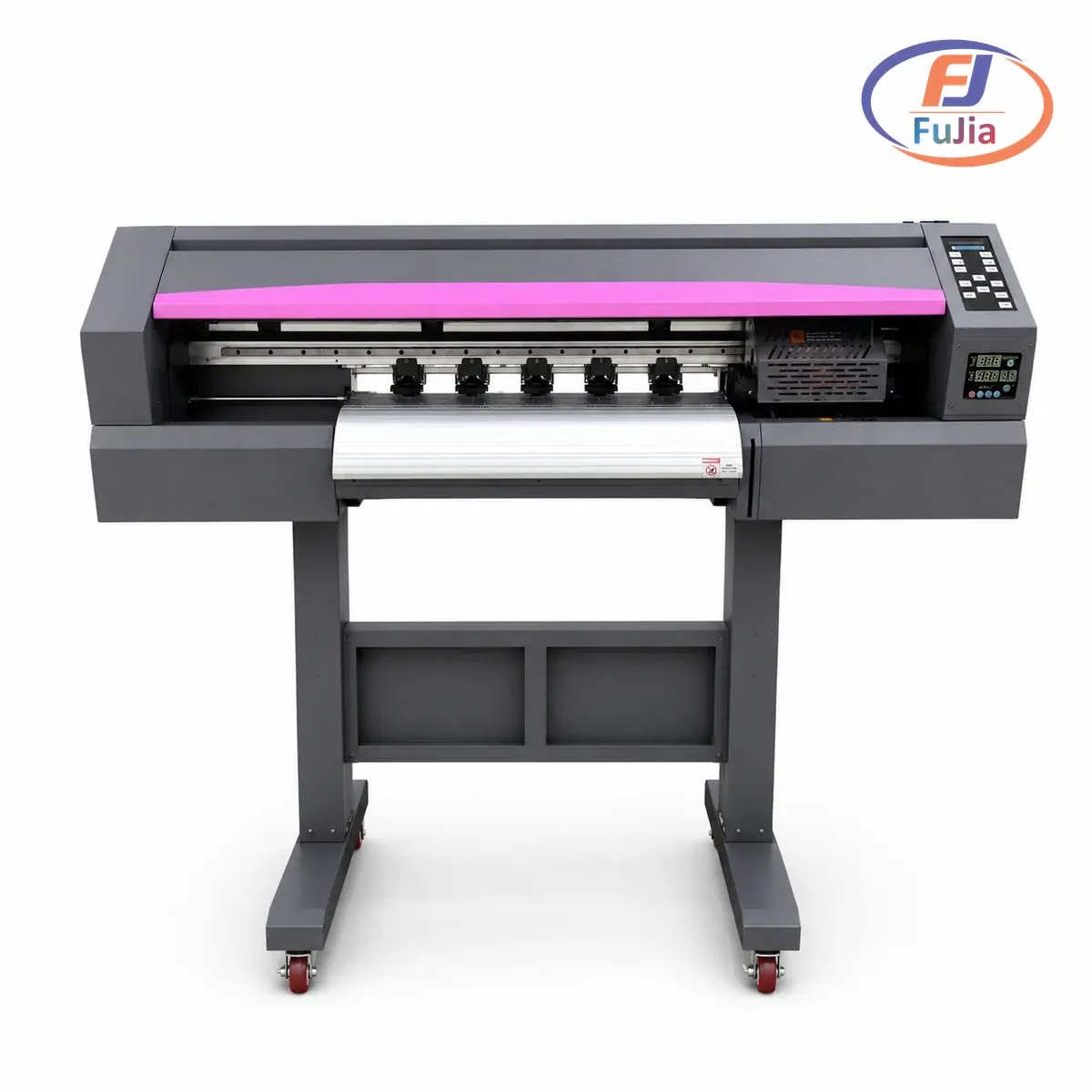
A DTF roll printer prints CMYK plus white ink onto a continuous roll of PET transfer film, which is then powdered, cured, and heat-pressed onto garments. Roll-fed models dominate high-volume DTF production because one roll yields hundreds of transfers without reloading. The global roll-to-roll DTF printer market reached USD 652 million in 2024 and is projected to grow to USD 987 million by 2030 at a 6.9% CAGR, according to Grand View Research.
Key Takeaways
- A DTF roll printer feeds continuous PET film (typically 30 cm to 162 cm wide) through piezoelectric printheads, eliminating the sheet-by-sheet reloading of desktop A3/A4 models.
- Roll-to-roll DTF printer prices range from USD 1,399 for entry-level desktop roll units (Punehod A4 L800) to USD 13,995 for production-grade dual-head machines (Uninet 6000).
- The Epson SureColor G6070 offers a 35.4-inch (90 cm) print width with a PrecisionCore Micro TFP printhead and 1,200 x 600 dpi resolution, while the Roland BY-20 covers 20 inches at 1,440 dpi.
- Buyers should match printhead configuration, roll width, and monthly transfer volume to their production targets before committing to a specific model.
- Fujia Print manufactures A1 DTF roll printers with 650 mm print width, 27 m²/hr output at 4-pass, and an Honson mainboard plus Leadshine servo motor and THK guide rail for continuous 12-hour runs.
What Is a DTF Roll Printer?
A DTF roll printer is a direct-to-film printing machine that pulls a continuous roll of coated PET film through one or more piezoelectric printheads. The printheads deposit CMYK ink for color and white ink for opacity onto the film surface. After printing, the film passes through an adhesive powder shaker, enters a curing oven, and is then heat-pressed onto fabric at approximately 160 degrees Celsius for 15 seconds with a cold peel.
The defining feature of a roll-fed DTF printer is the media handling system. Sheet-fed desktop DTF printers (A3 or A4 size) require manual loading of individual film sheets, which caps daily output at roughly 50 to 100 transfers depending on operator speed. A DTF roll printer, by contrast, can print gang sheets containing dozens of designs on a single continuous web. One 100-meter roll of 60 cm wide film yields approximately 600 to 900 individual transfer designs, depending on design size and nesting efficiency.
Roll-fed DTF printers fall into three width categories. Desktop roll models (30 to 42 cm wide) serve hobbyists and small Etsy shops. Mid-range models (50 to 65 cm wide, A1 format) handle small-to-medium commercial operations at 8 to 27 m²/hr. For a broader overview of DTF printers across all form factors, the A1 industrial class represents the sweet spot between speed and footprint. Wide-format production machines (90 cm and above, such as the Epson G6070 at 35.4 inches or the Uninet 6000 at 162 cm) serve print factories running multiple shifts per day.
(TOC triggers here)
DTF Roll Printer Specs: What Matters Most
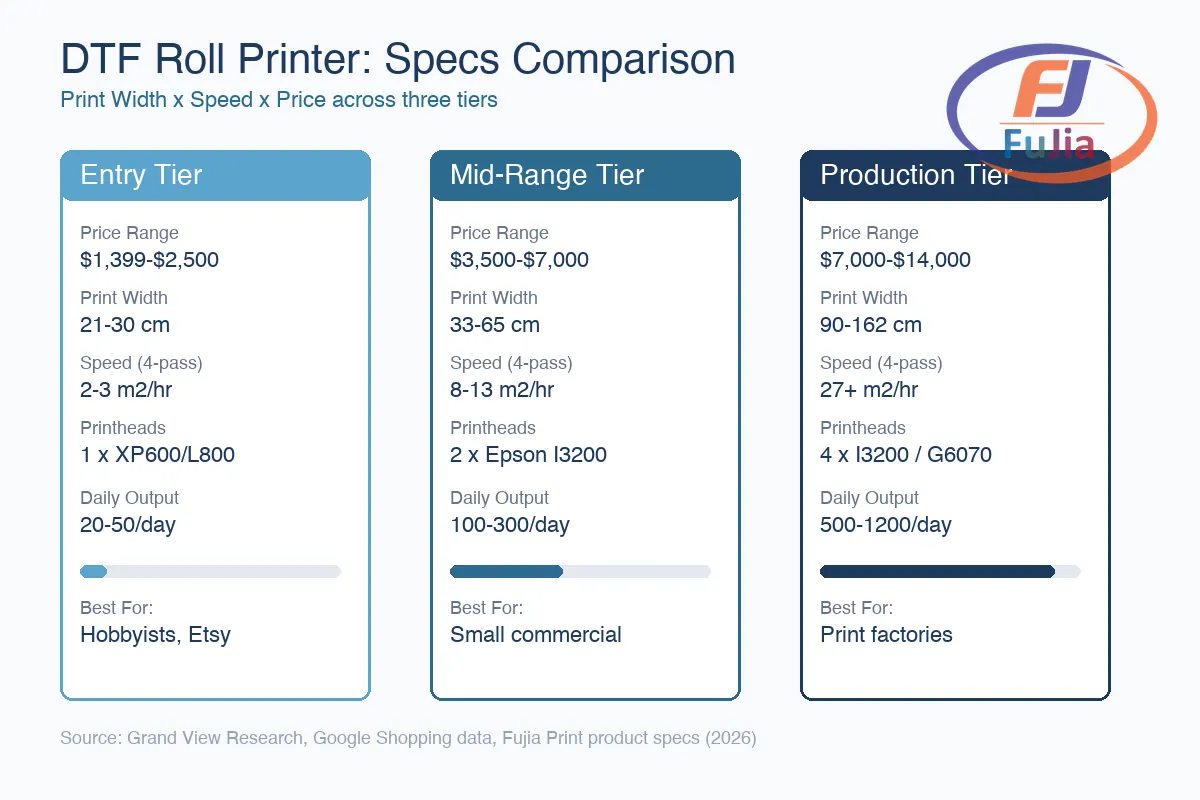
Three specifications determine a DTF roll printer’s production capacity: print width, printhead configuration, and rated speed at a given pass count.
Print width dictates how many designs fit side by side on the film web. A 60 cm (A1) width fits two columns of standard 30 cm chest designs. A 90 cm width fits three columns, increasing per-linear-meter yield by roughly 50%. The Epson SureColor G6070 maximizes this with a 35.4-inch (90 cm) maximum media width, fitting oversized graphics like full-back hoodie prints in a single pass.
Printhead configuration controls both speed and ink coverage quality. Single-head machines using one Epson XP600 deliver 2 to 3 m²/hr, adequate for a shop producing 20 to 50 transfers per day. Dual-head machines with two Epson I3200 printheads reach 8 to 13 m²/hr at 4-pass. Four-head machines like the Fujia A1 DTF 4-Head achieve 27 m²/hr at 4-pass, which translates to approximately 800 to 1,200 finished transfers per 8-hour shift depending on design complexity.
Rated speed varies by pass count, and buyers must verify the pass level quoted by the manufacturer. A machine rated at “27 m²/hr” might only reach that speed at 4-pass draft quality. The same machine at 8-pass (production quality for photographic designs) drops to 17 m²/hr. Always confirm which pass count applies to the advertised speed figure.
DTF Roll Printer Specification Comparison
| Model | Print Width | Printhead(s) | Max Resolution | Speed (4-Pass) | Approx. Price |
|---|---|---|---|---|---|
| Punehod A4 L800 Roll | 21 cm (A4) | 1 x Epson L800 | 5,760 x 1,440 dpi | 2-3 m²/hr | $1,399 |
| Roland BY-20 | 50 cm (20 in) | Piezo inkjet (CMYK+W) | 1,440 dpi | Medium | $6,995 |
| Procolored P13 | 33 cm (A3+) | Epson I3200 | 5,760 x 1,440 dpi | Medium | $3,599 |
| Fujia A1 DTF 2-Head | 65 cm (A1) | 2 x Epson I3200 | 720 x 1,440 dpi | 8-13 m²/hr | Factory-direct |
| Fujia A1 DTF 4-Head | 65 cm (A1) | 4-5 x Epson I3200 | 720 x 2,400 dpi | 27 m²/hr | Factory-direct |
| Epson SureColor G6070 | 90 cm (35.4 in) | PrecisionCore Micro TFP | 1,200 x 600 dpi | Production | $13,495 |
| Uninet 6000 | 162 cm (64 in) | Dual-head | Production | Production | $13,995 |
DTF Roll Printer Pricing Tiers
DTF roll printer prices span an order of magnitude, and understanding the tiers prevents overspending on capacity you do not need or underspending on a machine that cannot keep up.
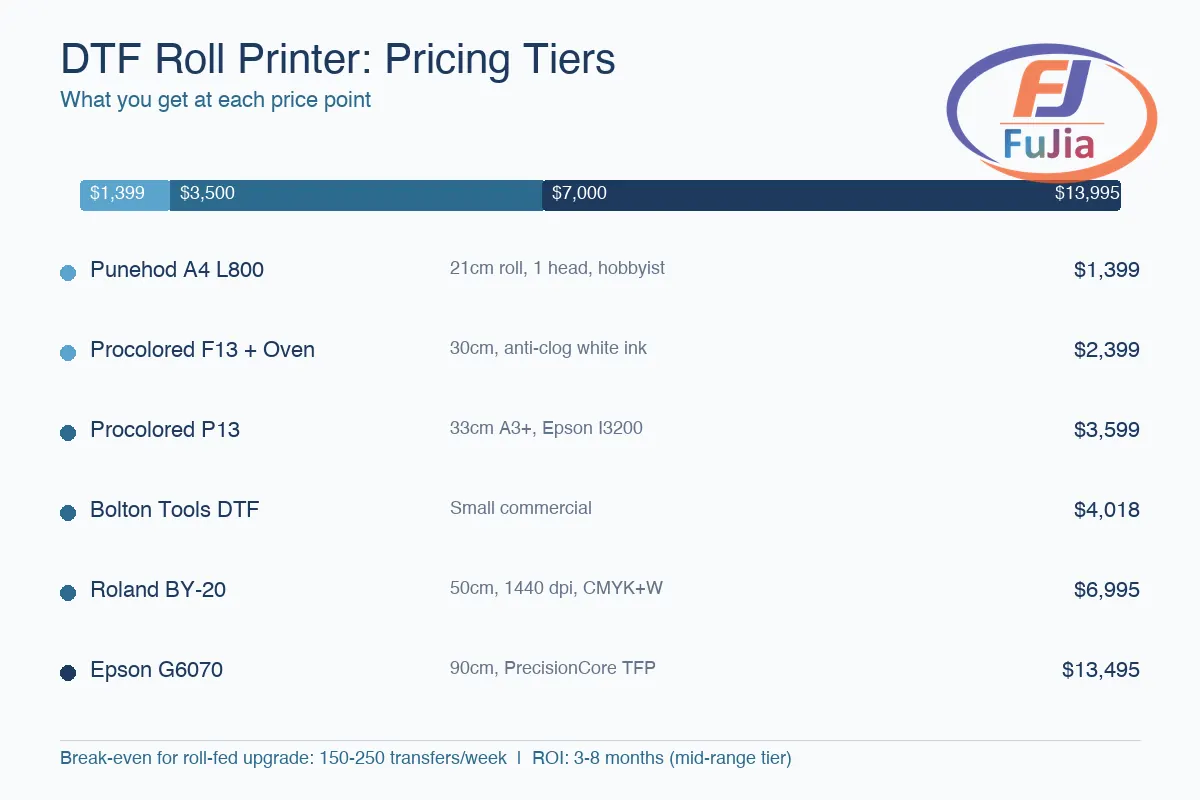
Entry tier ($1,300 to $2,500). Desktop roll printers like the Punehod A4 L800 ($1,399) and HTVRONT D2 ($2,499) use modified Epson desktop engines. These machines print on narrow rolls (21 to 30 cm) and suit hobbyists, Etsy sellers, or startups testing the market at 20 to 50 transfers per day. Build quality, warranty terms, and white ink reliability vary significantly in this tier. The Procolored F8 Panda at $1,599 offers anti-clog white ink circulation, a feature often missing in the cheapest models.
Mid-range tier ($3,500 to $7,000). The Procolored P13 ($3,599), Bolton Tools DTF machine ($4,018), and Roland BY-20 ($6,995) occupy this band. These machines use industrial-grade piezo printheads, offer wider rolls (33 to 50 cm), and target small commercial operations producing 100 to 300 transfers per day. The Roland BY-20 delivers 1,440 dpi resolution with CMYK plus white ink in a 50 cm format.
Production tier ($7,000 to $14,000+). The Epson SureColor G6070 ($13,495) and Uninet 6000 ($13,995) serve print factories running multiple shifts. The G6070’s 90 cm width and sealed 1.6-liter ink packs per color (C, M, Y, K, White, Light Magenta) minimize refill interruptions during long production runs. Factory-direct manufacturers like Fujia Print offer A1-format four-head machines at competitive pricing by eliminating distributor markups, with the added advantage of bundled consumables (ink, film, powder) from a single supplier.
Roll Media: Sizes, Materials, and Compatibility
DTF roll printers consume coated PET film, and the roll specifications directly affect print quality and transfer durability.
Standard roll widths match the printer’s print width. Common sizes include 30 cm (A3 desktop), 42 cm (A2), 60 cm (A1), and 90 cm (wide-format). The Epson G6070 accepts rolls up to 35.4 inches wide with a 2-inch or 3-inch core diameter and a maximum roll weight of 22 pounds (10 kg). The maximum roll diameter is 5.9 inches (15 cm).
Film coating types fall into two categories: cold peel and hot peel. Cold peel film requires waiting for the film to cool completely (approximately 30 seconds) after heat pressing before removing it, which produces a matte finish and sharper edges. Hot peel film can be removed immediately after pressing, which speeds production but may produce slightly softer edges on fine text. Both types use a proprietary coating that controls ink absorption and release characteristics.
Film thickness typically ranges from 50 to 100 microns. Thinner film (50 to 75 microns) runs more smoothly through high-speed roll-fed machines but tears more easily during handling. Thicker film (75 to 100 microns) resists wrinkling but may require adjusted printhead heights. PET film exhibits a glass transition temperature between 70 and 80 degrees Celsius, which keeps the film dimensionally stable during the 160-degree heat press transfer without warping or shrinking. Fujia Print’s A1 DTF film uses a Hengli virgin PET base with a self-developed coating refined through five years of R&D iteration, offering consistent ink absorption across production batches. For a deeper look at how DTF transfer film chemistry affects print quality, see our DTF transfer film guide.
DTF Roll Printer vs Sheet-Fed: When to Upgrade
The decision between a sheet-fed desktop DTF printer and a roll-fed model comes down to daily transfer volume and gang sheet efficiency.
Sheet-fed A3 desktop printers work well for shops producing fewer than 50 transfers per day with varied, one-off designs. The operator manually loads each A3 sheet, prints, powders, cures, and presses. Total cycle time per sheet runs 4 to 6 minutes including handling. At 50 sheets per day, the operator spends roughly 4 to 5 hours on active printing.
Roll-fed DTF printers justify their higher cost when daily volume exceeds 100 to 150 transfers or when gang sheet nesting can combine multiple designs per linear foot of film. A roll-fed machine with automated powder shaker and curing oven runs as a continuous production line. The operator loads a 100-meter roll, queues dozens of designs in the RIP software, and the machine prints, powders, and cures without manual intervention between transfers.
Based on data from our customers across 50+ countries, the break-even point for upgrading from sheet-fed to roll-fed typically falls between 150 and 250 transfers per week. Below that volume, the higher machine cost and larger physical footprint (roll-fed machines with shaker and oven require 4 to 8 m² of floor space) do not pay back quickly enough. Above that volume, the labor savings from eliminating manual sheet loading become the single largest cost reduction in the production line.
Choosing the Right Roll Size for Your Operation
DTF film rolls come in standard lengths of 50 meters, 100 meters, and occasionally 200 meters for wide-format machines. The right roll size depends on storage conditions, monthly consumption, and printer core compatibility.
| Roll Width | Typical Printer Class | Monthly Film Usage (50 transfers/day) | Recommended Roll Length | Storage Life |
|---|---|---|---|---|
| 30 cm (A3) | Desktop | 15-20 meters | 50 meters | 3-4 months |
| 42 cm (A2) | Small commercial | 20-30 meters | 50-100 meters | 3-4 months |
| 60 cm (A1) | Mid-range industrial | 30-50 meters | 100 meters | 2-3 months |
| 90 cm+ (Wide) | Production factory | 80-150 meters | 100-200 meters | 1-2 months |
A shop consuming 30 to 50 transfers per day on an A1 machine uses approximately 30 to 50 meters of film per month. A 100-meter roll lasts two to three months. Storing film longer than six months risks coating degradation, especially in humid environments above 65% relative humidity. For shops in tropical climates, purchasing 50-meter rolls and rotating stock more frequently prevents moisture-related ink adhesion problems.
The core diameter must match the printer’s roll holder. Desktop roll printers typically use 2-inch cores. Industrial A1 and wide-format machines accept both 2-inch and 3-inch cores. The Epson G6070 supports both core sizes with a maximum roll weight of 22 pounds. Verify the core diameter specification before ordering bulk film, as mismatched cores require adapter rings that can introduce wobble and tracking errors during printing.
What printer is best for DTF transfers?
The best DTF printer depends on production volume and budget. For entry-level shops producing 20 to 50 transfers per day, the Procolored F13 ($2,399) or Punehod A4 L800 ($1,399) provide adequate output at low cost. For commercial operations handling 200+ transfers daily, a roll-fed machine with dual or quad Epson I3200 printheads delivers the necessary speed. The Epson SureColor G6070 ($13,495) offers a 35.4-inch print width with PrecisionCore Micro TFP technology and OEKO-TEX certified UltraChrome DF inks. Factory-direct manufacturers like Fujia Print provide A1 four-head DTF printers producing 27 m²/hr at 4-pass with Honson mainboard and Leadshine servo motor integration for 12-hour continuous production runs. The key matching criteria are: daily transfer target divided by 8-hour shift speed, fabric types (cotton requires white ink opacity), and available floor space for the printer, shaker, and curing oven combination.
Is owning a DTF printer worth it?
Owning a DTF printer becomes profitable when your weekly transfer volume exceeds approximately 150 to 250 pieces, based on aggregate data from print businesses across 50+ countries. Below that volume, outsourcing transfers or using a sheet-fed desktop machine costs less. The main cost components are: machine depreciation ($1,400 to $14,000 spread over 3 to 5 years), consumables (ink at $0.05 to $0.15 per A3-size transfer, film at $0.02 to $0.05 per transfer, powder at $0.01 to $0.03 per transfer), and labor ($12 to $25 per hour depending on region). A shop charging $3 to $6 per custom transfer typically reaches break-even at 30 to 60 transfers per day on a mid-range machine. The Turkish garment factory case study demonstrated a 40% throughput increase and 30% cost reduction after switching to a Fujia A1 dual-head DTF roll printer, reducing delivery times from 7 days to 2.5 days for small-batch orders.
How much does a DTF printer cost?
DTF printer prices range from $1,399 for entry-level desktop roll printers to $13,995 for production-grade wide-format machines. The Google Shopping data for DTF roll printers shows: Punehod A4 L800 at $1,399, Procolored F8 Panda at $1,599, Procolored F13 with oven at $2,399, HTVRONT D2 at $2,499, Procolored P13 at $3,599, Bolton Tools DTF machine at $4,018, Swing Design DTF bundle at $4,999, Roland BY-20 at $6,995, Epson SureColor G6070 at $13,495, and Uninet 6000 dual-head at $13,995. The price jumps reflect printhead quality (modified desktop engines versus industrial piezo heads), print width (21 cm to 162 cm), and included accessories (shaker, oven, RIP software). Factory-direct suppliers like Fujia Print reduce the mid-range price point by eliminating distributor markups while maintaining industrial-grade components such as THK silent guide rails and dual-section heating systems.
What is a DTF roll?
A DTF roll is a continuous web of coated PET (polyethylene terephthalate) film used in roll-fed direct-to-film printing. The film roll feeds through a DTF roll printer, where piezoelectric printheads deposit CMYK ink plus white ink onto the coated surface. The printed film then passes through an adhesive powder shaker that applies hot-melt adhesive powder, followed by a curing oven that melts the powder into the ink layer. The cured transfer is heat-pressed onto fabric at approximately 160 degrees Celsius for 15 seconds with a cold peel. DTF rolls come in widths from 30 cm (A3 desktop) to 162 cm (wide-format production), lengths of 50 to 200 meters, and core diameters of 2 or 3 inches. The PET base provides dimensional stability during printing, while the proprietary coating controls ink absorption and enables clean release during the heat press transfer step. PET film’s glass transition temperature of 70 to 80 degrees Celsius ensures the film remains stable during the 160-degree heat press without warping.
Conclusion
A DTF roll printer transforms garment decoration from a batch-by-batch process into a continuous production line, with prices and capacities scaling from $1,399 desktop units to $13,995 wide-format machines. For factory-direct DTF roll printers with A1 industrial specs, bundled consumables, and lifetime engineering support, explore the Fujia Print lineup.
Sources
- Grand View Research: Roll-to-Roll Printers DTF Market: Market size USD 652M (2024) growing to USD 987M (2030) at 6.9% CAGR.
- Epson SureColor G6070 Official Specification Sheet: 35.4-inch print width, PrecisionCore Micro TFP printhead, 1,200 x 600 dpi, 1.6L ink packs.
- Epson News: SureColor G6070 Launch Announcement: First wide-format DTFilm printer, launched April 2025, Fiery Digital Factory software included.
- ScienceDirect: PET Glass Transition Temperature Reference: PET glass transition temperature (Tg) of 70 degrees Celsius, melting point of 240 degrees Celsius, confirming dimensional stability during 160-degree heat press.
