

DTF transfer durability refers to the ability of direct-to-film printed designs to resist fading, cracking, and peeling through repeated machine washing cycles. Properly produced DTF transfers last 50-100 wash cycles at Grade 4-5 colorfastness on the AATCC scale, making DTF one of the most durable digital decoration methods for cotton, polyester, and blended fabrics. Fujia Print calibrates every DTF system to achieve 50+ wash cycles verified through AATCC 61 accelerated laundering tests in the Guangzhou testing center.
Key Takeaways
- DTF transfers survive 50-100 home laundering cycles when produced with correct parameters: 160 degrees C, 15 seconds, 1.5-2.5 kg/cm2 pressure, cold peel.
- The AATCC 61 accelerated wash test simulates 5 home washes in one 45-minute cycle at 49 degrees C, providing the industry standard for colorfastness evaluation.
- DTF failure modes include fading (Grade 3 or below on Gray Scale), cracking (micro-tears from insufficient adhesive melt), and edge peeling (adhesion failure from incomplete curing).
- Colorfastness Grade 4-5 indicates negligible color change after testing, which is the commercial acceptance threshold for retail apparel.
- Unused DTF transfers stored at room temperature retain bonding capability for up to 3 years, making them suitable for inventory and seasonal production.
What Determines DTF Transfer Durability?
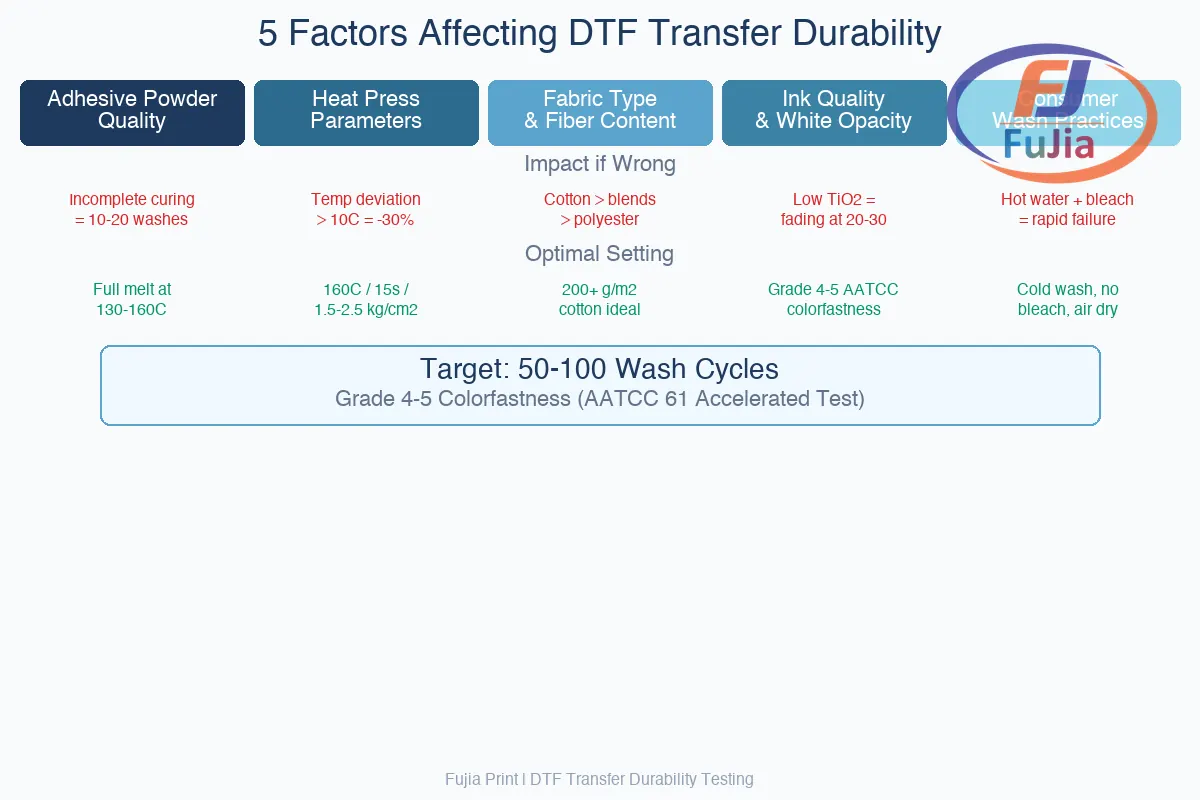
DTF transfer durability is determined by five factors that interact during both production and consumer use. Each factor must be controlled within specific parameters to achieve the 50-100 wash cycle benchmark that defines commercial-grade DTF performance.
Factor 1: Adhesive Powder Quality and Application
The TPU adhesive powder creates the bond between ink and fabric. Thermoplastic polyurethane powder with a melting point of 110-125 degrees C must fully melt during the curing stage to form a continuous gel layer. Incomplete curing, caused by insufficient oven temperature (below 130 degrees C) or short dwell time (under 60 seconds), leaves unmelted powder particles that create weak points in the adhesive matrix. The quality of the DTF transfer film also matters: film with inconsistent coating thickness causes uneven powder adhesion. Transfers with properly cured adhesive withstand 50+ washes. Transfers with partially cured adhesive may fail after 10-20 washes.
Factor 2: Heat Press Parameters
The heat press transfer stage re-melts the adhesive at 160 degrees C for 15 seconds with 1.5-2.5 kg/cm2 pressure. Temperature deviation of more than 10 degrees C below the target significantly reduces adhesion. Pressure that is too low (under 1.0 kg/cm2) fails to force molten adhesive into fabric interstices. Cold peel timing is critical: removing the film before the adhesive solidifies causes ink smearing, while delayed peeling does not affect durability but may make film removal more difficult.
Factor 3: Fabric Type and Fiber Content
DTF transfers bond mechanically to fabric fibers through adhesive penetration. Natural fibers like cotton provide excellent adhesion because their irregular surface texture creates a strong mechanical interlock with TPU adhesive. Polyester fibers have a smoother surface that reduces mechanical bonding, though DTF still achieves 40-60 wash cycles on polyester. Fabric blends (50/50 cotton-polyester) perform between the two extremes. Fabric weight matters: heavyweight fabrics (200+ g/m2) provide better adhesion surfaces than lightweight fabrics (under 120 g/m2).
Factor 4: Ink Quality and White Ink Opacity
The white ink underbase in DTF printing serves as both a color barrier (preventing fabric color from showing through CMYK layers) and an adhesion promoter (the white ink layer carries the adhesive powder). White ink with high TiO2 content (titanium dioxide, refractive index 2.75) provides better opacity and UV resistance. Low-quality white inks with insufficient pigment loading produce transfers that fade visibly after 20-30 washes, compared to Grade 4-5 performance from properly formulated inks.
Factor 5: Consumer Washing Practices
Even perfectly produced DTF transfers degrade faster under harsh washing conditions. Hot water washing (60 degrees C and above) softens TPU adhesive over time, reducing bond strength by approximately 15-20% after 50 cycles compared to cold water washing. Chlorine bleach attacks both the ink pigments and the adhesive polymer, causing rapid fading and adhesion failure. Fabric softeners coat the transfer surface with a hydrophobic layer that can reduce breathability and affect appearance without directly reducing bond strength.
Industry Testing Standards for DTF Durability
Professional DTF durability testing follows two internationally recognized standards that provide objective, reproducible measurements of wash performance.
AATCC 61: Accelerated Colorfastness to Laundering
AATCC Test Method 61 is the primary standard for evaluating textile colorfastness to laundering in North America. The test simulates 5 home laundering cycles in a single 45-minute accelerated procedure. Test specimens are placed in stainless steel canisters with detergent solution and steel balls at 49 degrees C (Method 2A). The steel balls create abrasive action mimicking mechanical washing stress.
After the test cycle, specimens are evaluated using the Gray Scale for Color Change. Grade 5 indicates no visible color change. Grade 4-5 indicates negligible change (commercial acceptance threshold). Grade 3 or below indicates noticeable color loss. Running the AATCC 61 test ten times approximates 50 home washes, providing a reliable durability prediction in under one day of testing.
AATCC 135: Dimensional Changes After Laundering
AATCC TM135 measures fabric dimensional stability through controlled washing and drying cycles. While primarily a fabric shrinkage test, it provides data on whether the DTF transfer distorts or wrinkles when the underlying fabric changes dimensions. A DTF transfer applied to fabric with excessive shrinkage (over 5%) may develop wrinkles or micro-cracks that compromise appearance and adhesion.
Durability Comparison: DTF vs Other Decoration Methods
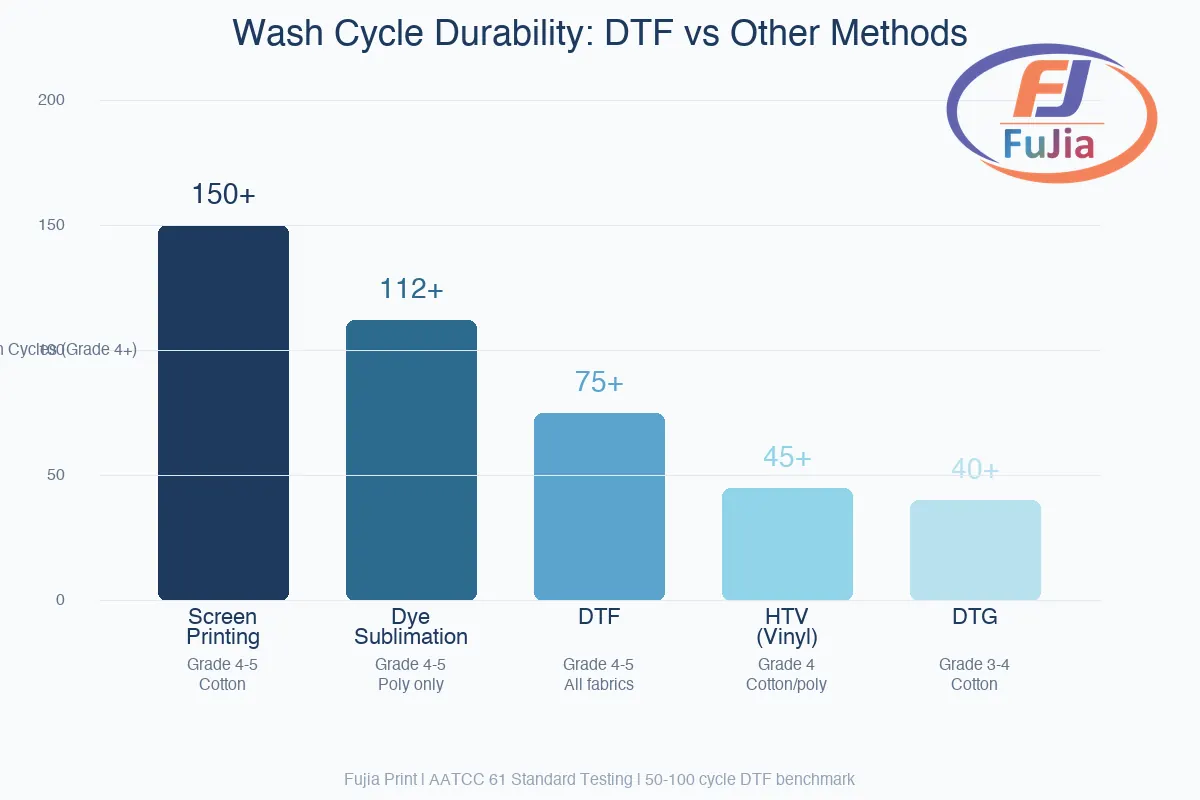
DTF transfer durability compares favorably to other digital and traditional decoration technologies. The comparison below uses standardized testing data from AATCC and ISO procedures.
Wash Cycle Comparison Table
| Decoration Method | Wash Cycles (Grade 4+) | Color Fastness | Crack Resistance | Peel Resistance | Best Fabric |
|---|---|---|---|---|---|
| DTF | 50-100 cycles | Grade 4-5 | High (TPU flexibility) | High | Cotton, poly, blends |
| Dye Sublimation | 75-150 cycles | Grade 4-5 | Very high (dye in fiber) | N/A (no adhesive) | Polyester only |
| Heat Transfer Vinyl | 40-50 cycles | Grade 4 | Medium (rigid vinyl) | Medium | Cotton, poly |
| Screen Printing | 100-200 cycles | Grade 4-5 | Very high (plastisol) | Very high | Cotton primarily |
| DTG (Direct-to-Garment) | 30-50 cycles | Grade 3-4 | Medium | Medium | Cotton primarily |
DTF’s advantage over DTG lies in the adhesive layer: DTF powder creates a stronger mechanical bond than DTG ink-to-fiber absorption. DTF’s advantage over HTV is versatility: DTF works on any fabric color, while HTV requires different products for light and dark garments. Sublimation outlasts DTF on polyester because the dye becomes part of the fiber rather than sitting on top. Screen printing remains the most durable option but requires high setup costs and large minimum order quantities.
Common DTF Failure Modes and Prevention
Understanding why DTF transfers fail helps operators prevent the most common durability problems. Each failure mode has a specific root cause and a corresponding prevention strategy.
Fading (Color Loss)
Fading appears as gradual lightening of the transfer after repeated washing. The primary cause is low pigment loading in the ink, particularly in the white underbase. Prevention: use high-quality DTF inks with verified TiO2 content. Test new ink batches by printing a solid white block and measuring opacity with a spectrophotometer before production runs. Secondary causes include UV exposure during storage and hot water washing by the end consumer.
Cracking
Cracking appears as fine lines or splits in the transfer surface, usually visible when the fabric is stretched. The primary cause is insufficient adhesive melt during curing or transfer, which leaves the TPU layer brittle rather than flexible. Prevention: verify oven temperature reaches 130-160 degrees C with a contact thermometer, and confirm heat press temperature accuracy within +/- 5 degrees C. Using fine-grade powder (0-80 micrometers) instead of medium-grade also reduces cracking on lightweight fabrics because finer particles melt more uniformly.
Edge Peeling
Edge peeling begins at corners and sharp angles in the design, where the adhesive surface area is smallest relative to the mechanical stress. The primary cause is incomplete powder coverage at transfer edges. Prevention: ensure powder shaker distributes powder evenly to all edges, and verify that excess powder is removed from non-inked areas before curing. Increasing heat press pressure by 0.5 kg/cm2 at edges (using a edge-specific second press) can improve adhesion by 10-15%.
How to Maximize DTF Transfer Lifespan
Maximizing DTF transfer lifespan requires attention to both production parameters and consumer care instructions. Based on data from our customers across 50+ countries, transfers produced with calibrated equipment and paired with proper care instructions achieve 80-100 wash cycles consistently.
Production Best Practices
- Calibrate heat press temperature weekly using a surface thermometer. Temperature drift of 10 degrees C reduces wash durability by 20-30%.
- Verify powder coverage by inspecting cured film under bright light. Translucent areas indicate insufficient powder.
- Run AATCC 61 wash tests on new fabric types before accepting production orders. Testing costs USD 50-100 per sample but prevents costly recalls.
- Maintain 35-65% relative humidity in the printing area. Low humidity increases static, causing uneven powder distribution. High humidity causes powder clumping.
- Use medium-grade powder (70-170 micrometers) for general apparel. Fine grade for lightweight fabrics, coarse grade only for heavy workwear.
Consumer Care Instructions
- Wash DTF garments inside-out in cold water (under 30 degrees C)
- Use mild detergent without bleach or fabric softener
- Tumble dry on low heat or hang dry
- Do not iron directly on the transfer; use a cover sheet if ironing is necessary
- Store garments folded rather than hung to prevent transfer stretching
How long can a DTF transfer last?
A properly produced DTF transfer lasts 50-100 machine wash cycles when cared for according to manufacturer instructions. The DTF process uses thermoplastic polyurethane adhesive powder melted at 160 degrees C for 15 seconds, creating a bond that achieves Grade 4-5 colorfastness on the AATCC Gray Scale. In terms of calendar time, a garment worn once per week and washed after each wear translates to 50-100 weeks, or approximately 1-2 years of regular use before visible degradation appears. Transfers produced with high-quality TPU powder, properly cured at 130-160 degrees C, and heat-pressed at the correct temperature and pressure consistently reach the upper end of this range. Transfers made with budget powder or incomplete curing may show fading or cracking after 20-30 washes.
What are the disadvantages of DTF transfers?
DTF transfers have several disadvantages compared to alternative decoration methods. First, the transfer has a slightly heavier hand feel than direct-to-garment (DTG) printing because the adhesive layer adds approximately 20-40 grams per square meter to the fabric surface. Second, DTF transfers can reduce fabric breathability in the printed area, since the TPU adhesive and ink layers create a barrier to moisture vapor transmission. Third, DTF requires a multi-step production process (print, powder, cure, press) that involves more equipment than DTG or sublimation. Fourth, DTF white ink requires daily agitation to prevent TiO2 pigment settling, adding maintenance time. Fifth, the cost per transfer (USD 0.30-0.60 per A3 sheet including film, ink, and powder) is higher than screen printing for large runs above 500 pieces.
Which lasts longer, DTF or vinyl?
DTF transfers generally last longer than heat transfer vinyl (HTV). DTF achieves 50-100 wash cycles at Grade 4-5 colorfastness, while HTV typically achieves 40-50 wash cycles before showing signs of cracking or peeling. The durability difference stems from material chemistry: DTF uses flexible thermoplastic polyurethane adhesive that stretches with fabric, while most HTV products use a more rigid polyurethane film that resists stretching and develops micro-cracks over time. DTF also offers full-color photographic reproduction, while HTV is limited to solid colors cut from pre-colored sheets. DTF applies to any fabric color in a single step, while HTV requires separate light and dark products. The primary advantage of HTV over DTF is lower equipment cost: HTV requires only a vinyl cutter and heat press (USD 500-1,500 total), while DTF requires a dedicated printer, powder shaker, and curing oven (USD 2,000-15,000 total).
Does DTF crack or peel?
DTF transfers do not crack or peel when produced and applied correctly, but they can fail under specific conditions. Cracking occurs when the TPU adhesive is insufficiently melted during curing or heat pressing, leaving a brittle rather than flexible bond. The cure temperature must reach 130-160 degrees C for 60-120 seconds in the oven, and the transfer temperature must reach 160 degrees C for 15 seconds in the heat press. Peeling occurs at transfer edges when powder coverage is incomplete or when pressure is uneven across the platen. Using fine-grade powder (0-80 micrometers) on lightweight fabrics and medium-grade powder (70-170 micrometers) on standard apparel prevents most cracking issues. Regular heat press calibration (weekly temperature verification with a surface thermometer) and AATCC 61 wash testing on new fabric types catch adhesion problems before they reach customers.
Conclusion
DTF transfer durability of 50-100 wash cycles places DTF among the most reliable digital decoration methods for commercial apparel production. Controlling adhesive quality, heat press accuracy, ink formulation, and consumer care practices ensures transfers that maintain appearance through the garment’s usable life. For factory-tested DTF systems calibrated to deliver 50+ wash durability, explore the Fujia Print DTF product line.
Sources
- AATCC Test Method 61: Colorfastness to Laundering, Accelerated: Industry standard for accelerated wash durability testing, simulating 5 home laundering cycles in 45 minutes at 49 degrees C with steel ball abrasion.
- AATCC Test Method 135: Dimensional Changes of Fabrics after Home Laundering: Standard for evaluating fabric shrinkage and dimensional stability that affects transfer adhesion integrity.
- ScienceDirect: TPU Nanocomposites for Thermal Transfer Printing: Academic research demonstrating TPU/TiO2 nanocomposite adhesion strength, water resistance, and optical opacity for DTF applications on dark fabrics.
