

DTF PET film is a coated polyethylene terephthalate sheet used as the ink-receptive carrier in direct-to-film printing. DTF PET film receives pigment ink and adhesive powder, then releases the design onto fabric under heat press, producing transfers rated for 50 or more wash cycles on cotton garments.
Key Takeaways
- PET film is single-use, designed for one transfer cycle, not reusable.
- Three peel types govern workflow: hot peel (instant), warm peel (10-15 seconds), and cold peel (full cool-down).
- Standard thickness ranges from 75 to 100 micrometers, with 100-micrometer film preferred for industrial production stability.
- Double-sided matte coating prevents static and improves printer feed reliability over single-sided alternatives.
- The global DTF printing market reached USD 2.72 billion in 2024, growing at 6 percent annually through 2030.
What Is DTF PET Film?
DTF PET film is a polyethylene terephthalate substrate coated with an ink-receptive layer that holds printed designs during the direct-to-film transfer process. The film serves as a temporary carrier: a DTF printer deposits CMYK and white ink onto the coated surface, hot-melt adhesive powder is applied to the wet ink, and the combination is heat-pressed onto fabric where the design permanently bonds to textile fibers while the PET carrier is peeled away.
Polyethylene terephthalate is the same polymer used in beverage bottles and food packaging, chosen for DTF film because of its dimensional stability at transfer temperatures. PET has a glass transition temperature of approximately 70 to 80 degrees Celsius and a melting point of 250 to 260 degrees Celsius, meaning the film maintains structural integrity during heat pressing at 150 to 165 degrees Celsius without warping or shrinking.
The coating on DTF PET film is the critical differentiator between commodity polyester film and transfer-grade PET film. This proprietary coating controls ink absorption, powder adhesion, and release behavior, directly determining color vibrancy, print resolution, and wash durability of the final transfer. For a broader overview of the entire DTF transfer film category including non-PET options, see our companion DTF transfer film article.
(TOC triggers here)
DTF PET Film Types by Peel Method
Peel method is the primary classification for DTF PET film because it determines production speed, finish quality, and operator workflow.
| Peel Type | Timing | Finish | Best For | Production Speed |
|---|---|---|---|---|
| Hot Peel | Immediately after pressing | Matte, soft hand feel | High-volume production | Fastest |
| Warm Peel | 10-15 seconds cooling | Balanced matte/gloss | General-purpose workflows | Medium |
| Cold Peel | Full cool to room temperature | Glossy, vibrant colors | Detailed designs, premium finish | Slowest |
| Three-in-One | Supports all three | Variable | Maximum flexibility | Flexible |
Hot peel film allows operators to remove the carrier immediately after lifting the heat press, which eliminates cooling wait time and suits high-volume garment factories running continuous batch cycles. Cold peel film requires complete cool-down before removal, which typically takes 30 to 60 seconds per garment, but produces a glossier surface finish preferred for retail-quality apparel. Three-in-one film supports all peel temperatures, giving shops flexibility when processing mixed order types.
Thickness and Coating Specifications
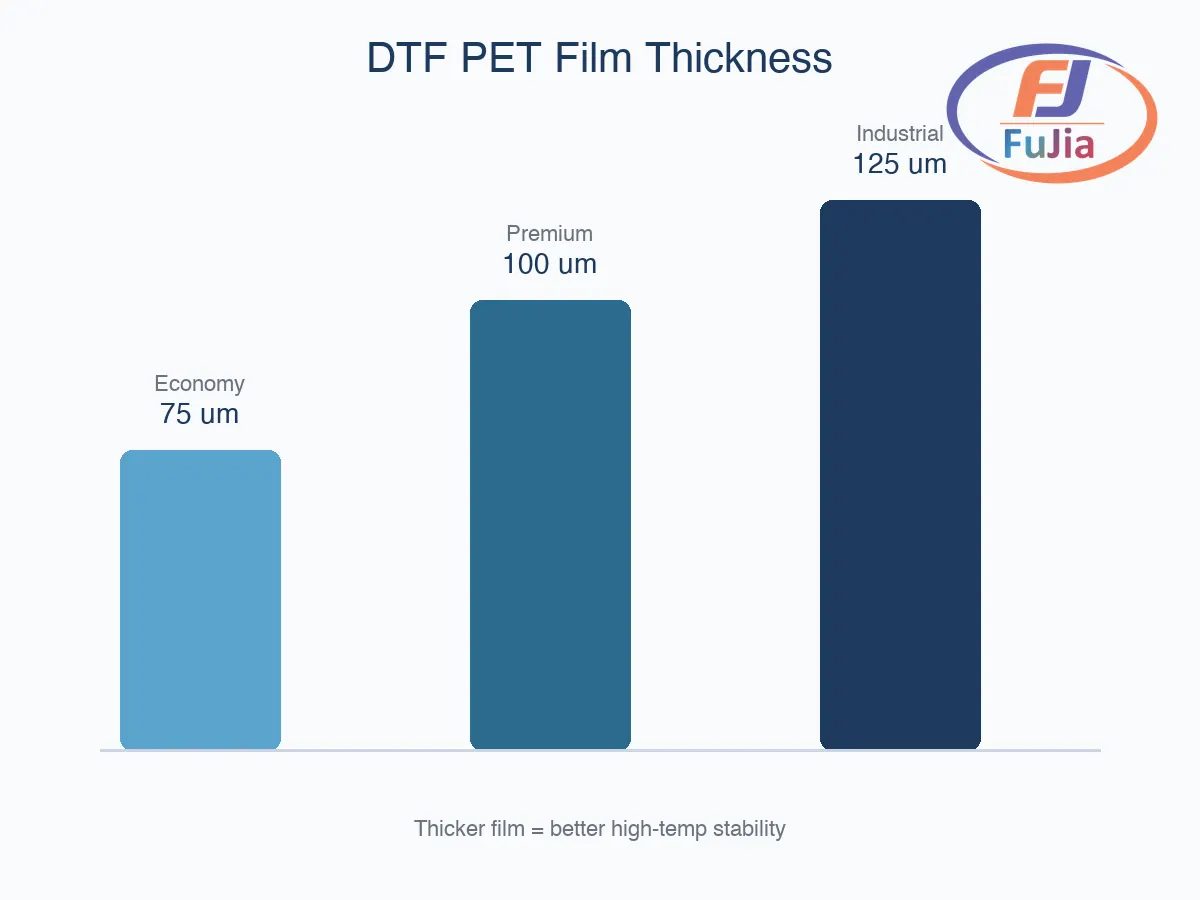
DTF PET film thickness directly impacts dimensional stability during printing and heat pressing. The industry offers three standard thickness tiers.
| Thickness | Stability | Application | Price Tier |
|---|---|---|---|
| 75 micrometers | Standard | Desktop A3/A4 printers, short runs | Economy |
| 100 micrometers | High | Industrial A1 roll printers, mass production | Premium |
| 125-130 micrometers | Maximum | Heavy-duty, high-temperature environments | Premium Plus |
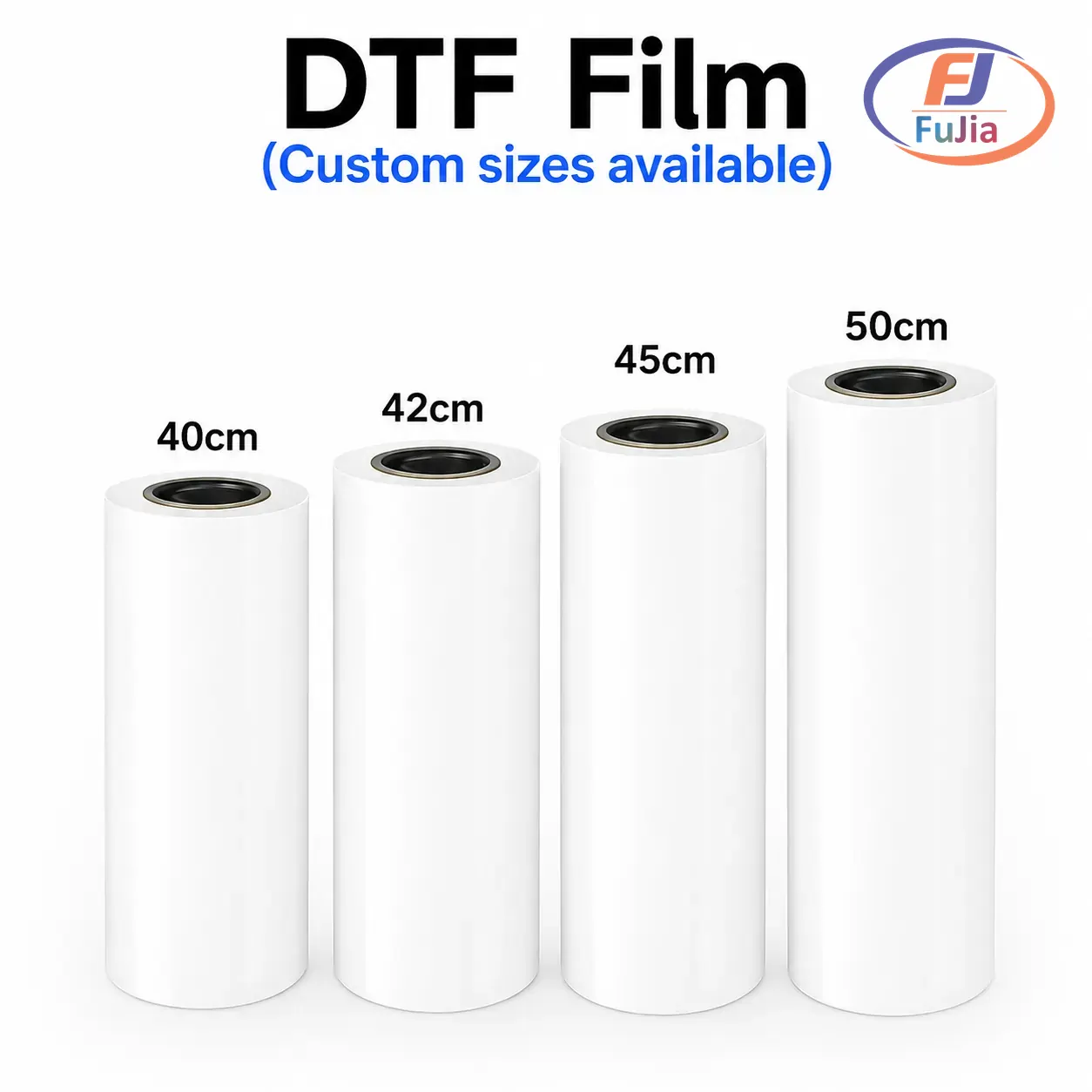
Fujia Print’s DTF film line, developed through 5 years of iterative R&D, uses Hengli virgin PET base material with a proprietary cold and hot peel coating formula. The A1 roll format (65cm width), A2 roll (42cm width), and A3 roll (30cm width) cover the full printer size range from desktop to industrial.
Single-sided coating applies ink-receptive treatment to one surface only, leaving the reverse side glossy. Double-sided coating applies the treatment to both surfaces, creating a matte finish on both sides that increases friction and prevents film slipping during printer feed. Double-sided matte film reduces static buildup in dry environments, which is a common cause of registration errors on high-speed DTF printers.
Single-Sided vs Double-Sided DTF Film
The coating configuration determines how the film behaves in the printer and how reliably it feeds during long production runs.
Single-sided film has one matte coated side for printing and one glossy uncoated side. The glossy reverse makes the printable side easy to identify by touch and visual inspection. Single-sided film works well for controlled environments with moderate humidity (40 to 60 percent RH) where static is manageable.
Double-sided film features matte coating on both surfaces. The dual-matte construction increases friction between the film and printer feed rollers, improving transport reliability on machines that process long continuous rolls. Double-sided film also minimizes static-related issues in low-humidity production environments where dry conditions cause film to cling and misfeed.
DTF PET Film Sizes and Formats
DTF PET film is available in two formats: pre-cut sheets for desktop printers and continuous rolls for industrial machines.
| Format | Sizes | Typical Use | Printer Type |
|---|---|---|---|
| Sheets | A4 (210x297mm), A3 (297x420mm), Letter (8.5x11in), Tabloid (11x17in) | Small batches, custom orders, startups | A3/A4 desktop DTF |
| Rolls | 30cm, 33cm, 43cm, 60cm, 80cm, 120cm widths x 100m length | Volume production, gang sheet printing | A1/A2 roll DTF |
Roll format dominates industrial production because it enables gang sheet printing, where multiple designs are arranged on a single roll to maximize material utilization and reduce waste per transfer. Roll widths of 60cm and above pair with A1 DTF printers running Epson I3200 printheads at speeds up to 27 square meters per hour at 4-pass resolution.
DTF Transfer Process Using PET Film
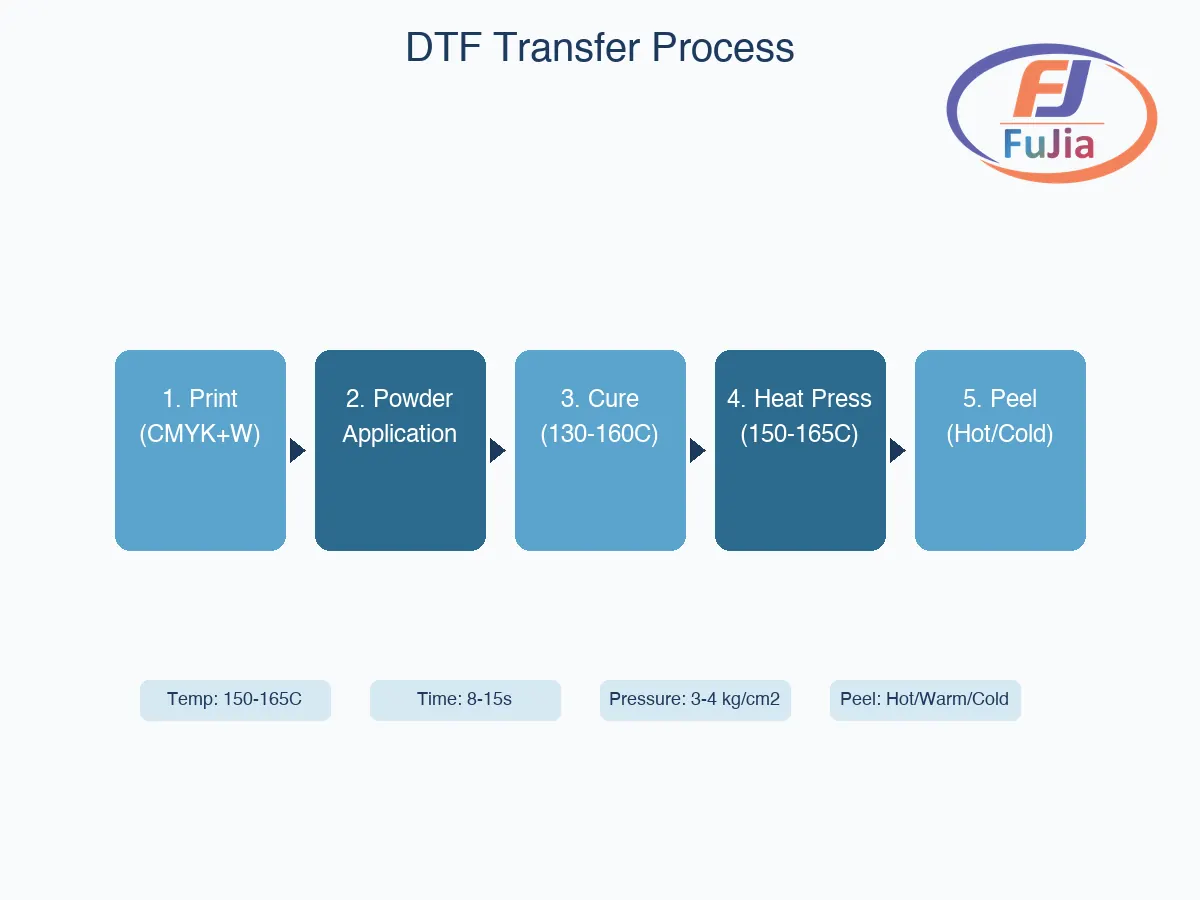
The PET film workflow consists of five sequential stages from digital file to finished garment.
Print the design. The DTF printer deposits CMYK colors first, then a white ink underbase layer, onto the coated side of the PET film. Print resolution typically ranges from 720×1440 dpi for production runs to 1440×1440 dpi for premium quality.
Apply adhesive powder. Hot-melt adhesive powder is applied to the wet ink surface while the white ink layer is still tacky. Automatic powder shakers distribute powder evenly across the printed area at approximately 0.3 grams per square foot of fabric coverage.
Cure the powder. The powdered film passes through a shaking oven at 130 to 160 degrees Celsius, melting the adhesive into the ink layer. Curing time ranges from 8 to 15 seconds depending on film thickness and powder type.
Heat press transfer. The cured film is placed ink-side down on the garment and pressed at 150 to 165 degrees Celsius for 8 to 15 seconds at 3 to 4 kilograms per square centimeter pressure. Fujia’s apparel printing case data confirms optimal DTF transfer parameters at 160 degrees Celsius for 15 seconds with cold peel on cotton substrates.
Peel the film. The carrier is removed according to the film’s peel specification. Hot peel removes immediately. Cold peel waits for room-temperature cool-down.
DTF PET Film Pricing and Cost Factors
DTF PET film pricing varies by thickness, coating quality, format, and peel type. Based on current market data from leading suppliers, roll prices range from USD 0.15 to 0.22 per square foot depending on width and volume discounts.
| Supplier Tier | Roll Size | Price Range | Price per sq ft | MOQ |
|---|---|---|---|---|
| Economy (single-sided) | 30cm x 100m | $40-$50 | $0.15 | 1 roll |
| Premium (double-sided matte) | 33cm x 100m | $55-$65 | $0.17 | 1 roll |
| Industrial (100 micrometer) | 60cm x 100m | $100-$110 | $0.17 | 1 roll |
| Factory-direct bulk | 60cm x 100m | $70-$85 | $0.12-$0.14 | 20+ rolls |
Based on aggregate data from our customers across 50+ countries, PET film cost represents 15 to 25 percent of total per-transfer production cost, with ink at 30 to 40 percent, powder at 10 to 15 percent, and labor plus equipment depreciation making up the remainder. Buying film in factory-direct bulk quantities of 20 rolls or more typically reduces material cost by 30 to 40 percent compared to single-roll retail purchases.
Wash Durability and Quality Standards
DTF transfers produced on quality PET film meet international textile durability standards when properly applied and cured.
The ISO 105-C06 standard governs color fastness to domestic and commercial laundering, requiring test specimens to retain specified grayscale ratings after controlled wash cycles. Premium DTF transfers, using certified inks and properly cured adhesive powder, withstand 40 to 60 wash cycles at 40 degrees Celsius with Grade 4 to 5 color fastness on the AATCC grayscale. Fujia’s apparel printing application data documents transfers surviving 50 or more heavy machine washes with cold-water cycling.
Wash durability depends on three factors working together: film coating quality (controls ink release completeness), adhesive powder melt consistency (determines bond strength to fabric fibers), and transfer parameter accuracy (temperature, time, and pressure must match the film and substrate specifications).
What is PET film for DTF?
PET film for DTF (direct-to-film) printing is a coated polyethylene terephthalate sheet that serves as the temporary carrier for printed designs before heat transfer to fabric. The PET substrate provides dimensional stability at heat press temperatures of 150 to 165 degrees Celsius, maintaining flatness without warping, shrinking, or curling during the transfer cycle. The coating applied to the PET base controls ink absorption, adhesive powder bonding, and release behavior, which together determine the color vibrancy, resolution, and wash durability of the final garment transfer. Standard PET film thickness ranges from 75 to 100 micrometers for DTF applications, with 100-micrometer film preferred for industrial production because its rigidity reduces registration errors on high-speed roll-to-roll printers. PET is the same polymer used in recyclable beverage bottles (plastic identification code 1) and is rated for temperatures up to 250 degrees Celsius before structural deformation occurs.
How much does DTF film cost?
DTF PET film costs between USD 0.12 and 0.22 per square foot depending on thickness, coating type, format, and purchase volume. A single 30cm by 100m roll of economy single-sided film costs approximately $40 to $50, while a 60cm by 100m roll of premium double-sided matte film in 100-micrometer thickness costs $100 to $110. Factory-direct bulk purchasing at minimum order quantities of 20 rolls or more reduces the per-square-foot cost to $0.12 to $0.14, representing a 30 to 40 percent savings compared to single-roll retail prices. Pre-cut A4 sheets typically sell at $15 to $25 per 100-sheet pack, and A3 sheets at $25 to $40 per 100-sheet pack. For a garment factory producing 200 transfers per day on A1 roll film, monthly film cost runs $600 to $900, which represents 15 to 25 percent of total per-transfer production cost when ink, powder, and labor are included.
What does DTF mean in film?
DTF in film context stands for Direct-to-Film, a digital textile printing method where designs are printed onto a PET transfer film and then heat-pressed onto fabric. The term distinguishes this process from DTG (Direct-to-Garment), where ink is applied directly to fabric fibers without an intermediate carrier, and from dye sublimation, where transfer paper carries sublimation ink that converts to gas under heat. The “direct” in DTF refers to the digital inkjet printing step depositing ink straight onto the film surface, as opposed to screen printing where ink passes through a mesh stencil. DTF film specifically denotes the PET carrier sheet engineered with an ink-receptive coating and release layer, not generic polyester film. The DTF process was commercialized around 2018 and has grown rapidly, with the global direct-to-film printing market valued at USD 2.72 billion in 2024 according to Grand View Research.
How many times can you reuse DTF film?
DTF PET film cannot be reused. The coating that enables ink adhesion and clean release is consumed during the first transfer cycle. After the design is heat-pressed onto fabric and the film is peeled away, the coating layer has bonded with and separated from the transferred ink, leaving the surface depleted of its release properties. Attempting to print on used film results in ink bleeding, incomplete powder adhesion, and failed transfers because the coating can no longer properly receive or release ink. DTF film is classified as a single-use consumable in all manufacturer documentation and industry guidelines. Clean, unprinted portions of film trimmings can be repurposed as protective packaging layers for shipping finished garments, and some suppliers offer partially recycled PET film with 30 to 50 percent post-consumer content, but each sheet still functions for only one transfer cycle.
Conclusion
DTF PET film is the backbone consumable of the direct-to-film printing process, and choosing the right type means matching thickness, coating configuration, and peel method to your printer model and production volume. For factory-direct pricing on DTF film and compatible printers, explore Fujia Print’s consumables lineup.
Sources
- Grand View Research: Direct to Film Printing Market Size & Outlook: Global DTF market data (USD 2.72 billion in 2024, 6% CAGR through 2030).
- ScienceDirect: Strain-optical behavior of PET film (Polymer, 2019): PET material properties including glass transition temperature (70-80 degrees Celsius), melting point (250-260 degrees Celsius), density, and crystallinity data.
- ISO 105-C06:2010 Textiles – Colour fastness to domestic and commercial laundering: International standard governing wash durability testing for textile transfers, published 2010-03, confirmed in 2026.
