
UV DTF applications live on hard, smooth, non-porous surfaces: glass drinkware, powder-coated metals, rigid plastics, ceramic glaze, and sealed wood all hold crystal transfers through 20-30 handling cycles, while fabric, silicone, rubber, and raw unsealed wood reject the adhesive outright. The application map is a surface-energy map, and the sellers who thrive with UV DTF are the ones who match the transfer list to the products their market already buys. This page ranks the surfaces, prices the product categories, and marks the boundaries where UV DTF hands off to other methods.
\n\n\n\n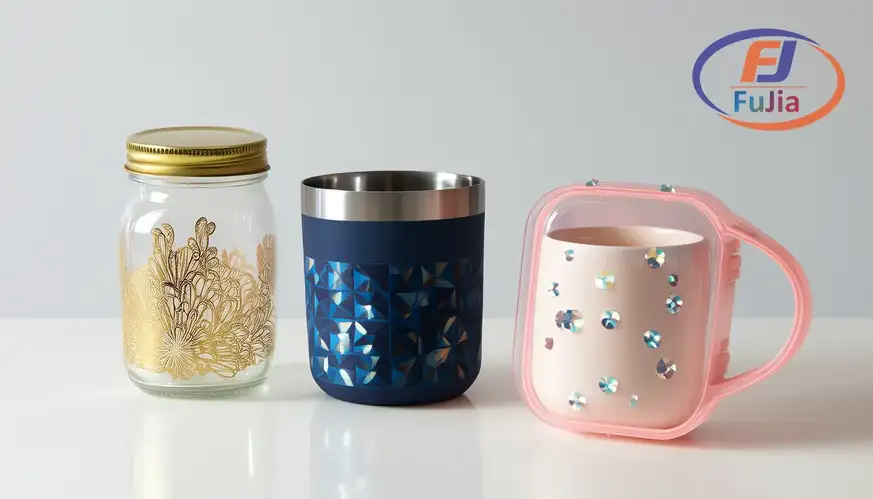
Key Takeaways
\n\n\n\n- \n\n\n
- Surface ranking: coated metal and glass first, rigid plastics and ceramic glaze second, sealed wood third, with adhesion following surface energy and wash survival spanning 20-30 cycles at 40 °C. \n\n\n
- Product economics: tumbler wraps at $2-5 margins, phone decor at $1-3, jar and candle labels at $0.50-2, and helmet or gear decals at $1.50-4. \n\n\n
- The silicone and fabric boundary is absolute: rubber, silicone, TPU-soft, and textile surfaces reject the adhesive, and DTF textile transfers cover that half of the market instead. \n\n\n
- Curvature tolerance runs to moderate wraps on 20-30 oz formats; tight radii under 5 mm and soft-touch coatings are the two product features that fail crystal applications. \n\n\n
- We recommend test-applying every new product surface before quoting, because soft-touch coatings and mold releases are invisible until the wash test reveals them. \n\n\n
The Surface Ranking Table
\n\n\n\nThe ranking table grades the surfaces UV DTF bonds to, and the preparation column is where outcomes are decided. All grades assume degreased application at standard settings:
\n\n\n\n| Surface | \nAdhesion grade | \nPrep demand | \nWash survival | \n
|---|---|---|---|
| Powder-coated metal | \nexcellent | \nisopropyl wipe | \n20-30 cycles | \n
| Glass | \nexcellent | \nisopropyl wipe | \n30+ cycles | \n
| Rigid plastic (PC, ABS) | \nvery good | \ndegrease | \n20-30 cycles | \n
| Ceramic glaze | \nvery good | \nthorough degrease | \n30+ cycles | \n
| Sealed wood | \ngood | \nlight sanding plus wipe | \nhand wash only | \n
The ranked surfaces decorated:
\n\n\n\nGlass and coated metal top the list because their stable surfaces present exactly the chemistry the adhesive layer bonds to, and the isopropyl wipe is what removes the handling oils that turn good surfaces into failed applications, per the substrate ranking our UV printers application guides document across crystal programs. Application temperature between 15-30 °C keeps the adhesive tacky enough to seat, and cold surfaces below 10 °C are the hidden cause of first-attempt failures.The sealed-wood tier is the one sellers enter without testing, because wood sealers vary wildly by brand, and the same product line can hold or lift depending on which factory sealed the blanks that week.
\n\n\n\nThe Product Category Table and Its Margins
\n\n\n\nThe category table prices the product lines crystal transfers serve, and the margin column explains why the niche attracts personalization businesses. Costs include label plus blank:
\n\n\n\n| Product category | \nProduction cost | \nRetail range | \nMargin | \n
|---|---|---|---|
| Tumbler wraps | \n$3-8 | \n$15-35 | \n$2-5 per unit value | \n
| Phone decor and cases | \n$1-3 | \n$12-25 | \n$1-3 value | \n
| Jar and candle labels | \n$0.60-2.50 | \n$8-25 | \n$0.50-2 value | \n
| Helmet and gear decals | \n$1-3.50 | \n$15-40 | \n$1.50-4 value | \n
| Small logo stickers | \n$0.04-0.15 | \n$2-6 | \nhigh at volume | \n
The categories in one frame:
\n\n\n\nWhen it comes to the category economics, the label is the smallest cost line in every row, which means the business lives or dies on blank sourcing and market access rather than on film prices, per the product economics our product labeling cases document across decoration programs. Tumbler wraps anchor the trade because their repeat cycles run on team rosters and gift seasons. Helmet decals serve motorsport and cycling communities whose orders arrive in roster-sized batches. We recommend sellers pick the category their local market already buys rather than the one with the best chart margin, because a 60 percent margin with demand beats an 80 percent margin without it.
\n\n\n\nThe Boundary: Where UV DTF Hands Off
\n\n\n\nThe boundary table lists the surfaces and conditions where crystal transfers fail or underperform, and each row names the method that covers the need instead:
\n\n\n\n| Surface or condition | \nUV DTF result | \nBetter method | \n
|---|---|---|
| Fabric and textiles | \nrejects adhesive | \nstandard DTF transfers | \n
| Silicone and rubber | \npoor bond | \npad printing, silicone ink | \n
| Soft-touch coatings | \nlifting at edges | \nremove coating or skip | \n
| Tight radii under 5 mm | \nwrinkling | \npad print or waterslide | \n
| Unsealed raw wood | \nabsorbs, fails | \nstain then seal, or laser | \n
The boundary in one frame:
\n\n\n\nWe recommend the surface test as the boundary arbiter for any product the chart does not settle: apply one transfer, wash or flex it the way the customer will, and let the result draw the line, per the qualification logic our application cases apply across decoration methods. Soft-touch coatings deserve a special caution, because the rubberized paint that feels premium also blocks adhesion invisibly, and coatings vary between production batches of the same product. The fabric boundary is also the business boundary that protects the DTF textile trade, and shops running both UV DTF and textile DTF cover the full product spectrum without competing against themselves.
\n\n\n\n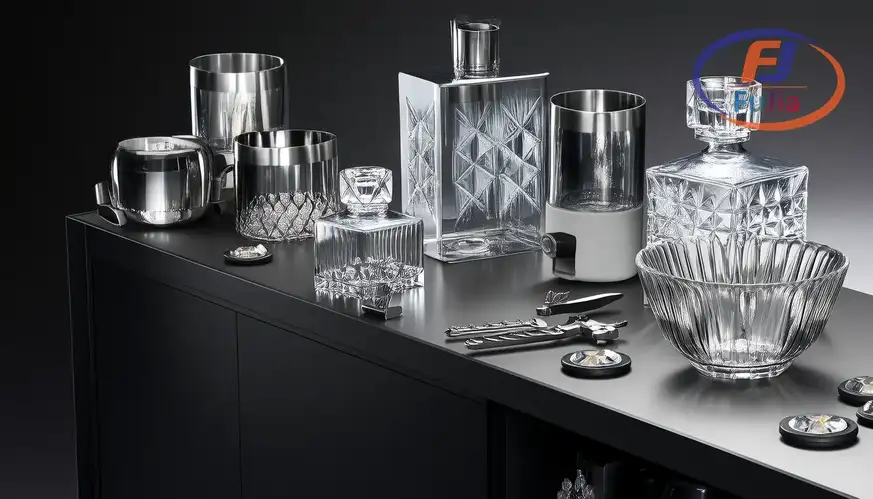
What can UV DTF be applied to?
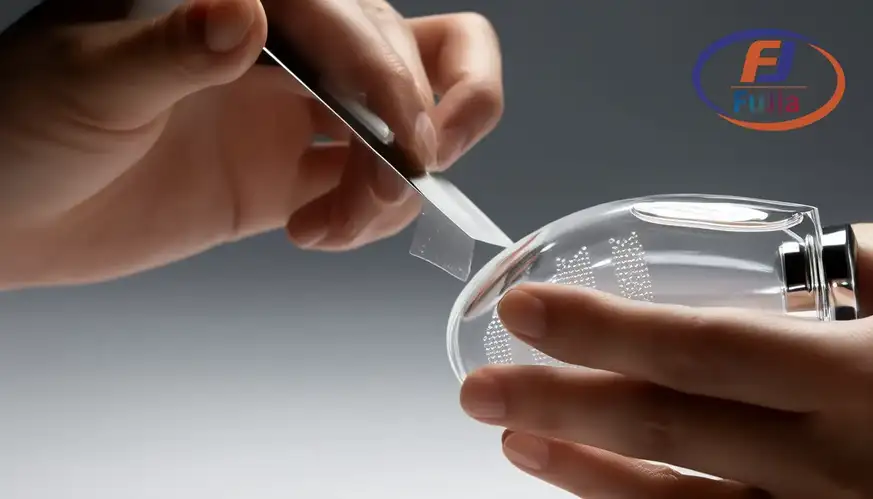
UV DTF applies to hard, smooth, non-porous surfaces: glass drinkware and jars, powder-coated metal tumblers and bottles, rigid plastics including polycarbonate and ABS, glazed ceramic, sealed wood, and acrylic all hold transfers through 20-30 handling cycles when degreased before application. The surfaces that reject UV DTF are fabrics, silicone, rubber, soft-touch coatings, and raw unsealed wood, each for adhesion reasons the surface test confirms in minutes. The application list maps to a $8-40 retail product range at margins of 50-85 percent depending on category. Surface energy is the physics behind every row, and the wipe is the habit that honors it.
How do I apply UV DTF transfers?
Applying UV DTF transfers takes five steps: cut the transfer from the sheet, peel the clear carrier from the backing, position the design on the degreased surface, press from the center outward with a squeegee to push air and seat the adhesive, then peel the top film away leaving the raised crystal design bonded. The whole application takes 30-60 seconds with no heat or water, and the isopropyl wipe before positioning is the step that determines dishwasher survival. Practice five applications on test surfaces before selling, because the squeegee rhythm is short but real.
Is UV DTF better than DTF?
UV DTF and DTF are better on different halves of the product world rather than competing directly: UV DTF wins on hard non-porous surfaces including glass, metal, plastic, and ceramic where its crystal finish applies without heat, while DTF wins on fabrics and textiles where its powder adhesive bonds to fibers that UV adhesive rejects. A shop decorating both tumblers and t-shirts needs both systems, because neither substitutes for the other on the other’s surface. The choice is substrate-driven first, and finish preference decides only within each substrate’s own method list.
Can UV DTF be used on fabric?
UV DTF cannot be used on fabric, because its adhesive layer bonds to hard non-porous surfaces and textile fibers provide neither the smoothness nor the chemistry the bond requires, producing transfers that peel at the first wash or flex. Fabric decoration belongs to standard DTF transfers, whose powder adhesive melts into garment fibers at pressing temperatures, or to sublimation on polyester content. Shops that serve both drinkware and apparel customers run UV DTF and textile DTF side by side. The two systems together cover the full personalized-product spectrum, and each one fails precisely where the other excels.
Verdict
\n\n\n\nUV DTF applications are a surface-energy map: coated metal, glass, rigid plastics, and glazed ceramic hold crystal transfers through 20-30 handling cycles, fabric, silicone, and soft-touch coatings reject them entirely, and the tumbler, phone, candle, and gear categories between those poles carry $1-5 unit margins at personalization scale. The isopropyl wipe decides more outcomes than surface selection does, the test application settles every chart ambiguity, and the fabric boundary is where textile DTF takes over rather than where the business ends. Map your products to the surfaces, prep religiously, and run both transfer systems if your market spans hard goods and garments. For AB film matched to your application list, contact Fujia Print with your product surfaces.
\n\n\n\nSources
\n\n\n\n- \n\n\n
- Wikipedia: UV curing: adhesive film chemistry. \n\n\n
- Wikipedia: Surface energy: adhesion science fundamentals. \n\n\n
- ASTM International standards: adhesion test methods. \n\n\n
- Fujia Print application guides: surface testing and program cases. \n\n\n
