

A sublimation printer uses heat to turn solid dye into gas that bonds into polyester fibers, while an inkjet printer sprays liquid ink onto a surface. The sublimation printer vs inkjet choice comes down to substrate: polyester and polymer-coated blanks favor sublimation, while paper, canvas, and cotton favor inkjet.
Key Takeaways
- Sublimation ink becomes part of the fabric; inkjet ink sits on top and can flake or fade.
- Sublimation works on polyester 60% or higher and polymer-coated hard blanks; inkjet handles paper, cotton, canvas, and film.
- Sublimation output survives 50-plus wash cycles when applied to 100% polyester at 200 degrees Celsius for 45 to 60 seconds.
- Desktop inkjet hardware starts around $100; dedicated sublimation printers like the Sawgrass SG500 begin near $495 and the SG1000 near $1,495.
- Pick sublimation for apparel, mugs, and soft signage; pick inkjet for photos, documents, and cotton-blend garments.
Side-by-Side Comparison
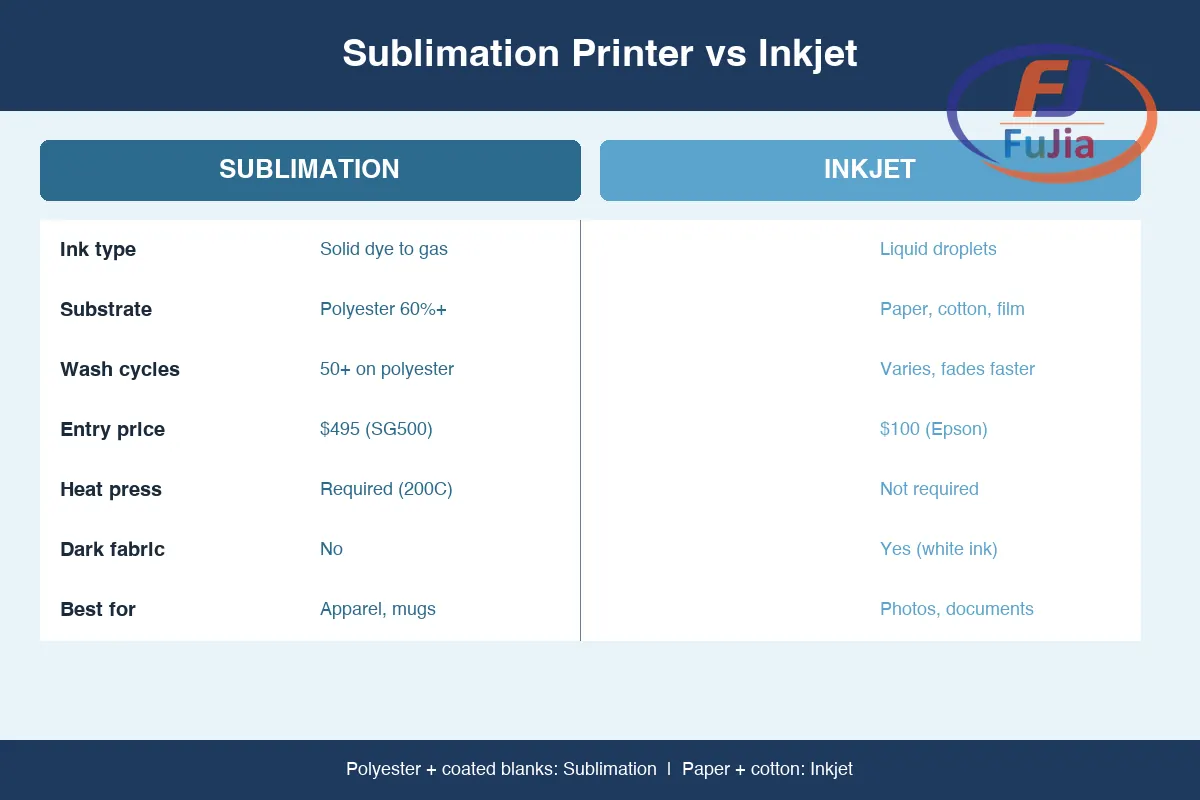
| Feature | Sublimation Printer | Inkjet Printer |
|---|---|---|
| Ink type | Solid dye turned to gas | Liquid ink sprayed through nozzles |
| Core substrate | Polyester 60%+, polymer-coated blanks | Paper, cotton, canvas, film |
| Transfer method | Heat press at 200 degrees Celsius | Direct print onto media |
| Wash durability | 50+ cycles on 100% polyester | Varies; inkjet fabric prints fade faster |
| Entry price | ~$495 (Sawgrass SG500) | ~$100 (Epson Expression) |
| Industrial width | Up to 3.2m roll (Fujia A1 650mm) | Up to 2.4m (Epson SureColor) |
| Color on dark fabric | No (requires white base) | Yes with white ink option |
| Best for | Apparel, mugs, metal, soft signage | Photos, documents, canvas prints |
The table above frames the decision. Sublimation wins on durability and fabric feel. Inkjet wins on substrate range and entry price.
Sublimation Printer: Strengths
A sublimation printer uses a heat-sensitive dye that skips the liquid phase entirely. The solid ink turns to gas at around 200 degrees Celsius, penetrates the polyester fiber, and locks in as the fabric cools. The result is a print that cannot crack, peel, or wash out because the dye lives inside the fiber rather than on its surface.
The process starts on polyester fabric or a polymer-coated blank. A 60 percent polyester blend produces acceptable results; 100 percent polyester delivers the boldest color. The heat press runs at 200 degrees Celsius for 45 to 60 seconds at medium pressure. Fujia Print builds A1 sublimation printers with two Epson printheads and a 650mm print width in a 3,500 square meter Guangzhou factory, shipping to 50-plus countries.
The wash durability of a sublimated polyester shirt exceeds 50 heavy machine washes with color fastness rated Grade 4 to 5 under AATCC standards. The dye does not sit on the surface, so friction cannot remove it. Sublimation mugs pressed at 180 degrees Celsius for 60 seconds per 11 ounce cup survive more than 500 dishwasher cycles.
Sublimation also handles metal panels, ceramic tiles, polyester coasters, and polymer phone cases. The constraint is substrate chemistry: no polyester coating means no ink bond. The technology dominates custom apparel, sportswear numbers, soft signage for trade shows, and personalized drinkware.
Inkjet Printer: Strengths
An inkjet printer propels tiny droplets of liquid ink through microscopic nozzles onto the media surface. The ink absorbs into porous media like paper or sits on top of non-porous media. Inkjet handles the widest media range of any printing technology: plain paper, photo paper, canvas, cardstock, vinyl, and some films.
Entry-level inkjet hardware costs a fraction of a sublimation setup. The Epson Expression Home series retails near $100 and prints photos at 5760 by 1440 dpi resolution. Professional photo inkjet printers like the Canon imagePROGRAF PRO-300 reach 4800 by 2400 dpi with nine separate ink cartridges, delivering gallery-grade output on fine art paper.
The Wikipedia article on inkjet printing documents how thermal and piezoelectric nozzle technologies differ. Piezo heads used in Epson SureColor and Roland devices run at higher precision and last longer than thermal heads found in HP and Canon consumer models.
Inkjet pigment inks rated for 100-plus years of indoor lightfastness suit archival prints, wedding albums, and museum reproductions. Dye-based inkjet inks cost less but fade faster under UV exposure. The trade-off is upfront cost versus longevity.
The Deciding Factor: Substrate and Substrate Chemistry
The sublimation printer vs inkjet question collapses to one variable: what does the buyer print on?
Polyester fabric and polymer-coated blanks accept sublimation ink. Cotton fabric, plain paper, bare wood, untreated metal, and uncoated ceramic reject sublimation ink. The polymer coating acts as the receptor; without it, the gaseous dye has nowhere to bond and wipes off.
Inkjet works on almost anything porous or primed. Paper, cotton, canvas, vinyl, and film all accept inkjet droplets. The ink dries by absorption or evaporation rather than chemical bonding. That universality makes inkjet the default for documents, photos, and fine art reproduction.
Buyers who print on both polyester and cotton face a choice. They can run a sublimation printer for synthetics and a DTF printer for cotton. DTF uses a film-and-powder process that bonds to any fabric including 100 percent cotton. Our existing breakdown of DTF vs sublimation covers that hybrid path in detail.
Based on aggregate data from our customers across 50-plus countries, print businesses running both sublimation and DTF lines report 30 to 50 percent higher order acceptance than single-technology shops because they serve every fabric type.
Cost and Production Realities
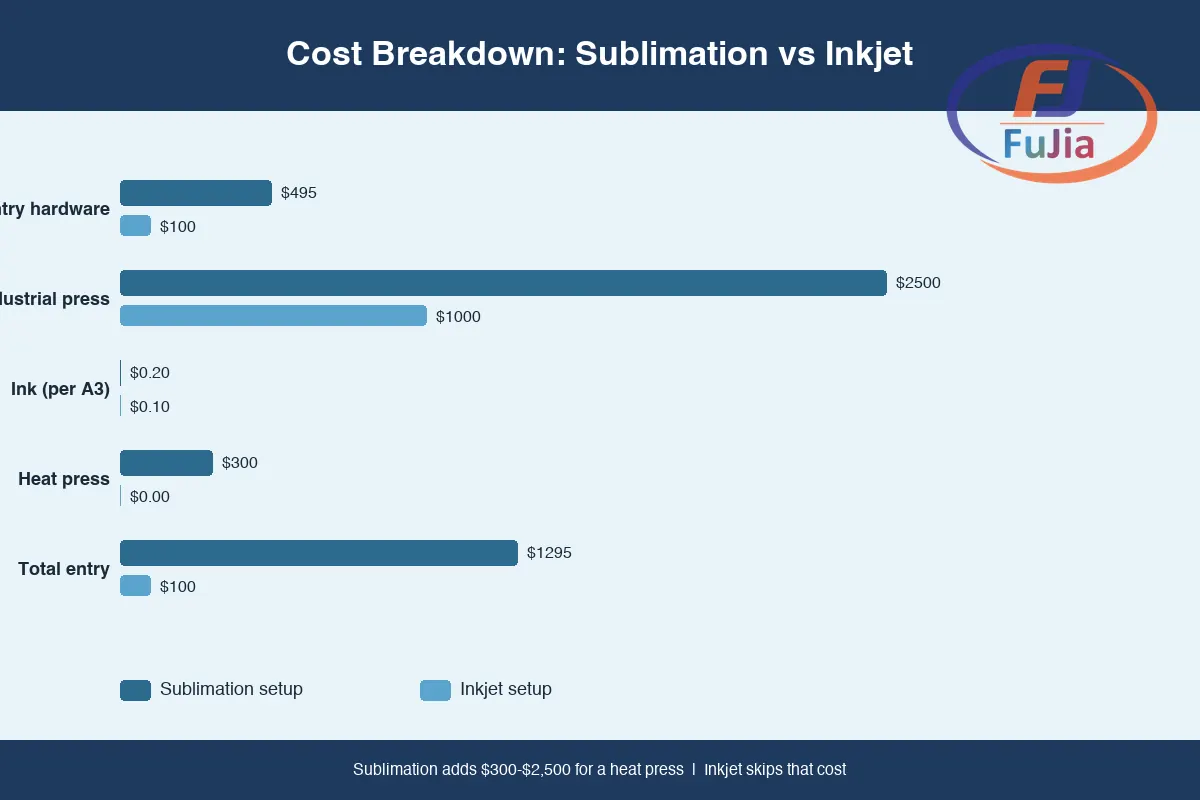
| Cost Factor | Sublimation Printer | Inkjet Printer |
|---|---|---|
| Entry hardware | $495 to $1,495 | $100 to $600 |
| Industrial hardware | $2,500 to $25,000 | $1,000 to $15,000 |
| Ink cost per A3 page | $0.15 to $0.25 | $0.10 to $0.30 (varies by ink type) |
| Paper or film cost | $0.20 to $0.50 per sheet | $0.05 to $0.80 per sheet |
| Heat press (sublimation only) | $300 to $2,500 | Not required |
| Maintenance | Printhead clean weekly | Printhead clean weekly |
Sublimation requires a heat press, which adds $300 to $2,500 to the total setup. Mug presses run $150 to $400. Flat heat presses in 15 by 15 inch or 16 by 20 inch sizes run $300 to $800. The Canon knowledge base article on dye sublimation notes that sublimation is a thermal transfer process distinct from direct inkjet printing.
Industrial sublimation printers like the Fujia A1 dual-head model print at 4 to 13 square meters per hour at 4 pass with 720 by 1440 dpi resolution. Industrial inkjet printers like the Epson SureColor F-series reach comparable speeds on fabric but cannot match sublimation wash durability on polyester.
Can I use an inkjet printer for sublimation?
A standard inkjet printer with dye or pigment ink cannot sublimate. Sublimation requires sublimation-specific ink loaded into a printer whose printhead tolerates the ink chemistry. Some users convert EcoTank models like the Epson ET-2800 by flushing the original ink and loading sublimation ink, which voids the warranty but works for low-volume hobby use. Dedicated sublimation printers like the Sawgrass SG500 and SG1000 arrive pre-loaded with sublimation ink and include color management software. Converted inkjet printers require manual ICC profile tuning to match colors, while dedicated sublimation printers ship with calibrated profiles for common substrates. Production-grade work demands a purpose-built sublimation press.
What are the disadvantages of sublimation printing?
Sublimation works only on polyester or polymer-coated substrates, which excludes cotton, plain paper, and uncoated metal. The process cannot print white ink, so dark or black substrates are off limits unless pre-coated white. The entry cost runs higher than inkjet because a heat press is mandatory equipment. Sublimation ink costs $0.15 to $0.25 per A3 sheet, above the $0.10 floor for generic inkjet ink. The color gamut on hard blanks depends on the polymer coating quality, and cheap coatings produce dull or muted output. Finally, the process requires a heat press at 200 degrees Celsius, which adds workspace, ventilation, and safety considerations that a desktop inkjet printer does not need.
Is it worth getting a sublimation printer?
A sublimation printer pays off when the buyer’s product mix centers on polyester apparel, mugs, metal panels, or polymer-coated blanks. Custom apparel businesses report margins of 60 to 70 percent on sublimated polyester shirts and mugs because the per-print cost runs $0.30 to $0.80 while the retail price runs $15 to $35. Buyers who want photo prints, documents, or cotton apparel should skip sublimation and choose inkjet or DTF. Sublimation makes sense for Etsy sellers, custom apparel shops, trophy and award businesses, and promotional product decorators who already work with polyester substrates. The technology earns its keep at volumes above 20 to 30 decorated items per month.
Can a Cricut do sublimation printing?
A Cricut cutting machine cannot print sublimation ink. Cricut designs and cuts shapes from vinyl, paper, and infusible ink sheets but does not function as a printer. Cricut Infusible Ink is a pre-printed sublimation transfer material that works with Cricut EasyPress heat to bond into polyester fabric. Users who want custom sublimation designs must pair a sublimation printer with a Cricut for cutting and weeding tasks. The Cricut handles the cutting; the sublimation printer handles the printing. The two tools work together but do not replace each other.
Which Should You Choose?
| If you need to print on… | Pick |
|---|---|
| Polyester apparel or sportswear | Sublimation printer |
| Mugs, metal panels, polymer blanks | Sublimation printer |
| Plain paper or photo paper | Inkjet printer |
| Cotton shirts | Inkjet with fabric sheets, or DTF printer |
| Fine art reproductions on canvas | Inkjet photo printer |
| Both polyester and cotton | Sublimation plus DTF (two machines) |
Conclusion
Sublimation printers serve polyester and coated-blank decorators who need wash-proof color; inkjet printers serve paper, photo, and cotton-blend workflows where substrate range matters more than wash durability. For factory-direct sublimation printer pricing on A1 dual-head industrial models built in Guangzhou, browse the Fujia Print sublimation printer lineup.
Sources
- Wikipedia: Dye-sublimation printer – Defines the sublimation phase change process and substrate requirements.
- Wikipedia: Inkjet printing – Documents thermal and piezoelectric nozzle technologies and ink chemistry.
- Canon USA Knowledge Base: Dye Sublimation vs Inkjet – Confirms sublimation is a thermal transfer process distinct from direct inkjet printing.
